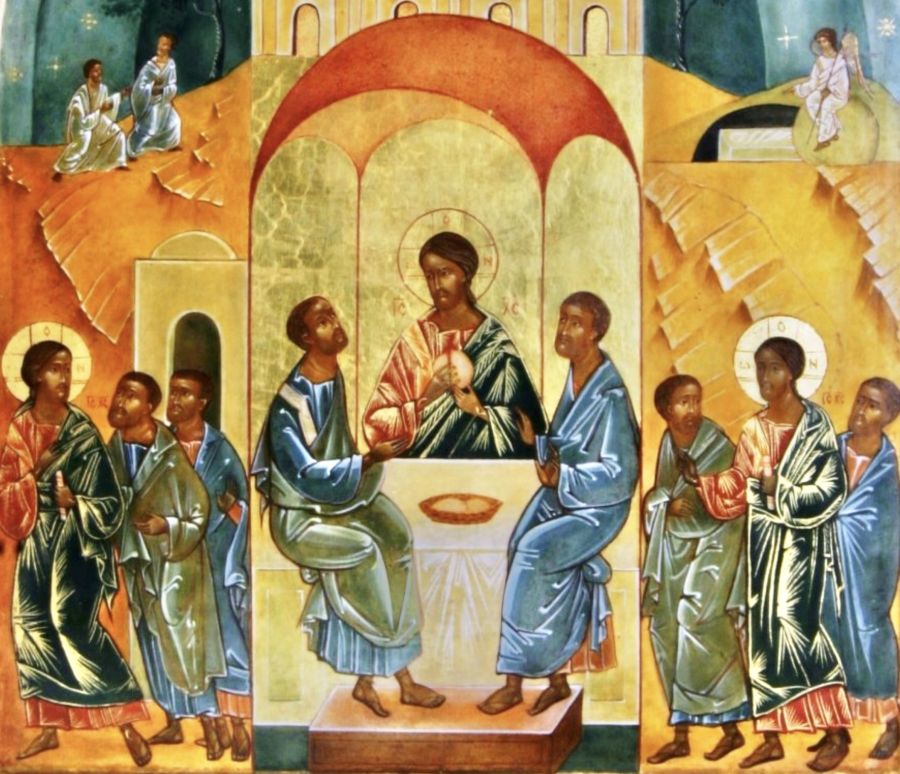
The Risen Jesus walked alongside the disciples on the road to Emmaus as they talked about Him and what had happened in Jerusalem. He put them to the test.
Christ’s body was now in a new, glorious state, whilst retaining its identity. To recognise Him required the faith and freedom of the children of God.
For Francis, poverty and freedom of spirit, united with faith, were the fundamental framework of his existential parable as a ‘minor’.
Begging for alms, for example, even during Eastertide, whilst living as a wayfarer on the road, was for him a wonderful exercise of the aforementioned values.
Leafing through the Sources, in the Major Legend, we read:
“Once, on the holy day of Easter, as he found himself in a hermitage far from any settlement and there was no possibility of going out to beg, mindful of Him who on that very day appeared to the disciples on their way to Emmaus in the guise of a pilgrim, he asked for alms, as a pilgrim and a poor man, from his own brothers.
Having received it, he instructed them with holy words to celebrate the Lord’s Easter continually, passing through the desert of the world in poverty of spirit and as pilgrims and strangers and as true Jews.
For, in begging for alms, he was not driven by the desire for gain, but by the freedom of the Spirit. God, the Father of the poor, showed him special care” (FF 1129).
And it was that inner freedom, together with faith, that became the gateway to recognising the Risen Christ at the breaking of bread, as at Emmaus.
Francis had three-dimensional eyes, which enabled him to look beyond appearances, grasping the essence of the message before him.
Indeed, in the Admonitions, he expresses it thus:
«Behold, every day he humbles himself, as when he descended from his royal throne into the womb of the Virgin; every day he himself comes to us in humble appearance […]
And just as he showed himself to the holy apostles in true flesh, so too does he now show himself to us in the consecrated bread.
And just as they, with the eyes of their bodies, saw only his flesh, but, contemplating him with the eyes of the spirit, believed that he was God himself, so too must we, seeing the bread and wine with the eyes of the body, see and firmly believe that this is his most holy body and living and true blood» (FF 144).
The Poverello had acquired, by grace, the inner capacity to discern the footsteps of the Lord in the ordinary course of daily life, with real concreteness.
«And it came to pass, as He sat at table with them, that He took bread, gave thanks, broke it and gave it to them. Then their eyes were opened and they recognised Him» (Lk 24:30–31)
3rd Sunday in Easter A (Lk 24:13–35)