
5th Lent Sunday (year A) [22 March 2026]
May God bless us and may the Virgin protect us! This Sunday touches upon the theme of death and of life that does not die. In the face of such fear of dying, may this word of salvation kindle within us the invincible hope of living eternally in God, who is Love
*First Reading from the Book of the Prophet Ezekiel (37:12–14)
This text is very brief, but it is clear that it forms a single unit: it is framed by two similar expressions; at the beginning, ‘Thus says the Lord God’, and at the end, ‘The word of the Lord’. A frame that is evidently intended to give solemnity to what it encloses. Whenever a prophet deems it necessary to specify that he is speaking on behalf of the Lord, it is because his message is particularly important and difficult to hear. Today’s message is therefore what lies within this framework: a promise repeated twice and addressed to God’s people, for God says “O my people”; on both occasions the promise concerns two points: firstly, “I will open your graves”; secondly, “I will bring you back to the land of Israel”, or “I will let you rest in your own land”, which amounts to the same thing. These expressions allow us to situate the historical context: the people are in exile in Babylon, at the mercy of the Babylonians, annihilated (in the true sense of the word, reduced to nothing), as if dead; this is why God speaks of graves. The expression ‘I will open your graves’ therefore means that God will raise up his people. Reading chapter 37 of the Book of Ezekiel, we see that this brief text follows a vision of the prophet known as ‘the vision of the dry bones’ and provides an explanation of it: the prophet sees a vast army of the dead, lying in the dust; and God says to him: your brothers are so desperate in their exile that they believe themselves to be dead, finished… well, I, God, will raise them up. This entire vision and its explanation thus evoke the captivity of the exiled people and their restoration by God. For the prophet Ezekiel, it is a certainty: the people cannot be wiped out, because God has promised them an eternal Covenant that nothing can destroy; therefore, whatever the defeats, the ruptures, the trials, it is known that the people will survive and regain their land, because this is part of the promise. “I will open your graves… O my people, and bring you back to the land of Israel”: ultimately, there is nothing surprising about these words; Israel has always known that its God is faithful; and the expression “You shall know that I am the Lord” precisely means that it is through his faithfulness to his promises that the true God is recognised. But why repeat almost the same things twice? In reality, the second promise does not merely repeat the first, but expands upon it: It continues: I will open your graves and bring you out of your tombs and let you rest in your own land, and you shall know that I am the Lord: all this is a return to the situation prior to the disaster of the Babylonian exile. In this second promise there is much more, something new and never seen before: “I will put my Spirit within you, and you shall live”; here the New Covenant is announced: from now on the law of love will no longer be written on tablets of stone, but in hearts. Or, to use another expression of Ezekiel, human hearts will no longer be of stone, but of flesh.
Here there is no room for doubt: the repetition of the phrase “my people” clearly shows that these two promises herald a rebirth, a restoration of the people. This is not a matter of individual resurrection. Individual death did not compromise the future of the people; and for a long time it was the future of the people, and that alone, that mattered. When someone died, it was said that they had fallen asleep with their fathers, without imagining any personal survival; on the contrary, the survival of the people has always been a certainty, because the people are the bearers of God’s promises. To believe in individual resurrection, two elements are required: firstly, an interest in the individual’s fate — something that did not exist at the beginning of biblical history; an interest in one’s personal fate is a later development. Secondly, it is essential to believe in a God who does not abandon you to death. The certainty that God never abandons humanity did not arise suddenly; it developed in step with the concrete events of the history of the chosen people. The historical experience of the Covenant is what nourishes the faith of Israel; it is the experience of a God who frees humanity from all forms of bondage and intervenes ceaselessly to liberate them; a faithful God who never goes back on his word. It is this faith that guides all of Israel’s discoveries; indeed, it is their driving force. Four centuries after Ezekiel, around 165 BC, these two combined elements—faith in a God who continually liberates humanity and the discovery of the value of every human person—led to faith in individual resurrection. It became evident that God would liberate the individual from the most terrible and definitive form of slavery, that of death. This discovery came so late to the Jewish people that, in Christ’s time, it was not yet shared by all: the Sadducees, in fact, were known as those who did not believe in the resurrection. Perhaps, however, Ezekiel’s prophecy might have surpassed his own understanding, without him realising it. The Spirit of God spoke through his mouth, and we might think: Ezekiel did not know how great was what he was proclaiming
*Responsorial Psalm (129/130)
In the Psalter there is a group of fifteen psalms bearing a particular name: Song of Ascents. Each of them begins with the words ‘Song of Ascents’, which in Hebrew signifies going to Jerusalem on pilgrimage. In the Gospels, moreover, the expression ‘going up to Jerusalem’ occurs several times with the same meaning: it evokes the pilgrimage for the three annual feasts and, in particular, the most important of these, the Feast of Tabernacles. These fifteen psalms therefore accompanied the entire pilgrimage. Even before arriving in Jerusalem, they already foreshadowed the unfolding of the festival. For some, one can even guess at which point in the pilgrimage they were sung; for example, Psalm 121/122 – ‘How joyful I was when they said to me: “We shall go to the house of the Lord”… now our feet stand within your gates, Jerusalem…’ – was probably the psalm of arrival. Psalm 129/130 is one of these Songs of Ascent; it was probably sung during the Feast of Tabernacles as part of a penitential celebration, which is why guilt and forgiveness feature so prominently in the psalm: ‘If you keep track of sins, O Lord, O Lord, who can stand before you?’. The sinner who pleads here is certain of being forgiven; it is the people who together acknowledge God’s infinite goodness, his tireless faithfulness (his Hesed) and man’s radical inability to respond to the Covenant. These repeated acts of unfaithfulness are experienced as a true spiritual death: “From the depths I cry out to you”, a cry addressed to Him whose very being is Forgiveness: this is the meaning of the expression “with you is forgiveness”. God is Love and is Gift, and the two are one and the same. Now “forgiveness” is nothing other than a gift that goes beyond everything. To forgive means to continue to offer a Covenant, a possible future, beyond the other’s infidelities. Let us recall the story of David: after the killing of Bathsheba’s husband, the prophet Nathan announced God’s forgiveness to him even before David had uttered a single word of repentance or confession. The idea that God always forgives, however, does not please everyone; yet it is undoubtedly one of the central teachings of the Bible, right from the Old Testament. And Jesus forcefully takes up this same teaching: for example, in the parable of the Prodigal Son in the Gospel according to Luke (chapter 15), the father is already out on the road waiting for his son (a sign that he has already forgiven him) and opens his arms to him even before the son has opened his mouth. And the example of God’s totally gratuitous forgiveness was given to us by Jesus himself on the cross: those who were killing him did not utter a single word of repentance, yet he says: ‘Father, forgive them, for they know not what they do’. It is precisely in his forgiveness, says the Bible, that God manifests his power. This too is a great discovery of Israel; consider what the Book of Wisdom states: “Your strength, Lord, is the source of justice… you who possess strength, judge with gentleness and rule us with great indulgence” (Wis 12:16, 18). The certainty of God’s mercy does not breed presumption or indifference towards sin, but humble and amazed gratitude: “With you is forgiveness, so that we may fear you.” This concise formula indicates the believer’s attitude before God, who is nothing but gift and forgiveness. This certainty of forgiveness, always offered beyond all fault, inspires in Israel an attitude of extraordinary hope. Repentant Israel awaits forgiveness “more than the watchmen await the dawn”. “He will redeem Israel from all its sins”: similar expressions recur frequently in biblical texts. They announce to Israel the definitive liberation, the liberation from all the sins of all time. Israel awaits even more: precisely because the people of the Covenant experience their own weakness and ever-recurring sin, but also God’s faithfulness, they await from God himself the definitive fulfilment of his promises. Beyond immediate forgiveness, what they await from age to age is the definitive dawn, which they hope for against all hope, like Abraham: the dawn of the Day of God. All the psalms are permeated by this messianic expectation. Christians know with even greater certainty that our world is moving towards its fulfilment: a fulfilment that has a name, Jesus Christ: “Our soul waits for the Lord more than watchmen wait for the dawn”.
*Second Reading from the Letter of Saint Paul the Apostle to the Romans (8:8–11)
“I will put my Spirit within you, and you shall live,” announces Ezekiel in the first reading, but from baptism, Saint Paul reminds us here, this is a reality, and he uses a figurative expression: the Spirit of God dwells within you. Taking this literally, one commentator speaks of a change of ownership. We have become the dwelling place of the Spirit: it is he who is now in charge. It would be interesting to ask ourselves, in all areas of our lives, both personal and communal, who is in charge, who is the master of the house within us; or, if we prefer, what is our purpose in life. According to Paul, there are not many alternatives: either we are under the influence of the Spirit, that is, we allow ourselves to be guided by him, or we do not allow ourselves to be inspired by the Spirit, and this he calls being under the influence of the flesh. Being under the influence of the Spirit is easy to understand: simply replace the word ‘Spirit’ with the word ‘Love’, as the Letter to the Galatians demonstrates when explaining the fruits of the Spirit: ‘love, joy, peace, patience, kindness, goodness, faithfulness, gentleness and self-control’ (Gal 5:22–23); in a word, love expressed in all the concrete circumstances of our lives. Paul is the heir to the entire tradition of the prophets: and they all affirm that our relationship with God is realised in the quality of our relationship with others; in the ‘Songs of the Servant’, the Book of Isaiah (chapters 42; 49; 50; 52–53) forcefully asserts that living according to the Spirit of God means loving and serving one’s brothers and sisters. Once life according to the Spirit—that is, life according to love—has been defined, it is easy to understand what Paul means by life according to the flesh: it is the opposite, namely indifference or hatred; in other words, love is turning away from oneself, whilst life under the influence of the flesh is centring on oneself. The question: ‘Who is in charge?’ here becomes ‘Who is the centre of our world?’ And those who are under the influence of the flesh cannot please God, says Paul. On the contrary, Christ is the beloved Son in whom God is well pleased, that is, he is in perfect harmony with God precisely because he too is all love. In this sense, the account of the Temptations, read on the first Sunday of Lent (Matthew chapter 4), is very eloquent because Jesus appears totally centred on God and on his Word and resolutely refuses to focus on his own hunger or even on the demands of his messianic mission. If the text of the temptations is presented to us every year at the start of Lent, it is because Lent is precisely a journey of shifting our focus away from ourselves in order to refocus on God and on others. Later on, in the same Letter to the Romans, Paul says that the Spirit of God makes us children: it is he who prompts us to call God ‘Father’. That which is love within us comes from God; it is our inheritance as children. The Spirit is your life, Paul says again: to put it another way, love is your life. After all, we know from experience that only love is creative. What is not love does not come from God and, precisely because it does not come from God, is destined for death. The great good news of this text is that everything within us that is love comes from God and therefore cannot die. As Paul says: ‘If God raised Jesus from the dead… he will also give life to your mortal bodies through his Spirit who dwells in you’.
From the Gospel according to John (11:1–45)
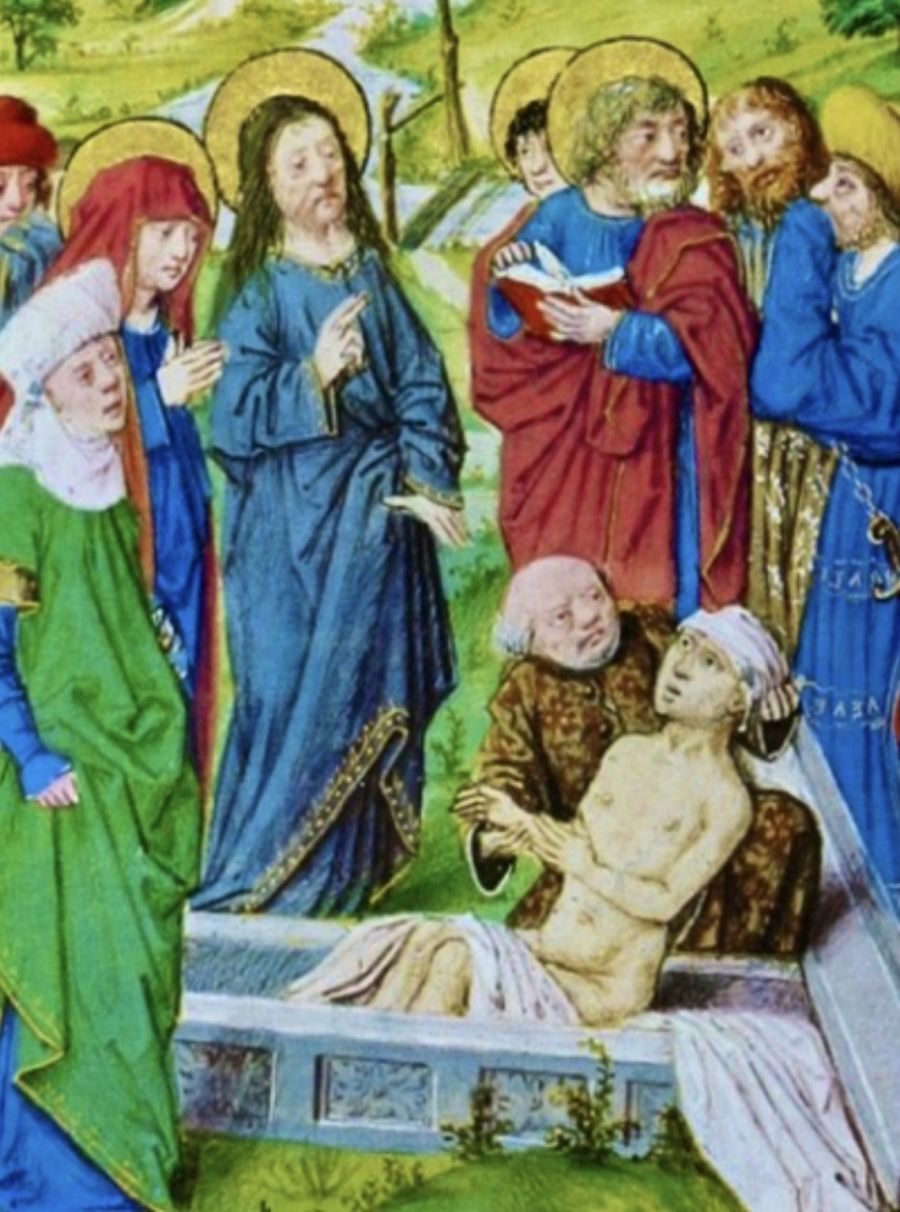
We have got into the habit of calling this passage the resurrection of Lazarus, but, to tell the truth, it is not the most appropriate term; when we proclaim ‘I believe in the resurrection of the dead and in eternal life’, we mean something quite different. Lazarus’s death was, in a sense, merely a parenthesis in his earthly life; after Jesus’ miracle, his life resumed its ordinary course and was, more or less, the same as before. Lazarus simply had his earthly life extended. His body was not transformed and he had to die a second time; his first death was not what it will be for us, that is, the passage to true life. So one might ask: to what end? In performing this miracle, Jesus took great risks, for he had already drawn far too much attention to himself… and for Lazarus, it was merely a matter of postponing the final appointment. It is St John who answers our question: ‘what was the purpose of this miracle?’ He tells us that it is a very important sign: Jesus reveals himself as the one in whom we have eternal life and in whom we can believe, that is, upon whom we can stake our lives. After all, the chief priests and the Pharisees were not mistaken: they fully understood the gravity of the sign performed by Jesus, for the Gospel of John tells us that many, many began to believe in him precisely because of Lazarus’s resurrection, and it was then that they decided to put him to death. This miracle thus sealed Jesus’ death sentence; thinking about it two thousand years later, it seems paradoxical: being able to restore life deserved death. A sad example of the aberrations to which our certainties can lead… Let us return to the account of what we might call the ‘raising of Lazarus’, because it is not a true resurrection but rather an extension of earthly life. Let us make just two observations.
First observation: for Jesus, only one thing matters, the glory of God; but to see the glory of God, one must believe (If you believe, you will see the glory of God, he tells Martha). Right from the start of the story, when they tell him: ‘Lord, the one you love is ill’, Jesus replies to the disciples: ‘This illness will not lead to death, but is for the glory of God’, that is, for the revelation of the mystery of God. Faith opens our eyes, removing the blindfold of mistrust that we had placed over our gaze. Second observation: here, faith in the resurrection takes its final step. In Israel, faith in the resurrection appeared late; it was clearly affirmed only in the second century BC, at the time of the persecution by Antiochus Epiphanes, and in Christ’s time it was not yet shared by everyone. Martha and Mary, evidently, are among those who believe in it. But in their minds it is still a resurrection at the end of time; when Jesus says to Martha: “Your brother will rise again”, she replies: “I know that he will rise again in the resurrection on the last day”. Jesus, however, corrects her: he is not speaking in the future, but in the present: “I am the resurrection and the life… Whoever believes in me, even if they die, will live; and whoever lives and believes in me will never die.” To put it plainly, we sense that the Resurrection is already here.” “I am the resurrection and the life” means that death as separation from God no longer exists: it is overcome in Christ’s resurrection, so that believers, with Paul, can say: “O death, where is your victory?”. Now nothing can separate us from the love of Christ, not even death. The true novelty of this Gospel is not that a dead person returns to life, but that life itself has a face: Jesus. When he says: ‘I am the resurrection and the life’, he is not merely promising a future event; he is affirming that those who live in communion with him are already entering a life that death cannot destroy. Lazarus will emerge from the tomb once more, only to die again; but those united with Christ will never return to the tomb as to a final prison. Biological death becomes a passage, not an end; a threshold, not an abyss. If we live in communion with God — that is, in love — we are already within eternity. For God is not merely the One who gives life: He is Life itself. And that which is united to Life cannot be annihilated.
As Saint Augustine writes: “Do you fear death? Love. Love kills death.”
And again, St Paul, in his Letter to the Romans: “Nothing can separate us from the love of God” (Rom 8:39). Herein lies the heart of the sign of Lazarus: whoever remains in love remains in God, and God remains in him, and this communion knows no end. The true resurrection begins now.
+Giovanni D’Ercole
