
Fourth Easter Sunday (year A) [26 April 2026]
First Reading from the Acts of the Apostles (2:14a, 36–41)
The account of Peter’s speech in Jerusalem on the morning of Pentecost continues, and since he is now filled with the Holy Spirit, he reads, as it were, an open book in God’s plan. Everything appears clear to him; he recalls the prophet Joel who had announced: “I will pour out my Spirit upon all flesh” (Joel 2:28), and it is evident to him that we are at the dawn of the fulfilment of this promise. Through Jesus, rejected and put to death by men, yet raised and exalted by God, the Spirit has been poured out upon all flesh, and Jewish pilgrims from every corner of the Roman Empire have come to celebrate the feast of Pentecost, the feast of the gift of the Law. During their journey and even upon arriving at the Temple in Jerusalem, the pilgrims sang psalms and implored God for the coming of the Messiah. Peter sought to open their eyes: the Messiah of whom you speak is that Jesus whom you have crucified, and when he declares Jesus to be Lord and Messiah, the Christ, these statements of his certainly seem very bold. If the man from Nazareth is the expected Messiah, this means that all the hope of Israel rests upon Jesus. Peter’s listeners were struck to the heart, says Luke, and Peter certainly knew how to touch their hearts. What must we do, they ask themselves? The answer is simple: repent to save yourselves from this perverse generation, and to repent, in biblical language, is precisely to turn around, to make a U-turn. There are two paths before us, and we often take the wrong one: we must then return to the right path. Peter makes a simple observation: the generation living at the time of Christ and the apostles was faced with a real challenge, namely to recognise in Jesus the Messiah awaited for centuries. Unfortunately, however, Jesus did not possess the characteristics or fulfil the hopes placed in the Messiah, who was imagined as the liberator of the Jewish people; thus, an error of judgement was made and the path was lost. For this reason, Peter calls on everyone to be converted and invites them to receive Baptism: be baptised in the name of Jesus Christ for the forgiveness of sins, and you will receive the gift of the Holy Spirit promised to you, to your children, and to all those who are far off, whom our Lord God will call. Furthermore, for Jews familiar with the study of the Scriptures, Peter recalls the prophecy of Joel – ‘I will pour out my Spirit upon all flesh’ – just as his words echo those of the prophet Isaiah concerning the peace and covenant desired by God with the people of Israel (cf. Is 49:1; 57:19). It was precisely through this Covenant that Israel felt bound to God: they were the chosen people, the son, as the prophet Hosea says (11:1), whilst other peoples seemed far from God. When Isaiah then states that peace is also for those who are far away, he recalls that the chosen people have a mission of peace for all humanity, called to enter into what might be called God’s plan of peace. The author notes that on that day three thousand were baptised. He adds that the three thousand Jews who had become Christians were among those whom Peter called ‘neighbours’. Little by little, throughout the Book of Acts, even those who were far off will join those ‘called’ by God. To them, St Paul will say, in his letter to the Ephesians: you who were once far off have now become neighbours through the blood of Christ. And it is Christ, our peace, for ‘of the two, the Jew and the Gentile’, he has made one (Eph 2:14–18).
Responsorial Psalm (22/23)
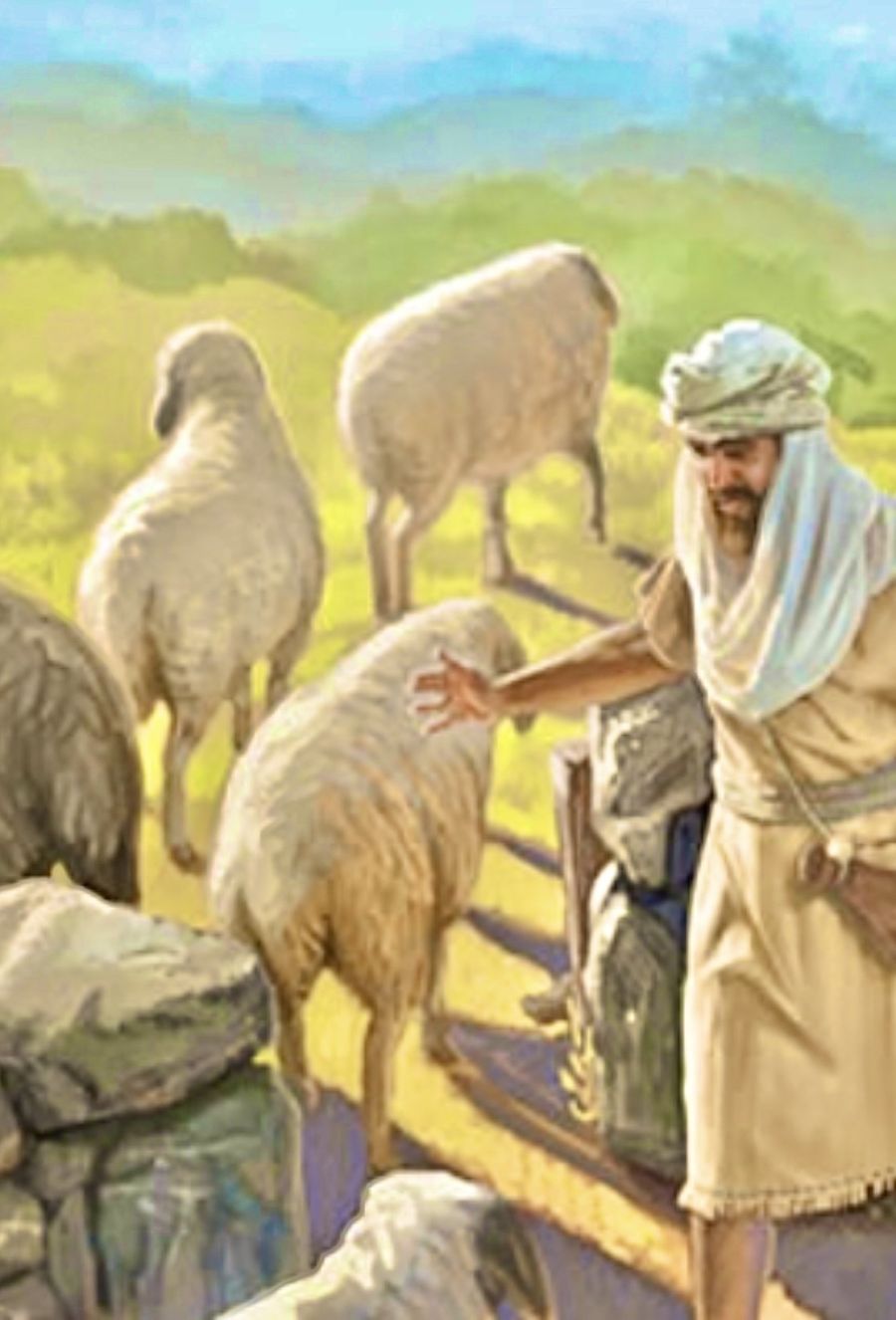
We encountered Psalm 22/23 on the Fourth Sunday of Lent. At the time, I emphasised three points in my commentary: first, the psalms speak of Israel as a whole, even though the speaker uses the first person singular, saying ‘I’; second, to describe its religious experience, Israel uses two comparisons: that of the Levite who finds joy in dwelling in the House of God, and that of the pilgrim who takes part in the sacred meal following the thanksgiving sacrifices. However, one must read between the lines to see that, through these two comparisons, the chosen people feel a sense of wonder and gratitude for God’s gratuitous Covenant. Thirdly, the early Christians recognised in this psalm the privilege of their own experience as the baptised, and Psalm 22/23 became, in the early Church, the hymn for the celebration of Baptism. I shall simply pause at the first verse: “The Lord is my shepherd; I shall not want.” There are many references in the Bible. The prophet Micah prays thus: Lord, with your staff be the shepherd of your people, the flock that belongs to you, so that the people may perceive themselves as God’s inheritance (cf. Mic 7:14). In Psalm 15/16, however, we find the inverse expression: ‘Lord, my portion and my cup; you determine my lot; the portion that falls to me brings me joy; I truly have the finest inheritance.’ When God is compared to a shepherd and Israel to his flock, one dares to think that the chosen people are a treasure to their God, which is a bold notion, and the use of such language is an invitation to trust, for God is portrayed as a good shepherd—that is, the one who gathers, guides, nourishes, cares for, protects and defends his flock, watching over all its needs. The prophet Micah writes that God will gather together all the remnant of Israel (cf. 2:12), and bring them together as a flock, gathering the lame and the scattered sheep. Zephaniah takes up the same theme: I will save the lame sheep (cf. 3:19), I will gather those who are scattered, which means that whenever we sow division, we are working against God. God, the attentive shepherd, shepherd-guide and defender of his flock. We find this frequently in the Psalms, particularly in Psalm 94/95, which is the daily morning prayer in the Liturgy of the Hours, where we read: ‘We are the people he leads, the flock guided by his hand’. In Psalm 77/78 we read that, like a shepherd, God leads his people, drives his flock into the desert, guides them, defends them, reassures them, and Psalm 79/80 begins with an appeal: “Shepherd of Israel: listen, you who lead Joseph, your flock, reveal your strength and come to save us”. It is clear that in difficult times, when the flock—that is, Israel—feels ill-guided, abandoned, mistreated or, worse still, beaten down, the prophets often turn to the image of the good shepherd to restore hope. It is therefore no surprise to find this theme in Second Isaiah, in the Book of the Consolation of Israel: God, like a shepherd, tends his flock; his arm gathers the lambs, carries them close to his heart, and leads the nursing ewes (cf. 40:11), so that along the roads they may still graze; on the barren heights shall be their pastures; they shall neither hunger nor thirst; the scorching wind and the sun shall no longer strike them, for he, full of compassion, will guide them, lead them to living waters (cf. Is. 49:9–10). Finally, Ezekiel also takes up this theme, saying that thus says the Lord God: “I myself will tend my sheep and search for them, just as a shepherd searches for his flock when he is among his scattered sheep; so I will search for my sheep and rescue them from all the places where they were scattered on a day of clouds and thick fog; I will feed them on the mountains of Israel, in the valleys and in all the best places. I will feed them in good pasture, and their grazing grounds will be on the highlands of Israel; there my sheep will lie down in lush pastures and graze in rich pastures. ‘On the mountains of Israel, I myself will tend my flock and let them rest,’ declares the Lord God. ‘The lost sheep I will seek out; the strayed I will bring back; the injured I will bind up; the sick I will strengthen’ (cf. 34:11–16). Today, in turn, we sing this Psalm 22/23, knowing that Jesus presented himself as the shepherd of the lost sheep, inviting us to place our trust in the tenderness of God the Shepherd. In a time like ours, when our societies are going through days of clouds and gloom, we are invited to contemplate the image of the Good Shepherd and to renew our trust: God, the true Good Shepherd, never abandons us.
Second Reading from the First Letter of Saint Peter the Apostle (2:20b–25)
Saint Peter addresses a particular social group, slaves, because slavery still existed at that time and, under Roman law, a slave was at the mercy of his master, an object in his hands. It therefore happened that slaves suffered mistreatment at the whim of their masters, and a Christian slave serving a non-Christian master was exposed to even harsher oppression. Peter essentially encourages us to imitate Christ, who was himself a ‘slave out of love’ (cf. Phil 2:7) and who devoted his entire life to the service of all people. How, then, did he behave? When insulted, he did not respond with insults; when made to suffer, he did not threaten, but entrusted himself to the One who judges justly. Saint Peter urges us to endure suffering even when doing good, knowing that it is a grace in God’s eyes to be able to behave like Christ when facing trials. Certainly there is no Christian vocation to suffering, but in suffering there is a call to behave according to the example of Christ. So it is not suffering for the sake of suffering, but imitating Christ, who himself suffered by taking our sins upon himself on the wood of the cross, so that, having died to sin, we might live for righteousness. For by his wounds we have been healed. God has saved us so that we may live for righteousness. We have been healed of our wounds, which are our inability to love and to give, to forgive, to share. Because of original sin, we were far from God and disoriented, wandering like sheep. In Christ, crucified for our sins, we have regained fidelity to God’s plan, and his wounds have healed us. Christ died to bear witness to the truth, remaining faithful to the Father even on the cross. The cross, a place of utter horror and unbridled human hatred, has become the throne of absolute love. In Jesus’ forgiveness of his executioners, we are given the chance to contemplate and believe in God’s love for humanity, revealed in the cross, which can transform and convert us. The prophet Zechariah reminds us: “They will look upon him whom they have pierced” (cf. 12:10), and this heals us, saves us—that is, it makes us capable once more of loving and forgiving as Christ did. When we allow ourselves to be moved by this absolute love of God, our hearts of stone become hearts of flesh, capable of living as he did. Let us allow ourselves to be transformed by this contagion of mercy so that Christ may continue, through us too, the work of transforming all humanity: He continues to send out disciples “like lambs among wolves” (cf. Lk 10:3; Mt 10:16) so that, following in his footsteps, we may be witnesses everywhere to God’s infinite mercy.
From the Gospel according to Saint John (10:1-10)
The coherence of this Sunday’s biblical readings is truly evident, for the psalm, the second reading and the Gospel lead us into a sheepfold. The psalm compares God’s relationship with Israel to a shepherd’s care for his flock: “The Lord is my shepherd; I shall not want; he makes me lie down in green pastures”; in the second reading, Saint Peter speaks of people like lost, wandering sheep, invited to return “to your shepherd, the guardian of your souls”. Here, in the Gospel, we read a passage from the long discourse on the Good Shepherd and a sheepfold. To understand it, we must make the effort to imagine the landscape of the Near East, where the flock is gathered for the night in a well-guarded enclosure and in the morning the shepherd comes to release the sheep to lead them to pasture: a scene very familiar to Jesus’ listeners at the time, firstly because there were many flocks in Israel, and secondly because the Old Testament prophets had taken to comparing God’s relationship with his people to that of a shepherd caring for his flock. In the responsorial psalm we have just heard some passages on this subject, and I would add a reference to the prophet Isaiah, who emphasises God’s care for his people: full of compassion, he ‘will lead them to springs of water’ (49:9–10). Furthermore, it was said of the future Messiah that he would be a shepherd for Israel, but at the same time the prophets never ceased to warn against false shepherds, a real danger to the sheep, and a matter of life and death for the flock. Jesus, in turn, takes up precisely this same theme, highlighting the shepherd’s care for his sheep and the danger of false shepherds—a subject he revisits in this Sunday’s Gospel in the form of two brief, successive parables: that of the shepherd, followed by that of the gate. It is interesting that he takes care to introduce both with the solemn formula ‘Truly, truly, I say to you’, an expression that always introduces something new. But if the theme of the shepherd was well known, where is the novelty? On the other hand, John specifies that these two parables are addressed to the Pharisees: Jesus tells the first, but, as he notes, they did not understand what Jesus meant to say to them, so Jesus continues with the second. The Pharisees did not understand the first, or did not want to understand it, perhaps simply because, quite clearly, Jesus suggests that he himself is this good shepherd capable of bringing happiness to his people, and they suddenly find themselves demoted to the rank of bad shepherds. Is it not that they understood perfectly well what Jesus meant, but could not accept it because that would be to admit that this Galilean is the Messiah, the One sent by God? Jesus bears no resemblance whatsoever to the image they had of him, and this is perhaps why Jesus took care to say, ‘Truly, truly, I say to you’. When he begins a discourse with this opening, one must pay particular attention, for it is equivalent to idiomatic expressions frequently found in the prophets of the Old Testament. Indeed, when the Spirit of God breathes into them words that are hard to understand or accept, the prophets always take care to begin—and sometimes end—their preaching with phrases such as ‘the word of the Lord’ or ‘thus says the Lord’. Although they knew this and were therefore aware that Jesus was speaking of matters of great importance, the Pharisees did not understand or did not wish to understand; nevertheless, Jesus persists, and John helps us to understand this deliberate insistence by noting that “then Jesus said again”. Here we see all of Jesus’ patience, as he tries in every way to convince his listeners: “Truly, truly, I say to you: I am the gate for the sheep” and whoever enters through me will be saved. Different ways to help them understand that he is the Messiah, the Saviour, and that only through him does the flock gain access to true life, life in abundance. We can draw one final lesson from this Gospel: Jesus says that the sheep follow the shepherd because they know his voice, and behind this image, we can discern a reality of the life of faith: our contemporaries will not follow Christ, will not be his disciples, if we do not make the voice of Christ resound, if we do not make the Word of God known. Is this not, once again, Jesus’ heartfelt appeal to make the sound of his voice heard by every means possible?
+Giovanni D’Ercole
