
5th Easter Sunday (year A) [3 May 2026]
First Reading from the Acts of the Apostles (6:1-7)
Paradoxically, the problem facing the early Christian community arose from its very success. In those days, as the number of disciples grew, the Greek-speaking believers began to grumble against the Hebrew-speaking ones (Acts 6:1). The numbers were growing so rapidly that maintaining unity became difficult. Every expanding group faces the same question: how to remain united when numbers grow? Numerous, and therefore diverse. In truth, the seeds of this difficulty were already present on the morning of Pentecost. In Jerusalem lived devout Jews from every nation under heaven (cf. Acts 2:5). On that day there were three thousand conversions, and others followed in the months and years that followed. All were Jews, for the question of non-Jews arose only later, but many were Jews who had come to Jerusalem on pilgrimage from all over the Empire. These were the Jews of the Diaspora known as Hellenists: their mother tongue was neither Hebrew nor Aramaic, but Greek, which was then the common language throughout the Mediterranean. Thus, the young community immediately found itself facing the ‘challenge of languages’. And we know that the language barrier is much more than a mere difficulty of translation: a different mother tongue means different cultures, customs, and ways of understanding life and solving problems. If language is a net cast over the reality of things, a different language is another net, and the meshes rarely coincide. The practical problem that arose in Jerusalem was the care of widows. Looking after them was a rule of the Jewish world and the community did so willingly, but those managing the service, recruited from the majority Hebrew-speaking group, tended to favour the widows of their own group, whilst the Greek-speaking widows were neglected. These complaints could only grow more bitter, until they reached the ears of the apostles. Their reaction can be summarised in three points. First: they summoned the entire assembly of disciples because every decision is taken in plenary session, given that the Church functions synodally: Why then has this been lost? Second: they recalled the objective. It is a matter of remaining faithful to three demands of apostolic life: prayer, the ministry of the Word and the service of the brothers and sisters. Third: they are not afraid to propose a new organisation. Innovation is not unfaithfulness; on the contrary: faithfulness demands the ability to adapt to new circumstances. Being faithful does not mean remaining fixated on the past, for example by entrusting all tasks to the Twelve simply because they were chosen by Jesus. Being faithful means keeping one’s eyes fixed on the goal, and the goal, as the evangelist John writes, is ‘that they may be one so that the world may believe’ (Jn 17:21). Accepting diversity is the challenge facing every growing community, and when conflicts arise, splitting up is not the best solution; this is why the apostles do not consider dividing the community in two, with Greeks on one side and Jews on the other. The Holy Spirit has brought about numerous and diverse conversions and now inspires the apostles to organise themselves differently to deal with the consequences. The Twelve therefore decide to appoint men capable of taking on the task of serving at the tables, since that is where the problem arises: “Brothers, choose seven of you, men respected by all, full of the Holy Spirit and wisdom, and we will entrust this task to them. We, for our part, will devote ourselves to prayer and the ministry of the Word’. The seven chosen all bear Greek names: they were therefore almost certainly part of the group of Greek-speaking Christians, from whom the complaints had come. Thus a new institution is born: these servants of the community do not yet have a title, and the text does not use the word ‘deacon’. Although we must not be too quick to identify these men with today’s deacons, one thing remains clear: in every age, the Spirit inspires innovations that are indispensable for faithfully fulfilling the Church’s various missions and priorities.
Responsorial Psalm (32/33)
I shall begin where the reading of this psalm ends, for there lies a key to understanding the whole. I return to the penultimate verse, verse 18: “The Lord’s eye is on those who fear him, on those who hope in his love.” Here we discover a beautiful definition of “fear of God”: to fear the Lord is simply to place our hope in his love. The believer, in the biblical sense, is a person full of hope; and if they are so, whatever happens, it is because they know that ‘the earth is full of his love’, as verse 5, which we have just heard, says. Knowing that the Lord’s loving gaze is always upon us is the source of our hope. I should point out that, in the Hebrew text, the name ‘Lord’ is the one revealed to Moses in the burning bush: the four-letter name YHWH which, out of respect, Jews never pronounce, and which means something like ‘I am, I will be with you, from everlasting to everlasting, in every moment of your history’. This name reminds Israel of the care with which God surrounded his people throughout the Exodus. If we translate it as ‘God watches over’, this vigilance is well conveyed. Thus we understand the following verse: ‘to deliver him from death and sustain him in times of famine’ (v. 19). These are allusions to the exodus from Egypt: by leading the people across the sea on dry ground behind Moses, the Lord saved the people from the certain death decreed by the Pharaoh; then, by sending manna from heaven in the desert, he truly nourished his people in times of famine. Then praise flows spontaneously from the heart of those who have experienced God’s care: “Rejoice, O righteous ones, in the Lord; for the upright, praise is beautiful” (v. 1). The expression “the upright” may surprise us, yet it is common in the Bible. One is considered upright/righteous who enters into God’s plan, who is united with God like a well-tuned musical instrument. This is said of Abraham: Abraham believed in the Lord, and it was credited to him as righteousness (Gen 15:6). He had faith, that is, he trusted in God and in his plan. Therefore, we could translate “righteous men”, in Hebrew hassidim, as “the men of the Covenant”, or “the men of God’s merciful plan”: those who have accepted the revelation of God’s benevolence and respond to it by adhering to the Covenant. These titles, “righteous men” and “upright men”, do not denote moral qualities, for the hassid is a man like any other, a sinner like any other, but he lives within the Lord’s Covenant; he lives in trust in the faithful God. And since he has discovered the God of tenderness and faithfulness, quite logically he lives in praise: “Rejoice in the Lord, you righteous; praise is fitting for the upright.” This call to praise was the entrance hymn of a liturgy of thanksgiving. We note in passing an indication of how the psalms were performed and of at least one of the instruments used in the Temple of Jerusalem: this psalm was probably intended to be accompanied by a ten-stringed harp. Singing a new song to the Lord does not mean a song never heard before, but a new song in the sense that words of love, even the most familiar ones, are always new. When lovers say ‘I love you’, they are not afraid to repeat the same words, and yet the wonder is that that song is always new. One more note: “The word of the Lord is upright, and all his works are trustworthy” (v. 4). Contrary to appearances, these are not two separate statements, one concerning the word of God and the other concerning his works, because in the Bible the Word of God is already an act in progress: “God said, and it was done,” repeats the account of creation in the first book of Genesis. It is no coincidence that this psalm has twenty-two verses, corresponding to the twenty-two letters of the Hebrew alphabet: it is a tribute to the Word of God, as if to say that it is the whole of our life, from A to Z. And it is no empty compliment, for Israel recognises that from God’s first word to his people, Israel has simultaneously experienced how the promised Word of liberation is, at the same time, already God’s liberating intervention: in every age, the Word of God calls to freedom, and is at the same time a divine force acting within humanity to secure freedom from all idolatry and all slavery. Finally: “He loves righteousness and justice; the earth is full of the Lord’s love” (v. 5). Here the vocation of the whole of creation is described: God is love, and the earth is called to be a place of love, righteousness and justice. Remember the prophet Micah: ‘O man, it has been taught to you what is good and what the Lord requires of you: to do justice, to love kindness, and to walk humbly with your God’ (Mic 6:8).
Second Reading from the First Letter of Saint Peter the Apostle (2:4–9)
In Hebrew, the same verb is used to mean ‘to build a house’, ‘to found a family’ and ‘to found a society’. For this reason, even in the Old Testament, the prophets readily used the language of building to speak of human society. Isaiah, for example, devised a parable: he compared the kingdom of Jerusalem to a building site (Isaiah 28:16–17). On that site there was a remarkable block of stone that was meant to become the cornerstone of the building, but the architects scorned that block and preferred to use stones of poor quality. This was a way of accusing the authorities of abandoning true values to build society on false ones. Over time, it became customary to apply the term ‘cornerstone’ to the Messiah: he would be able to take over and restore God’s building site. Peter, in turn, develops this comparison to speak of Christ. Jesus, the Messiah, is truly the most precious stone that God has placed at the centre of the building; and all people are called upon to become stones in this spiritual edifice. Those who agree to become one with him are integrated into the structure, becoming supporting elements themselves. But of course this is a choice to be made, and people may also choose the opposite path, that is, to reject the project and even sabotage it. Then everything happens for them as if the keystone were not at the heart of the building: it has remained on the ground, an admirable block but a hindrance on the building site. The stone rejected by the builders has become the cornerstone, a stumbling block and a stone of offence (cf. 1 Pet 2:7–8). Our Baptism was the moment of choice. Since then, we have been integrated into the building of what Peter calls the spiritual temple, as opposed to the stone temple in Jerusalem where animal sacrifices were offered. From the beginning of history, humanity has sought to reach God by worshipping him in the way it believes is worthy of him. Along its journey, the chosen people discovered the true face of God and learnt to live within his Covenant. Little by little, in the light of the prophets’ teaching, it was discovered that the true temple of God is humanity itself, and that the only worship worthy of him is love and service to our brothers and sisters, and no longer animal sacrifices. But this places a tremendous responsibility upon us: the temple in Jerusalem was the sign of God’s presence among his people. Now, the sign of God’s presence visible to the world is us, the Church of Christ. Peter’s words then resound as a vocation: “Like living stones, you too are being built into a spiritual house” (1 Pet 2:5). Peter distinguishes between those who entrust themselves to Christ and those who reject him. ‘Believing’ and ‘rejecting’ are two acts of free will, and those who do not accept Christ, Peter affirms, stumble because they do not obey the Word. This was their destiny (cf. v. 5); this phrase speaks only of the consequence of their free choice, not of predestination by God’s arbitrary decision: the liberating God can only respect our freedom. At the presentation of Jesus in the temple, Simeon had announced to Joseph and Mary: ‘He is here for the fall and the rising again of many in Israel’ (cf. Lk 2:34). Simeon does not speak of a necessity willed by God, but of the consequences of Jesus’ coming. In fact, his presence was for some an occasion of total conversion, whilst others hardened their hearts. Peter concludes: ‘ But you are a chosen race, a royal priesthood” (1 Pet 2:9). On the day of our Baptism, grafted into Christ, we became members of Christ, the one true “priest, prophet and king”. United with him, we have become part of his holy people; we have acquired a new citizenship, that of the people of God, and our national anthem is now the Alleluia. Peter concludes by telling us that we are charged with proclaiming the marvellous works of the One who has called us out of darkness into his marvellous light.
From the Gospel according to John (14:1–12)
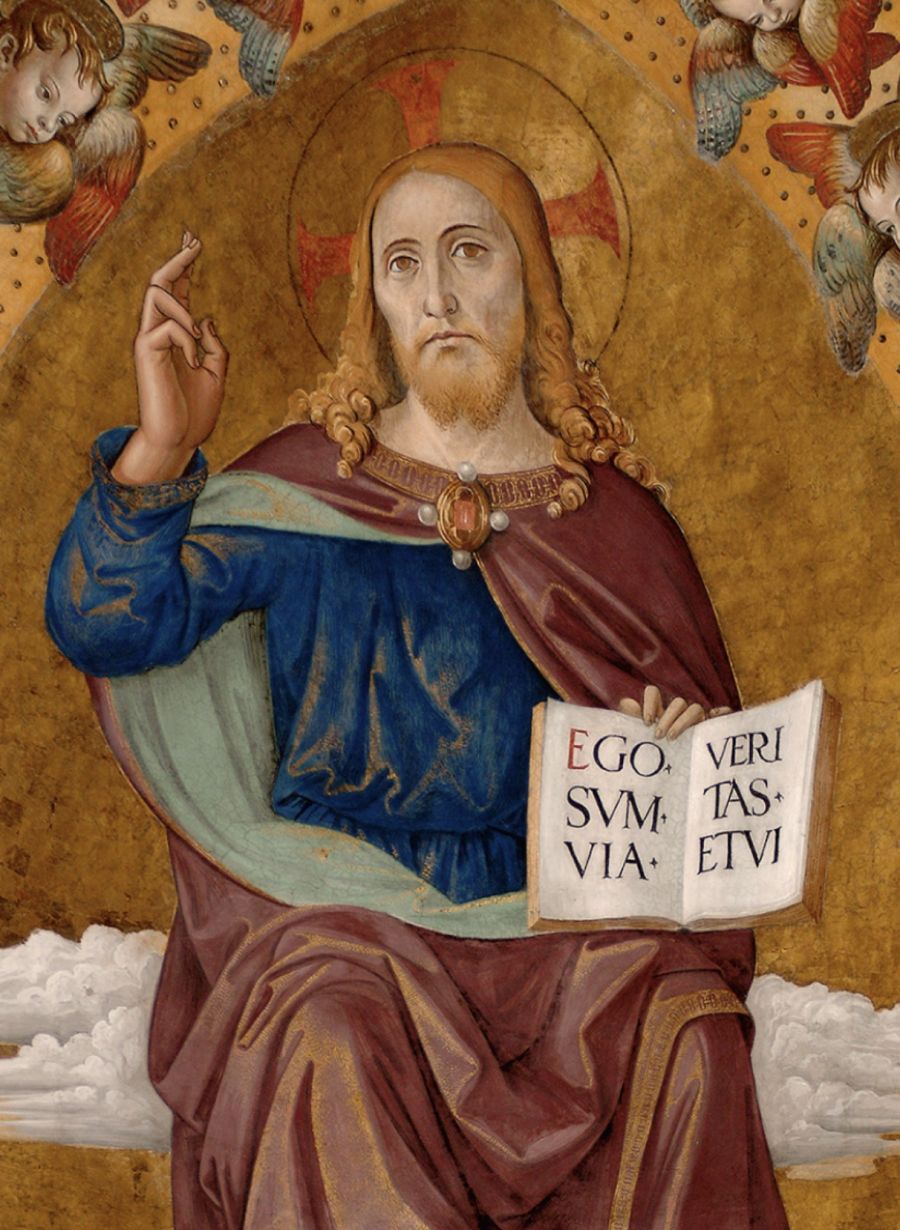
If Jesus begins by saying, ‘Do not let your hearts be troubled’ (Jn 14:1), it is because the disciples were not hiding their anguish, and one can understand why. They knew they were surrounded by general hostility and sensed that the countdown had begun. This anguish was compounded, at least for some of them, by a terrible disappointment: “We had hoped that he would be the one to redeem Israel” (from the Romans), the disciples of Emmaus would say (cf. Lk 24:21). The apostles shared this political hope; now their leader is about to be condemned and executed, and their illusions are coming to an end. Jesus sets about redirecting their hope: he will not fulfil the expectations his miracles have raised; he will not lead the national uprising against the occupier; on the contrary, he will not cease to preach non-violence. The liberation he has come to bring lies on another plane: he does not wish to fulfil his people’s earthly and political expectation of the Messiah, but to make them understand that he is the one who has always been awaited. He begins by appealing to their faith, that is, to that fundamental attitude of the Jewish people which we read of in all the psalms, for hope can rest firmly only on faith. This is why Jesus returns repeatedly to these words: ‘believe’, ‘let not your hearts be troubled (for) you believe in God’. Yet it is one thing to believe in God—and this is a given—and quite another to believe in Jesus, precisely at the moment when he seems to have definitively lost the battle. For his contemporaries, to accord Jesus the same faith as God required a tremendous leap, and Jesus seeks to help them perceive the profound unity existing between the Father and himself. Here we have the second key theme of this text: “I am in the Father and the Father is in me” (a phrase he repeats twice). And then: “Whoever has seen me has seen the Father”, and this last phrase resonates in a very special way in the light of what will happen a few hours later, for the revelation of the Father reaches its climax when Jesus dies on the cross. As he dies, Jesus continues to love mankind, all mankind, and even forgives his executioners. It would be necessary to dwell on every sentence of this final conversation between Jesus and his disciples, indeed on each of the words laden with the whole of biblical experience: to know, to see, to abide, to go towards. Every word is at the same time an event, a ‘work’. When he says: ‘I am’, to Jewish ears this clearly evokes God himself, and he dares to say: “I am the way, the truth and the life”, identifying himself with God himself. And at the same time, the Father and he are two distinct persons, for Jesus says: “I am the way” (implied: to the Father). No one comes to the Father except through me. Another way of saying “I am the way” or “I am the gate”, as in the discourse on the Good Shepherd. And when we are united with him, the divine plan of our solidarity in Jesus Christ with the whole of humanity is realised. This is truly a mystery, and we struggle greatly to grasp it, yet it is the very essence of God’s merciful plan, which St Augustine calls the “total Christ”. This solidarity in Jesus Christ is present throughout the New Testament. Paul, for example, evokes it when he speaks of the New Adam and also when he says that Christ is the head of the Body of which we are the members. “The whole creation groans and suffers the pains of childbirth until now” (Rom 8:22): the birth of which he speaks is precisely that of the Body of Christ. Jesus himself very often used the expression ‘Son of Man’ to announce the definitive victory of the whole of humanity gathered together as one man. If we take seriously the expression ‘No one comes to the Father except through me’ and if we consider the solidarity existing among all men in Jesus Christ, then we must also say that Christ does not go to the Father without us. This is the meaning of these words of Jesus: “Where I am, there you will be too”, and again, “When I have gone and prepared a place for you, I will come again and take you to be with me”. Paul affirms this in another way when he writes: “Nothing can ever separate us from the love of God, which is in Christ Jesus” (Rom 8:39). Jesus concludes with a solemn promise: “Whoever believes in me will do the works that I do.” After all that Jesus has just said about himself, the term “works” certainly does not refer solely to miracles, for throughout the Old Testament, when the word “work” is used in reference to God, it always refers to God’s great work of liberating his people. This means that the disciples are now associated with the work undertaken by God to free humanity from all physical or moral bondage. This promise of Christ encourages us to believe that, even though history shows the enduring presence of many forms of slavery, this liberation is possible and will come to pass. It is up to each of us to make our own contribution.
+Giovanni D’Ercole
