
6th Easter Sunday (year A) [10 May 2026]
First Reading from the Acts of the Apostles (8:5–8, 14–17)
Let me return to the first sentence: ‘Philip, one of the Seven’, that is, one of the seven men appointed to organise the distribution of food in Jerusalem. In practical terms, the issue was ensuring a fair distribution of what amounted to a food bank for widows. Last Sunday we saw that a problem had arisen among the very first Christians. After Jesus’ Resurrection, all those who followed the apostles and asked for baptism were Jews, either by birth or converts to Judaism (those known as proselytes). But there were already great differences amongst them. Among these Jews, some were originally from Israel, and in particular from Jerusalem, and spoke Hebrew in the synagogue and Aramaic on the street: they were called Jews. The others were from the Diaspora, that is, the rest of the Roman Empire: they spoke Greek and were called Hellenists. For the celebration of the Sabbath, all Jews, whether they had become Christians or not, would go to the synagogues: Jews on one side, Hellenists on the other. But for Christian celebrations, the Jews who had become Christians would gather in private homes, Hellenists and Jews together. It was in the context of these Christian celebrations that a first dispute broke out between these two groups of Christians, concerning the aid given to widows. And, to resolve it, seven men were appointed to be in charge of the distribution of food (today we might say ‘material matters’). That was last Sunday’s reading. Among these seven men, Stephen and Philip—both Jews who had recently become Christians—were ardent, fervent Hellenists and were likely recognised as leaders; they sought to convert to Jesus Christ the Jews who attended the synagogues where Greek was spoken, and it was there that a second dispute arose. Not a dispute between Christians of different origins, but a far more serious one between Hellenistic Jews (that is, Jews of the Diaspora): a dispute pitting those who believe in Jesus of Nazareth, the unrecognised Messiah, crucified and risen, against those who continue to think that Jesus was nothing but an impostor. And that is where the first persecution begins: the Jews who refuse to believe in Jesus Christ attack their Jewish brothers who have become Christians. Stephen is martyred: denounced by Hellenistic Jews to the authorities in Jerusalem, he is arrested and executed. Stephen’s martyrdom does not quell the fury of his opponents; on the contrary, they will turn their wrath upon the other Christians in Stephen’s group. This very first persecution does not target Jesus’s direct apostles—Peter, John, James and the others who are part of the Jewish group; it targets only the Hellenists. Thus, Jesus’ apostles were not disturbed and remained in Jerusalem, continuing to practise the Jewish religion whilst preaching in the name of Jesus. Instead, out of prudence, the Hellenist group dispersed: those most at risk moved away, but naturally, wherever they went, they spoke of the Messiah, Jesus of Nazareth. And so, thanks to the persecution, the Good News spreads beyond Jerusalem and reaches the other cities of Judea and Samaria. Later, people will recall Jesus’ final words on the day of the Ascension: ‘You will be my witnesses in Jerusalem, throughout Judea and Samaria, and to the ends of the earth’ (Acts 1:8). This is exactly what is happening: paradoxically, it is this trial—the persecution and scattering of the community—that allows evangelisation to gain ground. This is why Philip went down to Samaria, and instead of hiding, he began to preach, quickly going beyond the mission entrusted to him. At first, Philip was chosen to be one of the Seven charged with the service of the widows’ tables in Jerusalem, and we find him preaching in Samaria. At the same time, he remains visibly in contact with those who entrusted him with his mission, for the Jerusalem community sends Peter and John to him, who will in a sense authenticate the work accomplished by Philip. This takes place in Samaria, and we know just how much the people of Jerusalem despised the Samaritans: they regarded them as heretics; for centuries, Jews and Samaritans had carefully nurtured their quarrels and mutual contempt. Philip is not troubled by these old quarrels: he, the man of the Diaspora, is undoubtedly far removed from these theological disputes and, in any case, thanks to him, the Gospel has just crossed the boundaries of the synagogue. Instead, he emphasises the joy of the Samaritans in receiving the Good News
Responsorial Psalm (65/66)
We have heard only a few verses of the twenty that make up Psalm 65/66, yet the long journey of the faithful is summarised here in three stages. The first is suggested in verse 6 with the reference to the Exodus, the departure from Egypt with Moses: “He turned the sea into dry land”, then the entry into the Promised Land under the guidance of Joshua, with the miracle of the drying up of the Jordan: “They crossed the river on dry ground”. When one reads the Psalms carefully, one is struck by the abundance of echoes of the Exodus, which is the foundation of Israel’s faith experience and thus of its hope. In the second stage, the psalmist invites his contemporaries to prayer, praise and the sharing of the faith experience: “Come, listen, all you who fear God; I will tell you what he has done for my soul” . Third stage: the whole earth is invited to join in the praise of God: “Praise God, all the earth; celebrate the glory of his name, glorify him by singing his praises. Say to God: How awesome are your works!” It is not the first time that Israel’s prayer has expanded to encompass the whole earth, that is, all humanity. The chosen people have come to understand over time that their mission is to bring all peoples into the joy of God. Isaiah says: “My house shall be called a ‘House of prayer for all peoples’” (Is 56:7). In the psalm, one already senses a kind of anticipation of that day, as if all peoples were already part of the procession of pilgrims ascending to Jerusalem: ‘The whole earth bows down before you, sings to you, sings to your name.’ This psalm looks at once to the past, the present and the future... In the past, God freed his people from slavery in Egypt. Today, he liberates at every moment those who allow him to act; in the future, all humanity will be definitively freed from the chains that currently bind it in fear and war. This psalm thus introduces us to what the historical dimension of the faith experience represents for the Jewish people. And, as always in the biblical world, the collective dimension takes precedence over the individual experience. From the earliest age, the Jewish child shares in the memory of his people: daily prayers, the Sabbath, festivals and pilgrimages evoke a collective memory into which the child is gradually immersed; he hears adults singing the glory of God and recounting His mighty deeds countless times, and one day, in turn, quite naturally, he too will take up the baton. They hear their elders say: “Blessed be God who has not rejected my prayer, nor turned his love away from me.” They will remember the deeds of God who freed their ancestors from slavery in Egypt: He turned the sea into dry land, and they crossed the river on dry ground. The adults’ day, from morning prayer to evening prayer, passing through meals and all the acts of daily life, is steeped in this memory of the God who frees from all bondage. The Jewish child enters quite naturally into the ‘memory’ of his people, but all this presupposes family life and a strong sense of belonging to a people. Here, perhaps, lies one of the keys to our problems in passing on the faith: it is precisely this collective memory that is lacking in many of our young Christians. The memory of a people is not a matter for religious education classes, however excellent they may be, but a matter of community life, of repeated rituals, of slow assimilation; and we can clearly see how grave the dangers of individualism are. At the same time, we know what remains for us to do if we wish to pass on the faith to the new generations: it is urgent that we return to imbuing the whole of family life with this faith-filled memory and give renewed vigour to our Christian communities.
Second Reading from the First Letter of Saint Peter the Apostle (3:15–18)
Reading between the lines of this text, one can imagine that Peter’s listeners were suffering harassment and ridicule at the hands of the pagans; not overt persecution, but latent hostility, and they had to explain time and again why they rejected certain pagan practices, such as sacrifices to pagan deities. Peter tells them: ‘Brothers, it is now your turn to behave as Christ behaved. He too faced accusations, slander and threats, yet he did not waver; now it is your turn, and you must be able to stand firm against your adversaries.
Where will this steadfast courage come from? Christians have but one source, one argument, one message: Christ died and rose again. Peter says nothing else: “Worship the Lord, Christ, in your hearts… For Christ too died once and for all for sins, the righteous for the unrighteous, to bring you back to God; put to death in the body, but made alive in the spirit”. The body, the flesh, in biblical language, signify human weakness, the fact of being mortal. It is difficult for enemies to understand that Jesus died and rose again. Christians explained that, because he was filled with the Spirit of God, death could not hold him in its power, and the Spirit enabled him to pass through biological death and brought life to him—the gift of the Spirit of life which had been manifested upon him on the day of Jesus’ Baptism. This same Spirit, who entered us through Baptism, enables us to overcome evil, hatred and sadness, and this is our hope—the hope of which Peter says we must give an account at all times. Christ had said to the Apostles: “Take heart; I have overcome the world.” The witness the world expects from us is that evil is not inevitable, and for this reason we must never give up in the face of evil, hatred and violence. Christ suffered for our sins once and for all, and the expression ‘once and for all’ is a cry of victory: the world of evil and sin is definitively conquered through the obedience of the Son. Peter strongly links the two aspects of Christian witness: prayer is what takes place in the secret of the heart, and then there is the public courage of witness; the first cannot exist without the other. “Worship the holiness of Christ in your hearts” is what takes place in the secret of prayer, from which we shall draw the boldness needed to proclaim our hope through our lives: “Always be ready to give an answer to anyone who asks you to give an account of the hope that is within you.” Peter advises us not to speak first, but to be ready to answer the questions of those who ask. This phrase comes to mind: “Do not speak unless you are asked, but live in such a way that they ask you.” If life becomes a true witness to hope, those who meet you will wonder where such indestructible hope comes from. It is therefore not possible to bear witness to Jesus unless we live this hope, which means that witness is given first and foremost through deeds and not through words. Jesus says: “Let your light shine before others, so that they may see your good works and give glory to your Father in heaven” (Mt 5:16). Saint Paul VI noted that our contemporaries seek witnesses, not teachers… and they listen to teachers only if they are witnesses. A witness given with “gentleness and respect”, Pietro emphasises, which must never desert us so that “those who slander our good conduct in Christ may be put to shame”.
From the Gospel according to John (14:15–21)
On the evening of Holy Thursday, after the washing of the feet, Jesus speaks at length with his disciples for the last time. He speaks of the Father and of the relationship that unites him, the Son, to the Father, but he also speaks of the bond that now unites the apostles to his Father and to him. A bond that nothing and no one can destroy: “I am in my Father, you are in me and I am in you… Whoever loves me will be loved by my Father”.
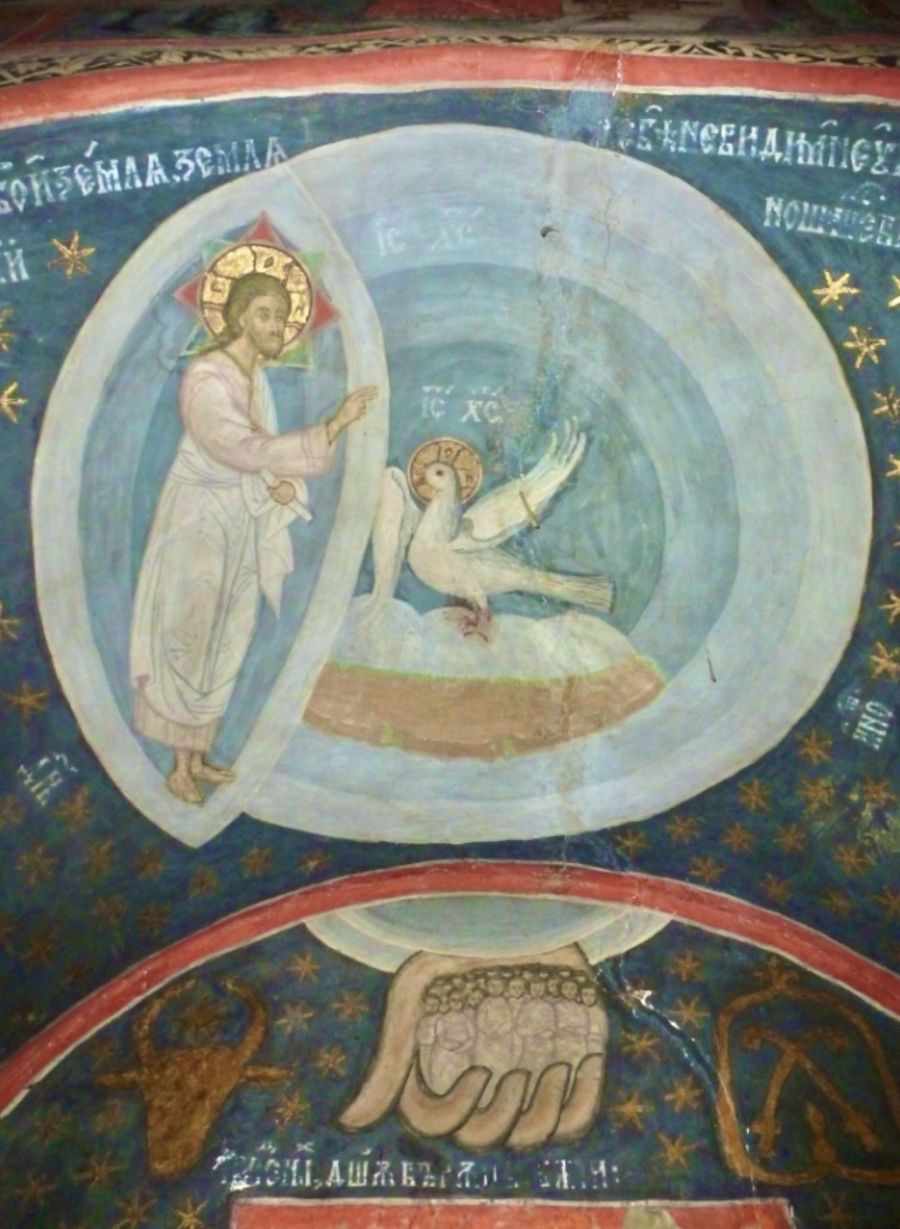
And as he prepares to leave them, he announces the coming of the Spirit. The apostles recalled the prophecies of Ezekiel: “I will give you a new heart and put a new spirit within you” (Ezek 36:26) and “I will no longer hide my face from them, for I will have poured out my Spirit upon the house of Israel” (Ezek 39:29). With Joel, the promise of the gift of the Spirit had become universal: “I will pour out my Spirit upon all flesh” (Joel 3:1). When Jesus says, “The Spirit of truth remains with you, and will be in you”, he announces that the great day of the definitive Covenant has arrived. These words of his evoke Israel’s long wait, for the aspiration of all Old Testament believers was the presence of God in the midst of his people. There had been the Tabernacle during the Exodus, then the Temple in Jerusalem, but they awaited the New Covenant in which God would dwell not in buildings, but in the hearts of his people, intimately present in every believing heart. God had promised this through the mouth of Ezekiel, for example: ‘My dwelling place will be with them; I will be their God, and they will be my people’ (Ezek 37:27) and Zechariah: ‘Sing and rejoice, O daughter of Zion; behold, I am coming to dwell among you’ (Zech 2:14). The apostles were imbued with this hope: they knew that the definitive Covenant promised in the Old Testament was intended for all humanity, and during his public life, Jesus had repeatedly expressed the desire that the whole world might be saved. But why does he say that the world is incapable of receiving the Spirit of truth, and why does he say this at this very decisive moment of salvation? It is certainly not a value judgement, but an observation: The world cannot receive him, because it neither sees nor knows him. But Jesus continues: you, however, know him, because he dwells with you and will be in you. This is a sending forth on mission, for it is as if he were saying: “The world does not know the Spirit of truth… It is up to you to make him known; it is up to you to help people discover the active presence of the Spirit in every human reality”. Jesus wants to strengthen his disciples: to help them believe that the contagion of love will gradually prevail and that it is possible to transform the spirit of the world into the spirit of love. In a way, the mission he entrusts to his disciples is evangelisation by contagion, from person to person. This will be possible because Jesus assures them: “I will pray to the Father and he will give you another Paraclete to remain with you forever”. In Greek, “parakletos” refers to one who is called to stand by an accused person to assist them: he is the comforter, the intercessor, the counsellor, the advocate, the defender. An advocate for a trial, but what trial are we talking about? The one in which the world acts against Christ’s disciples, and through them, against the Father himself and against Christ. Ultimately, it is the trial of “Truth”. Hence Jesus’ insistence on the word “truth” whenever he warns his disciples of the persecutions that await them: “When the Advocate comes, whom I will send to you from the Father, the Spirit of truth who proceeds from the Father, he will bear witness to me; and you also will bear witness, because you have been with me from the beginning” (Jn 15:26–27).
+Giovanni D’Ercole
