
18th Sunday in Ordinary Time (Year A) [2 August 2016]
First Reading from the Book of the Prophet Isaiah (55:1–3)
We have reached the end of the second book of Isaiah, which is entirely focused on the end of the Exile and the return to the Promised Land, and is therefore called ‘the book of the consolation of Israel’. Chapter 54 heralds the long-awaited return, and this chapter specifies the spirit in which we are to return. Four major themes are evoked. The first theme is the gratuitous nature of God’s gifts: ‘Come, buy without paying’. Sometimes, it is precisely this gratuitousness that is the hardest to accept. We tend to think of merits and dignity that must be regained in order to stand before God, whilst mercy bends down to repentant sinners. Isaiah declares: ‘For my thoughts are not your thoughts, nor are your ways my ways. As the heavens are higher than the earth, so are my ways higher than your ways’ (55:8–9). Voltaire used to say: “God made man in his own image, and man has done him a fine job of it.” He was right, because we sometimes imagine a God with the same feelings as our own – one who takes revenge and punishes – whereas in the Bible, God always shows such an abundance that is entirely free and generous that we might say that in God’s supermarket, everything is always free. But if everything is free, can we do as we please? Certainly not, because if we are touched by God’s love, our hearts change and we begin to resemble him. In a society founded more on commerce than on service, Christians must nurture the kingdom of gratuitousness, for if we stray from the path of gratuitousness, we are far from God’s ways. The second theme is the struggle against idolatry, a temptation that constantly resurfaces. Only God holds the keys to our happiness and freedom, and with Him, everything is given. We simply need to trust. The third theme is listening and trust – ‘Give ear and you shall live’ ‘Give ear and come to me; listen and you shall live’ (55:3). We lend an ear to so much commercial advertising; why, then, does this message from Isaiah – spoken in God’s name and marked by gratuitousness – fail to convince us? The way of gratuitousness stands above our ways of calculation and ‘quid pro quo’. Fourth theme: God’s faithfulness to the Covenant, another key theme in the sermons of Second Isaiah: the exiles feared they would be abandoned by God forever, yet His love is entirely gratuitous and unconditional, and He never calls His Covenant into question; indeed, He renews it at every moment.
Responsorial Psalm (144/145)
Psalm 144/145 is an alphabetic psalm of praise for the Covenant. This Sunday’s first reading speaks of the gratuitousness and abundance of God’s gifts; this psalm says nothing other than this! It is an alphabetic, acrostic psalm: it has as many verses as there are letters in the Hebrew alphabet, with each verse beginning with a different letter of the alphabet. This style of composition has a specific, consistent purpose: to express to God the believers’ gratitude for the gift of the Covenant. It is therefore no surprise to find in this psalm a reference to all aspects of the Covenant: the extraordinary discovery of a God who is both almighty and close to humankind. The Book of Wisdom made this clear: ‘You, Lord, who possess power, judge with gentleness; you rule us with great forbearance, for when you wish, you can use your power’ (12:16–18). Even before the Book of Wisdom, other Old Testament texts had powerfully proclaimed God’s greatness and goodness. At the outset, verse 8 of the psalm echoes God’s revelation to Moses on Mount Sinai: ‘The Lord, a God merciful and gracious, slow to anger and abounding in love and faithfulness’ (Ex 34:6); the burning bush: Exodus 3:1–6 presents a twofold revelation: God reveals himself to Moses in the burning bush whilst he was tending the flock of Jethro, his father-in-law, the priest of Midian (cf. Exodus 3:7). He always reveals himself to be compassionate and merciful = literally ‘a heart open to our miseries’, who takes the side of those in distress. Moses, who had previously veiled his face, realises that he need not be afraid. ‘My people’ is a reference to the Covenant with the people dating back to Abraham. Just as God had seen the misery of Abraham, an elderly man without children, so He has seen the misery of His people. In conclusion, this psalm, like the account of the Exodus, is important for the faith of Israel and therefore for our own: it reveals the dual nature of God as both the Wholly Other and the Wholly Near. He is the Wholly Other, to whom one approaches only with awe and reverence, and at the same time the Wholly Near, who sees the misery of his people and raises up a liberator. In the verses chosen from Psalm 144/145 for this Sunday, the emphasis is placed on this tenderness of God, a conviction that forever nourishes the faith of the Jewish people and our own, just as it filled the heart of Jesus of Nazareth.
Second Reading from the Letter of Saint Paul the Apostle to the Romans (8:35, 37–39)
Nothing can ever separate us from the love of God: this statement brings to a close Chapter 8, which we have been reading for several weeks, in which Paul marvels at God’s love. In Chapter 5 he had said: ‘The love of God has been poured into our hearts through the Holy Spirit’ (Rom 5:5). Here he gives free rein to the exultation that fills the hearts of believers when they realise God’s work on their behalf: ‘God, who did not spare his own Son, but handed him over for us all’ (Rom 8:32). From now on, no one can break the covenant so closely bound between God and us. As the first Eucharistic Prayer of Reconciliation states, ‘with your arms outstretched on the cross, you have drawn between heaven and earth the indelible sign of the covenant’. From now on, every attempt at separation is doomed to failure. Paul takes up one of the major themes of Scripture: the very stake of the lives of the children of Adam is to remain attached to God, without allowing themselves to be separated from him by the Tempter. In the wilderness, Jesus faced the onslaught of the Tempter, who tempted him with power, ease and honours. Peter himself tempted Jesus to flee from the inevitable persecution. But nothing—neither hunger nor the mirages of success—could separate the Son from the Father. In turn, Paul and the other apostles draw from the Spirit of Christ the strength to remain grafted onto him. Paul offers us here a great profession of faith: ‘For I am convinced that neither death nor life… nor anything else will ever be able to separate us from the love of God, which is in Christ Jesus our Lord’ (Rom 8:38–39). This is not pride, but the certainty of faith: Paul does not for a moment consider that the credit for this faithfulness lies with him. When he states, ‘In all these things we are more than conquerors through him who loved us’, the key word is ‘through’ him. His declaration resembles that of the prophet Isaiah concerning the Servant of God: ‘The Lord God helps me; therefore I shall not be disgraced’ (Isaiah 50:7).
From the Gospel according to Matthew (14:13–21)
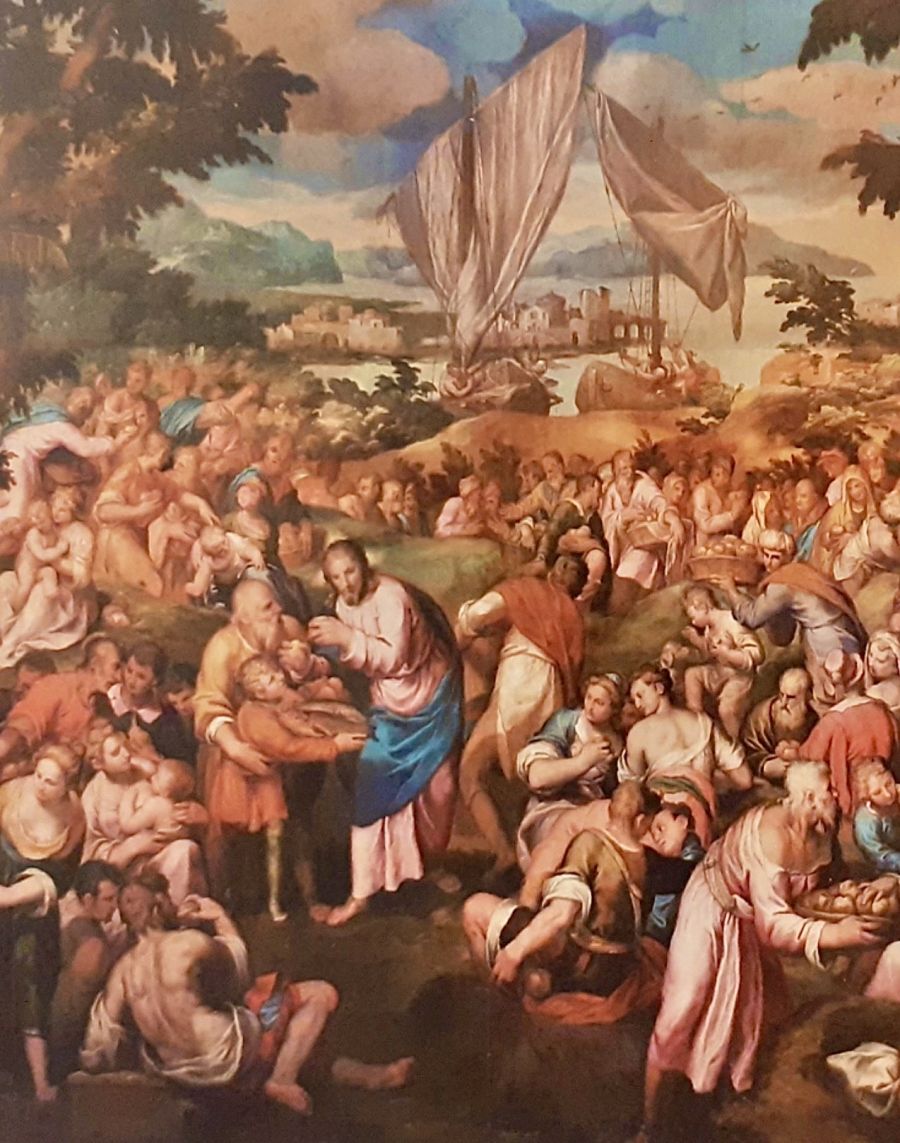
The episode of the multiplication of the loaves follows immediately after the announcement of John the Baptist’s execution. Matthew recounts John’s death and concludes: ‘His disciples went and took his body, buried it, and went to tell Jesus’ (14:12). Jesus’s first reaction, which appears to be prudence, is to withdraw: “On hearing this, Jesus got into a boat and withdrew to a deserted place by himself” (14:13). But he is immediately overtaken by the crowd’s pleas and “he had compassion on them” – literally, “he was moved to the depths of his being”, as Matthew puts it. Humanly speaking, Jesus commits an act of reckless folly. It was politically imprudent because the wise course of action at that moment would have been to keep a low profile, since his popularity would attract the hatred of the Pharisee leaders; it was folly because it was senseless to believe that five loaves and two fish would be enough to feed such a crowd. The disciples, being realists, pointed this out to him, but Jesus replied, unperturbed: ‘You yourselves give them something to eat’ (14:16). This episode brings to mind the prophet Elisha, in the Northern Kingdom, 800 years earlier, whose story was known to all. In the midst of a famine, a faithful follower had brought an offering of the first fruits of the harvest: twenty barley loaves that would normally have been Elisha’s due, but he, given the circumstances, decided to share them with everyone. Twenty loaves were too many for a single prophet, but they were a pittance for the hungry people around him: the text says there were a hundred people. Elisha had told his servant, ‘Give it to the people to eat’, but the servant could see that the numbers didn’t add up: ‘How can I set this before a hundred people?’. And the prophet insisted: ‘Give it to the people to eat. For thus says the Lord: “They shall eat and there will be some left over.”’ And the servant distributed it: ‘They ate and there was some left over, according to the word of the Lord’ (2 Kings 4:42–44). In this miracle, too, we note the disparity between the number of diners, the few loaves and fish available, and the amount of leftovers collected. Matthew is keen to point out: ‘They all ate and were satisfied; and they carried away twelve baskets full of the fragments’ (14:20). What do Jesus and Elisha have in common? What is their secret? First of all, both believe that sharing is possible, whatever the number of diners, because both place their trust in God. They also share the mention of the leftovers and the precise statement that ‘everyone ate their fill’. This miracle brings to mind the gift of manna in the Book of Exodus: ‘I will satisfy you with bread, and you shall know that I am the Lord your God’ (Ex 16:12). Jesus, as the evangelist writes, had gone off to a deserted place on the outskirts in search of some peace and quiet, but he agrees to let himself be found, to draw near to the people, and this leads him to commit the ‘foolish recklessness’ I mentioned at the beginning. Disciples of all ages are in turn invited to nurture this reckless folly: in other words, it is enough to have faith to remember that sharing works miracles. And we must learn to rejoice in our own poverty, for it is the privileged place where God acts. When we recognise our powerlessness, we call upon God for help, and this is always the first thing to do. Whilst the first reading, taken from Isaiah, proclaims the abundance and gratuitousness of God’s gifts, Jesus’ multiplication of the loaves is a magnificent illustration of this.
+Giovanni D’Ercole
