
22nd Sunday in Ordinary Time (year A) [30 August 2026]
First Reading from the Book of the Prophet Jeremiah (20:7–9).
The central theme here is Jeremiah’s inner struggle: the fire of the Word. His is an experience of persecution and inner turmoil that he endured throughout his life. And he is not alone: many other prophets and, later, Jesus himself faced similar situations. Jeremiah carried out his ministry during the 40 years leading up to the disaster in Jerusalem in 587 BC and the deportation to Babylon. Forty years of spiritual decline. His task was to foretell the catastrophe, not to be a harbinger of doom, but on the contrary in the hope of securing, at the very last moment, the conversion of the king and the people. He spared no effort to warn his contemporaries, whilst there was still time, but they, in turn, spared no effort to silence this spoilsport. It is in this contentious and distressing context that the private reflections from which we have read an excerpt arise: his ‘confessions’. Unfortunately, the word ‘lamentations’, which derives from this, has taken on a pejorative connotation, and this is unjust: Jeremiah’s confessions are magnificent, full of sorrow, yes, but even more so full of faith and passion for the cause of his God. In today’s text, he reveals to us the inner struggle taking place deep within him: torn between God’s call, which urges him to speak, and human wisdom, which urges him to remain silent: ‘I said, “I will think no more of him; I will speak no more in his name!” But in my heart there was like a burning fire, shut up in my bones; I tried to hold it back, but I could not’ (Jer 20:9). To give up would mean abandoning his fellow citizens to their sad fate and betraying God’s trust. It is clear why this text is set before us on the Sunday when we hear the Gospel following Peter’s confession at Caesarea. When Jesus asked the disciples, ‘Who do you say that I am?’, Peter replied that Jesus was the expected Messiah. But immediately afterwards, Jesus reveals to the disciples the fate that awaits him: Passion, the cross, death and resurrection (Mt 16:21). Peter protests: ‘God forbid, Lord; this shall never happen to you.’ But Jesus calls him ‘Satan’ and warns the disciples that they will not be treated any better than their Master: ‘If anyone wishes to come after me… (Mt 16:24–25). This proves that every true prophet is inevitably a thorn in the side of the prevailing ideas of the moment. The consuming fire of the Word of God, which calls for conversion, is not meant to please: ‘I have become a byword all day long; everyone mocks me,’ confesses Jeremiah, and he does not hide the fact that at times he is afraid. He hears people talking behind his back and plotting to get rid of him: ‘I hear the slander of many’ (Jer 20:10). The prophet is all the more troublesome because, as the Lord’s messenger, the Lord gives him the strength to carry on despite all the persecution, so that there is no way to silence him. It is clear why persecution is inevitable. The verses preceding today’s reading describe a particularly harrowing episode: Jeremiah had so exasperated everyone in the Temple with his rebukes that the priest Pashur had him tied to a pillory, hanging upside down in the public square. The next day, when Pashur himself came to untie him, thinking that such punishment had calmed him down, Jeremiah spoke out even more forcefully and took his anger out on Pashur himself. Yet these confessions of Jeremiah’s, steeped in sorrow, are at the same time an admission of the all-consuming passion that burns within him and, ultimately, illuminates his life: ‘You have seduced me, Lord, and I let myself be seduced’ (Jer 20:7). He complains, yes, but he would not give his place to anyone else. The Word was a burning fire in my heart, a consuming fire that brings to mind Psalm 68/69: ‘Zelo for your house has consumed me’, which aptly expresses the persecution suffered by all the prophets. To begin with, this was the case with the people of Israel, entrusted with a prophetic mission in the service of the nations. Throughout their history, they sought to remain faithful to that mission, and this earned them terrible persecution at times. Then it was the case for all the prophets, one after another, and subsequently for the early Christians, who imitated Jesus, who was ultimately silenced. But nothing can silence the Word of God: Christ is risen; and now we know that a day will come when people will hear the Word and finally find their light in it.
Responsorial Psalm (62/63)
This psalm echoes the experience of Jeremiah, whom we encounter in the first reading, who endured inner turmoil and constant attacks, even though his passion for God—stronger than anything else—helped him to endure every threat and humiliation. However, this psalm was not composed to speak of Jeremiah; rather, it is like a prayer that King David might have composed whilst being hunted down by his enemies. The Old Testament recounts at least three episodes in which David had to take refuge in the Judean desert: the first two times to escape the murderous rage of King Saul, who had become so jealous of David that he wanted to kill him. The third time was even more dramatic: the one pursuing and seeking to kill David was his own son Absalom, who was too eager to seize the throne and hasten his father’s death, and who had already eliminated his elder brother. David did not immediately realise the danger, and by the time he did, it was too late: Absalom was on the verge of conquering Jerusalem; there was only one solution left: flight. And all of Jerusalem saw their king, humiliated, fleeing on foot from the holy city and climbing the Mount of Olives in tears (cf. 2 Sam 15:23–28). The words of this psalm are attributed to David: ‘Your love is better than life’ (v. 4). As is well known, the title of the psalms does not designate the author—in this case, King David. This psalm in particular contains several clear allusions to the Temple in Jerusalem, which David certainly did not know, as the Temple was only built by his son Solomon. ‘A psalm of David’ here means ‘in the manner of David, the one who thirsts for God’. The prayer ‘O God, you are my God; at dawn I seek you; my soul thirsts for you’ may have been David’s, but it is also that of all generations of the chosen people, from Abraham right up to the Day of Salvation. In the most dramatic periods, this prayer took on even greater force, as during the Exile in Babylon. Upon their return from the Exile, the people give thanks: ‘Yes, you have been my help; I rejoice in the shelter of your wings.’ These are the wings of the cherubim that cover the Ark of the Covenant in the Holy of Holies; but they also recall the wings of the great desert eagle that protects its brood whilst teaching them to fly: and Moses had taken up this image to express the care with which God had surrounded his people: ‘I carried you on eagle’s wings,’ God had said (cf. Ex 19:4; Dt 32:10–11). Then came the even more terrible periods of persecution in the 2nd century BC under the Greek king Antiochus Epiphanes, when many Jews died for their faith, proclaiming: ‘Your love, Lord, is worth more than life.’ This verse resonates particularly on this Sunday, when we shall hear Jesus say to his disciples: ‘Whoever loses their life for my sake will save it’ (Mt 16:25). This is the struggle of all the prophets.
Second Reading from the Letter of Saint Paul the Apostle to the Romans (12:1–2)
‘I urge you, brothers and sisters, by the tenderness of God’: this is the theme of the Letter to the Romans. The first eleven chapters deal with the major themes of Paul’s theology, which are set out at length and in depth: the universality of sin, justification by faith, the Paschal Mystery, the work of the Holy Spirit, and the salvation promised and granted to all. But all of this always returns to a single subject: the tenderness of God. Now, as in all his letters, Paul draws out for his readers the implications of his teaching: the discovery of God’s immense tenderness cannot fail to shake us to the core, or rather, to permeate our whole life from now on. ‘I urge you, brothers and sisters, by the tenderness of God…’. What he is about to say is closely linked to everything he has written so far, particularly in the final lines of the previous chapter: ‘God wishes to show mercy to all’, which are followed by the hymn of thanksgiving we read last Sunday: ‘Oh, the depth of the riches and wisdom and knowledge of God! How unsearchable are his judgements, and his ways beyond our understanding!’ (Rom 11:32–33). The logical response is to offer ourselves as a ‘living, holy sacrifice’. Therefore, says Saint Paul, there is no room for hesitation: to this God, so astonishing in his tenderness and his desire to save all humanity, there is but one possible response: that of trusting surrender, offering ourselves to him as a sacrifice so that he may accomplish his work within us. The verb ‘to sacrifice’ means ‘to make sacred’, and St Paul invites us to make our lives sacred—that is, divine. Paul devotes the remainder of his Letter to the Romans to setting out the nature of the Christian commitment: each person, according to their gifts and qualities, is invited to take their place in the Church’s mission, which is the service of all people. This commitment is an active participation in ‘God’s will’. This undoubtedly requires us to accept, day by day, to be transformed—that is, to ‘renew our minds’—which for us is, at times, a true conversion because, all too often, our thoughts are not God’s thoughts but those of men, as Jesus rebuked Peter at Caesarea Philippi, as we read in this Sunday’s Gospel. But the Spirit has been given to us to bring about this renewal within us, which requires us to refuse to conform to the mindset of this age (Rom 12:2). True freedom lies in charting our own course, whatever the siren calls of fashion may be; in loving the world without being enslaved by the world’s ways; and in remaining constantly immersed in God’s tenderness, even though we know full well that it is not easy.
From the Gospel according to Matthew (16:21–27)
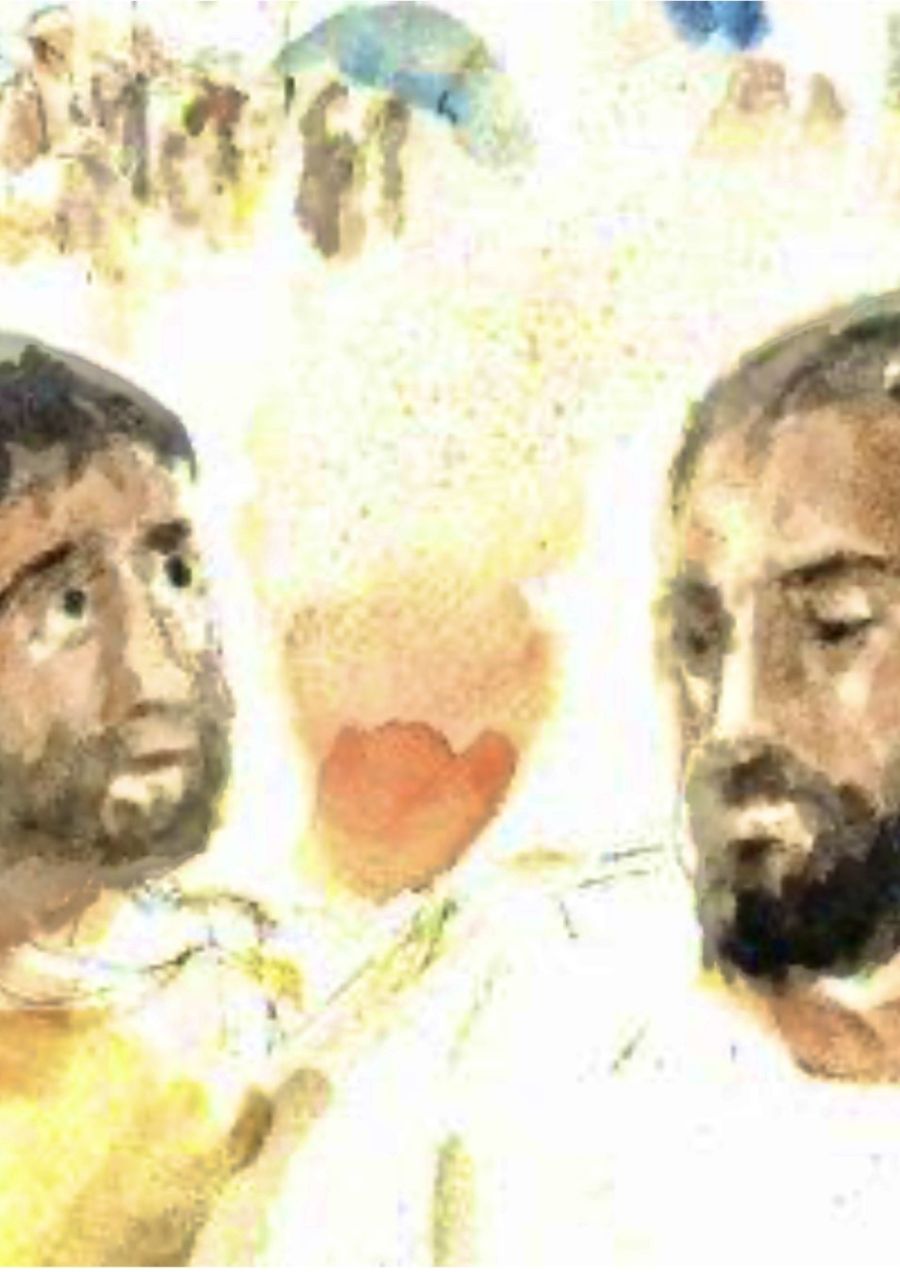
From ‘You are the Christ’ to the rejection of the cross. This account follows Peter’s memorable profession of faith which we heard last Sunday: ‘You are the Christ, the Son of the living God’, a statement which earned him this reply from Jesus: ‘Blessed are you, Simon son of Jonah: it was not flesh and blood that revealed this to you (that is, you did not guess it on your own), but my Father in heaven. Like any blessing, this ‘Blessed are you’ sounds like a compliment – and what a compliment! – but also like encouragement. And indeed, it will take a great deal of courage for Peter to remain faithful to this first profession of faith. For he does not yet fully grasp its significance, and Jesus has not finished surprising him. In fact, Jesus accepts, at least implicitly, Peter’s recognition of his title as the Messiah: ‘My Father has revealed this to you’. And immediately afterwards, he sets out his plan, which does not fit at all with the common idea people had of the Messiah: ‘From that time on, Jesus began to explain to his disciples that he must go to Jerusalem and suffer greatly…’ (Mt 16:21). It was a world turned upside down: a king without weapons or privileges… Worse still, a king who was mistreated and seemingly consenting… . He speaks of suffering greatly and even of being put to death! Peter has some reason to protest because, like many of his contemporaries, he was expecting a triumphant, glorious, powerful Messiah-King who would drive the Roman occupiers out of Jerusalem. What Jesus announces is therefore unacceptable: the almighty God cannot allow such things to happen! One might almost entitle this text: ‘Peter’s first denial’, his first refusal to follow the Messiah in his suffering. Jesus faces this spontaneous refusal on Peter’s part as a real temptation for himself and tells him so vehemently: ‘Get behind me, Satan! You are a stumbling block to me’ (Mt 16:23). We must allow the Spirit to transform—and at times completely overturn—our plans and ideas if we are to remain faithful to God’s plan. As Paul says in the second reading, we must allow the Spirit of God to transform our ways of seeing (cf. Rom 12:2) and we will experience wonderful surprises, for God’s ways are entirely different from our own. We must never lose sight of Isaiah’s famous words: ‘God says: “My thoughts are not your thoughts, nor are your ways my ways,” declares the Lord’ (Isaiah 55:8–9). ‘If I understood God, he would not be God,’ said Saint Augustine. We must therefore accept being taken by surprise: the apostles and all the Jews of their time were, Peter foremost among them. With rare exceptions, they had anticipated a powerful, triumphant Messiah; instead, Jesus is the very antithesis of these grand expectations. God’s plan is nothing other than the salvation of the world, that is, the birth of a new humanity, one that will live solely by tenderness and mercy, in the image of God Himself. The logic of the cross is required to save humankind, and the salvation of humankind—that is, our total and definitive conversion to love and forgiveness, to brotherhood and peace, to sharing and justice—cannot happen with a wave of a magic wand. The salvation of humankind inevitably involves a slow transformation of humankind, but how can we transform humankind without showing them the way? Therefore, it was absolutely necessary for Jesus to walk the path of gentleness, goodness and forgiveness to the very end, in order to give us some chance of walking it ourselves. This is why Jesus, when explaining his passion and death to the disciples on the road to Emmaus, said ‘it had to be’, in the sense of ‘unfortunately, it had to be’. God’s plan of salvation is not compatible with a triumphant Messiah. For people to come to a full knowledge of the truth (1 Tim 2:4), they must discover the God of tenderness and forgiveness, of mercy and compassion, and this is not achieved through power but through the supreme gift of the Son’s life. We can then better understand this saying of Jesus: ‘No one has greater love than this: to lay down one’s life for one’s friends’ (John 15:13). Only this supreme proof of love can lead us, too, to walk the path of love.
NOTE. ‘You are a stumbling block to me’ – the Greek word skandalon means ‘stumbling block’ – and our frailties and doubts can become stumbling blocks for ourselves or for others.
+Giovanni D’Ercole
