
30th Sunday in Ordinary Time (year A) [25 October 2026]
First Reading from the Book of Exodus 22:20–26
This text forms part of the Book of the Covenant, that is, the law which God gave at Sinai immediately after the Ten Commandments. It is not an isolated civil law, but the practical consequence of the Covenant that has just been made. Israel has come out of Egypt, has experienced slavery and liberation, and now God says to them: your freedom must become justice for the most vulnerable.
Four groups are protected in this text: the stranger, the widow and the orphan, and the poor person seeking a loan. Three different groups, yet united by a single principle: those without protection must find divine protection in Israel. For the stranger, the historical memory applies: ‘You were strangers in the land of Egypt.’ Those who have known what it is like to live without rights cannot allow others to remain without rights, and God reminds Israel of its own history to prevent it from becoming an oppressor. For the widow and the orphan, the rationale is even stronger. In ancient patriarchal society, without a husband and without adult sons, these people were vulnerable to the confiscation of their property, to exploitation and to starvation. This is why the law states: ‘If you afflict them, when they cry out to me, I will hear their cry and my anger will be kindled.’ The verb ‘to hear’ is central. The cry of the poor, zaaq in Hebrew, is the prayer that God cannot ignore. God takes the side of the wronged. Not afflicting the widow and the orphan is not merely a social duty; it is an act of fidelity to God himself. For the poor debtor, the law intervenes on two fronts. It commands that usury must not be practised: do not impose interest on those who are already poor; in other words, do not turn another’s need into profit. And return the pledge before sunset. In the ancient world, a cloak was the poor person’s only possession – a blanket at night and a garment by day – so taking it as a pledge meant leaving the person unprotected. The law commands that it be returned because human dignity is worth more than financial security. The conclusion, then, is the key to it all: when the poor cry out, I will hear them, for I am merciful; and God calls for social justice because, if He is merciful, so too must His people be. Here, then, is the text’s deepest message: God does not present Himself as a cold lawgiver or a distant judge, but as the One who listens and is moved. True liturgy and true worship are not the sacrifice offered on the altar if the heart remains indifferent to the cry of the weak. God’s holiness is not power; it is active compassion, and human holiness consists in imitating this compassion of His.
This message is of burning relevance today. Today’s strangers are migrants, refugees and undocumented people, but also the new neighbour, the one who is different in culture or faith. Many of our families were once migrants themselves and know what it means to be welcomed or rejected. The memory of our own past as strangers must challenge us: are our homes, our parishes, our country a welcoming inn or a fortress that turns people away? Our widows and orphans are the single mothers, the abandoned elderly, the children without a future, the victims of violence, and the young people without work. When a system crushes them with bureaucracy, unaffordable rents and precarious living conditions, God hears their cry. We cannot claim to love God whilst remaining indifferent. Our poor debtors are the families strangled by mortgages, by easy loans, by three-figure interest rates, by gambling. The biblical principle stands: no debt can take away dignity. Even today, one cannot take a man’s cloak – that is, his last possession – as security. The economy must always retain a human face. This is why Exodus 22:20–26 is not merely an ancient text; it is a call to translate faith into concrete actions. To welcome the stranger, to visit those who are alone, to lend without exploiting, to return what is needed to live. Then the cry of the poor will no longer be an accusation against us, but will become an opportunity to respond to the cry of God, who invites us to be merciful as he is merciful.
Responsorial Psalm (17/18)
The title of the psalm attributes it to David, the Lord’s servant, who addressed the words of this song to the Lord when he was delivered from the hand of all his enemies and from the hand of Saul. It is a true hymn of thanksgiving, not a private prayer, but a liturgical song following a victory. We are probably at the Feast of the Covenant or the commemoration of a deliverance, and the king speaks in the first person, yet he represents the people. Here, only a few of the 51 verses of the psalm are quoted; it opens with a profession of faith: ‘I love you, O Lord, my strength, my rock, my fortress, my deliverer.’ Seven divine titles, like a crown. God is not described in the abstract, but in relation to concrete salvation. The Psalm goes on to recount the danger and the answered prayer. The king is grappling with the waters of death, the snares of Sheol, the torrents of Belial. It is the experience of mortal anguish, but the prayer from the temple is heard: ‘From his temple he heard my voice.’ Then comes the theophany, which forms the heart of the Psalm. God intervenes as a cosmic warrior. The earth trembles, the mountains smoke, the heavens draw near; God rides upon a cherub, hurling lightning and hail. The language is drawn from Sinai and from the myth of the warrior God who battles the sea and chaos. This is not a scientific description, but poetic language to convey that when God acts, the entire universe participates in the salvation of his chosen one. The king’s justice and victory follow. After the storm, God reaches out his hand and delivers from the deep waters and from powerful enemies. The rationale is central: ‘The Lord has rewarded me according to my righteousness.’ This is not presumption: David presents himself as one who observes the Law, a man of integrity. The Psalm echoes the theology of retribution: to those who are faithful, God is faithful; to those who are good, you are good; to the upright, you are upright. The Psalm concludes with a universal perspective: the delivered king sings not only for Israel, but proclaims God’s name amongst the nations.
For the believer today, this Psalm teaches us to pray in times of trial by invoking God’s names, to recognise that deliverance comes from him, and to live consistently, for faithfulness attracts faithfulness. The theophany reminds us that our personal history is part of a cosmic plan: God does not save on a small scale; he saves in such a way as to make the waters of chaos tremble, like a victorious warrior.
Second Reading from the First Letter of Saint Paul the Apostle to the Thessalonians (1:5c–10)
Paul expresses his gratitude to the community in Thessalonica, which received the Gospel with genuine faith, despite difficulties and persecution. He recognises in the Thessalonians the tangible fruits of God’s work: their lives have been transformed by the Word and their witness has become an example to other believers. It was a newly formed community, born in difficult circumstances, yet it had managed to take root in the faith. Paul thus shows that the strength of the Church does not depend on the absence of problems, but on the ability to receive and live out the Gospel in the power of the Holy Spirit. First of all, Paul recalls that the Thessalonians received the Word ‘with the joy of the Holy Spirit’, even in the midst of tribulations. Their faith did not remain a mere theoretical commitment, but became an experience capable of facing difficulties. Christian joy, in fact, does not consist in the absence of suffering, but in the certainty of God’s presence even in the most difficult moments. And in this way, the Thessalonians became a model for the believers in Macedonia and Achaia. Their faith spread beyond the boundaries of the community, as a living proclamation of the Gospel. Paul emphasises that Christian witness is expressed not only through words, but above all through a life transformed by the encounter with Christ; and proof that the Thessalonians had been converted lies in their turning away from idols to serve the living and true God and to await his Son, Jesus, risen from the dead. This is a radical change: it is not merely a change in the way one thinks, but a shift in the very centre of one’s existence. Christian faith always involves a concrete choice: to leave behind what distances us from God, to live in his service, and to keep our gaze fixed on Christ, our hope.
St Paul invites us to reflect on the quality of our faith. To embrace the Gospel means allowing the Word to transform our daily choices, our relationships and the way we face life’s trials; and the joy of the Holy Spirit reminds us that even in suffering we can find strength and hope. Furthermore, like the Thessalonians, we are called to become credible witnesses to Christ, not so much through grand speeches as through concrete acts of love, service and solidarity. Finally, turning away from idols is more necessary than ever in our own time, for even today we can place the idols of consumer culture at the centre of our lives: success, money, power or the pursuit of approval. Conversion means recognising that only God can give fulfilment to our existence and living in confident anticipation of Jesus’ return. In conclusion, we can say that here Saint Paul presents a journey of faith that leads from listening to the Word to conversion, from conversion to witness, and from witness to hope. The Christian community thus becomes a tangible sign of God’s presence in the world, capable of proclaiming through its very life that Christ is risen and that salvation is found in him.
From the Gospel according to Matthew (22:34–40)
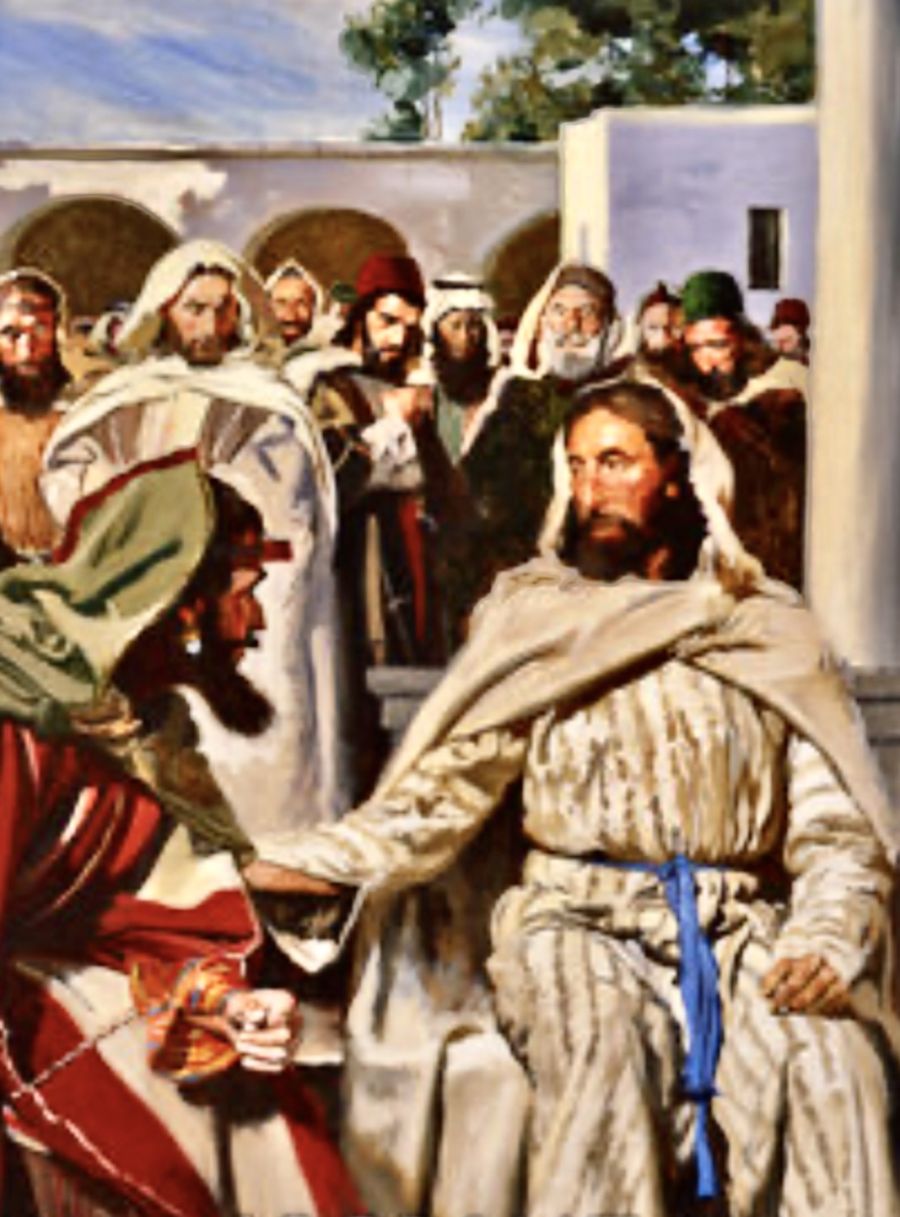
The greatest commandment. We are in Jerusalem, in the final days of Jesus’ life. Following the exchange with the Sadducees on the resurrection, the Pharisees gather in council, not to seek the truth, but to trap him. They send a teacher of the Law – an expert in the 613 precepts of the Law – with a trick question: which is the greatest commandment? For the rabbis, this is a classic debate between different rabbinic schools. Many rabbis of the school of Shammai maintained that the Sabbath was the greatest commandment; others, that it was circumcision; and still others, that it was the study of the Torah. Jesus responds succinctly, yet with startling depth. He does not cite any of the 613 commandments found in the Babylonian Talmud, Makkot 23b, and in the subsequent rabbinic tradition (248 positive commandments corresponding to the limbs or parts of the human body and 365 negative commandments corresponding to the days of the year), but draws upon two fundamental texts for Israel: the Shema: ‘Hear, O Israel: The Lord our God, the Lord is one. You shall love the Lord your God with all your heart, with all your soul and with all your strength’, found in Deuteronomy (cf. 6:5) and which every Jew recited morning and evening because, ultimately, it is the fundamental act of faith. The second text is found in the Book of Leviticus: ‘You shall love your neighbour as yourself’ (cf. 19:18). Jesus does something unprecedented: he places the two texts on an equal footing and says that the second is like the first, using the Greek term homoios, meaning equal in nature, not merely similar in importance. And he concludes: ‘On these two commandments hang all the Law and the Prophets.’ The image that emerges is that of a building: the entire Torah hangs on these two nails, and if you remove these two nails, the whole structure collapses. Jesus, therefore, does not abolish the 613 precepts, but points out the centre that sustains them. The Law is not, therefore, a burden of rules; it is the concrete expression of a twofold love, and Jesus reveals to us that God does not want mere religiosity; He asks for love – total love. To love God with all one’s heart, with all one’s soul, with all one’s mind means not reserving just a corner of one’s life for God, but the centre and the entirety of one’s life; for the heart is the will, the soul is life itself, and the mind is thought. It is not enough to say one believes; one must love through one’s choices, through one’s very breath, through one’s reason… To love one’s neighbour as oneself is the revolution. It does not say to love one’s neighbour more than oneself; it says ‘as oneself’, that is, with the same natural care with which we look after ourselves, nourish ourselves and seek what is good. One’s neighbour, therefore, is not a stranger; they are another version of oneself. And who is one’s neighbour? In the parable of the Good Samaritan, Jesus explains that we are called to be a neighbour to anyone we meet on our path, even to the enemy and the stranger. Loving God and loving one’s neighbour point to two inseparable forms of love, for one cannot claim to love God whilst hating one’s brother; nor can one truly love one’s brother without loving God, because it is only in God that we find the strength to love those who do not love us. These two pillars are like the wings of a bird: without a wing, no bird can fly. But how do we live out this new commandment today? On closer inspection, in our world we are witnessing a reversal of this hierarchy of values, for we place ourselves at the centre whilst God and our neighbour become mere options. We betray our first love every time our heart is divided amongst a thousand idols: work, success, money, image, power. We love God with our lips, but our minds and hearts are elsewhere. Jesus asks us today: have you given God first place, or just the leftovers of your time? It is easy to betray our love for our neighbour in this paradoxical age of connection and loneliness. We know everything about everyone on social media, yet we do not know our next-door neighbour, and perhaps not even those living under our own roof. Our neighbour sometimes becomes a nuisance, a rival, someone to be judged. Jesus reminds us that the measure of love is not a feeling, but a concrete act. Loving our neighbour as ourselves means treating others as you would wish to be treated when you are sick, poor, lonely or a stranger. The challenge, therefore, is a practical one. Love for God is measured by love for one’s neighbour, and love for one’s neighbour is rooted in the love of God. We cannot separate them, and when we truly love, the whole Law and the Prophets are fulfilled.
+Giovanni D’Ercole
