
The Easter Triduum and Easter [2–5 April 2026]
Holy Week, the most important week of the year for us Christians, allows believers to immerse themselves in the central events of the Redemption by reliving the Paschal Mystery, the great Mystery of faith. These are the days of the Easter Triduum, the fulcrum of the entire liturgical year, which help us to open our hearts to an understanding of the priceless gift that is the salvation obtained for us through Christ’s sacrifice. This immense gift is recounted in a famous hymn contained in the Letter to the Philippians (cf. 2:6–11), which we often have the opportunity to meditate upon during Lent. In it, Saint Paul traces the entire mystery of the history of salvation, alluding to the pride of Adam who, though not God, wanted to be like God. And he contrasts this pride of the first man—which we all feel to some extent within ourselves—with the humility of the true Son of God who, by becoming man, did not hesitate to take upon himself all the weaknesses of the human being, except sin, and went as far as the depths of death. This descent into the ultimate depths of passion and death is then followed by his exaltation, true glory, the glory of love that went to the very end. And it is therefore fitting – as Paul says – that ‘at the name of Jesus every knee should bow, in heaven and on earth and under the earth, and every tongue confess: Jesus Christ is Lord!’ (2:10-1). St Paul alludes, with these words, to a prophecy of Isaiah where God says: ‘I am the Lord; let every knee bow before me in heaven and on earth’ (cf. Is 45:23). This, says Paul, applies to Jesus Christ. He truly, in his humility, in the true greatness of his love, is the Lord of the world, and before him every knee truly bows. How wonderful, and at the same time surprising, is this mystery! We can never meditate sufficiently on this reality. Jesus, though he was God, did not wish to make his divine prerogatives an exclusive possession; he did not wish to use his divinity, his glorious dignity and his power, as an instrument of triumph and a sign of distance from us. On the contrary, ‘he emptied himself’ by taking on the wretched and weak human condition – Paul uses, in this regard, a very evocative Greek verb to indicate the kénosis, this descent of Jesus. The divine form (morphé) was hidden in Christ under the human form, that is, under our reality marked by suffering, poverty, our human limitations and death. This radical and true sharing in our nature—sharing in everything except sin—led him to that frontier which is the sign of our finitude: death. Yet all this was not the result of some obscure mechanism or blind fate: rather, it was his free choice, born of a generous adherence to the Father’s plan of salvation. And the death he faced – adds Paul – was that of the cross, the most humiliating and degrading one imaginable. All this the Lord of the universe accomplished out of love for us: out of love he chose to ‘empty himself’ and become our brother; out of love he shared our condition, that of every man and every woman. A great witness of the Eastern tradition, Theodoret of Cyrus, writes on this subject: ‘Being God and God by nature, and being equal with God, he did not regard this as something to be grasped, as do those who have received some honour beyond their merits, but, hiding his merits, he chose the deepest humility and took the form of a human being’ (Commentary on the Epistle to the Philippians, 2:6–7).
Let us now pause to reflect briefly on the various moments of the Easter Triduum. The prelude to the Easter Triduum, with the evocative afternoon rites of Holy Thursday, is the solemn Chrism Mass, which the Bishop celebrates in the morning with his presbyterate, and during which the priestly promises made on the day of Ordination are renewed together. It is a gesture of great significance, a most propitious occasion on which priests reaffirm their fidelity to Christ, who has chosen them as his ministers. Also during the Chrism Mass, the oil of the sick and the oil of catechumens will be blessed, and the Chrism will be consecrated. These rites symbolically signify the fullness of Christ’s Priesthood and that ecclesial communion which must animate the Christian people, gathered for the Eucharistic sacrifice and enlivened in unity by the gift of the Holy Spirit.
In the afternoon Mass, known as the Mass of the Lord’s Supper, the Church commemorates the institution of the Eucharist, the ministerial priesthood and the new commandment of charity, left by Jesus to his disciples. Saint Paul offers one of the earliest accounts of what took place in the Upper Room on the eve of the Lord’s Passion. ‘The Lord Jesus,’ he writes in the early 1950s, drawing on a text he received from the Lord’s own circle, ‘on the night he was betrayed, took bread, and having given thanks, broke it and said: “This is my body, which is for you; do this in remembrance of me”. In the same way, after supper, he also took the cup, saying: “This cup is the new covenant in my blood; do this, whenever you drink it, in remembrance of me” (1 Cor 11:23–25). Words steeped in mystery, which clearly reveal Christ’s will: under the species of bread and wine, He makes Himself present with His body given and His blood shed. It is the sacrifice of the new and definitive covenant offered to all, without distinction of race or culture. And for this sacramental rite, which He entrusts to the Church as the supreme proof of His love, Jesus appoints as ministers His disciples and all those who will continue His ministry throughout the centuries. Holy Thursday is therefore a renewed invitation to give thanks to God for the supreme gift of the Eucharist, to be received with devotion and adored with living faith. For this reason, the Church encourages us, after the celebration of Holy Mass, to keep vigil in the presence of the Most Holy Sacrament, recalling the sorrowful hour that Jesus spent in solitude and prayer in Gethsemane, before being arrested and subsequently condemned to death.
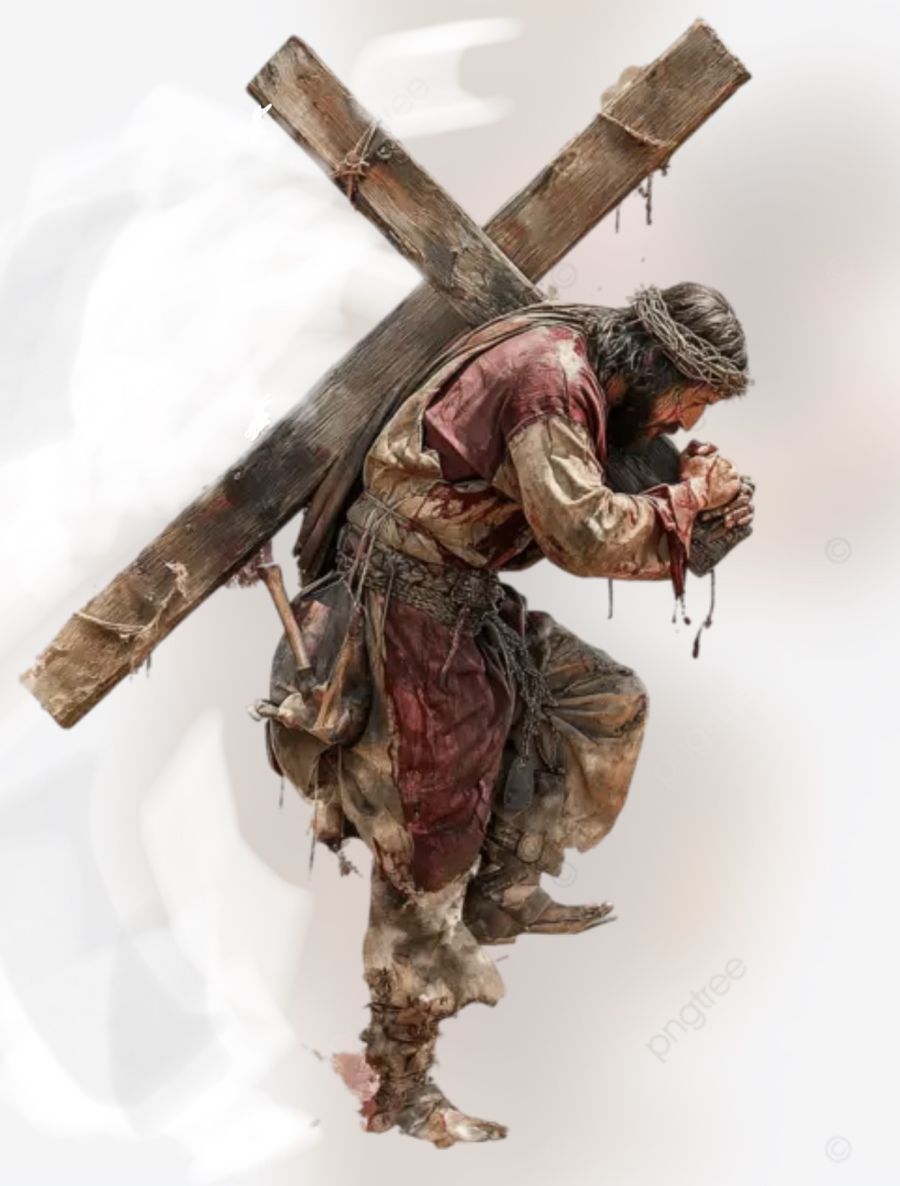
Good Friday is the day of the Lord’s Passion and Crucifixion. Every year, as we stand in silence before Jesus hanging on the wood of the cross, we sense how full of love are the words He spoke the evening before, during the Last Supper. “This is my blood of the covenant, which is poured out for many” (cf. Mk 14:24). Jesus wished to offer His life as a sacrifice for the forgiveness of humanity’s sins. Just as with the Eucharist, so too with the Passion and death of Jesus on the Cross, the mystery becomes unfathomable to reason. We are faced with something that, from a human perspective, might seem absurd: a God who not only becomes man, with all the needs of man, not only suffers to save man by taking upon himself the full weight of humanity’s tragedy, but dies for man.
Christ’s death recalls the accumulation of pain and evil that weighs upon humanity in every age: the crushing burden of our mortality, the hatred and violence that still today stain the earth with blood. The Lord’s Passion continues in the sufferings of mankind. As Blaise Pascal rightly writes, ‘Jesus will be in agony until the end of the world; we must not sleep during this time’ (Pensées, 553). If Good Friday is a day full of sadness, it is at the same time a day more propitious than ever for reawakening our faith, for strengthening our hope and the courage to carry our own cross with humility, trust and surrender to God, certain of his support and his victory. The liturgy of this day sings: O Crux, ave, spes unica – Hail, O Cross, our only hope!
This hope is nourished in the great silence of Holy Saturday, as we await the resurrection of Jesus. On this day, the churches are stripped bare and no special liturgical rites are scheduled. The Church keeps vigil in prayer like Mary and together with Mary, sharing her same feelings of sorrow and trust in God. It is rightly recommended that a prayerful atmosphere, conducive to meditation and reconciliation, be maintained throughout the day; the faithful are encouraged to approach the Sacrament of Penance, so that they may participate in the Easter celebrations truly renewed.
The recollection and silence of Holy Saturday will lead us through the night to the solemn Easter Vigil, ‘the mother of all vigils’, when the song of joy for Christ’s Resurrection will burst forth in all churches and communities. Once again, the victory of light over darkness, of life over death, will be proclaimed, and the Church will rejoice in her encounter with her Lord. Thus we shall enter into the spirit of the Easter of the Resurrection.
Let us prepare ourselves to live the Holy Triduum intensely, so that we may participate ever more deeply in the Mystery of Christ. The Blessed Virgin accompanies us on this journey; she followed her Son Jesus in silence to Calvary, sharing in his sacrifice with great sorrow, thus cooperating in the mystery of Redemption and becoming the Mother of all believers (cf. Jn 19:25–27). Together with Mary, we shall enter the Upper Room, we shall remain at the foot of the Cross, we shall keep vigil in spirit beside the dead Christ, awaiting with hope the dawn of the radiant day of the Resurrection. In this spirit, I offer you all, even at this early stage, my warmest wishes for a joyful and holy Easter, which I ask you to extend to your families, your parishes and your communities.
+Giovanni D’Ercole
