
don Giuseppe Nespeca
Giuseppe Nespeca è architetto e sacerdote. Cultore della Sacra scrittura è autore della raccolta "Due Fuochi due Vie - Religione e Fede, Vangeli e Tao"; coautore del libro "Dialogo e Solstizio".
34th Sunday in O.T. Christ the King
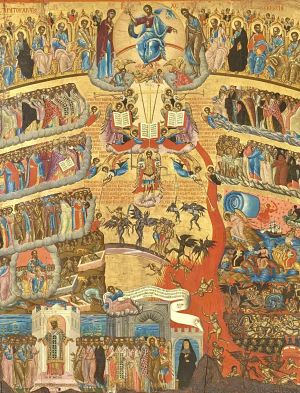
Solemnity of Our Lord Jesus Christ, King of the Universe (year A) [22 November 2026]
This is the last Sunday of the liturgical year
First Reading from the Book of the Prophet Ezekiel (34:11–12, 15–17)
The Book of the Prophet Ezekiel was written in Hebrew in Babylon (593–571 BC), but the Church has always read the Greek version of the Septuagint (LXX), which is the one quoted in the New Testament. The year is 591 BC: Ezekiel is in exile in Tel Aviv, on the River Chebar. Jerusalem has not yet fallen completely, but the ruling class has already been deported, and chapter 34 is an indictment of the kings, priests, leaders and shepherds of Israel. We are at the heart of the great chapter on the ‘shepherd’ in Ezekiel, one of the most important texts in the entire Old Testament for understanding the biblical concept of God as Shepherd and, subsequently, the presentation of Jesus as the Good Shepherd in John 10. The people are in exile and the temple is destroyed; the king is a prisoner and Israel seems finished; the flock is ‘scattered’. Who are the ‘bad shepherds’? In the ancient Near East, ‘shepherd’ was the title of the king, and in Ezekiel the shepherds are the kings of Judah—in particular Zedekiah—but also the leaders, priests and prophets who were supposed to guide the people. The prophet accuses them in the harshest terms in the preceding verses (vv. 2–4): ‘Woe to the shepherds of Israel who feed themselves!’ The kings had thought only of their own power, of political alliances with Egypt or Babylon, and of their own well-being, not of the good of the people. The result was dispersion: exile. The image of the scattered flock ‘in days of clouds and thick darkness’ (v. 12) is a theological description of exile: not merely a military defeat, but a day of darkness, of God’s judgement. In Israel, following the failure of the kings, people were expecting a new David, an ideal king. Ezekiel announces this, but only in v. 23: ‘I will raise up for them a shepherd who will tend them, my servant David.’ Before this, however, there is an even more radical development: it will not be another man who saves Israel, but God himself, who personally takes action. This is the theological structure of the entire chapter: human failure is not the final word, because God no longer delegates his mercy. And ‘he will gather his sheep from all the places where they were scattered’. It is the promise of a return from exile, but also a broader promise: the diaspora of Israel will be restored. For Ezekiel, exile is not God’s abandonment, but the place where God goes to seek out his people. Ezekiel lists six actions of God, in ascending order: I will seek out the lost, bring back the strayed, bind up the wounded, heal the sick, care for the fat and the strong, and feed them with justice. Note the precision: God does not treat all the sheep in the same way, for the lost sheep must be sought out, the strayed sheep must be brought back, the wounded sheep must be bandaged, and the sick sheep must be healed. God’s justice, here, is not the justice that punishes everyone in the same way, but the justice that gives each one what they need. And here is a crucial detail: in some ancient versions of verse 16, the Hebrew text states that God ‘will destroy the fat and the strong’, whilst the CEI translates it as ‘I will care for’. The textual issue is complex, but the meaning is clear in the context of verse 17: God is not indifferent; therefore, he will judge the fat sheep that oppress the others, for his care is always linked to justice. ‘I will judge between sheep and sheep, between rams and goats.’ At this point, the perspective in the text shifts. Up to this point, the judgement was directed against the shepherds; now it is within the flock itself. Even amongst the sheep there are oppressors: the rams and goats that jostle, trample, drink the clear water and muddy the rest with their hooves (as Ezekiel will say in verses 18–19). As well as the leaders, God also judges the relationships within the community. It is not enough to be a victim of bad shepherds to be considered righteous, for everyone is responsible for how they treat their weakest brother or sister. This verse will be taken up again by Jesus in Matthew 25:31–46, in the judgement between the sheep and the goats. This text is an examination of conscience for every authority: political, ecclesiastical, and familial. The true shepherd is recognised by one question: ‘Am I feeding myself, or am I feeding the flock?’ . The criterion is not efficiency, nor consensus, nor the preservation of power. It is the care of the most vulnerable: the lost, straying, wounded or sick sheep. A shepherd, a parish priest, a parent or an administrator who forgets the least among us, according to Ezekiel, has already failed, even if the flock appears numerous. Then there is the central message of the passage, and the most comforting one. If we are going through a time of crisis on a ‘day of clouds and thick mist’—that is, of inner exile and distance from God—the prophet reminds us that it is not up to us to find the way back, but God himself comes to seek us out. Ezekiel’s spirituality is the opposite of a ‘do-it-yourself’ approach. God does not wait for the sheep to return on its own. He goes out to seek it. And when He finds it wounded, He does not reproach it for having been wounded. He binds up its wounds. This is the biblical foundation of the parable of the Good Shepherd and, in the New Testament, of Christ’s mercy: ‘The Son of Man came to seek and to save what was lost’ (Luke 19:10). The Church is not merely a victim of bad shepherds; even within the community there are sheep who oppress other sheep: through judgement, through gossip, through indifference, through the pursuit of the highest positions. God judges ‘between sheep and sheep’. In summary, Ezekiel (34:11–12, 15–17) tells us that human failure is not the end of the story, for God himself becomes the shepherd, and his justice is tailored care, not a one-size-fits-all approach: the community will be judged not only for its leaders, but also for how its members treat one another.
Responsorial Psalm (22/23)
This Psalm is the most beloved in the Bible. Although attributed to David, it does not matter whether it was written by David the young shepherd or David the king in exile. It is both a regal and a personal Psalm, a Psalm of trust, not a supplication, nor a thanksgiving for a specific event, but a comforting affirmation: the Lord is present. It is the Psalm that was prayed in Israel when ascending to the Temple, composed of two intertwined images: God as Shepherd and God as host, as master of the house. The Psalm becomes a journey: from the pasture to the home, from the countryside to the Temple, from life to death and beyond, whilst the historical context is the nomadic experience of Israel: a people who lived for 40 years in the desert guided by God the Shepherd, and then experienced exile in Babylon – the valley of the shadow of death – and the return. The Psalm is the song of those who have been guided.
“The Lord is my shepherd: I shall not want” speaks of my shepherd, “the shepherd of Israel”. The personal possessive “my” indicates the intimacy of biblical faith. “I shall not want” does not mean that I will have everything I want, but that I shall not lack what is necessary to live as a child of God; it is the same promise we find in Matthew 6:33, which invites us to “seek first the kingdom of God and his righteousness” because all the rest will be given in addition. ‘You prepare a table before me in the presence of my enemies. You anoint my head with oil; my cup overflows.’ Here the image shifts: from shepherd to host. In the East, when a guest arrives, the host sets the table even if there are enemies outside. God does not wait for the war to end before feeding you. He nourishes you in the midst of the battle. He anoints your head with fragrant oil, which is a gesture of welcome, honour and joy; it is not, therefore, the anointing of a king, but rather the anointing of a beloved guest, as we see in the episode of the sinful woman who anoints Jesus (cf. Lk 7). “My cup overflows” – not a full cup, but one that overflows; that is to say, God does not give merely what is necessary, but everything in superabundance. On closer inspection, this psalm is the very definition of contemplation: to contemplate is not to do something, but to allow oneself to be shepherded, to be given rest; and those whose task it is to shepherd others must first and foremost allow themselves to be shepherded by God, for if they do not lie down in God’s pastures, they will not be able to lead anyone to still waters. The true shepherd does not run ahead of the sheep; he walks with them through the valley. Here are some pastoral guidelines: the shepherd’s primary task is not to organise events, but to be with people in the valley of the shadow of death – amongst those suffering from anxiety, depression, bereavement and loneliness – and to assure them that sharing in their lives matters more than organising pastoral structures and planning apostolic programmes. The shift from ‘He’ to ‘You’ is also interesting. The Psalm teaches that spiritual maturity lies in moving from speaking about God to speaking to God. The cup that overflows is the Eucharist, the table set before one’s enemies. God nourishes us not afterwards, but during the battle; so how can we say: ‘I don’t have time for adoration because I have too many things to do’? It is precisely in adoration and in the celebration of the Eucharistic sacrifice that God prepares a table for us. Finally, the Psalm is an invitation to pray: ‘Lord, my Shepherd, let me not lack rest in You. When I walk through the valley of the shadow of death, remind me that it is only a shadow, not death, for You are with me. You prepare my table; You anoint my head; let my cup overflow to quench the thirst of the sheep You have entrusted to me, until I dwell in Your house for ever. Amen.
Second Reading from the First Letter of Saint Paul the Apostle to the Corinthians (15:20–26, 28)
This is the longest and most important chapter on the Resurrection in the entire New Testament. Paul wrote it to Corinth around AD 55, in response to those in Corinth who claimed that ‘there is no resurrection of the dead’ (15:12), and in his reply he summarises the Church’s most ancient kerygma. Corinth was a cosmopolitan port, a wealthy, immoral, philosophical Greek city where the inhabitants believed in the immortality of the soul in the manner of Greek philosophy (the soul is immortal, and the body is its prison); for this reason, the resurrection of the body seemed absurd and vulgar to them, because the soul survives but the body does not. Paul, a Jewish Pharisee, cannot accept this philosophical theory because, according to the Bible, man is body, soul and spirit all together; therefore, if the body does not rise again, man is not saved. His reasoning is as follows: ‘I have received this kerygma: “Christ died for our sins according to the Scriptures in our place—that is, not “because of”, but “in our place”. He was buried—and Paul emphasises the burial because it proves that He was truly dead, even in the body. He was raised on the third day, and is now in a state of resurrection because the Father raised him up. He appeared—indeed, he was seen by many witnesses.’ If Christ has not been raised, everything is in vain; but Christ is the firstfruits of those raised from the dead and is the King who conquers death, and just as he has been raised, so shall we all be raised with our bodies. The Apostle emphasises: ‘You were not saved just once; you are saved every day, and I have faithfully passed on to you what I received.’ In other words, he states that he is not inventing anything new, but is passing on the formula of the kerygma, which dates back to 30–35 AD—that is, five years after Jesus’ death—and which constitutes the oldest historical evidence of his Resurrection. He then adds that the risen Jesus appeared – that is, he actually showed himself – and so these were not subjective visions but objective appearances. He lists the witnesses: Cephas, the Twelve, 500 brothers – most of whom are still alive, so you can go and ask them yourselves. Finally, he adds that he also appeared to me, as to a miscarriage. ‘Ektroma’ is a very strong medical term referring to a miscarried foetus because it was born prematurely. Paul feels unworthy, born out of time, a persecutor who has nevertheless received this grace as the least of all. And he concludes: ‘By the grace of God I am what I am.’ And the grace in me has not been in vain – that is, empty – because grace is always at work. Paul acknowledges: ‘I am what I am by grace’, yet he adds: ‘I have laboured more than any of them’. Here is an example of what many call the synthesis of the contemplative and the active: the contemplative professes ‘everything is grace’, whilst the active recognises ‘everything depends on me’. The Christian life is Grace at work within us. I shall merely touch upon another theme present here: Death is an enemy, not a friend. Today it is said that death is part of life, whilst Paul states: ‘Death is the last enemy’. According to St Paul, death is not to be tamed, but must be proclaimed as an enemy already conquered by Christ. At funerals, why say that the deceased ‘has gone to a better place’, almost as if it were merely psychological consolation? No! St Paul advises: he affirms that the risen Christ is the firstfruits, and if you believe in him, the departed have fallen asleep; they have not been lost, because Christ has already conquered death and is now with them if they have believed in him. It is in the Christian proclamation of death that the difference between human consolation and Christian hope lies. Finally, closely linked to the theme of death, the Apostle presents two kinds of humanity: human beings in the manner of Adam (subject to the logic of taking, possessing, dominating, and then dying) or in the manner of Christ (where to live is to give, to hand over the Kingdom, and to be certain that one day God will be all in all). Our life as Christians is therefore the daily transition from Adam to Christ—that is, from living for oneself according to the logic of possession to living surrendered to the redemptive love of Christ according to the logic of gift.
From the Gospel according to Matthew (25:31–46)
In this passage from the Gospel of Matthew we find the only parable in which Jesus identifies himself entirely with the poor. He does not say ‘as if it were me’, but ‘you are doing this to me personally’. We are on the Mount of Olives, in chapter 25, and this is Jesus’ final discourse before the Passion, the eschatological discourse. After speaking of the ten virgins and the talents, he concludes with the judgement, thus leaving us his testament before his death. It is therefore not a parable, but an apocalyptic vision. The Lord, in fact, uses the language of Daniel 7:13–14: ‘Behold, one like a son of man is coming with the clouds of heaven’, but he reverses the perspective of the ‘Son of Man’, who is at once the judge and also the poor person being judged. When the Son of Man comes in his glory—the very same glory of the Transfiguration, now the glory of the King-Judge—all the peoples will be gathered together (the ‘ethne’ are the pagan nations together with Israel) and the Last Judgement will take place, with the final separation, just as the shepherd-judge does (see the responsorial psalm) when he judges between one sheep and another. Jesus is the Shepherd of Ezekiel (see chapter 34) who now judges: ‘Come, you who are blessed by my Father; inherit the Kingdom prepared for you from the foundation of the world.’ He will say: ‘inherit’, because the Kingdom is not conquered, but is inherited—as adopted children—the Kingdom prepared for us before we even existed. This eschatological text invites us to recall and reflect on the so-called ‘Last Things’ [Novissimi] —namely, Death, Judgement, Hell and Heaven—and it is such a well-known text that I shall confine myself merely to highlighting a few elements. I invite you to contemplate this passage from the Gospel, in the certainty that sooner or later it will be our turn too, as if it were a majestic triptych of three paintings.
The first: The Throne (vv. 31–33); the second: the separation (vv. 34–40); the third: the judgement of the righteous and the judgement of the damned (vv. 41–46).
Ideally, as Saint Alphonsus Maria de’ Liguori urges us, we should meditate on this whilst living in the present in the light of eternity. We must not wait until the moment of death to take stock of our lives. We must live each day knowing that our existence has an eternal destination and that one day we shall appear before Christ. Saint Alphonsus Maria de’ Liguori addresses this theme in a very explicit and in-depth manner in his book *Preparation for Death, or Considerations on the Eternal Maxims*. I would also recommend ‘Consideration X – Means of Preparing for Death’, in which Saint Alphonsus emphasises the crucial importance of preparing for death and quotes Sirach: ‘In omnibus operibus tuis memorare novissima tua, et in aeternum non peccabis’ – ‘In all your deeds, remember your end, and you shall never fall into sin’. (Sir 7:36 according to the Vulgate numbering).
Here, then, are just a few clarifications: ‘I was a stranger and you welcomed me; naked and you clothed me; sick and you visited me; in prison and you came to me—not merely to see me, but to be with me.’ ‘Whatever you did for one of the least of these my brothers, you did for me.’ He uses the term ‘Elachiston’, which is the superlative of ‘small’, thus defining them as the very smallest and calling them ‘Adelphon mou’ – my brothers. Jesus calls all these people the very poorest and ‘my brothers’.
Another point to emphasise: ‘Depart from me, you who are cursed, into the eternal fire’. On closer inspection, we learn that the Kingdom of God has been prepared for us, the blessed, ever since the creation of humankind, whilst the fire was intended and prepared for the devil and his angels, not for humankind. Hell, therefore, was not prepared for us as human beings, and going there can only be the result of our own free choice. If you end up there, it is because you have chosen to turn away from God, you have rejected Him and allowed yourself to be deceived by Satan, who will imprison you in his kingdom—which is called hell—a reality that is difficult to describe and even to imagine.
One more point to consider. If we pay close attention, we notice that the question posed to the Judge by the damned is identical to that asked by the righteous: “Lord, when did we see you?” and both are taken by surprise. The difference, therefore, does not stem from theological knowledge, but from one’s actions: for the righteous acted without realising it was Christ, whilst the damned did not act because they failed to recognise Christ. Thus, one becomes a saint quite simply by allowing oneself to be guided by a right conscience and by the natural law written in the heart of every human being, regardless of ethnicity or religion.
Finally, here are a few brief comments from the Church Fathers. St John Chrysostom (4th century), in his 79th homily on Matthew, writes that Jesus does not speak of great deeds, but of small things, so that no one may say, ‘I could not’. ‘He does not say: I was in prison and you set me free, I was sick and you healed me, but he says: you visited me, you came to me. He does not ask for impossible things, but for small and easy things: a piece of bread, a glass of water, a visit. And then he adds: ‘Do you wish to honour the Body of Christ? Do not despise it when it is naked. Do not honour it here in the church with silk garments, whilst outside you leave it to die of cold and hunger. He who said, “This is my body”, is the same one who said: “You saw me hungry and did not give me food.” Chrysostom thus links the Eucharist and the poor. You cannot worship Christ in the Host and ignore him in the poor, for it is the very Body of Christ. St Augustine dwells on the amazement of the righteous: “When did we see you?” “The righteous did not know they had served Christ, for they did not seek a reward. They served out of love. If they had known it was Christ, they would have served out of self-interest. God has hidden himself in the poor to test whether we love for love’s sake or for a reward. (Sermo 86, PL 38,560. And then: ‘Christ is in heaven as King; he is on earth as a poor man. Do not despise the poor on earth, if you wish to find the King in heaven.’ St Gregory the Great interprets this text as an examination of conscience for pastors: “The Lord will not say: ‘Why did you not perform miracles?’ But: ‘Why did you not give bread?’ He will not call you to account for your learning, but for your mercy. Mercy is the balance of judgement.” (Homiliae in Evangelia, Book II, Homily 39, PL 76, 1302). St Francis of Assisi, who was no theologian, lived out the text to the letter. In the Unconfirmed Rule he writes: “And all the friars, when they see a poor person, should remember that for his sake the Lord made himself poor.” And in the Letter to All the Faithful: “Where there is charity and wisdom, there is neither fear nor ignorance. Where there is patience and humility, there is neither anger nor distress.’ Saint Vincent de Paul in the 17th century, often described as the modern Chrysostom, wrote: ‘One must not judge a poor peasant or a poor woman by their outward appearance, nor by what appears to be their spirit… But one must turn the coin over and see with the eyes of faith that the Son of God… chose to be poor… Therefore, when we go to visit the poor, we go to honour God in them” (Conference of 6 December 1658, Coste XII, p. 264). Saint Vincent said that the poor are our masters, an expression often echoed by Saint Luigi Orione, whom Pius XII described as the “apostle of the poor and abandoned”. Saint Teresa of Calcutta states: “Each one of them is Jesus in disguise.”
To conclude: The judgement will not be on what you thought, but on what you did – and did not do. Matthew 25 is the only judgement described in detail in the Gospel. The sin of the damned is not that they have done evil, but that they have failed to do good; it is the sin of omission, for the greatest danger is not in doing evil, but in failing to do good – and this out of habit, weariness or closed-mindedness. Ultimately, we see here the six faces of Christ today: the hungry are not only those who lack bread, but those who hunger for meaning, for a listening ear, for a father. The thirsty are those who thirst for truth and authenticity, not for ‘likes’. The stranger is the migrant, but also the foreign pupil in the classroom, the foreign brother in the community. The naked are those deprived of dignity, mocked on social media, exposed. The sick are those afflicted by anxiety, depression and loneliness – described as the ‘disease of the century’. Imprisoned is the one in a physical prison, but also the one in the prison of addiction, of pornography, of gambling. Ultimately, in this passage, which concludes the eschatological discourse, we find the evangelist Matthew’s synthesis of Christ: he is the King-Judge (v. 31) and the Poor One who is judged (v. 35). There are therefore not two Christs, but only one, and he is the Christ who reigns and who begs. If we wish to reign with him, we must learn to serve him when he begs.
+Giovanni D’Ercole
Judgement, despite the verdicts. And God the Judge… to save us
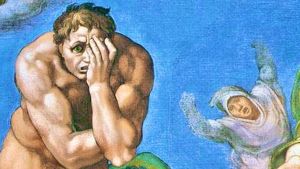
THE SULK – (by Francesco Giovannozzi, psychologist and psychotherapist)
The Sulk.
How many times a day do we take offence?
How often does our excessive sensitivity to other people’s attention and words get on our nerves?
This is what happens to many people… and at certain times in life, it has happened to all of us… without exception.
The trouble is that if this feeling pervades our very being and shapes the way we are, then we will never be content.
People react in the way that is most natural to them and their nature, and these behaviours originate in childhood.
There are people who take offence at actions, glances or words; others don’t even get upset by what is actually an offence – or, very wisely, let it go without feeling the slightest disturbance.
And here, if we think back on events that have happened to us and our friends, there is no shortage of examples.
I know several people who need to be ‘treated with kid gloves’; they take offence at the slightest thing, or misinterpret certain words… and then, just like small children, they sulk.
This is a facial expression combined with a pursing of the lips and a furrowing of the brow that expresses unease, annoyance or resentment.
We usually speak of ‘sensitivity’ when one is overly attentive and sensitive to what others say to us; of ‘touchiness’ when, in addition to this excessive sensitivity, there is also resentment, animosity and closed-mindedness.
These are attitudes often seen in children up to a certain age (around 7–8 years old), but which an adult should have outgrown.
Venturing into a field outside my own – that of philosophy – Aristotle argued that those who take offence easily are unable to manage their anger and react disproportionately.
Immanuel Kant asserted that such people react emotionally rather than rationally.
Those who feel offended assess what the other person says to them based on how they feel (pain or annoyance) rather than on the objectivity of what is actually said.
Despite this philosopher’s pessimistic view, I find Schopenhauer’s metaphor (from 1851) particularly beautiful.
In short, on a cold winter’s day, a group of porcupines huddle together to keep warm, so as not to freeze to death. After a while, they realise the pain caused by each other’s quills and so move apart.
However, driven once more by the cold, they draw closer again and start pricking one another… so, by repeatedly moving apart and coming together, they find the right distance between them to keep warm without pricking one another.
This metaphor aptly describes the behaviour of those who take offence easily and sulk.
One solution suggested by this metaphor is to find the right relational distance, based on good manners.
Returning to my own field, that of psychology, this topic has also been addressed there.
For Freud, the tendency to take offence is seen as a defence mechanism associated with narcissism, punitive moral standards, and projection; that is, with what is ours, what lies within us – which we perceive and attribute to others.
The touchy person believes themselves to be great and flawless; an image they have constructed to hide their own weaknesses.
Young children live in a world that revolves entirely around them, and if an adult remains stuck in this phase, every word, expression or glance is seen as a personal attack.
Marie-Louise von Franz, a Jungian analyst, speaks of sensitivity as a specific aspect of our inferior functions.
She argues that almost all of us become childish when this dimension is stimulated.
Unable to tolerate the slightest criticism, we feel under massive attack – and so we force the rest of humanity to interact with us with great caution.
In doing so, we fail to realise that this behaviour of ours is a form of tyranny.
Personally, I think that irony and self-irony can be of help – precisely to cope better with the annoyances of ‘over-sensitively’ perceiving the voices of others.
Irony and self-deprecating humour allow us to play down the problem that has gripped us, and point to a vital path that requires tenacity.
We need irony and self-deprecating humour to re-examine our thoughts and feelings from a different perspective.
This is no easy task, because to ensure these feelings do not get the better of us, we need to make an effort and practise….
We really do need to summon our inner strength, and sometimes laugh at our own shortcomings or flaws.
This makes life better.
Sometimes, in addition to the ‘ghosts’ we believe we have internalised, there are comments directed at us that are genuinely hurtful; and here it might perhaps be useful to point out to these people that anyone could find themselves in such situations.
So that we do not allow ourselves to be overwhelmed by what hurts us, or what we think has hurt us.
[This brief reflection, too, stems from my school days and professional training].
Dr Francesco Giovannozzi, Psychologist and Psychotherapist
Seven husbands, and God who binds His heart to humanity

(Lk 20:27-40)
The defeat of death is the cruel fate that has clouded the mind of all civilizations.
But if God creates us and calls incessantly to enter into dialogue, then what remains of us? Is the goal of all our turmoil a pit?
The Sadducees want to ridicule the doctrine of the resurrection dear to the Pharisees and - it seems - also to Jesus.
However, Master does not apply provisional categories of this world to dimensions that go beyond.
The ties also must be conceived in the relief of the divine reality.
Members of the priestly class did not believe in another life, and in the Torah it seemed to them that there was no note about the resurrection.
In short, they conceived the relationship with God in the dimension of life on earth.
In fact, the Pharisees believed in the raising of the dead in a very banal sense: a sort of improvement and sublimation of the (same) conditions of being natural.
For them, the existence of the afterlife was only an accentuated, ennobled and embellished extension of this form of our being.
Instead life «in the era, that» [v.35 Greek text] is not a strengthened existence, but an indescribable and new condition - as of direct communication. Comparable to the immediacy of love.
The body decays, gets sick and undergoes dissolution: it is a natural cycle.
‘Resurrection of the flesh’ designates access to an intimate existence of pure Relationship, in our weakness and precariousness, assumed.
Evangelists use two terms to indicate the difference between these forms of life: (transliterating) Bìos and Zoe Aiònios [Life of the Eternal] which has nothing to do with the biological reality [v.36: «equal to angels»].
Life «in the era, that» is not an enhanced existence with respect to this mode of existence, but an indescribable and new condition - precisely, as of ‘direct communication’.
Comparable to the one-to-one of Friendship: a ‘being-with and for’ others; readily, everywhere.
Collimating with the way of existence of the Angels: they do not have a life transmitted by parents, but by God himself.
«About the bush...» - Jesus replies. He also silences the Sadducees by making them reflect; and He draws the foundation of the Resurrection (but as He understands it) precisely from Exodus.
Thus He shows that already in the Law there is a presentation of God incompatible with a destiny of humanity devoted to extermination.
The Father does not seek dialogue with the sons and then make them fall on the most beautiful.
Since creation, He takes pleasure in walking with man, and from the patriarchs he has been looking for empathy with us. His Love does not abandon.
In the archaic religious mentality the Most High was named after the region or the heights in its borders [es. Baal of Gad, Baal of Saphon, Baal of Peor, etc.].
The God of Israel already from the First Testament binds his heart to man - no longer to a territory: He is the God of Abraham, of Isaac and of Jacob.
The Father of life arouses all understanding, Alliances, and if the ally could be annihilated, the same divine identity would be shattered.
All the Scriptures attest to this: He is a God of the living, not of dust or of the nothingness.
This is why we call our missing loved ones «deceased» or «departed» - not "dead".
[Saturday 33rd wk. in O.T. November 21, 2026]
Seven Husbands, like Angels
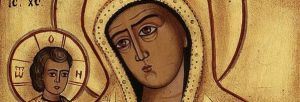
And God binding His heart to humanity
(Lk 20:27-40)
The defeat of death is the cruel destiny that has clouded the minds of all civilisations, infusing disorientation and anguished thoughts about the meaning of life, about why each of us exists.
If God creates us and calls us ceaselessly, to enter into dialogue with us, then what is left? Is the goal of all our agitation a pit?
The Sadducees want to ridicule the doctrine of resurrection dear to the Pharisees and - it seems - to Jesus as well.
He, however, held that the Father was far more than a Living One... who finally began to raise corpses!
[This is why we call our departed loved ones 'deceased' - not 'dead'].
In the Semitic mentality, the norm of 'levirate' mirrored a feeble idea of existence after death - relegated to mere continuity of name.
The members of the priestly class did not believe in another life: they preached the religion that served to obtain blessings for existing on this earth in a comfortable manner - and that was enough for them.
In short, they conceived their relationship with God in the dimension of life on earth.
The Sadducees had already built their 'paradise' for themselves in the city and outside.
Their large villas with courtyards and private pools for ablutions were right on the hill opposite the Temple in Jerusalem, on the opposite side of the Mount of Olives (i.e. towards the west).
Their second homes - where they spent the winter - were in Jericho.
Also because of their direct interest in the sacrificial activity they carried out, they still believed that prophetic texts had no dignity as sacred Scripture: only the Law reflected God's will.
And in the Torah it seemed to them that there was no note about the resurrection of the dead.
So they also tried to frame Jesus, with an artfully constructed paradox, to highlight the contradictions of this belief - which only appeared from the 2nd century BC in the book of Daniel and in Maccabees.
They considered it absurd - therefore they intended to discredit the 'Master' [a term they used to designate him in order to ridicule him: v.28].
Indeed, the foothold was there, for the Pharisees believed in the resurrection in the trivial sense. A kind of accentuation, improvement or sublimation of (the same) natural living conditions - and bonds.
Thus not a definitive, boundless, qualitatively indestructible form.
In essence, in the 'world beyond' everyone would fully enjoy the family and clan affections of the previous form of life - and so on.
The 'afterlife' was to be nothing more than a sublimated, ennobled and embellished extension of this way of existing; without disease, suffering, various problems.
[In short, life only advanced; perhaps as it was once conveyed to us by willing catechists... but little attentive to the Word of God].
So precisely the Sadducees - conservatives - who only accepted the Pentateuch - where they maintained that there is no mention of another, further life.
In this way, they had an easy job of exposing the fragility of that popular belief, to which the leaders of Phariseeism were conversely attached.
However, the Master does not apply categories of this world, provisional, to dimensions that go beyond.
Even bonds must be conceived in the relief of divine reality.
In the Latin milieu, even today, the way of understanding the Resurrection is influenced not a little by the representational modes of the pictorial tradition.
Reading the representations to which we are accustomed... we notice that immediately the Risen One puts down the gendarmes and frightens everyone.
He emerges from the tomb with the banner of victory, strong and muscular. He bursts in as if coming back this way to beat his adversaries.
Descriptive and naturalistic claims that do not do credit to the Faith and almost ridicule the Gospels.
Conversely, in Eastern icons, the Resurrection is understood and depicted in a substantial, mysterious way: the Descent to the Underworld.
It is not a triumph of God, who imposes himself on the world. He has no need of it.
Rather, the theological event remains in support of the victory of his children, who receive life directly from the Father.
Here is the redemption of the ordinary woman and man [Adam and Eve] who are drawn from the tombs by the divine - not natural - power of the Risen Christ.
The ultimate world turns the idea of the Sheôl upside down and totally unhinges it, clearing away the darkness - and that great drama of humanity.
One enters God's world; one does not return this way - perhaps to live better: rejuvenated and healthy rather than sick, in a villa with a garden rather than a studio apartment.
Life 'in the age of that' [v.35 Greek text] is not an enhanced mode of existence, but an indescribable and new condition - as of direct communication.
Comparable to the immediacy of love: a being-with and for others. Collimating to the Angels' mode of existence (v.36): they do not have a life transmitted by parents, but by God himself.The body decays, falls ill and goes into dissolution: it is a natural cycle.
"Resurrection of the flesh" designates access to an intimate existence of pure relationship, to the very intimacy of God - in our weakness and precariousness, assumed.
Obviously we cannot believe that we are being brought into the Divine Condition if during our earthly course we have not experienced a constant existential death-resurrection vector.
It is the experience of gain in defeat; in particular, the discovery of an unthinkable life, which made us rejoice with Happiness. For Amazement: in the providential transmutation of our weak and obscure sides, from sluggish appearances to strengths.
Becoming evolutionary, perhaps the best of us.
The evangelists use two terms to indicate the difference between these two forms of being: (transliterating from the Greek) Bìos, and Zoè Aiònios.
The Zoë, Life itself of the Eternal, is keenly relational and experienceable - but it has nothing to do with biological existence and our carcass ["equal to the angels" v.36].
What does not die is not the DNA of the body, but the heavenly DNA, which we have received as a gift from the Father.
The divine Gold dwells in us and - if we wish - can surface already, in a full existence, of realisation of one's Vocation, in an atmosphere of Communion.
Life "in the age of the one" is not an enhanced existence compared to this mode of existence, but an indescribable and new condition - as of direct communication.
Comparable to the face-to-face of Friendship: a being-with and for others; readily, everywhere.
Collimating to the Angels' way of existence: they do not have a life transmitted by parents, but precisely by God Himself.
"About the Bush..." - Jesus retorts.
He also muzzles the Sadducees, making them think, treating them as incompetent.
He draws the foundation of the 'doctrine' of the Resurrection [but as He understands it] precisely from the book of Exodus.
Thus he shows that right from the scrolls of the Law there is a presentation of the Eternal One that is incompatible with the destiny of a humanity doomed to extermination.
The Father does not seek dialogue with His children only to have them fall at the most beautiful moment.
Since creation He has delighted in walking with man, and since the patriarchs He has sought empathy with us.
His Love does not abandon.
In the archaic religious mentality, each shrine was named after the deity, specified by its territory or the heights in its borders [e.g. Baal of Gad, Baal of Saphon, Baal of Peor, etc.].
A bad pagan vice that we have unfortunately inherited.
The God of Israel since the First Testament binds his heart to man - no longer to a territory: the 'God of Abraham, Isaac, Jacob'.
It was possible for the three Patriarchs to have descendants, not by natural concatenation.
In that mentality, the only possibility of perpetuating life from generation to generation was to be able to pass on one's name to the firstborn male.
This happened instead by intervention from above, while the wives were sterile [infertile matriarchs: Sarah, Rebecca, Rachel, long without heirs].
The Father of life gives rise to all understandings, covenants, and if the ally could be annihilated, the divine identity itself would crumble.
All Scripture attests to this: he is a God of the living - not of the dead (of dust, of insubstantiality, of nothingness).
In His Name, our Name

The five Books of Moses were the only ones that the Sadducees recognized in the canon of the Old Testament and there is no mention in them of the Resurrection; so they denied it. The Lord shows the reality of the Resurrection precisely by these five Books and says: “Have you not read what was said to you by God, ‘I am the God of Abraham, Isaac and Jacob?’” (cf. Mt 22:31-32). God therefore takes these three and in his very name they become the name of God. To understand who this God is it is necessary to see these figures who became the name of God, a name of God, who are immersed in God. In this way we see that anyone who is in the name of God, who is immersed in God, is alive, because God — the Lord says — is not a God of the dead but of the living, and if he is the God of the latter, he is a God of the living.
The living are alive because they are in our memory, in God’s life. And this happens to us in being baptized: we come to be inserted in the name of God, so that we belong to this name and his name becomes our name and we too, with our witness — like the three in the Old Testament — can be witnesses of God, a sign of who this God is, a name of this God.
Consequently, being baptized means being united to God; in a unique, new existence we belong to God, we are immersed in God himself.
[Pope Benedict, Lectio 11 June 2012]
On the theology of the body
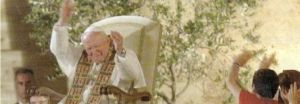
1. We resume today, after a rather long pause, the meditations we have been holding for some time and which we have called reflections on the theology of the body.
In continuing, it is worthwhile, this time, to return to the words of the Gospel, in which Christ refers to the resurrection: words that have a fundamental importance for understanding marriage in the Christian sense and also "the renunciation" of married life "for the sake of the kingdom of heaven".
The complex casuistry of the Old Testament in the field of matrimony not only prompted the Pharisees to come to Christ to put to him the problem of the indissolubility of marriage (cf. Mt 19:3-9 ; Mk 10:2-12 ), but also, another time, the Sadducees, to question him on the law of the so-called Levirate (this law, contained in Deut 25:7-10 , concerns brothers living under the same roof. If one of them died without leaving children, the brother of the deceased had to take the widow of the dead brother as his wife. The child born of this marriage was recognised as the son of the deceased, so that his lineage would not be extinguished and the inheritance would be preserved in the family [cf. Deut 3:9-4:12 ]). This conversation is reported in agreement by the Synoptics (cf. Mt 22:24-30 ; Mk 12:18-27 ; Lk 20:27-40 ). Although all three redactions are almost identical, some slight but, at the same time, significant differences can be noted between them. Since the colloquy is referred to in three versions, those of Matthew, Mark and Luke, a more in-depth analysis is required, as it includes contents that are of essential significance for the theology of the body.
Next to the other two important colloquies, namely: the one in which Christ refers to the "beginning" (cf. Mt 19:3-9 ; Mk 10:2-12 ), and the other in which he refers to the intimacy of man (to the "heart"), pointing to the desire and concupiscence of the flesh as the source of sin (cf. Mt 5:27-32 ), the colloquy, which we now propose to analyse, constitutes, I would say, the third component of the triptych of Christ's own utterances: a triptych of essential and constitutive words for the theology of the body. In this colloquy, Jesus refers to the resurrection, thus revealing a completely new dimension of the mystery of man.
2.
The revelation of this dimension of the body, stupendous in its content - and yet connected with the Gospel reread in its entirety and to its very depth - emerges in the conversation with the Sadducees, "who affirm that there is no resurrection" (1); they have come to Christ to present him with an argument that - in their opinion - validates the reasonableness of their position. This argument was to contradict "the hypothesis of the resurrection". The reasoning of the Sadducees is as follows: "Master, Moses left us written that if the brother of one dies and leaves his wife childless, the brother shall take his wife to give offspring to his brother" ( Mk 12:19 ). The Sadducees refer here to the so-called law of Levirate (cf. Deut 25:5-10 ), and referring back to the prescription of this ancient law, they present the following "case": "There were seven brothers: the first took a wife and died without leaving any descendants; then the second took her, but died without leaving any descendants; and the third likewise, and none of the seven left any descendants. Finally, after all, the woman also died. In the resurrection, when they rise again, to which of them will the woman belong? For seven had her as their wife" ( Mk 12:20-23 . The Sadducees, turning to Jesus for a purely theoretical "case", at the same time attack the Pharisees' primitive conception of life after the resurrection of bodies; in fact, they insinuate that belief in the resurrection of bodies leads to the admission of polyandry, which is contrary to the law of God.
3.
Christ's answer is one of the key-answers of the Gospel, in which another dimension of the question is revealed - precisely from and in contrast to purely human reasoning - namely that which corresponds to the wisdom and power of God himself. Similarly, for example, the case of the tribute coin with the image of Caesar and the correct relationship between what in the sphere of power is divine and what is human ("Caesar's") (cf. Mt 22:15-22 ). This time Jesus replies as follows: "Are ye not in error, since ye know not the scriptures, nor the power of God? For when they rise from the dead, they will not take wives or husbands, but will be as angels in heaven" ( Mk 12:24-25 ). This is the basic answer to the 'case', i.e. to the problem contained therein. Christ, knowing the conceptions of the Sadducees, and intuiting their authentic intentions, takes up, later, the problem of the possibility of the resurrection, denied by the Sadducees themselves: "Concerning the dead who are to be raised, have you not read in the book of Moses, concerning the bush, how God spoke to him, saying: I am the God of Abraham, the God of Isaac and Jacob? He is not a God of the dead, but of the living" ( Mk 12:26-27 ). As we can see, Christ quotes the same Moses to whom the Sadducees referred, and ends by saying: "You are in great error" ( Mk 12:27 ).
4.
Christ also repeats this concluding statement a second time. In fact, the first time he pronounced it at the beginning of his exposition. He said then: "You deceive yourselves, knowing neither the scriptures nor the power of God": so we read in Matthew ( Mt 22,29 ). And in Mark: "Are ye not deceived, since ye know not the scriptures, neither the power of God?" ( Mark 12,24 ). By contrast, Christ's own reply, in Luke's version ( Lk 20:27-36 ), is devoid of polemical accent, of that "you are in great error". On the other hand, he proclaims the same thing insofar as he introduces some elements into his reply that are not found in either Matthew or Mark. Here is the text: "Jesus replies: the children of this world take a wife and take a husband; but they that are accounted worthy of the other world, and of the resurrection from the dead, take neither wife nor husband: neither can they die any more, for they are equal to the angels, and being children of the resurrection, they are the children of God" ( Lk 20:34-36 ). Concerning the very possibility of the resurrection, Luke - like the two other synoptics - refers to Moses, that is, to the passage in the Book of Exodus 3:2-6, where it is narrated that the great legislator of the Old Covenant had heard from the bush, which "burned in the fire and was not consumed", the following words: "I am the God of your father, the God of Abraham, the God of Isaac, the God of Jacob" ( Ex 3:6 ). In the same place, when Moses had asked the name of God, he had heard the answer: "I am he who is" ( Ex 3:14 ).
Thus then, speaking of the future resurrection of bodies, Christ refers to the very power of the living God.
[Pope John Paul II, General Audience 11 November 1981]
New kind of life
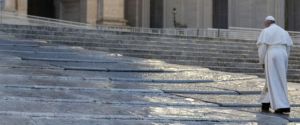
Within just days of the Solemnity of All Saints and of the Commemoration of the faithful departed, this Sunday’s Liturgy invites us once again to reflect upon the mystery of the resurrection of the dead. The Gospel (cf. Lk 20:27-38) presents Jesus confronted by several Sadducees, who did not believe in the resurrection and considered the relationship with God only in the dimension of earthly life. Therefore, in order to place the resurrection under ridicule and to create difficulty for Jesus, they submit a paradoxical and absurd case: that of a woman who’d had seven husbands, all brothers, who died one after the other. Thus came the malicious question posed to Jesus: in the resurrection, whose wife will the woman be (v. 33)?
Jesus does not fall into the snare and emphasizes the truth of the resurrection, explaining that life after death will be different from that on earth. He makes his interlocutors understand that it is not possible to apply the categories of this world to the realities that transcend and surpass what we see in this life. He says, in fact: “The sons of this age marry and are given in marriage; but those who are accounted worthy to attain to that age and to the resurrection from the dead neither marry nor are given in marriage” (vv. 34-35). With these words, Jesus means to explain that in this world we live a provisional reality, which ends; conversely, in the afterlife, after the resurrection, we will no longer have death as the horizon and will experience all things, even human bonds, in the dimension of God, in a transfigured way. Even marriage, a sign and instrument of God in this world, will shine brightly, transformed in the full light of the glorious communion of saints in Paradise.
The “sons of heaven and of the resurrection” are not a few privileged ones, but are all men and all women, because the salvation that Jesus brings is for each one of us. And the life of the risen shall be equal to that of angels (cf. v. 36), meaning wholly immersed in the light of God, completely devoted to his praise, in an eternity filled with joy and peace. But pay heed! Resurrection is not only the fact of rising after death, but is a new genre of life which we already experience now; it is the victory over nothing that we can already anticipate. Resurrection is the foundation of the faith and of Christian hope. Were there no reference to Paradise and to eternal life, Christianity would be reduced to ethics, to a philosophy of life. Instead, the message of Christian faith comes from heaven, it is revealed by God and goes beyond this world. Belief in resurrection is essential in order that our every act of Christian love not be ephemeral and an end in itself, but may become a seed destined to blossom in the garden of God, and to produce the fruit of eternal life.
May the Virgin Mary, Queen of Heaven and Earth, confirm us in the hope of resurrection and help us to make fruitful in good works her Son’s word sown in our hearts.
[Pope Francis, Angelus 6 November 2016]
Liberation and Personalization: difference between religiosity and Faith
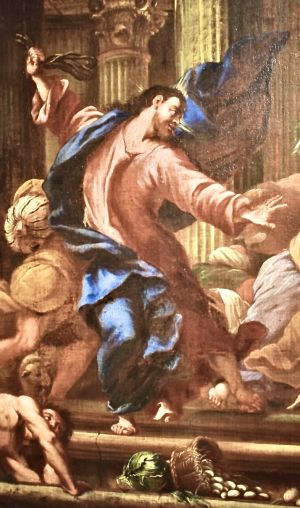
Little House of God? No more haggling with loan sharks
(Lk 19:45-48)
The teaching of Jesus in the sacred place is presented by Lk as enduring: «He was teaching every day» (v.47). Main topic: the Grace.
So over time we learn conviviality: encouraged to dialogue with our personal, unrepeatable Vocation, which captivates because it really corresponds.
And the intimate conviction is alone, incomparable, precious energy of transformative valence - which leads to not withdrawing from oneself, nor disregarding the reality of sisters and brothers.
Rather it induces to make Exodus, explore new conditions of being, transfigure perception into blissful action.
Hunting the false friends of religiosity, the Lord is not so much oriented to compensate the purity of the Place, nor to mend and revive the enamel of the sober original cult - as Prophets wanted.
He renders a holy service not to ancient God, but to people - by that system [or tangle] made totally unaware of their vocational dignity: only chained, milked, and sheared.
The first Tent of God is therefore humanity itself, its beating heart - not a delimited space:
Upon entering Jerusalem, the Master takes possession of the heavenly House - which is not the Temple, but the People.
He does not teach to enter into habitual and formal armor accepted by the contour but distant from persons.
Rather, He stimulates us not to restrain our true nature with costume hoods, according to which "it is never enough".
Our inner world should not be hysterically regarded as a dangerous stranger.
Innate roots and our natural energy have the right to flourish and prevail over common manners or ideas: they are an experimental trace of the Divine.
In them there is a Personal bond, which wins every intimate torment.
We must therefore change our approach. He himself is the essential point of the Eternal’s worship.
In this light of Person in his Person, everyone can embrace proposals that are not of others and intruders; wich will not turn out to be ballasts.
The phantasmagorical ancient culmination is becoming periphery, it is decaying. And to find ourselves, we have difficulties.
An opportunity not to be missed to proceed in a living and singular way, in tune with an ever new teaching on unprecedented Love, which takes our step.
It is the burning Appeal of «the Mount», which focusses on ‘passion’: precisely on Desire.
No more a strict call to the "no" of great appearances - but finally Listening to the Voice in the soul, which amazes (v.48).
Authentic sacred of the temple.
No more loan sharks in power.
With what does not correspond, even from a cultural, social and spiritual point of view, we no longer haggle.
[Friday 33rd wk. in O.T. November 20, 2026]
Liberation and Personalisation: the difference between religiosity and Faith
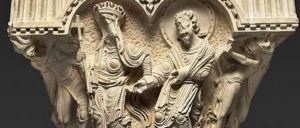
Little Home of God or a place of business and usury? No more haggling
(Lk 19:45-48)
Jesus notes that around the activity that took place within the perimeters of the Temple a whole ambiguous structure of sin had been articulated.
The Sanctuary's business eagerness was not even hidden - indeed, it even confronted it.
But the priestly perspectives of the holy tribute and the horizons of the people's full life conflicted.
Ditto for the aims of jurists and doctors, who willingly flocked especially under Solomon's porch [on the other side, towards the east] to 'grant' advice.
The exclusive function of fostering an encounter with the presence of God was totally mortified.
The sacred area had become a den of shrewd merchants, businessmen perpetually on the prowl, always intent on changing currency.
This was with the blessing of the sect of the ruling Sadducees, who could not resist the temptation to pull the strings of the lavish trade.
In ousting the false friends of the succouring Father, the parasites of religiosity, the Lord does not so much aim to restore the purity of the Place, nor to restore the polish of the original sober worship - as the Prophets intended.
He renders a holy service not to the ancient God (as in the religions) but to the people - by that system [or tangle] rendered totally unaware of their own vocational dignity: only chained, milked, and sheared.
Indeed, the Zealots aimed to restore the purity of rituals. They imagined that they could somehow recover their coherence.
The Essenes, on the other hand, had abandoned the Temple altogether. They considered the shameful situation now compromised.
John the Baptist had made the same detachment.
Although of priestly lineage, he preached to the people the forgiveness of sins through a conversion of life, not through the sacrifices of the liturgy [only in Jerusalem].
Instead, the authentic Angel of the Covenant was definitely intransigent, far more radical than any of them!
In fact, according to the very first Christians, who frequented the Temple, the place of encounter with God, the land from which his Love radiated, was no longer linked to material aspects.
Nor was it in itself religious; much less imbued with doctrinal observances, moralistic codes, or one-sided worldviews.
Thus, for us too, the divine Presence and its Communion are not caught in mythical purity, ancient magnificence, perfectionist endeavours - or à la page adherence.
Service to God is honouring woman and man as and where they are: sacred respect starts from a Gift that already runs through our lives. Opinions are of no use.
The unknown Friend wants to dwell in us not to appropriate, but to merge and expand our relational and qualitative capacities. Our own, not others' or on the side.
In Christ, we move from obedience to more or less dated norms [even futuristic ones] to the style of personal likeness. That which builds living shrines.
Honour to the Father is realised not in the details or in the spirit of the body already dictated, but in the sons and daughters, however - if they live in fraternity.
This happens especially when they assimilate Jesus' Teaching [on Grace] (v.47).
Thus in time, they learn conviviality from Himself, and together they are encouraged to dialogue with their exceptional and unrepeatable Vocation, which captivates because it truly corresponds.
And intimate conviction is alone, incomparable and precious energy of transformative value - which leads one not to withdraw from oneself, one's own exceptionalism, nor to overlook the reality of one's brothers.
Rather, it induces one to make Exodus, to explore new conditions of being, to transfigure perception into blissful action.
Only from here does coexistence arise.
And Sin indeed remains deviation, but no longer transgression of the law - but inability to correspond to the Call that characterises, unleashes and empowers a surprising uniqueness of Relationship.
The first Tent of God is thus humanity itself, its beating heart - not a space of stones and bricks, fixed, delimited, or fanciful... to be adorned with overlays.
Having entered Jerusalem, the Master takes possession of the heavenly House - which is not the Temple, but the People.
That is why He casts out of the sacred imagery inculcated in the naive, precisely the most uneducational traits of the festival - and especially teaches the unhealthy, to feel already adequate!
Unbelievable: to each Christ changes the mental atmosphere.
The true Lord does not teach us to enter into habitual or abstract and formal armour, accepted in outline but distant from ourselves, from creatures.
Rather, he encourages us not to restrain our true nature with cloaks of habit [dated or not] according to which 'it is never enough'.
Behind our character essence lies a fruitful, unrepeatable, singular Calling; with visual and social implications that we do not know.As we are - just so - we are fine.
There is no need to exorcise anything of our deepest being, which spontaneously manifests its compressed discomforts and joyful correspondences, even in outward eccentricities.
Rather, any conventional epidermal, adaptive, or cunning domestication stifles the core of the Calling by Name - authentic Guidance, impulse of Spirit.
Our inner world is not to be hysterically regarded as a dangerous outsider to be reconfigured.
Our innate roots and natural energy have the right to flourish and prevail over common ways or ideas: they are experimental traces of the Divine.
There is a Personal bond in them.
The Lord's claim is immediately countered by the hostility of the paludates, interested in the give-and-take of that mannerist theatre.
They make him out to be deranged, to be eliminated immediately: a very dangerous dreamer, because he activates and enhances souls, instead of the mediating structure.
This is the condemnation handed down by the 'big boys' in society: the outcome of any truth operation.
This is how they try to tarnish any attempt at emancipation of the oppressed in spirit, in the core of the self - whether through fear of God or obsession with unworthiness.
But in today's reality, which heels us in, the Risen One continues to demythologise the excessive preoccupation with identified places, the "heights" of settled and material character.
With their implications that do not nourish in a full and stable way - on the contrary, they become a cankerworm.
In short, a change of approach is needed.
He himself is the essential point of worship of the Eternal.
In such a light of Person in His Person, each one can embrace proposals that are not others and intrusive; that will not prove to be ballast.
And the Church's authentic prestige will be to echo the proclamation that liberates and truly pleases.
Obviously provoking the same mercantile tensions; litmus test of our divine action.
Through the work of apostles frightened by the bluntness of the authorities, and perhaps themselves prone to compromise - the magnificent sanctuary that Jesus had explicitly described as a den of scoundrels will once again become the centre of the ecclesial assembly [Lk 24:53; Acts 5:12].
It will provide more effectively... not the burning conscience, but the tragic history of the holy city, to make its excess of importance fade away.
Even today: the ancient phantasmagorical culmination is becoming periphery, decay. And to find ourselves, we make it difficult.
An opportunity not to be missed to move forward in a lively and singular way, in tune with an ever new teaching on Love, which takes our step.
It is the burning Call of "the Mount", which centres on passion: precisely on Desire.
No longer a stern call to the 'no' of great appearances - but finally Listening to the Voice in the soul, which amazes (v.48).
Authentic sacredness of the temple.
Jesus' teaching in the venerable place is presented by Lk 19:47 as enduring: "he was teaching every day" [Greek text].
Through the Word that does not remain on high but partakes of our humanity (finally opened wide) He also finds His Temple today.
Dwelling place cleared of old and new hunters.
He only longs for his People - women and men freed from the cave of robbers [Jer 7:11; Lk 19:46] who still try to penetrate our quality of relationship.
Paraphrasing the encyclical Fratelli Tutti (No. 226) we gladly reiterate with Pope Francis: "there is no more room for empty diplomacies, for dissimulations, double talk, cover-ups, good manners that hide the reality" (irritating) of business partners with God.
The rubbish must be eliminated. The stakes are too high and personal.
With what does not correspond, even culturally, socially and spiritually, one no longer bargains.
No more loan sharks in power.
To internalise and live the message:
Do you still need set times, carved-out places, gestures of atonement and propitiation, or do you feel a living relationship with God?
What is your House of Prayer?
Churches of service, not supermarkets.
The most important temple of God is our heart
"Churches of service, churches that are gratuitous, just as salvation was gratuitous, and not 'supermarket churches'": Pope Francis did not mince words in re-proposing the relevance of Jesus' gesture of driving the merchants out of the temple. And "vigilance, service and gratuitousness" are the three key words he relaunched in the mass celebrated on Friday 24 November at Santa Marta.
"Both readings of today's liturgy," the Pontiff explained, "speak to us of the temple, indeed of the purification of the temple. Taking his cue from the passage in the first book of Maccabees (4:36-37, 52-59), the Pope pointed out that "after the defeat of the people that Antiochus Epiphanes had sent to paganise the people, Judas Maccabaeus and his brothers wanted to purify the temple, that temple where there had been pagan sacrifices, and to restore the spiritual beauty of the temple, the sacredness of the temple". For this "the people were joyful". Indeed, we read in the biblical text that "great was the joy of the people, because the shame of the pagans had been wiped away". Therefore, the Pope added, "the people rediscovered their own law, they rediscovered their own being; the temple became, once again, the place of the encounter with God".
"Jesus does the same when he expels those who were selling in the temple: he purifies the temple," said Francis, referring to the Gospel passage from Luke (19:45-48). In doing so, the Lord makes the temple "as it should be: pure, only for God and for the people who go to pray". But, on our part, "how do we purify the temple of God?". The answer, said the Pope, lies in "three words that can help us understand. First: vigilance; second: service; third: gratuitousness'.
"Vigilance", therefore, is the first word suggested by the Pontiff: "Not only the physical temple, the palaces, the temples are the temples of God: the most important temple of God is our heart, our soul". So much so that, the Pope pointed out, St Paul tells us: 'You are the temple of the Holy Spirit'. Therefore, Francis reiterated, 'within us dwells the Holy Spirit'.
And this is precisely 'why the first word' proposed by Francis is 'vigilance'. Hence some questions for an examination of conscience: "What is happening in my heart? What is happening within me? How do I deal with the Holy Spirit? Is the Holy Spirit one more of the many idols I have within me or do I care for the Holy Spirit? Have I learnt to be vigilant within myself, so that the temple in my heart is only for the Holy Spirit?"
Here, then, is the importance of "purifying the temple, the inner temple, and keeping watch," said the Pope. With an explicit invitation: "Be careful, be vigilant: what happens in your heart? Who is coming, who is going... What are your feelings, your ideas? Do you speak with the Holy Spirit? Do you listen to the Holy Spirit?" It is, therefore, a matter of "watchfulness: be attentive to what is happening in our temple, within us".
The "second word is service," continued the Pontiff. "Jesus," he recalled, "makes us understand that he is present in a special way in the temple of those in need". And "he says it clearly: he is present in the sick, those who suffer, the hungry, the imprisoned, he is present there". For the word "service" Francis also suggested some questions to ask oneself: "Do I care for that temple? Do I take care of the temple with my service? Do I approach it to help, to clothe, to console those in need?"
"St John Chrysostom," Francis noted, "rebuked those who made so many offerings to adorn, to beautify the physical temple and did not take care of those in need: he rebuked and said: 'No, this is not good, first the service then the ornaments'". In short, we are called to "purify the temple that is others". And to do this well, we must ask ourselves: "How do I help to purify that temple?". The answer is simple: "With service, with service to the needy. Jesus himself says that he is present there". And 'he is present there,' the Pope explained, 'and when we approach to give service, to help, we resemble Jesus who is there'.
In this regard, Francis confided that he had 'seen such a beautiful icon of Cyrene helping Jesus carry the cross: looking closely at that icon, the Cyrene had the same face as Jesus'. Therefore, 'if you guard that temple which is the sick, the imprisoned, the needy and the hungry, your heart will also be more like that of Jesus'. Precisely "that is why guarding the temple means service".
"The first word, vigilance," the Pontiff summarised, expresses something that "happens within us". While "the second word" leads us towards "service to the needy: that is purifying the temple". And "the third word that comes to mind," he continued, "reading the Gospel is gratuitousness. In the Gospel passage, Jesus says: "My house shall be a house of prayer. You, on the other hand, have made it a den of thieves'. Precisely with these words of the Lord in mind, said the Pope, "how many times with sadness do we enter a temple - think of a parish, a bishopric - and we do not know whether we are in the house of God or in a supermarket: there are businesses there, even the price list for the sacraments" and "gratuitousness is missing".
But 'God saved us gratuitously, he did not make us pay for anything,' the Pontiff insisted, inviting us to be of help 'so that our churches, our parishes are not a supermarket: that they are a house of prayer, that they are not a den of thieves, but that they are free service'. Of course, the Pope added, someone could object that 'we must have money to maintain the structure and also we must have money to feed the priests, the catechists'. The Pontiff's answer is clear: "You give freely and God will do the rest, God will do what is lacking"."Guarding the temple," Francis affirmed, "means this: vigilance, service and gratuitousness". First of all "vigilance in the temple of our heart: what happens there, be careful because it is the temple of the Holy Spirit". Then "service to the needy" he repeated, also suggesting reading chapter 25 of Matthew's gospel. Service also "to the hungry, the sick, the imprisoned, those in need because Christ is there", always with the certainty that "the needy is the temple of Christ".
Finally, the Pope concluded, the 'third' point is the 'gratuitousness in the service that is given in our churches: churches of service, churches that are gratuitous, just as salvation was gratuitous, and not 'supermarket churches'."
[Pope Francis, St. Martha, in L'Osservatore Romano 25/11/2017]