


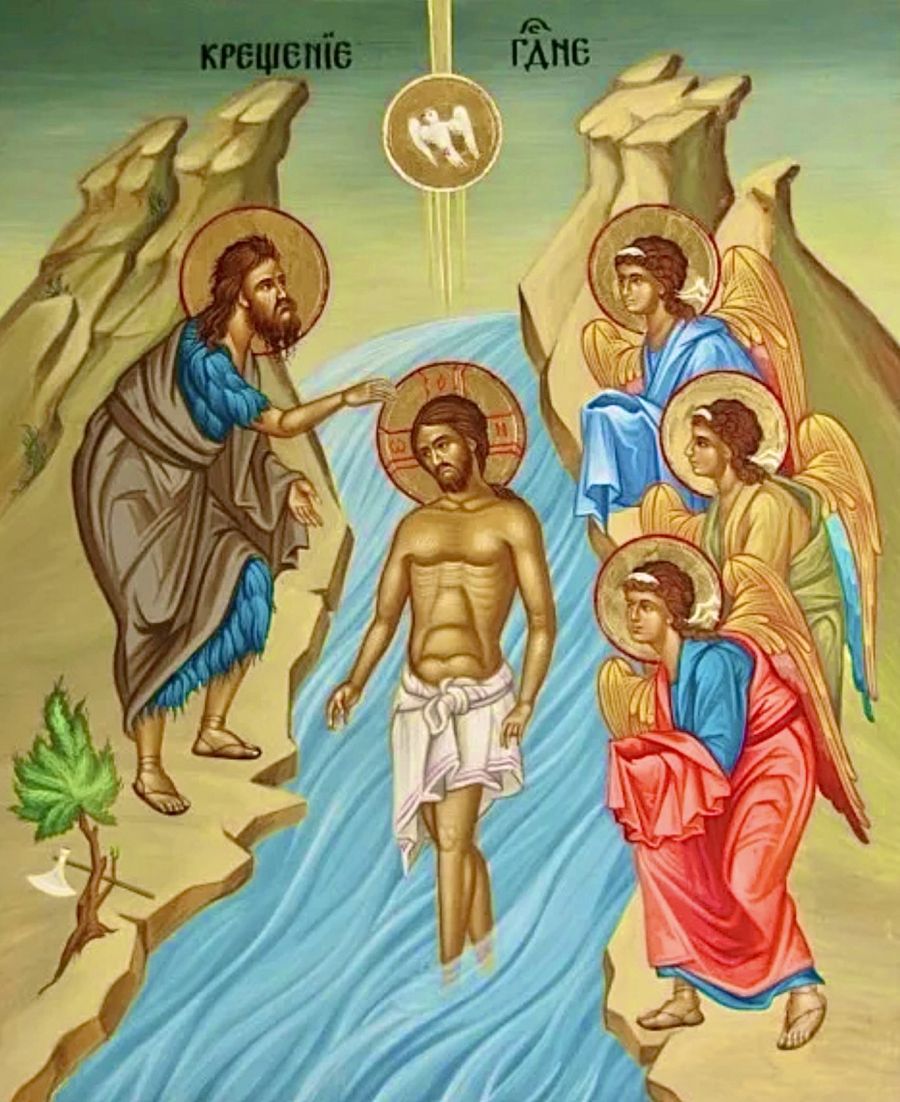
Baptism of the Lord (year A) [11 January 2026]
May God bless us and may the Virgin protect us! Today marks the end of the Christmas season, as we give thanks to Providence for having been able to celebrate this Mystery of Light and Peace in an atmosphere of serenity.
*First Reading from the Book of the Prophet Isaiah (42:1-4, 6-7)
The Servant of the Lord and his universal mission. This text from Isaiah is rich and complex, but it can be divided into two main parts. In both parts, it is God who speaks, but in two different ways: in the first part, he speaks of his Servant, and in the second, he addresses him directly. First part: God describes the Servant as the bearer of justice and universal law: 'He will bring justice to the nations... he will not fail or be discouraged until he has established justice on earth; he will not falter until he has established it on earth'. 'I have called you for justice': here judgement does not mean condemnation, but salvation and liberation. The Servant will act with gentleness and respect for the fragile, he will not crush the weak or extinguish those at risk. His mission concerns all humanity, because God desires that even the distant islands aspire to his justice, to his salvation. In all this, the Servant is sustained by the Spirit of God: 'Behold my Servant, whom I uphold... I have placed my Spirit upon him'. Part Two: God clarifies the Servant's mission: "to open the eyes of the blind and bring prisoners out of the dungeon... those who dwell in darkness." Here, judgement becomes total liberation, a passage from darkness to light. The mission is universal: the Servant is the light of the nations, and God continues to sustain him: "I, the Lord, have called you... and taken you by the hand." Who is this Servant? Isaiah does not specify, because it was clear to his contemporaries: the Servant is the people of Israel, called to be the privileged instrument of salvation. Messianism in Isaiah is not individual but collective: the small faithful nucleus becomes light and guidance for the whole world. Jesus, at his baptism in the Jordan, takes the lead of this servant-people and fulfils the mission announced by the prophets. The key message is this: God's judgement is not condemnation but liberation and universal salvation. God supports the Servant and entrusts him with the task of bringing light and justice to all nations. God's faithfulness and creative power are the guarantee of our hope, even in the most difficult moments.
*Important elements: +Text divided into two parts: God speaks about the Servant and directly to the Servant. +Judgement of the Servant = salvation and liberation, not condemnation and universal mission: light for the nations, opening the eyes of the blind, liberation of prisoners. +Gentleness and care for the fragile: 'he will not extinguish a dimly burning wick'. +Support of the Spirit of God on the Servant understood as the people of Israel, collective messianism. +Jesus at his baptism takes on the leadership of the servant-people. +Hope based on God's faithfulness and creative power.
*Responsorial Psalm (28/29)
To understand this psalm, one must imagine the force of a violent storm, shaking the country from Lebanon and Hermon to the desert of Qadesh. The psalm describes the voice of the Lord as powerful, thunderous, lightning-like, capable of breaking cedars and frightening the desert. This voice recalls the revelation at Sinai, when God made his voice heard to Moses amid fire and lightning, and every word of the Law appeared as flashes of fire. The name of God (YHWH, the Lord) is repeated several times, emphasising God's living presence and his saving action. The repetition of 'voice of the Lord' recalls the creative Word, as in the first chapter of the book of Genesis: the Word of God is effective, while idols are powerless. The psalm insists on God's sovereignty: God is the only legitimate king, worthy of glory and worship, and soon everyone – people and false powers – will recognise his dominion. God's powerful voice also evokes victory over the waters and chaos, as in the time of the flood or the liberation from Egypt, demonstrating his saving and liberating power. The central theme is the glory of God, repeated several times, and the anticipation of a time when all humanity will recognise his kingship. The psalm is linked to the feast of the Baptism of Christ, when the Kingdom of Heaven draws near through Jesus: God is finally recognised as king and his salvation is announced to all.
*Important elements: +Powerful image of the storm: voice of the Lord, lightning, broken cedars and Reference to Sinai: Word of God as fire, Law and covenant. +Repetition of God's name: YHWH, sign of presence and power. +Creative Word: as in Genesis, the Word is effective, idols are powerless. +Universal sovereignty of God: the only legitimate king, worthy of glory. +Victory over the waters and chaos: flood, exodus from Egypt. +Glory of God: central theme, anticipation of his universal recognition. +Connection to the baptism of Christ: manifestation of the Kingdom of Heaven and universal salvation
*Second Reading from the Acts of the Apostles (10:34-38)
In this account from Acts 10, we witness a truly revolutionary moment: Peter, guided by the Holy Spirit, breaks all the social and religious rules of his time and crosses the threshold of the house of a pagan, the Roman centurion Cornelius. Cornelius is a pious man who fears God, esteemed by the Jews for his almsgiving and justice, but he is not circumcised. He receives a vision: an angel invites him to send for Peter in Joppa, where he is staying with Simon the tanner. At the same time, Peter receives a vision from heaven: a large sheet filled with animals orders him to eat, but he refuses because, according to the Law, they are unclean. A voice answers him: What God has declared clean, you must not declare unclean. This prepares him to understand that no man is unclean in God's eyes and that faith is no longer limited by nationality or ritual laws. When Cornelius's messengers arrive, the Holy Spirit confirms to Peter: Follow them without hesitation, for it is I who send them. Peter goes down, welcomes them, and sets out for Caesarea with some Christians, aware of the importance of the meeting. The arrival at Cornelius' house is significant: Peter explains to everyone that God is impartial and welcomes anyone who fears him and does good, regardless of nationality. The Holy Spirit falls on all those present, even on the pagans, showing that the gift of the Spirit is no longer reserved for Jews alone. Peter concludes that these pagans must also be baptised, because they have received the Holy Spirit just like the Jewish believers. This episode fulfils what Jesus had promised: the apostles would be witnesses to the ends of the earth (Acts 1:8). The election of Israel is not denied, but salvation in Christ is now open to all nations.
*Important elements: +Missionary revolution: Peter crosses the threshold of a pagan's house by the will of the Holy Spirit. Cornelius, a devout pagan who fears God, is an example of spiritual openness. +Peter's vision: nothing is unclean to God, universal openness of faith, and the Holy Spirit guides Peter, confirming the call of the pagans. +Reception and baptism: even pagans receive the Spirit and the sacrament of water. +Universality of the Gospel: fulfilment of the mission to the ends of the earth. +Balance: election of Israel confirmed, but salvation accessible to all.
*From the Gospel according to Matthew (3:13-17)
The baptism of Jesus marks his first public appearance: until then, for many, he was just Jesus of Nazareth. Matthew presents him simply as Jesus, who comes from Galilee and goes to John to be baptised in the Jordan. This gesture becomes the first revelation of his true role as Messiah in the eyes of all. The main images in this text are: The march to the Jordan: Jesus travels through Galilee to the banks of the river, as do the other Jews who go to John for the baptism of conversion. The gesture of John the Baptist: initially surprised and hesitant, John recognises in Jesus the one who is greater than himself and who will baptise in the Holy Spirit and fire. The heavens opening and the dove: the open heavens symbolise the fulfilment of Israel's expectations; the dove represents the Holy Spirit descending on Jesus, recalling the divine presence over Creation and the promised Messiah. The main words are: John expresses his amazement: ' I need to be baptised by you!' recognising the greatness of Jesus. Jesus replies: Let it be so now, for thus it is fitting for us to fulfil all righteousness, that is, to conform fully to God's plan. This shows Jesus' humility and his complete solidarity with humanity. The voice of the Father from heaven: 'This is my beloved Son, in whom I am well pleased' . With this phrase, Jesus is recognised as Messiah-King and Messiah-Servant, fulfilling the prophecies of Isaiah and the Davidic promise: God declares his love and his saving mission upon him. And these are the theological and spiritual meanings: Jesus fully enters into the human condition, even though he is without sin, taking the place of sinners. Baptism represents a new creation: the waters of the Jordan symbolise purification and the journey towards the spiritual Promised Land, guided by the Spirit. The scene reveals the Trinity: the Father speaks, the Son is baptised, the Spirit descends like a dove. Baptism is the beginning of the building of the Body of Christ: all those who participate in baptism are integrated into this saving mission.
St. Gregory of Nazianzus writes: "Christ is baptised not to be purified, but to purify the waters" (Oratio 39, In Sancta Lumina).
*Important elements: +First public manifestation of Jesus: revelation of the Messiah. +Solidarity with humanity: Jesus places himself among sinners to fulfil God's justice. +Role of John the Baptist: recognises the Messiah and his baptism in the Spirit and fire. +Presence of the Holy Spirit: symbol of the dove, confirms the mission and the new creation and Voice of the Father: confirms the divine sonship and love for Jesus. +Messiah-King and Messiah-Servant: fulfilment of Isaiah's prophecies and the Davidic promise. +New creation and journey towards the spiritual Promised Land: baptism as entry into the Body of Christ. +Revelation of the Trinity: Father, Son and Holy Spirit present in Baptism. +Universality of the message: Baptism opens the way to salvation for all humanity.
+ Giovanni D'Ercole








