


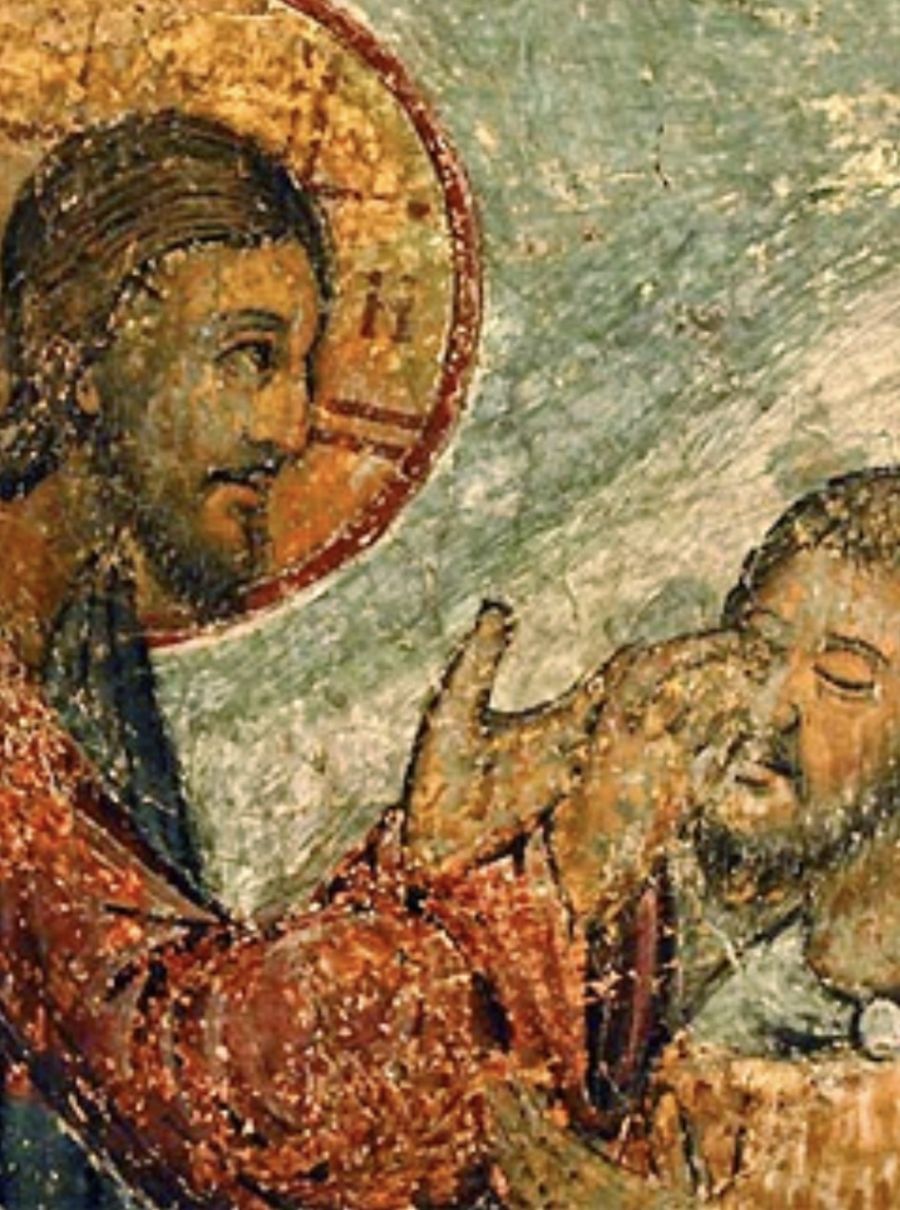
4th Lent Sunday [15 March 2026] Laetare
May God bless us and the Virgin protect us! This Sunday is a pause of light in the penitential journey. In the Gospel, Jesus gives sight to the blind man. Laetare means this: light is already overcoming the shadows. Even though we are still in Lent, Easter is near. The blind man's joy is achieved through questioning, rejection and loneliness. Laetare is not an escape from pain, but joy that arises from trial. Laetare is the smile of the Church in the middle of the desert: if I allow myself to be enlightened by Christ, my night is not definitive. The man born blind thus becomes an icon of the catechumen, but also of every believer who, in the heart of Lent, discovers that the light is already present and that Christian joy is born from the encounter with Him.
*First Reading from the First Book of Samuel (16:1b, 6-7, 10-13a)
Reading this biblical text, we understand that the great prophet Samuel had to learn to change his perspective. Sent by God to designate the future king from among the sons of Jesse in Bethlehem, he apparently had only the embarrassment of choice. Jesse first brought his eldest son, named Eliab: tall, handsome, with the appearance worthy of succeeding the current king, Saul. But no: God let Samuel know that his choice did not fall on him: Do not look at his appearance or his tall stature... God does not look as man looks: man looks at the appearance, but the Lord looks at the heart (cf. 1 Sam 16:7).
So Jesse had his sons pass before the prophet one by one, in order of age. But God's choice did not fall on any of them. In the end, he had to call the last one, the one no one had thought of: David, whose only occupation was to tend the sheep. Well, it was he whom God had chosen to guard his people! The biblical account emphasises once again that God's choice falls on the smallest: "God chose what is weak in the world to shame the strong," St Paul will say (1 Cor 1:27), because "my power is made perfect in weakness" (2 Cor 12:9). Here is a good reason to change our way of looking at people! From this text we draw at least three lessons about kingship in Israel:
First: the king is God's chosen one, but the election is for a mission. Just as Israel is chosen for the service of humanity, so the king is chosen for the service of the people. This also entails the possibility of being deposed, as happened to Saul: if the chosen one no longer fulfils his mission, he is replaced. Second: the king receives anointing with oil; he is literally the 'messiah', that is, 'the anointed one'. God says to Samuel: 'Fill your horn with oil and set out! I am sending you to Jesse the Bethlehemite, for I have chosen a king among his sons' (1 Sam 16:1). Third: anointing confers the Spirit of God. ' Samuel took the horn full of oil and anointed him in the midst of his brothers, and the Spirit of the Lord came upon David from that day forward' (1 Sam 16:13). The king thus becomes God's representative on earth, called to rule according to God's will and not according to that of the world. There is also another great lesson: men judge by appearances, God looks at the heart. Many biblical stories insist on this mystery: God often chooses the least. David was the youngest of Jesse's sons; no one thought he had a great future. Moses declared himself slow of speech (Ex 4:10). Jeremiah considered himself too young (Jer 1:6). Samuel himself was inexperienced when he was called. Timothy was in poor health. And the people of Israel were small among the nations. These choices cannot be explained by human criteria. As Isaiah says: "My thoughts are not your thoughts, nor are your ways my ways" (Is 55:8-9). The text summarises it thus: "What man sees does not count: for man sees the appearance, but the Lord sees the heart" (1 Sam 16:7). This truth protects us from two dangers: presumption and discouragement. It is not a question of merit, but of availability. No one possesses the necessary strength within themselves: God will give it at the right moment.
*Responsorial Psalm (22/23)
We have just heard this psalm in its entirety: it is one of the shortest in the psalter, but it is so dense that the early Christians chose it as the privileged psalm for Easter night. On that night, the newly baptised, rising from the baptismal font, sang Psalm 22/23 as they made their way to the place of their Confirmation and First Eucharist. For this reason, it was called the 'psalm of Christian initiation'. If Christians were able to read the mystery of baptismal life in it, it is because this psalm already expressed in a privileged way the mystery of life in the Covenant, of life in intimacy with God for Israel. It is the mystery of God's choice, who elected this particular people for no apparent reason other than his sovereign freedom. Every generation marvels at this election and this Covenant offered: 'Ask the former generations that preceded you, from the day God created man on earth... has anything so great ever happened?' (Deut 4:32-35). This people, freely chosen by God, was given the privilege of being the first to enter into his intimacy, not to enjoy it selfishly, but to open the door to others. To express the happiness of the believer, Psalm 22/23 refers to two experiences: that of a Levite (a priest) and that of a pilgrim. We are familiar with the institution of the Levites: according to Genesis, Levi was one of the twelve sons of Jacob, from whom the twelve tribes of Israel took their name. But the tribe of Levi had a special place from the beginning: at the time of the division of the Promised Land, it did not receive any territory because it was consecrated to the service of worship. It is said that God himself is their inheritance; an image also taken up in another psalm: "Lord, my portion of inheritance and my cup... for me, the lot has fallen on delightful places" (Ps 15/16:5). The Levites lived scattered among the cities of the other tribes and lived on tithes; in Jerusalem, they were dedicated to the service of the Temple. The Levite in our psalm sings with all his heart: "Goodness and faithfulness shall follow me all the days of my life; I shall dwell in the house of the Lord for long days." His experience is an image of Israel's election: just as the Levite is happy to be consecrated to the service of God, so Israel is aware of its special vocation among humanity. Furthermore, Israel presents itself as a pilgrim going up to the Temple to offer a sacrifice of thanksgiving. On the way, it is like a sheep: its shepherd is God. In the culture of the ancient Near East, kings were called "shepherds of the people," and Israel also uses this language. The ideal king is a good shepherd, attentive and strong to protect the flock. But in Israel it was strongly affirmed that the only true king is God; the kings of the earth are only his representatives. Thus, the true shepherd of Israel is God himself: 'The Lord is my shepherd: I shall not want; he makes me lie down in green pastures, he leads me beside still waters, he restores my soul'. The prophet Ezekiel developed this image at length. Similarly, the Old Testament often presents Israel as God's flock: "He is our God and we are the people of his pasture, the flock he leads" (Ps 94/95:7). This recalls the experience of the Exodus: it was there that Israel experienced God's care, who guided them and enabled them to survive amid a thousand obstacles. For this reason, when Jesus said, "I am the Good Shepherd" (Jn 10), his words had a shocking effect: they meant "I am the King-Messiah, the true king of Israel." Returning to the psalm: pilgrimage can be dangerous. The pilgrim may encounter enemies ("You prepare a table before me in the presence of my enemies"), he may pass through "the dark valley" of death; but he does not fear, because God is with him: "I fear no evil, for you are with me; your rod and your staff give me security". Once he reaches the Temple, he offers a sacrifice of thanksgiving and participates in the ritual banquet that follows: a joyful feast, with an overflowing cup and the anointing of oil on his head. We can understand why the early Christians saw in this psalm the expression of their experience: Christ is the true Shepherd (Jn 10); in baptism he leads us out of the valley of death to the waters of life; the table and the cup evoke the Eucharist; the perfumed oil recalls Confirmation. Once again, Christians discover with amazement that Jesus does not abolish the faith experience of his people, but brings it to fulfilment, giving it fullness.
*Second Reading from the Letter of Saint Paul the Apostle to the Ephesians (5:8-14)
Often in Scripture, it is the end of the text that provides the key. Let us start with the last sentence: 'For this reason it is said: "Awake, O sleeper, and arise from the dead, and Christ will give you light."' The phrase "This is why it is said..." clearly shows that the author did not invent this song, but quoted it. It must have been a well-known baptismal hymn in the early Christian communities. Awake... rise... and Christ will give you light was therefore a song of our first brothers and sisters in faith: and this cannot leave us indifferent. Thus, we better understand the beginning of the text: it simply serves to explain the words of that hymn. It is as if, after a baptismal celebration, someone had asked the theologian on duty — Paul, or one of his disciples (since it is not entirely certain that the Letter to the Ephesians was written by him personally) —: "What do the words we sang during baptism mean?" And the answer is this: thanks to baptism, a new life has begun, a radically new life. So much so that the newly baptised were called neophytes, meaning 'new plants'. The author explains the song in this way: the new plant that you have become is profoundly different. When a graft is made, the fruit of the grafted tree is different from the original one; and that is precisely why the graft is made. The colour makes it easy to distinguish what belongs to the new plant and what is a remnant of the past. It is the same with baptism: the fruits of the new man are works of light; before the grafting, you were darkness, and your fruits were works of darkness. But old habits may resurface: this is why it is important to recognise them. For the author, the distinction is simple: the fruits of the new man are goodness, justice and charity. Anything that is not goodness, justice and charity is a sprout from the old tree. Who can make you bear fruits of light? Jesus Christ. He is all goodness, all justice, all charity. Just as a plant needs the sun to bloom, so we must expose ourselves to his light. The song expresses both the work of Christ and the freedom of man: 'Awake, arise' — it is freedom that is called into question. 'Christ will enlighten you' — only he can do this. For St Paul, as for the prophets of the Old Testament, light is an attribute of God. To say 'Christ will enlighten you' means two things: first of all, Christ is God. The only way to live in harmony with God is to remain united to Christ, that is, to live concretely in justice, goodness and charity. The text of Isaiah (Is 58) comes to mind: share your bread with the hungry, welcome the poor, clothe the naked... Then your light will rise like the dawn. This is the glory of the Lord, his light that we are called to reflect. As Paul says in his second letter to the Corinthians (2 Cor 3:18): we reflect the glory of the Lord and are transformed into his image. To reflect means that Christ is the light; we are its reflection. This is the vocation of the baptised: to reflect the light of Christ. For this reason, at baptism, a candle lit from the Paschal candle is given. Secondly, a light does not shine for itself: it illuminates what surrounds it. In his letter to the Philippians, Paul writes: 'You shine like stars in the world' (Phil 2:14-16). This is his way of translating the words of Jesus Christ: 'You are the light of the world'. The Letter to the Ephesians, written directly by Paul or by one of his disciples (according to the then common practice of "pseudepigraphy"), remains for the Church a fundamental testimony of the baptismal vocation, called to pass from darkness to light.
*From the Gospel according to John (9:1-41)
The worst blindness is not what one thinks. Here we hear an illustration of what St John writes at the beginning of his Gospel, in the so-called Prologue:
"The Word was the true light, the light that enlightens every man... He was in the world, and the world was made through him, yet the world did not recognise him" (Jn 1:9-10). This is what we might call the drama of the Gospels. But John continues: 'Yet to all who did receive him, he gave them the right to become children of God'. This is exactly what happens here: the drama of those who oppose Jesus and stubbornly refuse to recognise him as the One sent by God; but also, fortunately, the salvation of those who have the grace to open their eyes, like the man born blind.
John insists on making us understand that there are two kinds of blindness: physical blindness, which this man had from birth, and, much more serious, blindness of the heart.
Jesus meets the blind man for the first time and heals him of his natural blindness. He then meets him a second time and opens his heart to another light, the true light. It is no coincidence that John takes care to explain the meaning of the name 'Siloam', which means 'Sent'. In other cases, he does not translate the terms: here he does so because it is important. Jesus is truly the One sent by the Father to enlighten the world. Yet we return to the same question: why was the one who was sent to bring God's light rejected by those who awaited him most fervently? The episode of the man born blind takes place immediately after the Feast of Tabernacles, a great solemnity in Jerusalem, during which the coming of the Messiah was ardently invoked. And the danger of certainties can be great. At the time of Jesus Christ, the expectation of the Messiah was very intense. There was only one question: is he truly the Father's Envoy or is he an impostor? Is he the Messiah, yes or no? His actions were paradoxical: he performed the works expected of the Messiah — he restored sight to the blind and speech to the mute — but he did not seem to respect the Sabbath. And it was precisely on the Sabbath that he healed the blind man. Now, if he were truly sent by God, many thought, he should observe the Sabbath. It was 'obvious'. But it is precisely this 'obviousness' that is the problem. Many had too rigid ideas about what the Messiah should be like and were not ready for God's surprise. The blind man, on the other hand, is not a prisoner of preconceptions. To the Pharisees who ask him for explanations, he simply replies: "The man called Jesus made mud, spread it on my eyes... I washed and gained my sight." The Pharisees are divided: He is not from God, because he does not observe the Sabbath. How can a sinner perform such signs? The blind man reasons with simplicity and freedom: If this man were not from God, he could do nothing (cf. Jn 9:31-33). It is always the same story: those who close themselves off in their own certainties end up seeing nothing; those who take a step in faith are ready to receive grace. And then they can receive true light from Jesus. This episode takes place in a context of controversy between Jesus and the Pharisees. Twice Jesus had rebuked them for "judging by appearances" (Jn 7:24; 8:15). It is natural to recall the episode of David's choice: "Man looks at the outward appearance, but the Lord looks at the heart" (1 Sam 16:7). The worst blindness, therefore, is not that of the eyes, but that of a heart that does not want to be enlightened. The man born blind does not only receive sight: he receives a new way of seeing. At first he sees Jesus as "a man"; then as a "prophet"; finally he recognises him as "Lord" and prostrates himself before him. The real miracle is not only the opening of the eyes, but the opening of the heart. Here we also find the wisdom of The Little Prince (novel by A.M. de Saint-Exupéry): "What is essential is invisible to the eye." The Pharisees see with their eyes, but remain blind inside; the beggar, on the other hand, passing through rejection and trial, comes to see the Invisible. The conclusion is this: faith is a journey from external light to inner light. One can have healthy eyes and remain in darkness; or one can have been blind and become a witness to the light. The man born blind teaches us that true sight is recognising Christ as the Light of the world and allowing our hearts to be illuminated.
+Giovanni D'Ercole








