


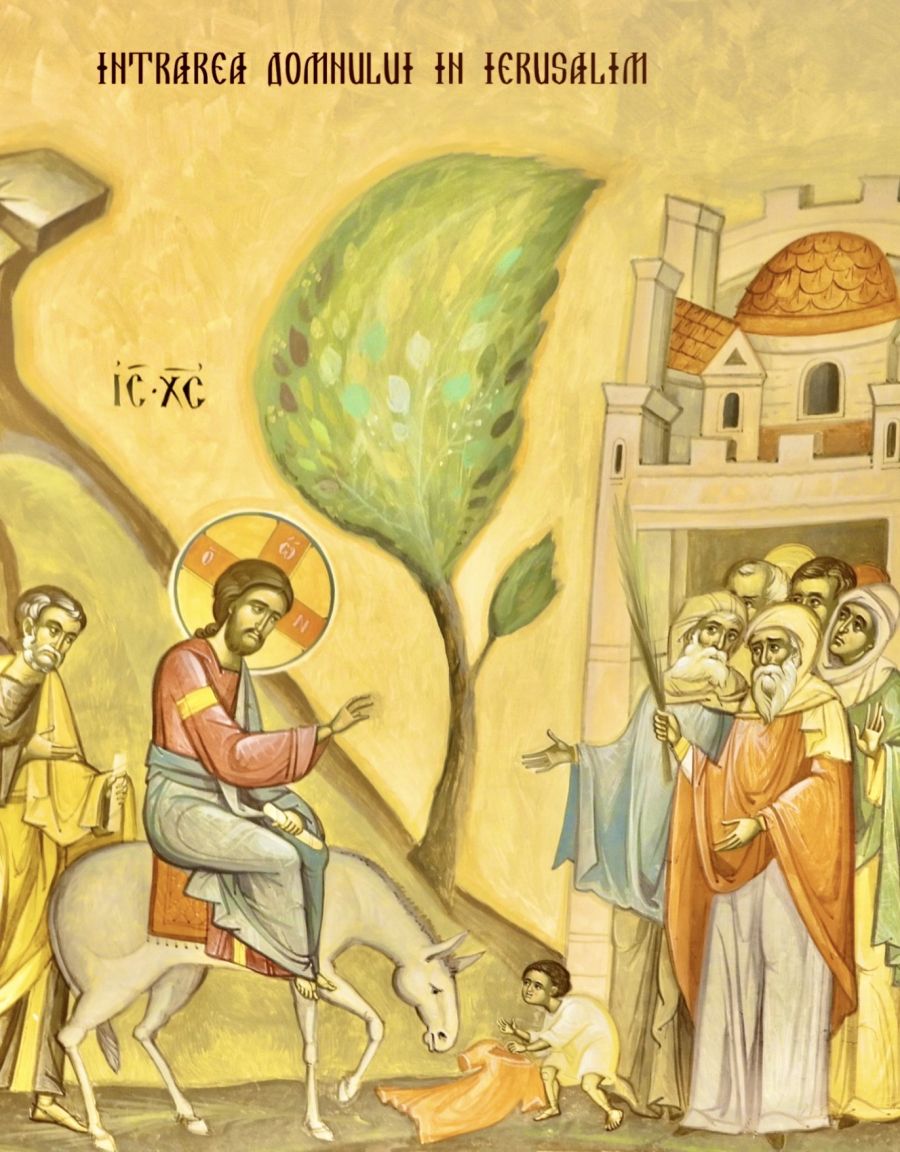
Palm Sunday and the Passion of the Lord [29 March 2026]
May God bless us and may the Virgin Mary protect us! We enter Holy Week, of which Palm Sunday already gives us a foretaste of the joy and sorrow, the mystery of love and hatred that leads to death: the whole Passion, death and resurrection of Christ. To relive is not merely to remember, but also to open our hearts ever more to this mystery of salvation.
*First Reading from the Book of the Prophet Isaiah (50:4–7)
Isaiah was certainly not thinking of Jesus Christ when he wrote this text, probably in the 6th century BC, during the exile in Babylon. Let me explain: since his people were in exile, in very harsh conditions, and could easily have succumbed to discouragement, Isaiah reminds them that they are always God’s servants. And that God is counting on them, his servants (that is, his people), to bring his plan of salvation for humanity to fulfilment. The people of Israel are therefore this Servant of God, nourished every morning by the Word, yet also persecuted precisely because of their faith and capable, despite everything, of withstanding all trials. In this text, Isaiah clearly describes the extraordinary relationship that unites the Servant (Israel) with his God. Its main characteristic is listening to the Word of God, ‘the open ear’, as Isaiah puts it. ‘Listening’ is a word that has a very particular meaning in the Bible: it means to trust. We usually contrast these two fundamental attitudes between which our lives constantly oscillate: trust in God, a serene surrender to his will because we know from experience that his will is always good; or mistrust, suspicion of God’s intentions, and rebellion in the face of trials—a rebellion that can lead us to believe that God has abandoned us or, worse still, that He might take some satisfaction in our sufferings.
The prophets repeat: “Listen, Israel” or: “Will you listen to the Word of God today?” And on their lips, the exhortation “listen” always means: trust in God, whatever happens. And Saint Paul explains why: We know that all things work together for good for those who love God (Rom 8:28).
From every evil, from every difficulty, from every trial, God brings forth good; to every hatred he opposes an even stronger love; in every persecution, he grants the strength of forgiveness; and from every death, he brings forth life, the resurrection. It is a story of mutual trust. God trusts his Servant and entrusts him with a mission; in turn, the Servant accepts the mission with trust. And it is precisely this trust that gives him the strength needed to remain steadfast even in the opposition he will inevitably encounter. Here the mission is that of a witness: “So that I may sustain with my words those who are weary,” says the Servant. In entrusting him with this mission, the Lord also grants the necessary strength and the appropriate language: “The Lord God has given me the tongue of a disciple.” And even more: he himself nourishes this trust, which is the source of all boldness in the service of others: “The Lord God makes my ear attentive”, which means that listening (in the biblical sense, that is, trust) is itself a gift from God. Everything is a gift: the mission, the strength, and even the trust that makes one unshakeable. This is precisely the hallmark of the believer: to recognise everything as a gift from God. He who lives in this permanent gift of God’s strength can face anything: “I did not resist, I did not turn back.” Faithfulness to the mission received inevitably entails persecution. True prophets, those who truly speak in the name of God, are rarely appreciated during their lifetime. In concrete terms, Isaiah says to his contemporaries: hold fast. The Lord has not abandoned you; on the contrary, you are on a mission for him. Do not be surprised, then, if you are mistreated. Why? Because the Servant who truly listens to the Word of God—that is, who puts it into practice—soon becomes a thorn in the side. His very conversion calls others to conversion. Some heed this call… others reject it and, convinced of their own righteousness, persecute the Servant. And every morning the Servant must return to the source, to the One who enables him to face everything. Isaiah uses a somewhat strange expression: “I set my face like flint” to express resolve and courage. Isaiah was speaking to his people, persecuted and humiliated during the exile in Babylon; but, naturally, when one re-reads the Passion of Christ, this text stands out in all its clarity: Christ corresponds perfectly to this portrait of the Servant of God. Listening to the Word, unshakeable trust and thus the certainty of victory even in the midst of persecution: all this characterised Jesus precisely at the moment when the acclamations of the crowd on Palm Sunday marked and hastened his condemnation.
*Responsorial Psalm (21/22)
Psalm 21 (22) begins with the famous cry: “My God, my God, why have you forsaken me?”. This phrase has often been taken out of context and interpreted as a cry of despair, whereas in reality the psalm must be read in its entirety. Indeed, after describing suffering and anguish, it ends with a great song of thanksgiving: “You have answered me! I will proclaim your name to my brothers and sisters’. The one who at first feels forsaken ultimately recognises that God has saved him and has not left him alone. Some images in the psalm seem to describe the crucifixion: ‘They have pierced my hands and my feet’, ‘they divide my garments’, ‘a band of evildoers surrounds me’. This is why the New Testament applies this psalm to the Passion of Jesus. However, the text originated in a specific historical context: the return of the people of Israel from the Babylonian exile. The exile had been like a death sentence for the people, who had risked disappearing; the return to their own land is therefore likened to the liberation of a condemned man who had narrowly escaped death. The image of the crucifixion serves to express the humiliation, violence and sense of abandonment experienced by the people, but the focus of the psalm is not suffering but rather the salvation received. The cry “My God, my God, why have you forsaken me?” is therefore not a cry of despair or doubt, but the prayer of one who suffers and continues to turn to God with trust. Even in the midst of trial, Israel does not cease to pray and to remember the covenant and the blessings received from the Lord. For this reason, the psalm can be likened to a votive offering: in times of danger, God’s help is invoked, and once saved, thanks are given publicly. The psalm recalls the tragedy endured, but above all proclaims gratitude towards God who has delivered his people. The final verses thus become a great hymn of praise: the poor shall be satisfied, those who seek the Lord shall praise him, and all nations shall acknowledge his lordship. God’s salvation will also be proclaimed to future generations. For this reason, in Christian tradition, this psalm has been recognised as a prophecy of Christ’s Passion: on the cross, Jesus echoes the first verse of the psalm, but just as for Israel, so too for him the final word is not suffering, but salvation and life.
*Second Reading from the Letter of Saint Paul the Apostle to the Philippians (2:6–11)
During the exile in Babylon, in the 6th century BC, the prophet Isaiah had bestowed upon the people of Israel the title of Servant of God. Their mission, amidst the trials of exile, was to remain faithful to the faith of their fathers and to bear witness to it among the pagans, even at the cost of humiliation and persecution. Only God could give them the strength to fulfil this mission. When the early Christians were confronted with the scandal of the cross, they sought to understand Jesus’ destiny and found the explanation in the words of St Paul: Jesus ‘emptied himself, taking the form of a servant’. He too faced opposition, humiliation and persecution, drawing his strength from the Father and living in total trust in Him. Although he was of divine nature, Jesus did not seek glory and honours. As Paul says, “though he was in the form of God, he did not regard equality with God as something to be exploited”. Precisely because he is God, he claims nothing for himself, but lives in gratuitous love and becomes man to show mankind the way to salvation. His exaltation is not a deserved reward, but a free gift from God. God’s logic is not that of merit or calculation, but that of grace, which is always a free gift. According to Paul, God’s plan is a plan of love: to bring humanity into his life, into his joy and into his communion. This gift is not earned, but received with gratitude. When man demands or claims, he closes himself off from grace, as happened symbolically with the sin in the Garden of Eden. Jesus, on the other hand, lives in the opposite attitude: the total acceptance of the Father’s will, what Paul calls obedience. For this reason, God exalted him and gave him the Name that is above every name: the name of Lord, a title which in the Old Testament belonged only to God. Before him “every knee shall bow”, to quote the words of the prophet Isaiah (Is 45:23). Jesus lived his entire life in humility and trust, even in the face of human violence and death. His obedience – which literally means “to place one’s ear before the word” – expresses a total and trusting listening to the Father’s will. For this reason, Paul’s hymn concludes with the Church’s profession of faith: “Every tongue shall confess that Jesus Christ is Lord, to the glory of God the Father”. In Christ, the glory of God is fully manifested, that is, the revelation of his infinite love. Seeing Jesus love to the very end and give his life, one can recognise, like the centurion beneath the cross, that he is truly the Son of God.
*The Passion of Jesus Christ according to Saint Matthew (26:14–27:66)
Every year, on Palm Sunday, the liturgy reads the account of the Passion from one of the three Synoptic Gospels; this year it is that of Matthew. The four accounts of the Passion are similar in broad outline, but each evangelist highlights certain particular aspects. Matthew, in particular, recounts certain episodes and details that the others do not mention. First of all, Matthew is the only one to specify the exact sum for which Judas betrays Jesus: thirty pieces of silver, which according to the Law was the price of a slave. This detail shows the contempt with which men treated the Lord. Later, Judas himself, overcome with remorse, returns the money to the chief priests, saying that he has handed over an innocent man to his death. They, however, do not wish to take responsibility for it. Judas throws the coins into the temple and hangs himself; the priests use that money to purchase the potter’s field, intended for the burial of foreigners, later called the ‘Field of Blood’, thus fulfilling a prophetic word. During the trial before Pilate, Matthew recounts a unique episode: the intervention of Pilate’s wife, who sends word to her husband not to have anything to do with ‘that righteous man’, for she has suffered greatly in a dream because of him. Pilate himself appears unsettled and, seeing that the crowd is growing ever more agitated, performs the symbolic gesture of washing his hands, declaring himself innocent of that man’s blood. The crowd replies: ‘Let his blood be on us and on our children.’ Pilate then releases Barabbas and hands Jesus over to be crucified. At the moment of Jesus’ death, Matthew also recounts that the veil of the temple is torn, but adds extraordinary details: the earth trembles, the rocks split, the tombs open, and many righteous people rise and appear in the holy city after Jesus’ resurrection. Finally, Matthew highlights the authorities’ concern to guard the tomb, fearing that the disciples might steal the body and claim that Jesus has risen; this very message is what they will spread after Easter. The account highlights a great paradox: the blindness of the religious authorities, who persecute Jesus, whilst some pagans, almost unwittingly, bestow upon him the highest titles. Pilate’s wife calls him ‘righteous’, Pilate has ‘King of the Jews’ written on the cross, and even the title ‘Son of God’, initially used to mock him, ultimately becomes a true profession of faith when the Roman centurion exclaims: ‘Truly this man was the Son of God’. This confession already foreshadows the opening of salvation to the pagans and shows that Christ’s death is not a defeat, but a victory. Matthew highlights the contrast between the weakness of the condemned man and his true greatness: it is precisely in his apparent powerlessness that Jesus manifests the greatness of God, who is infinite love. And in this light, we come to understand ever more deeply the significance of Christ’s Passion, which we shall relive visually this week and in particular during the Holy Triduum: Holy Thursday, Good Friday and Holy Saturday, and above all in the outpouring of Easter joy at Christ’s Resurrection.
+Giovanni D’Ercole








