


27th Sunday in Ordinary Time (year A) [4 October 2026]
First Reading from the Book of the Prophet Isaiah 5:1–7
This text begins as a song dedicated to the grape harvest: it recounts the vineyard-keeper’s patient care for his vineyard, from preparing the soil to selecting the best vine. In Israel, the vineyard was highly prized and required great care. For this reason, the song eventually came to be used as a wedding song too, urging the bridegroom to care for his wife with the same devotion as the vine-grower. The vineyard is also a symbol of the covenant with God. The prophet Isaiah draws on this image to speak of the relationship between God and Israel. The vineyard represents the house of Israel, whilst the beloved vine represents the people of Judah. The good fruits that God expects are righteousness and justice; the bad fruits, on the other hand, represent crime and cries of suffering. Above all, Isaiah denounces: greed and the hoarding of property, with the rich seeking to possess ever more land, and indifference towards the poor; the excessive pursuit of pleasure and drunkenness, whilst remaining indifferent to God’s work; above all, the loss of moral values and justice, to the point of regarding what is evil as good and what is good as evil. In summary: the vineyard is a metaphor for the people of Israel, loved and cared for by God. God expects this people to bear the fruits of justice, respect and solidarity, but Isaiah denounces selfishness, the accumulation of wealth, indifference towards the poor and moral corruption.
Responsorial Psalm (79/80)
The psalm takes up the theme of the vineyard from Isaiah: Israel is likened to a vineyard and God is the vine-grower. God has done for this vineyard everything a vine-grower can do: he has tended, protected and cared for it. He has prepared the soil, removed the stones, planted a choice vine, built a watchtower and set up a winepress. He expected good grapes, but the vineyard produced only bad grapes (Isaiah 5:1–2). Faced with this failure, the vineyard-keeper decides to abandon the vineyard: he will remove its protective hedge, turn it into a desolate wasteland, neither pruned nor cultivated, where thorns and brambles will grow, and he will even prevent the rain from falling on it (Isaiah 5:5–6). The metaphor of the vineyard was easily understood in the context of the Temple in Jerusalem, because the imagery of the vineyard describes the history and sufferings of Israel.
When the psalm says that God has opened the hedge and that passers-by are gathering the grapes, whilst wild boars and the beasts of the field are ravaging the vineyard, it is referring to foreign occupation: the wild beasts symbolically represent the enemies who are currently oppressing Israel. The vineyard is also described as destroyed and set ablaze, whilst the enemies and neighbouring peoples mock Israel. The people therefore turn to God, asking how long they must still endure his wrath, feeding on the ‘bread of tears’ and drinking tears in abundance. The text does not allow us to establish with certainty which particular invasion or occupation inspired this prayer. Wars and foreign occupations, in fact, produce similar situations of destruction and suffering. For this reason, it is not possible to establish with certainty the date of the psalm’s composition. One possibility is that it was written during the invasions of the Assyrian Empire, when the Northern Kingdom was threatened and Samaria was finally destroyed in 721 BC; this hypothesis would place the psalm between the 9th and 7th centuries BC, and therefore before the Babylonian exile. Another possibility is that it was composed later, after the conquest of Jerusalem by the Babylonians in the 6th century BC. The text does, however, acknowledge that other hypotheses also exist. Ultimately, the vineyard represents Israel, whilst God is the vine-grower who chose, tended and protected it. The failure to produce good fruit and the subsequent devastation of the vineyard represent the history of a people experiencing sin, suffering, invasions and foreign occupation. The psalm thus becomes a plea to God, in which Israel, wounded and persecuted, asks him to intervene and return to tend his vineyard.
Second Reading from the Letter of Saint Paul the Apostle to the Philippians (4:6–9)
‘Do not be anxious about anything,’ says Paul, and we might be tempted to reply that it is not always easy! But we must reread the verse that precedes this passage in Paul’s letter: ‘The Lord is near’. For Paul, this is the best – indeed, the only – reason to remain at peace, whatever may happen: ‘the Lord is near’. The Lord is near to us; we in Israel have known this for a long time, ever since the episode of the burning bush, and God is near to us because he loves us. The Lord is near because the time has been fulfilled, because the Kingdom of God has already begun and we are in the last days. Another phrase from Paul, ‘the time is short’, translates an expression taken from nautical vocabulary: ‘Time has lowered its sails’ (1 Cor 7:29); just as a boat about to enter harbour folds in its sails, so human history is very close to the harbour. To be a believer is to be drawn towards this fulfilment of history; not only has the Kingdom drawn near to us in Jesus Christ (for the Kingdom is Jesus Christ present in everyone), but, even more so, it draws us to itself like a magnet. The rest of the text follows on from this: since the Lord is near, let us not worry about anything. ‘Do not be anxious about anything’… since everything has already been given, all we need to do is draw upon it: we need do nothing but let ourselves be carried along by the torrent of grace. To pray, after all, is to immerse oneself in God’s gift. We then understand why, in prayer, supplication and thanksgiving are always linked; it is a characteristic of Jewish prayer, which always says simultaneously, ‘Blessed are You, Lord, who gives us… please, give us’ . It is logical, after all: if we pray to God, it is because we know that He can and does want our happiness. To ask Him for something is, at least implicitly, to give Him thanks. This is exactly what Paul says: ‘Brothers and sisters, do not be anxious about anything, but in every situation present your requests to God through prayer, supplication and thanksgiving’. But, as Jesus said, ‘Not everyone who says to me, “Lord, Lord”, will enter the Kingdom of Heaven, but only the one who does the will of my Father in heaven’ (Mt 7:21); Paul, too, makes the same recommendation: ‘Whatever is true, whatever is noble, whatever is just, whatever is pure… let these be the focus of your thoughts’. He certainly attaches great importance to this practice of living a righteous life, for he places it on exactly the same level as prayer. He begins by speaking of prayer and concludes, ‘the peace of God, which surpasses all understanding, will guard your hearts and your minds in Christ Jesus’. He then speaks of Christian conduct, ending with the phrase ‘the God of peace will be with you’. It seems to me that this parallelism, which is certainly intentional, means that, in Paul’s eyes, prayer goes hand in hand with community life. In this, moreover, he is simply echoing the preaching of the Old Testament prophets. For Saint Paul, peace lies at the end of the journey where a life of prayer and communal values go hand in hand: ‘Do not be anxious about anything… pray and make requests, giving thanks, so that God may know your needs… and the peace of God will guard your hearts and your minds’. If we take seriously the Scriptures’ insistence on the necessary link between prayer and brotherly love, we learn that not only do our anxieties make us forget that God loves us, but they also close our hearts… If we worried less about our daily bread, there would be bread today for many others.
From the Gospel according to Matthew (21:33–43)
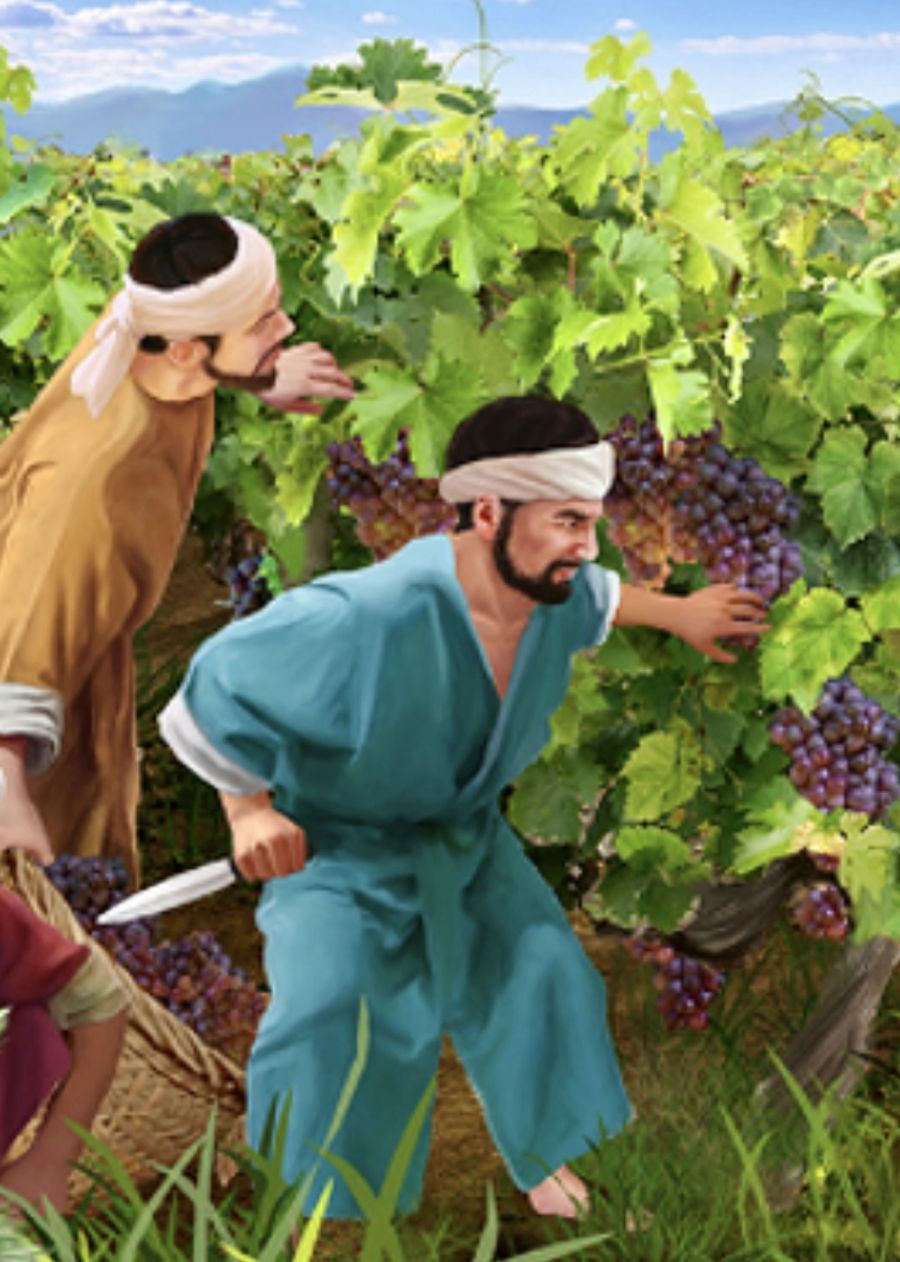
This parable of Jesus echoes the prophet Isaiah’s song of the vineyard: A man owned a piece of land where he planted a vineyard; he fenced it in, dug a pit for the winepress and built a watchtower. The owner tends to his vineyard with the same care as Isaiah’s vineyard-keeper, but the similarities end there. In the Gospel, the parable takes a new turn and thus offers a new lesson. In Isaiah, the owner is also the vineyard-keeper; the vineyard represents the people of Israel, a vineyard surrounded by care, yet disappointing and yielding only bad fruit. In Jesus’ parable, the owner is not the vine-grower; he does not work his vineyard directly, but entrusts it to other vine-growers: ‘He let it out to some farmers and went away to a distant place.’ Is there a vineyard? Who are the vine-growers? As for knowing what the vineyard represents, and who the vine-growers are, it is not clear. There are two possibilities: the first hypothesis is that the vineyard represents Israel, as in Isaiah, and the vine-growers are the chief priests and the Pharisees. They were responsible for the vineyard—the people of Israel—and they mismanaged it because they mistreated all the prophets and, ultimately, were about to reject the Father’s Beloved Son. The second possibility is that the vineyard represents the Kingdom of God and the vine-growers are the entire people of Israel, who had been entrusted with it. This second possibility is probably the correct one, as Jesus concludes by saying: ‘The Kingdom of God will be taken away from you and given to a people who will produce its fruit’. This last statement by Jesus is terrible: ‘The kingdom of God will be taken away from you and given to a people who will produce its fruit’. Must we conclude, then, that the people of Israel would be rejected? This is a grave question that has poisoned dialogue between Jews and Christians for twenty centuries; and one with which Saint Paul, a Jew himself, was already painfully grappling in his Epistle to the Romans. His conclusion was that, in a mysterious yet certain way, Israel remains the chosen people in the service of the world because ‘God cannot deny himself’ . On the other hand, we must not forget that a parable is never a verdict, but a call to conversion; it is true that, from one parable to the next, in this final stage of Jesus’ life, the tone grows more urgent, but this is because the need to recognise the Messiah is becoming ever more pressing. We are on the eve of the Passion. We must never lose sight of the fact that Jesus’ constant desire is to save people, not to condemn them; and that, whilst he heals those born blind, he desires even more to heal his own people from their blindness. We therefore have here a final attempt by Jesus to warn the Pharisees; his words are stern, but they do not constitute a definitive judgement. This is by no means a final, irrevocable judgement on the Jewish people as a whole, nor even on their leaders; that would be contrary to the whole of the Gospel. Moreover, the most important message is not that the Kingdom is being taken away from them: what matters is that, despite the obstacles placed in its way by men, the Kingdom bears its fruit. It is not the vine-grower that matters, but the grapes. Above all, however, it is Jesus’ commentary that gives us the key to the parable: ‘Have you never read in the Scriptures: “The stone which the builders rejected has become the cornerstone. This was the Lord’s doing, and it is marvellous in our eyes!”’ God is accustomed to such reversals of fortune. Indeed, in the Book of Genesis, Jacob’s sons had said of their brother Joseph, ‘Here is the dreamer; let us kill him’… they could not have imagined that the one they wished to kill was the very one who would save them, and the whole people (Gen 37:20). In a sense, Jesus is here foretelling his Resurrection: he, the rejected stone, will become the keystone of the building; in other words, the new people will be all those who gather round him, whatever their background. And no one is excluded: all the vine-growers are included in Jesus’ words on the cross: ‘Father, forgive them, for they know not what they do’. This means that Jesus has indeed taken up the theme of the parable of the vineyard found in Isaiah, but has modified its symbolism – something quite common amongst biblical authors. One need only consider how biblical metaphors (such as that of the cornerstone, for example) evolve from one author to another. The judgement that Jeremiah had already passed on the people of Israel can shed light on this: ‘On the day I brought them (your forefathers) out of the land of Egypt… this is the command I gave them: “Listen to my voice: I will be your God and you shall be my people; you shall follow all the ways I prescribe for you, so that you may be happy.” But they did not listen; they paid no heed; they followed the evil inclinations of their hardened hearts; they turned their backs on me, not their faces. From the day your forefathers came out of the land of Egypt until today, I have sent all my servants, the prophets, to you without ceasing. But they did not listen to me, they paid no heed; they stiffened their necks and were worse than their fathers. You shall speak all these words to them, and they will not listen to you. You shall call out to them, and they will not answer you. Then you shall say to them: ‘This is the nation that has not listened to the voice of the Lord its God, nor accepted instruction! Truth is lost; it has vanished from their mouths.” (Jer 7:22–28). Matthew wrote his Gospel at the end of the first century, at a time when the Jews’ refusal to recognise the Messiah had facilitated the entry of pagans into the Church; it is therefore not surprising to find in texts from this period a hint of polemic against those who had led the Jewish people to reject Christ.
+Giovanni D’Ercole








