Apr 11, 2026 Written by 

Seeing and believing on a pilgrimage

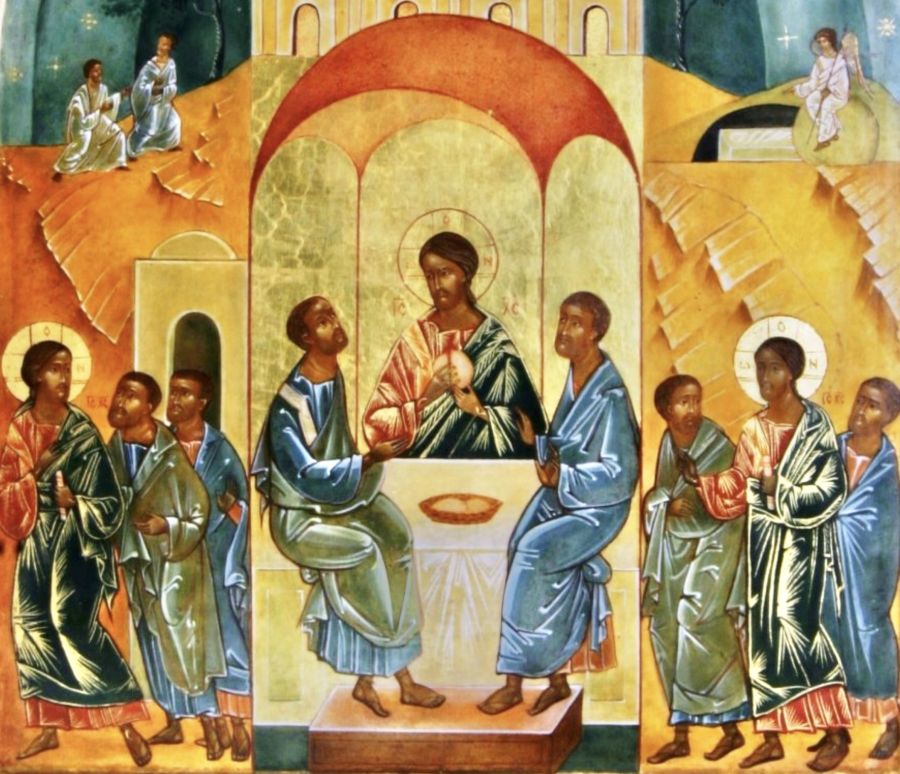
The Risen Jesus walked alongside the disciples on the road to Emmaus as they talked about Him and what had happened in Jerusalem. He put them to the test.

Christ’s body was now in a new, glorious state, whilst retaining its identity. To recognise Him required the faith and freedom of the children of God.


For Francis, poverty and freedom of spirit, united with faith, were the fundamental framework of his existential parable as a ‘minor’.

Begging for alms, for example, even during Eastertide, whilst living as a wayfarer on the road, was for him a wonderful exercise of the aforementioned values.

Leafing through the Sources, in the Major Legend, we read:

“Once, on the holy day of Easter, as he found himself in a hermitage far from any settlement and there was no possibility of going out to beg, mindful of Him who on that very day appeared to the disciples on their way to Emmaus in the guise of a pilgrim, he asked for alms, as a pilgrim and a poor man, from his own brothers.

Having received it, he instructed them with holy words to celebrate the Lord’s Easter continually, passing through the desert of the world in poverty of spirit and as pilgrims and strangers and as true Jews.

For, in begging for alms, he was not driven by the desire for gain, but by the freedom of the Spirit. God, the Father of the poor, showed him special care” (FF 1129).

And it was that inner freedom, together with faith, that became the gateway to recognising the Risen Christ at the breaking of bread, as at Emmaus.

Francis had three-dimensional eyes, which enabled him to look beyond appearances, grasping the essence of the message before him.

Indeed, in the Admonitions, he expresses it thus:

«Behold, every day he humbles himself, as when he descended from his royal throne into the womb of the Virgin; every day he himself comes to us in humble appearance […]

And just as he showed himself to the holy apostles in true flesh, so too does he now show himself to us in the consecrated bread.

And just as they, with the eyes of their bodies, saw only his flesh, but, contemplating him with the eyes of the spirit, believed that he was God himself, so too must we, seeing the bread and wine with the eyes of the body, see and firmly believe that this is his most holy body and living and true blood» (FF 144).

The Poverello had acquired, by grace, the inner capacity to discern the footsteps of the Lord in the ordinary course of daily life, with real concreteness.


«And it came to pass, as He sat at table with them, that He took bread, gave thanks, broke it and gave it to them. Then their eyes were opened and they recognised Him» (Lk 24:30–31)


3rd Sunday in Easter A  (Lk 24:13–35)

108 Last modified on Saturday, 11 April 2026 05:32
Teresa Girolami

Teresa Girolami è laureata in Materie letterarie e Teologia. Ha pubblicato vari testi, fra cui: "Pellegrinaggio del cuore" (Ed. Piemme); "I Fiammiferi di Maria - La Madre di Dio in prosa e poesia"; "Tenerezza Scalza - Natura di donna"; co-autrice di "Dialogo e Solstizio".

Email This email address is being protected from spambots. You need JavaScript enabled to view it.
The locality of Emmaus has not been identified with certainty. There are various hypotheses and this one is not without an evocativeness of its own for it allows us to think that Emmaus actually represents every place: the road that leads there is the road every Christian, every person, takes. The Risen Jesus makes himself our travelling companion as we go on our way, to rekindle the warmth of faith and hope in our hearts and to break the bread of eternal life (Pope Benedict)
La località di Emmaus non è stata identificata con certezza. Vi sono diverse ipotesi, e questo non è privo di una sua suggestione, perché ci lascia pensare che Emmaus rappresenti in realtà ogni luogo:  la strada che vi conduce è il cammino di ogni cristiano, anzi, di ogni uomo. Sulle nostre strade Gesù risorto si fa compagno di viaggio, per riaccendere nei nostri cuori il calore della fede e della speranza e spezzare il pane della vita eterna (Papa Benedetto)
Romano Guardini wrote that the Lord “is always close, being at the root of our being. Yet we must experience our relationship with God between the poles of distance and closeness. By closeness we are strengthened, by distance we are put to the test” (Pope Benedict)
Romano Guardini scrive che il Signore “è sempre vicino, essendo alla radice del nostro essere. Tuttavia, dobbiamo sperimentare il nostro rapporto con Dio tra i poli della lontananza e della vicinanza. Dalla vicinanza siamo fortificati, dalla lontananza messi alla prova” (Papa Benedetto)
In recounting the "sign" of bread, the Evangelist emphasizes that Christ, before distributing the food, blessed it with a prayer of thanksgiving (cf. v. 11). The Greek term used is eucharistein and it refers directly to the Last Supper, though, in fact, John refers here not to the institution of the Eucharist but to the washing of the feet. The Eucharist is mentioned here in anticipation of the great symbol of the Bread of Life [Pope Benedict]
Narrando il “segno” dei pani, l’Evangelista sottolinea che Cristo, prima di distribuirli, li benedisse con una preghiera di ringraziamento (cfr v. 11). Il verbo è eucharistein, e rimanda direttamente al racconto dell’Ultima Cena, nel quale, in effetti, Giovanni non riferisce l’istituzione dell’Eucaristia, bensì la lavanda dei piedi. L’Eucaristia è qui come anticipata nel grande segno del pane della vita [Papa Benedetto]
First, the world of the Bible presents us with a new image of God. In surrounding cultures, the image of God and of the gods ultimately remained unclear and contradictory (Deus Caritas est n.9)
Vi è anzitutto la nuova immagine di Dio. Nelle culture che circondano il mondo della Bibbia, l'immagine di dio e degli dei rimane, alla fin fine, poco chiara e in sé contraddittoria (Deus Caritas est n.9)
God loves the world and will love it to the end. The Heart of the Son of God pierced on the Cross and opened is a profound and definitive witness to God’s love. Saint Bonaventure writes: “It was a divine decree that permitted one of the soldiers to open his sacred wide with a lance… The blood and water which poured out at that moment was the price of our salvation” (John Paul II)
Jesus, the true bread of life that satisfies our hunger for meaning and for truth, cannot be “earned” with human work; he comes to us only as a gift of God’s love, as a work of God (Pope Benedict)
Gesù, vero pane di vita che sazia la nostra fame di senso, di verità, non si può «guadagnare» con il lavoro umano; viene a noi soltanto come dono dell’amore di Dio, come opera di Dio (Papa Benedetto)

Due Fuochi due Vie - Vol. 1 Due Fuochi due Vie - Vol. 2 Due Fuochi due Vie - Vol. 3 Due Fuochi due Vie - Vol. 4 Due Fuochi due Vie - Vol. 5 Dialogo e Solstizio I fiammiferi di Maria

duevie.art

don Giuseppe Nespeca

Tel. 333-1329741


Disclaimer

Questo blog non rappresenta una testata giornalistica in quanto viene aggiornato senza alcuna periodicità. Non può pertanto considerarsi un prodotto editoriale ai sensi della legge N°62 del 07/03/2001.
Le immagini sono tratte da internet, ma se il loro uso violasse diritti d'autore, lo si comunichi all'autore del blog che provvederà alla loro pronta rimozione.
L'autore dichiara di non essere responsabile dei commenti lasciati nei post. Eventuali commenti dei lettori, lesivi dell'immagine o dell'onorabilità di persone terze, il cui contenuto fosse ritenuto non idoneo alla pubblicazione verranno insindacabilmente rimossi.







