


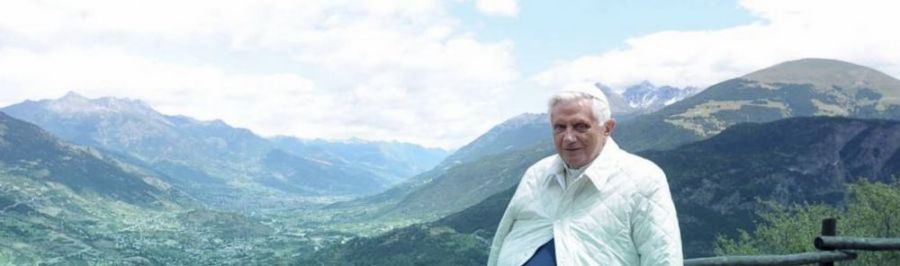
But what direction is this? How do we find it? Our Gospel passage offers two clues in this regard. In the first place it says that it is an ascent. This has first of all a very concrete meaning. Jericho, where the last part of Jesus' pilgrimage began, is 250 metres below sea-level, whereas Jerusalem the destination is located at 740 to 780 metres above sea level: a climb of almost 1,000 metres. But this external route is above all an image of the internal movement of existence that occurs in the following of Christ: it is an ascent to the true heights of being human. Man can choose an easy path and avoid every effort. He can also sink to the low and the vulgar. He can flounder in the swamps of falsehood and dishonesty. Jesus walks before us and towards the heights. He leads us to what is great, pure. He leads us to that healthy air of the heights: to life in accordance with the truth; to courage that does not let itself be intimidated by the gossip of prevalent opinions; to patience that bears with and sustains the other. He guides people to be open towards the suffering, to those who are neglected. He leads us to stand loyally by the other, even when the situation becomes difficult. He leads us to the readiness to give help; to the goodness that does not let itself be disarmed, even by ingratitude. He leads us to love he leads us to God.
Jesus "went on ahead, going up to Jerusalem". If we interpret these words of the Gospel in the context of the way Jesus took in all its aspects a journey which, precisely, continues to the end of time in the destination, "Jerusalem", we can discover various levels indicated. Of course, first of all, it must be understood that this simply means the place, "Jerusalem": it is the city in which God's Temple stood, whose uniqueness must allude to the oneness of God himself. This place, therefore, proclaims two things: on the one hand it says that there is only one God in all the world, who exceeds by far all our places and times; he is that God to which the entire creation belongs. He is the God whom all men and women seek in their own depths, and of whom, in a certain way, they all have some knowledge. But this God gave himself a Name. He made himself known to us, he initiated a history with human beings; he chose a man Abraham as the starting point of this history. The infinite God is at the same time the close God. He, who cannot be confined to any building, nevertheless wants to dwell among us, to be totally with us.
If Jesus, with the pilgrim Israel, goes up to Jerusalem, he goes there to celebrate with Israel the Passover: the memorial of Israel's liberation a memorial which, at the same time, is always a hope of definitive freedom, which God will give. And Jesus approaches this feast in the awareness that he himself is the Lamb in which will be accomplished what the Book of Exodus says in this regard: a lamb without blemish, a male, who at sunset, before the eyes of the children of Israel, is sacrificed "as an ordinance for ever" (cf. Ex 12: 5-6, 14). And lastly, Jesus knows that his way goes further: the Cross will not be his end. He knows that his journey will rend the veil between this world and God's world; that he will ascend to the throne of God and reconcile God and man in his Body He knows that his Risen Body will be the new sacrifice and the new Temple; that around him, from the hosts of Angels and Saints the new Jerusalem will be formed, that is in Heaven and yet also on the earth, because by his Passion he was to open the frontier between Heaven and earth. His way leads beyond the summit of the Mountain of the Temple to the heights of God himself: this is the great ascent to which he calls us all. He always remains with us on earth and he has always already arrived with God. He guides us on earth and beyond the earth.
Thus, the dimensions of our sequela become visible in the ascent of Jesus the goal to which he wants to lead us: to the heights of God, to communion with God, to being-with-God. This is the true destination and communion with him is the way to it. Communion with Christ is being on the way, a permanent ascent toward the true heights of our call. Journeying on together with Jesus is at the same time also a journeying on in the "we" of those who want to follow him. It introduces us into this community. Since the way to true life, to being people in conformity with the model of the Son of God Jesus Christ, surpasses our own strength, this journey always means being carried. We find ourselves, so to speak, roped to Jesus Christ together with him on the ascent towards God's heights. He pulls and supports us. It is part of following Christ that we allow ourselves to be roped together; that we acknowledge we cannot do it alone. This act of humility, entering into the "we" of the Church is part of it; holding tight to the rope, the responsibility of communion not breaking the rope through stubbornness or self-importance. Humbly believing, with the Church, like being a roped-party on the ascent towards God, is an essential condition for the following of Christ. This being roped together also entails not behaving as masters of the Word of God, not running after a mistaken idea of emancipation. The humility of "being with" is essential for the ascent. The fact that in the Sacraments we always let the Lord once again take us by the hand is also part of it; that we let ourselves be purified and strengthened by him; that we accept the discipline of the ascent, even when we are weary.
[Pope Benedict, Palm Sunday homily 28 March 2010]








