


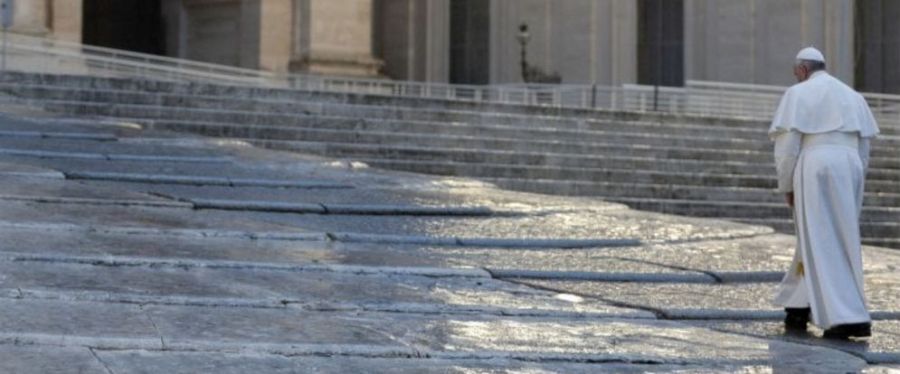
"Ask Jesus for the grace to follow him closely", so as not to leave him alone, thus overcoming the temptations of looking to ourselves to "share the cake" of personal interests: this is the spiritual advice suggested by Francis in the Mass celebrated on Tuesday 3 October at Santa Marta.
"This passage from the Gospel," the Pontiff immediately pointed out, referring to the liturgical passage from Luke (9:51-56), "tells us of the moment when the Lord's passion draws near: 'While the days were being fulfilled when he would be lifted up on high'". And so, he explained, 'Jesus goes on, the moment of the cross, the moment of passion, is approaching, and in the face of this Jesus does two things'.
First, the Lord 'made the firm decision to set out - "I accept the will of the Father" - and he goes forward'. Then, "he announces this to his disciples: Jesus is determined to do the Father's will to the end". And to the Father he says this clearly: 'It is your will, I am here to obey; you do not want sacrifice, but you want obedience and I obey and go forward'.
Moreover, said the Pope, Jesus "only once allowed himself to ask the Father to move this cross away a little": when in the Garden of Olives he asked the Father: "If possible, remove this cup from me, but not my will, but your will be done". Jesus is "obedient to what the Father wants: firm and obedient and nothing more, and so to the end".
"The Lord enters into patience," the Pontiff continued, because "it is an example of not just dying suffering on the cross, but walking in patience". Thus Jesus, "in the face of this firm decision he made, communicates to his disciples that the time is drawing near". For their part, 'the disciples - so many passages in the Gospels recount their attitude before this journey towards Jerusalem - sometimes they did not understand what it meant or did not want to understand, because they were afraid, they were frightened'. So much so that, the Pope pointed out, 'when Jesus told them to go to Martha and Mary because Lazarus was dead, they tried to convince him not to go there in Judea because it was dangerous for their lives: they were afraid, they were frightened'.
For this reason, therefore, the disciples "did not ask, they did not understand", perhaps telling themselves that it was "better not to ask about this: 'let time go on, perhaps it will change, and no we will not speak of this subject'". In short, it is the attitude of 'hiding the truth under the table, there, so that it cannot be seen'. What's more, 'others, at other times, spoke of things of their own, things totally detached from what Jesus was saying'.
In fact, when the Lord exhorted: "Let us go to Jerusalem, the son of man will be crucified", they did not understand what he was talking about. And "they were ashamed because they had talked about who among them was the greatest: 'No, you will get this when the kingdom comes; me on the right, you on the left'. And they shared the cake, a piece to each one". While Jesus remained "alone, alone". Instead "at other times, as in this case, they would try to do something: "Lord there is one who casts out demons, but he is not of us, what shall we do?". Or they did "like the two sons of Zebedee who wanted to be at the right and left of Jesus at the time of the coming of the kingdom". Luke, in his gospel, relates that the Samaritans did not want to receive Jesus in a village. And the reaction of James and John is strong: "Shall a fire come down from heaven and consume them?" In short, the Pope explained, 'they try to do alienating things' but, the evangelist continued, 'Jesus turned around and rebuked them'.
In essence, said the Pontiff, the disciples "were looking for an alibi so as not to think about what they were waiting for". And instead "Jesus" was "alone, he was not accompanied in this decision, because no one understood the mystery of Jesus, the loneliness of Jesus on his way to Jerusalem: alone!". All "this until the end": suffice it to think, the Pope relaunched, "of the disciples' abandonment, of Peter's betrayal". Jesus is therefore "alone: the Gospel tells us that only an angel appeared to him from heaven to comfort him in the Garden of Olives. Only that company. Alone!".
"But he, alone, took the decision to go ahead and do the Father's will," Francis noted. And the disciples "did not understand: they were doing other things, arguing among themselves or looking for alternatives so as not to think about it". This "loneliness of Jesus sometimes manifested itself: we remember the time he realised that he was not understood: 'O unbelieving and perverse generation, how long should I stay among you and put up with you?'". The Lord, therefore, "felt this loneliness".
Precisely in this perspective, the Pope suggested "that today we all take some time to think: Jesus loved us so much and was not understood by his own". Even 'the relatives, the Gospel says, when they went to see him said: "He is out of his mind, he is out of his mind. He was not understood'. And so, Francis insisted, it is important 'to think of Jesus alone, towards the cross, decisive, in the midst of his own incomprehension: to think this and to see Jesus walking decisively towards the cross and to thank him'. To say, in short: 'Thank you Lord because you were obedient, you were courageous; you loved so much, you loved me so much'.
In this way one can 'have a conversation with him today: how often do I try to do so many things and not look at you, who did this for me? You who entered into patience - the patient man, patient God - and who so patiently tolerates my sins, my failures?" And then, Francis said again, one can 'talk to Jesus like this - he is always determined to go ahead, to put on his face - and thank him'.
So, the Pontiff concluded, "let us take some time today, a few minutes - five, ten, fifteen - in front of the crucifix perhaps, or with our imagination see Jesus walking decisively towards Jerusalem and ask for the grace to have the courage to follow him closely."
[Pope Francis, St Marta, in L'Osservatore Romano 04/10/2017]








