


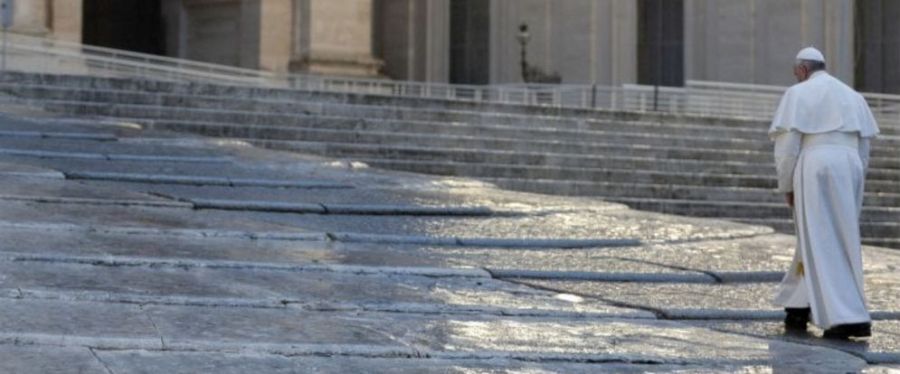
“When evening had come” [...] For weeks now it has been evening. Thick darkness has gathered over our squares, our streets and our cities; it has taken over our lives, filling everything with a deafening silence and a distressing void, that stops everything as it passes by; we feel it in the air, we notice in people’s gestures, their glances give them away. We find ourselves afraid and lost. Like the disciples in the Gospel we were caught off guard by an unexpected, turbulent storm. We have realized that we are on the same boat, all of us fragile and disoriented, but at the same time important and needed, all of us called to row together, each of us in need of comforting the other. On this boat… are all of us. Just like those disciples, who spoke anxiously with one voice, saying “We are perishing” (v. 38), so we too have realized that we cannot go on thinking of ourselves, but only together can we do this.
It is easy to recognize ourselves in this story. What is harder to understand is Jesus’ attitude. While his disciples are quite naturally alarmed and desperate, he is in the stern, in the part of the boat that sinks first. And what does he do? In spite of the tempest, he sleeps on soundly, trusting in the Father; this is the only time in the Gospels we see Jesus sleeping. When he wakes up, after calming the wind and the waters, he turns to the disciples in a reproaching voice: “Why are you afraid? Have you no faith?” (v. 40).
Let us try to understand. In what does the lack of the disciples’ faith consist, as contrasted with Jesus’ trust? They had not stopped believing in him; in fact, they called on him. But we see how they call on him: “Teacher, do you not care if we perish?” (v. 38). Do you not care: they think that Jesus is not interested in them, does not care about them. One of the things that hurts us and our families most when we hear it said is: “Do you not care about me?” It is a phrase that wounds and unleashes storms in our hearts. It would have shaken Jesus too. Because he, more than anyone, cares about us. Indeed, once they have called on him, he saves his disciples from their discouragement.
The storm exposes our vulnerability and uncovers those false and superfluous certainties around which we have constructed our daily schedules, our projects, our habits and priorities. It shows us how we have allowed to become dull and feeble the very things that nourish, sustain and strengthen our lives and our communities. The tempest lays bare all our prepackaged ideas and forgetfulness of what nourishes our people’s souls; all those attempts that anesthetize us with ways of thinking and acting that supposedly “save” us, but instead prove incapable of putting us in touch with our roots and keeping alive the memory of those who have gone before us. We deprive ourselves of the antibodies we need to confront adversity.
In this storm, the façade of those stereotypes with which we camouflaged our egos, always worrying about our image, has fallen away, uncovering once more that (blessed) common belonging, of which we cannot be deprived: our belonging as brothers and sisters.
“Why are you afraid? Have you no faith?” Lord, your word this evening strikes us and regards us, all of us. In this world, that you love more than we do, we have gone ahead at breakneck speed, feeling powerful and able to do anything. Greedy for profit, we let ourselves get caught up in things, and lured away by haste. We did not stop at your reproach to us, we were not shaken awake by wars or injustice across the world, nor did we listen to the cry of the poor or of our ailing planet. We carried on regardless, thinking we would stay healthy in a world that was sick. Now that we are in a stormy sea, we implore you: “Wake up, Lord!”.
“Why are you afraid? Have you no faith?” Lord, you are calling to us, calling us to faith. Which is not so much believing that you exist, but coming to you and trusting in you. This Lent your call reverberates urgently: “Be converted!”, “Return to me with all your heart” (Joel 2:12). You are calling on us to seize this time of trial as a time of choosing. It is not the time of your judgement, but of our judgement: a time to choose what matters and what passes away, a time to separate what is necessary from what is not. It is a time to get our lives back on track with regard to you, Lord, and to others. We can look to so many exemplary companions for the journey, who, even though fearful, have reacted by giving their lives. This is the force of the Spirit poured out and fashioned in courageous and generous self-denial. It is the life in the Spirit that can redeem, value and demonstrate how our lives are woven together and sustained by ordinary people – often forgotten people – who do not appear in newspaper and magazine headlines nor on the grand catwalks of the latest show, but who without any doubt are in these very days writing the decisive events of our time: doctors, nurses, supermarket employees, cleaners, caregivers, providers of transport, law and order forces, volunteers, priests, religious men and women and so very many others who have understood that no one reaches salvation by themselves. In the face of so much suffering, where the authentic development of our peoples is assessed, we experience the priestly prayer of Jesus: “That they may all be one” (Jn 17:21). How many people every day are exercising patience and offering hope, taking care to sow not panic but a shared responsibility. How many fathers, mothers, grandparents and teachers are showing our children, in small everyday gestures, how to face up to and navigate a crisis by adjusting their routines, lifting their gaze and fostering prayer. How many are praying, offering and interceding for the good of all. Prayer and quiet service: these are our victorious weapons.
“Why are you afraid? Have you no faith”?Faith begins when we realise we are in need of salvation. We are not self-sufficient; by ourselves we founder: we need the Lord, like ancient navigators needed the stars. Let us invite Jesus into the boats of our lives. Let us hand over our fears to him so that he can conquer them. Like the disciples, we will experience that with him on board there will be no shipwreck. Because this is God’s strength: turning to the good everything that happens to us, even the bad things. He brings serenity into our storms, because with God life never dies.
The Lord asks us and, in the midst of our tempest, invites us to reawaken and put into practice that solidarity and hope capable of giving strength, support and meaning to these hours when everything seems to be floundering. The Lord awakens so as to reawaken and revive our Easter faith. We have an anchor: by his cross we have been saved. We have a rudder: by his cross we have been redeemed. We have a hope: by his cross we have been healed and embraced so that nothing and no one can separate us from his redeeming love. In the midst of isolation when we are suffering from a lack of tenderness and chances to meet up, and we experience the loss of so many things, let us once again listen to the proclamation that saves us: he is risen and is living by our side. The Lord asks us from his cross to rediscover the life that awaits us, to look towards those who look to us, to strengthen, recognize and foster the grace that lives within us. Let us not quench the wavering flame (cf. Is 42:3) that never falters, and let us allow hope to be rekindled.
Embracing his cross means finding the courage to embrace all the hardships of the present time, abandoning for a moment our eagerness for power and possessions in order to make room for the creativity that only the Spirit is capable of inspiring. It means finding the courage to create spaces where everyone can recognize that they are called, and to allow new forms of hospitality, fraternity and solidarity. By his cross we have been saved in order to embrace hope and let it strengthen and sustain all measures and all possible avenues for helping us protect ourselves and others. Embracing the Lord in order to embrace hope: that is the strength of faith, which frees us from fear and gives us hope.
“Why are you afraid? Have you no faith”?Dear brothers and sisters, from this place that tells of Peter’s rock-solid faith, I would like this evening to entrust all of you to the Lord, through the intercession of Mary, Health of the People and Star of the stormy Sea. From this colonnade that embraces Rome and the whole world, may God’s blessing come down upon you as a consoling embrace. Lord, may you bless the world, give health to our bodies and comfort our hearts. You ask us not to be afraid. Yet our faith is weak and we are fearful. But you, Lord, will not leave us at the mercy of the storm. Tell us again: “Do not be afraid” (Mt 28:5). And we, together with Peter, “cast all our anxieties onto you, for you care about us” (cf. 1 Pet 5:7).
[Pope Francis, extraordinary moment of prayer 27 March 2020]








