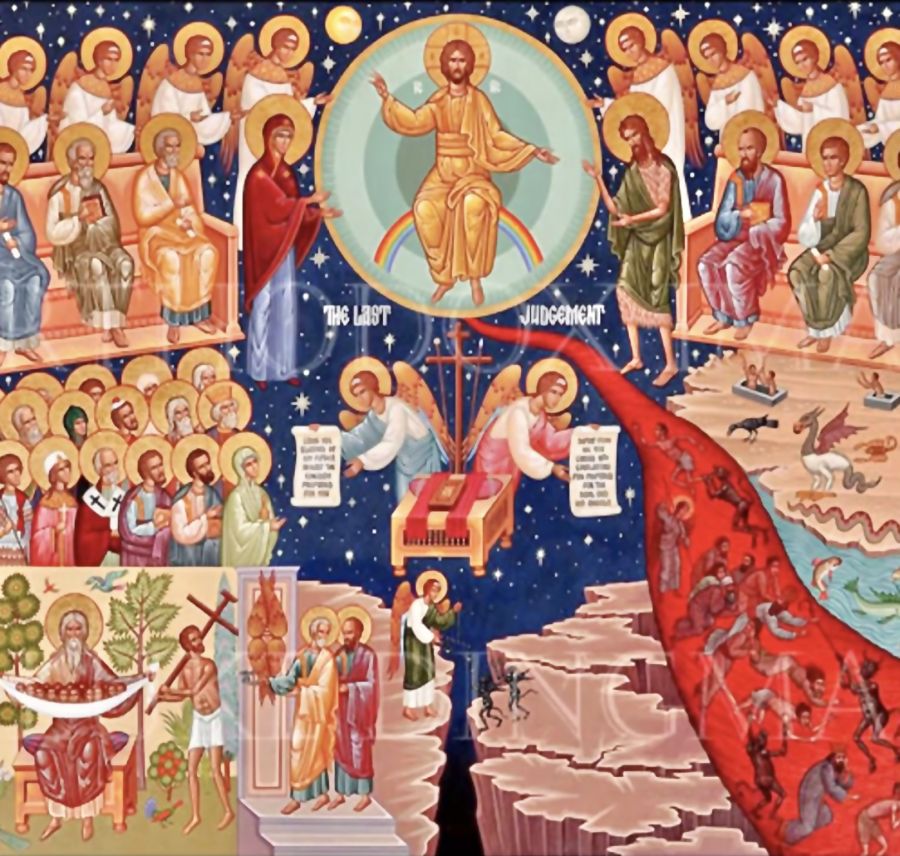
When the nations are gathered before the Lord, the works of blessing they have performed will speak on their behalf.
Those who recognised Christ himself in the needy of every kind – even if they did not realise it – will be in the divine state.
Those who, on the other hand, did not serve the little ones and the infirm will not be in the eternal Light.
Francis, a creature with a noble and sensitive heart, felt from a young age in his conscience the need not to turn a blind eye to the poor.
This tender inclination grew considerably after he encountered the Lord.
We read in the Sources some marvellous accounts of real life.
‘God, in fact, had instilled in the young Francis’s soul a feeling of generous compassion, which, growing with him from childhood, had filled his heart with goodness; so much so that even then, being no stranger to the Gospel, he resolved to give to anyone who asked him, especially if they asked for God’s sake.
On one occasion, whilst busy in his shop, he sent away empty-handed—contrary to his usual practice—a poor man who was begging him for alms for God’s sake. But immediately, coming to his senses, he ran after him, gave him a generous alms and promised the Lord God that, from then on, whenever he had the opportunity, he would never say no to anyone who asked him for the love of God.
And he kept this resolution until his death, with tireless charity, thereby deserving to grow abundantly in the love of God and in Grace.
Indeed, he later said, when he had by then been perfectly imbued with the sentiments of Christ, that even whilst he was still living as a layman, he could scarcely hear the love of God mentioned without feeling a deep stirring within him” (FF 1018).
«Come, you who are blessed by my Father […] for I was hungry and you gave me food» (Mt 25:34).
The Sources, moreover, tell of a woman who had come from Machilone to Rieti to have her eyes treated.
The doctor, having gone to see Francis, told him about this poor woman, claiming that he would treat her free of charge, paying the expenses himself.
The Poverello, then, immediately went to his guardian, stating that one must return what belongs to others.
The superior asked him what he was referring to, and Francis replied:
«This is the cloak we borrowed from that poor woman suffering from an eye ailment: we must return it to her» (FF 1602).
The guardian agreed.
The Friar then called a devout man with whom he was on close terms. He handed him the cloak and twelve loaves of bread, urging him to go to the eye doctor and ask to be directed to the poor woman to whom he should deliver everything.
«Go and say to that poor, ailing woman: “The poor man to whom you lent this cloak thanks you most sincerely for the loan. And now, take what belongs to you’» (FF 1602).
The friend did as the Saint had suggested. The woman, unable to make sense of it all and overcome by unease and suspicion, replied: “Leave me in peace. I don’t know what you’re on about” (FF 1602).
But the man placed the cloak and the twelve loaves in her hands. Then the poor woman became convinced that he was serious, torn between concern and happiness. Fearing, moreover, that the help she had received might be taken away from her, she returned to her home that night.
Francis had instructed his guardian to cover the expenses of the poor, sick woman every day, for as long as she remained in Rieti.
The Sources also emphasise what his friars attested:
«We who lived with him can bear witness that Francis, whether healthy or infirm, overflowed with love and tenderness not only for his friars, but towards all the poor, both the healthy and the sick.
He would deprive himself of the necessities that the brothers provided for him with care and affection – whilst still showing us kindness, so that we might not take offence – in order to offer them with great joy to others, even depriving his own body of what was indispensable to him» (FF 1602).
Charity speaks for itself!
«Come, you who are blessed by my Father; take your inheritance, the kingdom […] for I was hungry and you gave me food» (Mt 25:34)
34th Sunday in Ordinary Time, year A, Christ the King (Mt 25:31–46)