


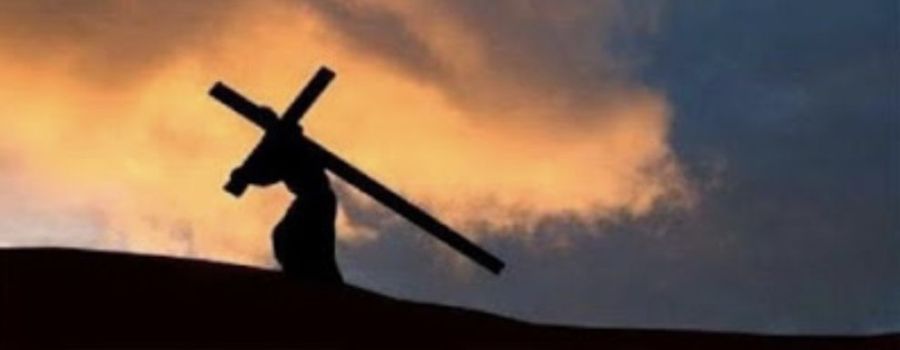
(Lk 23:35-43)
The Son is crucified between criminals. For the political and religious powers, he was a far greater danger.
According to Luke, only one of them reviled him; the other called Jesus by name and entrusted himself to him (v. 42).
At the beginning of the Gospel, the coming of the Lord is placed among the least of the earth.
From the beginning, he reveals himself to the world among unclean and despised people [who were even certain that they would be put to death by the Messiah the judge, and who therefore feared him], not among the righteous and holy of the Temple.
Then his whole life unfolds among tax collectors and sinners, because he came for them.
In fact, who brings us back to the Father's house? Just anyone, who represents all of us - a criminal who had committed murder - because all sins consist in taking away someone's life and joy of living.
So that murderer represents us. And Christ begins to build his family with a criminal at his side, who is us: sinners redeemed by his unconditional love.
What proposals offer us a valid impetus and do not amputate precious parts of ourselves?
What do we believe can deify us, bringing us closer to a full life?
Who is a friend who does not interrupt us, and who is an enemy - capable of making us grow (or dehumanise us)?
In Luke, the crowd is in disarray.
The people do not insult the Faithful accused by the religious authorities, but remain perplexed, unable to understand.
The people have not had sound spiritual guides capable of helping them recognise their own world of God - and vice versa, what makes it caricatural.
The title of universal King is one that today carries with it many misunderstandings - when attributed to the authentic Christ, it is reduced to nothing.
This is because it is confused with fatuous merits, artificial grandeur, theatrical magnificence and mere appearance [mostly ridiculous].
The royalty of those who believe in Him is unapparent, but it is all substance. It is a power that opens up new possibilities, even in dark times.
It has nothing to do with the temptations of self-fulfilment through trivial, hasty, superficial, comfortable thinking and the promotion of oneself alone (vv. 37.39).
In the Gospels, in fact, evil is presented not as a wicked adversary and antagonist, but as an affable and complacent advisor who seems to convey security from the unexpected and help us gain positions.
A friend who loves and protects us, therefore giving us tips on how to assert ourselves, impose ourselves, and succeed. And yet affirming in things of social [but superficial] importance that degrade our personal vocation.
Even (as has often seemed to be the case, unfortunately) in the spiritual realm.
But focusing on appearances ends up making us ignore and not understand the deep paths of the soul.
On Calvary, the Lord achieves kingship, a way of crowning life, an elevation of self, diametrically opposed to what the evil one suggests.
And here he is again at the crucial appointment set from the beginning of his public life (Lk 4:1-13), at the moment of extreme weakness!
In short, we want to be great, capable of surpassing others, and well regarded, even in the spiritual life.
But to become village chiefs, we must be cunning or blend in with the crowd, and follow criteria that have nothing to do with the life of Jesus.
We must ally ourselves with important people, introduce ourselves, make ourselves known, learn to seduce, be quick, well-connected, agile, and skilful.
In this way, even on the path to God, we give in to the temptation of status, calibre, notoriety, consideration, visibility, and comfort. And we must keep our mouths shut, otherwise there will be no career.
The urge of the gut recommends: 'Come on, together we can do something big, and you will be the dominant one in the nest. Instead of just another failure, you will become someone to be revered'.
But the dimension of the Kingdom is upside down.
At the word 'kingdom', Pilate immediately thought of that of Tiberius (vv. 2-4).
Instead, at the end of his life, what was Jesus' throne? And the obsequious servants?
Below him was an audience that insulted and challenged him.
The bodyguards? Where did the ambitious ministers, generals and colonels, those who sprang to his orders, end up?
Two unfortunate souls, disfigured by their own mistakes, who represent us.
But someone recites the mantra until the end: 'Save yourself!'.
Christ and his close friends do not intend to destroy the soul, so they do not come down from the gallows; on the contrary, they recognise it as 'their own': a supreme opportunity.
We do not want to add more years, but more intensity to life.
We do not adapt our hearts to the old royalty, that of those who intimidate, flex their muscles, use their abilities and even their devout appearance only for their own gain - building situations of papier-mâché, without backbone.
These are very dangerous people: they are the gendarmes of an ambitious, competitive, cynical world. Accustomed to the flattering servility that makes everyone bow their heads.
They offer 'vinegar', sour wine (v. 36): the corruption of love and celebration.
Their bitter product is that love of the system of things, and a caricature of happiness linked to power that 'counts'.
If approved, they risk making us give up our desire for an alternative world and fall back on ourselves.
Instead, the criminal calls him by name, recognising him as a travelling companion, confidant and natural ally.
Someone who stands by him and is able to create inner harmony; a quieter path.
So, how do Victory and Peace relate to each other within us?
It is a 'time' that we perhaps do not yet know, despite the virtuosity of devout fulfilments (which sometimes take root in the worst disturbances).
By becoming more attentive and loving, less distant and competitive, we might respond in a surprising way to such a question:
Is it prevailing that brings a sense of harmony, liveliness and completeness, or vice versa?
What distracts us from the whirlpool of idols that divert our existence and confuse our destination?
Salvation comes from what is considered insipid and nothing in our lives, yet it opens up the infinity that already dwells within us - the boundlessness of the primordial, present and final Friend.
He reverberates in the heart and guides us - the Eternal One who resonates intimately, even in tragic situations.
This comes even from the one who - the benevolent, oppressed Jesus - was considered cursed by God and regarded as the scum of society à la page.
Conversely, a friendly Presence; one that makes us 'see' and unlocks us.
The radical difference between religiosity and Faith? The sense of an intimate and surprising Mystery that awakens us.
The God of religions drives contradictory and inadequate women and men out of Paradise. The Father welcomes them.
To internalise and live the message:
The leaders mock: 'You have abilities: think of yourself, assert yourself, be selfless; you must rise above, or at least float. Don't worry about anything else!'.
Which character do you recognise yourself in?
In moments of weakness, are you tempted by power, or do you look inside and see better - precisely by going through your inadequacy?








