


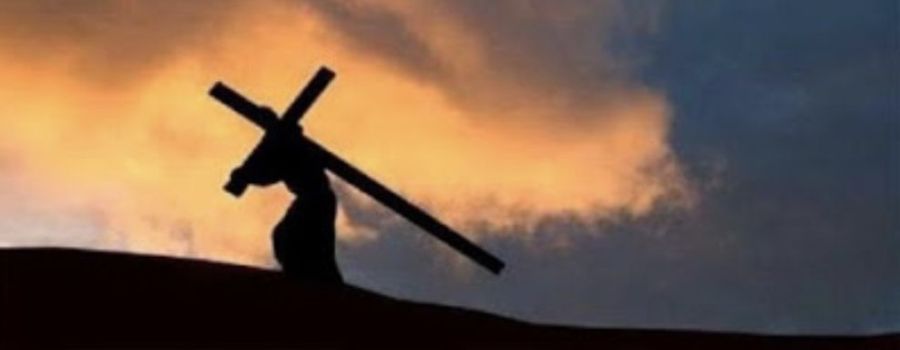
(Mt 8:23-27)
Excita, Domine, potentiam tuam, et veni
"Excita, Domine, potentiam tuam, et veni" - with these and similar words the Church's liturgy repeatedly prays [...].
These invocations were probably formulated in the period of the decline of the Roman Empire. The disintegration of the supporting orders of law and of the basic moral attitudes, which gave them strength, caused the breaking of the banks that had hitherto protected peaceful coexistence between men. A world was passing away. Frequent natural cataclysms further increased this experience of insecurity. No force could be seen to halt this decline. All the more insistent was the invocation of God's own power: that He would come and protect men from all these threats.
"Excita, Domine, potentiam tuam, et veni". Today, too, we have many reasons to associate ourselves with this prayer [...] The world with all its new hopes and possibilities is, at the same time, distressed by the impression that the moral consensus is dissolving, a consensus without which legal and political structures do not function; consequently, the forces mobilised to defend these structures seem doomed to failure.
Excita - the prayer is reminiscent of the cry addressed to the Lord, who was sleeping in the disciples' storm-tossed boat that was close to sinking. When His powerful word had calmed the storm, He rebuked the disciples for their little faith (cf. Mt 8:26 and par.). He wanted to say: in yourselves faith has slept. He also wants to say the same thing to us. Even in us so often faith sleeps. Let us therefore pray to Him to awaken us from the sleep of a faith that has become weary and to restore to faith the power to move mountains - that is, to give right order to the things of the world.
[Pope Benedict, to the Roman Curia 20 December 2010].
Our life proceeds as on a small boat tossed about by earthquakes. We go hopeful, but sometimes adversity threatens to drown us, and with us it seems to drag our whole life down.
Episodes that nevertheless make us realise how much Christ's friendship is worth to us and what it conveys to us.
For we experience that only the Lord overcomes the fear of upheavals.
But he does so without rushing, and without any set patterns that would frame him forever (it would be like making him perish).
If we welcome Him in a simple and forthright manner, we realise that there is another realm, that every element is in His power.
On such a wave that has become vital, everything will serve to reactivate us - even the headwind and the pitfalls of evil.
The Invisible Friend guides and fulfils us infallibly. And he brings us to Riva. Landing that is the ultimate condition.
Dry land that the force of the waves cannot affect, even when we have the feeling of being swept away by the waves.
Using paraphrases from the book of Exodus, Mt tries to help his communities understand the Mystery of the Person of Jesus.
Not a few Jewish converts considered Christ to be a person in line with their mentality and tradition, in agreement with First Testament prophecies and figures.
Elsewhere, some pagans who had accepted the Lord advocated an understanding with the worldly mentality - a kind of agreement between Jesus and the Empire.
But who could calm the storms?
The situation of the tiny Christian families in Galilee and Syria was still dark. Christ seemed not quite present, and the sea was rough, the wind contrary.
Could the Exodus be re-created?
Faith in Him was shaken, not relaxed. The disciples did not possess the Master's same calm trust in the Father.
And yet, in the very condition of shaken pilgrims, in approaching His Person they experienced a strange and different stability: the perseverance against the tide.
A crossing towards freedom that came from clinging to Jesus alone, in the chaos of security. A discordant permanence.
Even today, it is the unaccustomed and critical path of growth that reveals Him capable of manifesting His quiet strength, restoring the disrupted elements to calm.
The direction of travel imposed by Jesus on His disciples seems to go against the grain, and brazenly breaks the rules accepted by all.
While the disciples fondle nationalist desires, the Master begins to make it clear that He is not the vulgarly expected Messiah, restorer of the defunct empire of David or the Caesars.
The Kingdom of God is open to all mankind, who in those turbulent times sought security, acceptance, points of reference. Everyone could find home and shelter there (Mt 13:32c; Mk 4:32b).
But the apostles and church veterans seemed averse to Christ's proposals; they remained insensitive to an overly broad idea of fraternity - which displaced them. This is still a live and very serious problem.
The teaching and call imposed on the disciples is to cross to the other shore (Mk 4:35; Lk 8:22), that is, not to keep to oneself.
The Apostles have the task of communicating the riches of the Father to the pagans, who are considered impure and infamous.
Yet it was precisely the Master's intimates who did not want to know about risky disproportions that would actually make the Son of God's wide-ranging action stand out.
They were willingly tarred by common religiosity, and a circumscribed ideology of power.
The resistance to the divine commission, and the resulting lacerating internal debate, had already stirred up a great storm in the assemblies of believers in the 1970s.
"And behold, there came great turmoil in the sea, so that the boat was covered with waves" (Matthew 8:24).
The storm concerned the disciples alone, the only ones who were dismayed; not Jesus: "but he was asleep" (v.24c) [this is about the Risen One].
What was happening "inside" the little boat of the Church was not a mere reflection of what was happening "outside"! This is the error to be corrected.
For us too, such identification can block and make life chronic, precisely from the handling of emotionally relevant situations - which have their own meaning.
They always carry a meaningful appeal, introduce a different eye, introspection, dialogue.
In short, from the peace of the divine condition that dominates chaos, the Lord calls attention to and rebukes the apostles, accusing them of lacking Faith.
Though devout, they lack an ounce of risk. They lack love - like a mustard seed (v.26) - to bring to humanity to renew it.
And are we believers still confused, embarrassed? Is the chaos of patterns still raging - not excluding selfishness, which inexorably peeps out?
We paradoxically go the way of the Exodus, of the experience of the first; right 'knowledge', because it is direct. The only caveat: we must not be taken in by fear.
In Him, we are imbued with a different vision of danger.
Says the Tao Tê Ching (xxii): "The saint does not see by himself, therefore he is enlightened". Even in straits.
At all times it seems that Jesus expressly wanted the dark moments of confrontation and doubt for the apostles (Mk 4:35; Lk 8:22b). First and foremost, it will be some church leaders who will be called upon to cleanse themselves of repetitive convictions. Only in this way will their proclamation not remain misplaced.
For textbook expectations (and the habit of setting up conformist harmonies) block the flowering of what we are and hope for.
Especially what is annoying or even 'against' has something decisive to tell us.
Even in the boat of the assemblies [cf. Mk 4:36] discomfort must express itself.
"And they drew near and awoke him, saying, Lord, save us, we are lost!" (v.25).
The peril is an opportunity to revive the essence of each person and of the community itself.
The trial introduces change (hidden or repressed) and activates it in the most effective way.
Novelty comes from natural contact with hidden, primordial energies.
More than opposing frictions and conflicting external events, anxiety, impression, anguish, arise from the very fear of facing the normal or decisive questions of existence.
This can happen out of distrust: feeling the danger perhaps only because we perceive ourselves to be intimately undeveloped, and incapable of other conversation; of discovering and reworking, converting, or remodelling.
The fatigue of questioning ourselves and the suffering that the adventure of Faith holds, will also fade amidst the discomfort of the rough sea - which precisely does not want us to return to 'those of before'.
It is enough to disengage from the idea of stability, even religious stability, and listen to life as it is, embracing it.
Even in its throng of bumps, bitterness, shattered hopes for harmony, sorrows - engaging with this flood of new emergencies, and encountering one's own deep nature.
The best vaccine against the anxieties of adventuring together with Christ on the changing waves of the unexpected. will be precisely not to avoid worries upstream - on the contrary, to go towards them and welcome them; to recognise them, to let them happen.
Even in times of global crisis, the apprehensions that seem to want to devastate us, come to us as preparatory energies of other joys that wish to break through. New cosmic attunements; for wonderment from within ourselves - and guidance from beyond.
Our little boat is in an inverted, inverted, unequal stability; uncertain, unseemly - yet energetic, prickly, capable of reinventing itself.
And it may even be excessive, but it is disruptive.
For a proposal of Tenderness (not corresponding) that is not a relaxation zone, because it rhymes with terrible anxiety and... still unfulfilled suburbs!
To internalise and live the message:
On what occasions have you found easy what before seemed impossible? Do you ever raise your voice to Jesus? By what Name did He reveal Himself to you? By what title would you call Him? Have you crossed waters you did not foresee in your plans and intentions? Who has calmed your storms? How do you experience harmony?Some other providence, which you ignore
"It is good not to fall, or to fall and rise again. And if you happen to fall, it is good not to despair and not to become estranged from the love the Sovereign has for man. For if he wills, he can do mercy to our weakness. Only let us not turn away from him, let us not be distressed if we are forced by the commandments, and let us not be disheartened if we come to nothing (...).
Let us neither hurry nor retreat, but always begin again (...).
Wait for him, and he will show you mercy, either by conversion or by trials, or by some other providence that you do not know."
[Peter Damascene, Second Book, Eighth Discourse, in La Filocalia, Turin 1982, I,94]








