


don Giuseppe Nespeca
Giuseppe Nespeca è architetto e sacerdote. Cultore della Sacra scrittura è autore della raccolta "Due Fuochi due Vie - Religione e Fede, Vangeli e Tao"; coautore del libro "Dialogo e Solstizio".
26th Sunday in O.T.
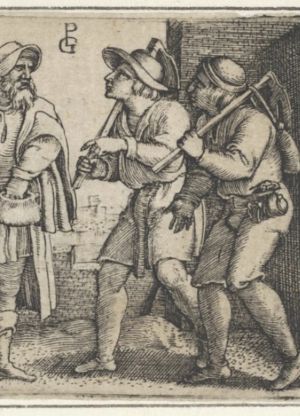
26th Sunday in Ordinary Time (year A) [27 September 2026]
First Reading from the Book of the Prophet Ezekiel (18:25–28)
To understand Ezekiel’s prophecy, we must recall the dramatic context in which he speaks. In 597 BC, many inhabitants of Jerusalem were deported to Babylon by Nebuchadnezzar’s army. Jerusalem had been devastated, the Temple desecrated, and the population decimated. The exiles found themselves far from the Promised Land and from everything that had given meaning to their lives. Faced with such a tragedy, the question arose spontaneously: ‘What have we done to God to deserve all this?’. At that time, it was widely believed that there was a direct correlation between a person’s behaviour and what happened to them: the righteous are rewarded and the sinner punished. For this reason, the exiles repeated a proverb: ‘The fathers have eaten sour grapes, and the children’s teeth are set on edge’ (Ezekiel 18:2). In other words: we are paying for the sins of our fathers and of previous generations.
Ezekiel breaks with this mindset. God says through the prophet: ‘You shall no longer repeat this proverb in Israel.’ No one is condemned to live under the burden of others’ sins. Every person is called to answer for their own choices. And here a great new truth emerges: the past does not definitively determine the future. If the wicked turn away from their ways, practise righteousness and justice, repent and return to God, they may live. ‘If the wicked turn away from all the sins they have committed, […] they shall live’ (cf. Ezekiel 18:21). It is an extraordinarily relevant message: no one is a prisoner of their own past, but it is always possible to start afresh, and this frees people from the belief that they are condemned to pay for the sins of others and restores to them the possibility of hope. No past is so burdensome as to prevent a fresh start. Even in times of trial, God opens up a new path before us. Hope springs precisely from the certainty that God’s mercy always leaves open the possibility of a fresh start. Conversion, from a biblical perspective, is precisely a change of direction, a ‘returning’ to God. Ezekiel also reminds us that true conversion does not consist merely of words or religious practices: it is manifested concretely in the practice of law and justice, that is, in the way we treat others.
Responsorial Psalm (24/25)
The words ‘way’, ‘road’, ‘path’ and the verb ‘guide me’ recur several times in the Psalm: ‘Lord, make me know your ways; teach me your paths. Guide me in your truth and instruct me, for you are the God of my salvation… The Lord shows sinners the way; he guides the poor in righteousness and teaches the humble his way’. The theme of the journey is characteristic of penitential psalms. God’s Law—that is, his commandments—is like a sort of ‘highway code’. The speaker is a sinner who recognises that he has gone astray, that he has taken the wrong path, and asks God to bring him back onto the right path. It is no coincidence that, in the Bible, to ‘convert’ literally means ‘to turn back’, ‘to turn round’. And it is never too late to turn back. In the first reading, Ezekiel reminded us that a future is always possible: no one is definitively condemned by their past. That is why we can still pray: ‘Lord, teach me your ways’. What is asked of us? First and foremost, not perfection, but humility: ‘The Lord teaches the humble his way’. The Hebrew word anawim, translated as ‘the humble’ or ‘the poor’, refers to those who recognise that they are poor, fragile, without resources and in need of God. They are the ‘poor in spirit’, those who are able to pray simply: ‘Lord, have mercy on me’. Their plea is already a call for conversion: ‘Lord, teach me your way’. And the ‘I’ speaking in the Psalm is not merely an individual, but the entire people. Psalm 24/25 was probably used in penitential celebrations in the Temple in Jerusalem, which is why there is a constant interplay between ‘I’ and ‘we’ in biblical prayer. The Psalm speaks in the first person, but at the end it says: ‘Deliver Israel, O God, from all its troubles’. The ‘I’ therefore encompasses the ‘we’. The biblical person possesses a strong sense of solidarity across generations: the God of Abraham, Isaac and Jacob is the God of their descendants; the Covenant with Noah, Abraham and Moses concerns not only the individual, but the whole people. Today, however, our society often tends to place the individual, their freedom and their personal rights at the centre, sometimes at the expense of the communal dimension. The Bible has taken a different path: it has progressively discovered the importance of the individual without ever separating them from the community. This is one of the great riches of biblical revelation: the individual is not lost within the community, nor is the community forgotten in favour of the individual. We are personally responsible, yet at the same time we stand in deep solidarity with one another. For this reason, in the Psalm, that humble and trusting sinner is at once each one of us and the entire community of believers. Finally, there is a particularly beautiful detail: the Psalm continually plays on the theme of memory and forgetfulness: ‘Remember, Lord, your mercy… Do not remember the sins of my youth… Do not forget me’. It is almost a prayer that God might have a ‘selective memory’: that he might forget our sins and remember his mercy instead!
It is a bold prayer, yet also one of profound humility. Bold, because it springs from trust in the Covenant; humble, because it acknowledges one’s own sin and frailty. Man asks God: ‘Do not remember what I have been; remember instead who You are: merciful, faithful, slow to anger and great in love.’ After all, even in the Old Testament, Israel had discovered something surprising: God is not merely the Judge, but a Father full of tenderness and mercy. And so the prayer of the Psalm can also become our own: “Lord, when I have gone astray, teach me your way. When I have fallen, show me that I can return. When I recognise my own poverty and fragility, guide me. Do not remember my sins: remember your mercy. And grant that my ‘I’ may never forget the ‘we’ of the community of your children”.
Second Reading from the Letter of Saint Paul to the Philippians (2:1–11)
On Palm Sunday, every year we hear above all the second part of this text, the part that contemplates the mystery of Christ: ‘Though he was in the form of God, he did not regard equality with God as something to be grasped’. Today, however, let us focus on the first part, in which Paul explains to us how to live ‘in Christ’. Paul uses this expression at the beginning and end of the passage: ‘If, then, there is any consolation in Christ…’ and then: ‘Have in you the same mindset as Christ Jesus’. Between these two statements, he lists the attitudes that must characterise the Christian life: comfort, love, fellowship, tenderness, compassion. It is no coincidence that these are the very same attributes with which God is described in the Old Testament. Being ‘in Christ’ is therefore not merely a figure of speech. From the moment of Baptism, we belong to Christ; we are incorporated into Him and become members of His Body. This new identity transcends all our differences: cultural, social, economic and physical. We now have a common name: Christians. It is like what happens in a large family: when we meet, before any other differences, we recognise that we belong to the same family. It is this profound sense of belonging that should characterise the Christian community. Paul says: ‘Have the same mindset, the same love, one spirit and one purpose’. It is as if he were telling us: honour the family to which you belong; honour the name you bear. Then comes a surprising expression: ‘Consider others better than yourselves’. This does not mean belittling oneself or thinking one is inferior. The Gospel does not ask us to rank people as superior or inferior. The Kingdom of God does not operate according to the logic of competition and comparison. The point is quite another: to learn to look at others with a positive gaze, almost with an attitude of admiration, seeking to see not what they possess, but what they are. The differences we see – physical, cultural, social, economic – belong above all to the dimension of ‘having’. Paul, on the other hand, leads us into the dimension of ‘being’: ‘ ‘As many of you as were baptised into Christ have clothed yourselves with Christ’ (Gal 3:27). When I meet another baptised person, therefore, I must not stop at what is apparent. I must remember that they are a member of the Body of Christ, a temple of the Holy Spirit, and that they have a personal vocation, different from my own, yet necessary to God’s plan. Everyone possesses a gift that no one else can replace. Because of the mission God has entrusted to them, the other person may be ‘better’ than me, in the sense that they possess what I do not possess and can accomplish what I cannot. For this reason, they also need my esteem, my encouragement and my trust. The important thing is not to determine who is worth more, but to know what mission God entrusts to each individual and to the community as a whole. Every person is called to contribute to the building of the Kingdom according to the gift received from the Spirit. Finally, there is a great truth contained in this text: the Kingdom of God is already present, but it has yet to be fulfilled in our lives. In Christ, indeed, God’s plan to reunite humanity has already begun and, through Baptism, we have been incorporated into this reality. But what is already true in Christ must also gradually become true in our daily lives. Our being ‘in Christ’ cannot remain merely an inner reality or a simple religious formula: it must tangibly transform the way we view, welcome and treat others, both Christians and non-Christians. And here we understand the profound link between the two parts of the text. First, Paul tells us how those who are ‘in Christ’ should live; then he shows us how Christ himself lived: not seeking his own advantage, but humbling himself, becoming a servant and giving himself even to the point of death on the cross. For this reason, the Christological hymn is not merely a beautiful contemplation of Jesus: it is the concrete measure of our lives. ‘Let this mind be in you which was also in Christ Jesus’. To be Christian, therefore, means allowing the very movement of Christ to enter our lives: not asserting ourselves against others, but giving of ourselves; not seeking to be superior, but serving; not focusing on what the other possesses, but recognising who they are before God. It is in this way that what Christ has already accomplished becomes, day by day, a reality lived out in the Church and in the world.
From the Gospel according to Matthew (21:28–32)
‘Which of the two did the will of his father?’ This question from Jesus seems simple, almost too simple. Once again we find ourselves in the vineyard, as we did last Sunday. A father asks his two sons to go and work in the vineyard. The first replies ‘no’, but then changes his mind and goes; the second replies straight away: ‘Yes, sir’, but then does not go. Jesus asks the chief priests and the elders: ‘Which of the two did the will of his father?’ Clearly, he does not wish to test them with a simple riddle: he wants to open their eyes. The answer is obvious: the first. And it is precisely then that Jesus applies the parable to his listeners: you are like the second son. You say ‘yes’ to God; you are religious people, you know the Law, you await the Messiah and pray for his coming; yet when God sends him to you, you do not recognise him and you do not accept his word. It was the Father’s will that his people—and above all his religious authorities—should welcome his Envoy, the Messiah, Jesus. Herein lies the tragedy that will lead to the Passion: precisely those who seemed best prepared to welcome the Messiah will be the ones who refuse to recognise him. Jesus then utters a very strong statement: ‘Tax collectors and prostitutes will enter the Kingdom of God before you.’ He is not praising them because they are sinners. Their sin is certainly no cause for merit. Rather, they are like the younger son: they began by saying ‘no’, but then changed their ways. What happened? They believed the preaching of John the Baptist. John had called everyone to repentance: ‘Bear fruit worthy of repentance.’ The tax collectors and prostitutes, precisely because they recognised their own poverty and sinfulness, were able to listen. The religious authorities, on the other hand, refused to believe John and later Jesus. Matthew probably links this parable to the events that had just taken place in Jerusalem. At the beginning of chapter 21, Jesus had entered the city and the crowd had welcomed him as the Messiah, shouting: ‘Hosanna to the Son of David! Blessed is he who comes in the name of the Lord!’ (Ps 117/118:26). But this enthusiasm was not shared by the chief priests and the elders. When Jesus was teaching in the Temple, they asked him: ‘By what authority are you doing these things? Who gave you this authority?’ In reality, the problem was precisely this: in their eyes, Jesus did not possess the necessary authority to speak in God’s name. Jesus, as is often the case, does not answer directly. He asks them: ‘Where did John’s baptism come from: from heaven or from men?’ They do not dare to reply, because any answer would have put them in a difficult position: to acknowledge John would have meant acknowledging his testimony about Jesus as well.
That is why Jesus tells the parable of the two sons. It is almost a final appeal for their conversion. Jesus does not wish to exclude anyone: he desires the salvation of all. If he speaks harshly, it is because time is now running out: we are on the eve of the Passion. But what had John the Baptist said? He had denounced precisely that religious self-assurance which prevents conversion: ‘Do not say amongst yourselves: “We have Abraham as our father.”’ It is not enough to belong to the chosen people, to know the Law or to hold a religious position. One must bear the fruits of conversion. Perhaps this was the real problem with the authorities: a certain certainty that they already possessed the truth about God, to the point where they were no longer capable of allowing themselves to be challenged by his word.
The tax collectors and the prostitutes, on the other hand, precisely because they recognised themselves as sinners and the poor before God, had more open ears and hearts. The problem, therefore, is not simply being a sinner or being religious. The problem is becoming so certain of one’s own convictions that one is no longer able to hear God when He speaks in a way that differs from what we expect. The parable thus presents us with a much deeper question. It is not enough to say ‘yes’ to God with our lips. Faith is recognised in our lives. It is not enough to know the Father’s will: we must carry it out. And the question that Jesus puts to the religious leaders becomes, today, a question for each of us: Have I truly entered the Father’s vineyard? Does my ‘yes’ to God find expression in my everyday life? Am I still capable of hearing a word that calls me to change? Or do I think I already know everything about God and leave no room for conversion?
The parable of the two sons goes even deeper than that of the labourers of the last hour. There, Jesus questioned the way we judge God’s mercy towards others; here, he questions our very piety. Ultimately, Jesus is not merely asking us: ‘Do you say “yes” to God?’, but: ‘Are you doing the Father’s will?’ Because in the Lord’s vineyard, it is not only what we say that counts, but the concrete response of our lives.
+Giovanni D’Ercole
Two Sons: «No» and «Me!». Reversed Moral, sidelined stars
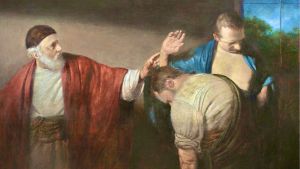
Greatness in the littleness
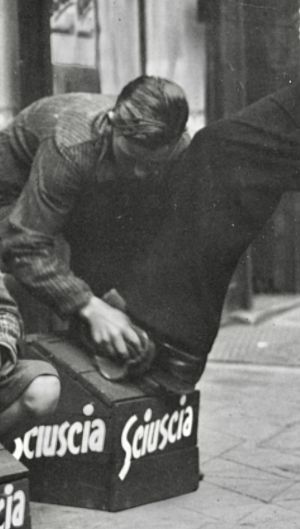
Initiates, circles, prejudices, or different paths
(Lk 9:46-50)
Redemption presents two essential aspects: the Gift of the Call and the aptitude to accept the Proposal.
From wave to wave this realizes a new Creation of the person, of fraternity, of the Church, and of the world.
Thus Faith: a relationship of welcome and incisiveness, wich reverberates; always young. Such is spiritual childhood.
It is for this reason that Greek text speaks of workshop boy, the servant of the house [«paidìon»: vv.47-48] as a model of disciple close to the Lord - ready to shoot in front of every life request.
Greatness in smallness.
But in this passage Lk joins that of the servant, with an idea of "first period" typical of those who present themselves at the threshold of communities: «mikròi» [v.48: incipients and shakies].
Often those who have less energy.
However, instead of an unconditional welcome, the latter feel the mistrust of veterans, who disdain dialogue and confrontation; always beware of novelties - and the danger of to be "overshadowed".
The unprecedented life that could arise is immediately suffocated or encapsulated by self-styled experts (v.49), neglecting and dampening the renewed God’s Gift to the assembly.
In short, the Community must return to its immediate and spontaneous Principle, without making the arrangements chronic.
The «following together with us» [instead of following Him personally, v.49] is contrasted with the simple richness of spiritual childhood and service, in the wider coexistence and sharing.
We also know in ourselves the cravings for domination; but those who become «minimum», «servant», «voiceless», leave ample room for the strength and tolerant - transmuting - work of life.
The New radiates the unforeseeable divine and human. And the boldness of modesty that listens and has respect for one’s own soul and brother as a gift-proposal, can make everyone find again, from within.
Pure freshness that evokes the joy of Grace; that keeps a clear eye on everything - even on the wiles of others, because they too can make us take different directions.
The place of honor is so coveted, but those who remain unpretentious can be much better available to an unparalleled condition, and to fraternity that respects the vocation of each one.
In this way, let us avoid punctuating the present in Christ with the models (vv.49-50) because in following the Lord not everyone walks in the same mode.
The Coming tide wants to drag us on the territory of growth without mortification: inside, there exists and it is eloquent a secret time and space, that inhabit us.
They resonate in harmony with the Gospels. There is no need to "get back in step" of all time always, nor just find a way out.
Let’s surrender to the young and creative instinct. It would be the journey of Joy: in the new reality and eminent Beauty, from discomfort.
To internalize and live the message:
What nourishes your desire for God, for youth, for brothers and sisters?
[Monday 26th wk. in O.T. September 28, 2026]
Greatness in smallness
Initiates, circles, prejudices, and different paths - from "emptiness"
(Lk 9:46-50)
According to the Tao Tê Ching (LXXXI) "The saint does not accumulate; the more he has done for others, the more he possesses; the more he has given to others, the more he abounds".
Redemption has two essential aspects: the Gift of the Call and the ability to accept the Proposal.
It brings about a new Creation of the person, of the fraternity, of the Church, and of the world.
Such is Faith: a relationship of acceptance and incisiveness that reverberates, always young. Such is spiritual infancy.
This is why the Greek text speaks of the shop boy, the house servant ["paidìon": vv.47-48] as a model of the disciple close to the Lord - ready to spring up in the face of every request for life.
Greatness in smallness.
But in this passage Lk also connects to that of the servant an idea of "first period" typical of those who present themselves at the threshold of the communities: "mikròi" [v.48: incipient and unsteady]. Often those with the least energy.
However, instead of an unconditional welcome, they feel the distrust of the veterans, who disdain dialogue and confrontation; always wary of new things - and the danger of being 'overshadowed'.
The unprecedented life that might arise is immediately stifled or pigeonholed by self-styled experts (v.49), neglecting and dampening the renewed Gift of God to the assembly.
In short, the Community must return to its immediate and spontaneous Principle: fraternal and universal love - re-actualised by the knocking at the door of the churches of the unimportant in society.
But we often go as if to war, because the top of the class only demand to be served and revered - by the new ones and those destined to efforts, obligations... and formulation of impersonal intentions.
So much for total acceptance: the little one is considered a usurper of private property - he who would indeed make the actors of holiness finally become 'great', resembling the Father.
On the other hand, those in charge on the ground continue to dry up things and situations, and stiffen everyone within immobile forms.
Even the missionary activity of outsiders to the official group is denigrated, suffers derision, and encounters contrived obstacles that attempt to chronicle the arrangements.
Thus evangelisation is weighed down: not service to the Lord and brothers, but territory of conquest to feel protagonists - and the many competitors seem dangerous... to self-assertion.
Such riches of 'following along with us' (v.49) instead of personally following Him, are contrasted with the simple riches of spiritual childhood and service in broader coexistence and sharing.
We also know in ourselves the delusions of dominance that transcend humility, the anxieties of memorable feats and important deeds that we deem more meaningful than understanding and fluency.
But those who make themselves 'minimal' leave ample space for the tolerant and transmuting power and work of life.
He perceives the inner self and takes note of new things, to truly exist and not feel orphaned - indeed, to shatter situations and bring attention to other dimensions.
The audacity of modesty that listens and has respect for one's own soul and for one's brother as a gift and a proposal, can make one rediscover within each the 'servant' and the 'voiceless' waiting to be called back to life.
Pure freshness that evokes the joy of Grace; that keeps a clear eye on everything, even on the decision-making wiles of others, because they too can take us in different directions.
The place of honour is much coveted, but those who remain unassuming can much better be themselves and make themselves available to a condition of the other kingdom - to the fraternity that respects the incomparable vocation of each one.
We must not dot the present in Christ with models, for in following the Lord not everyone walks in the same way. And the new radiates the unpredictable.
Simplicity and upheaval: Rebirth without mortification
It is not a matter of finding excuses to justify laziness in the spiritual quest and exodus: small, spontaneous and natural - but rich inside - one becomes, lowering oneself from one's character.
It is the art of making life dense and complex, multifaceted and vast, then simplifying, without dispersing.
Often all it takes is to observe in a singular and personal way, or to rest one's gaze in a different place, to find a thousand unexpected and self-regenerating outlets.
Indeed, the solution to the complications that stifle the soul and the experience of the fullness of being we seek is inherent in our own questioning.
Not infrequently, it belongs to preconceptions rather than reality or the tide that comes, which wants to drag us into the territory of growth - simply, with its own rhythm.
We are obnubilated by thoughts. But there is an innate knowledge that watches over our uniqueness and does not intoxicate the soul.It exists and is eloquent within, a secret time and space that inhabits us: they resonate in tune with the Gospels.
There is no need to 'catch up' with the past, or just find a way out.
If we surrender to such a young and creative instinct, wiser, comforted by the Word, the Core of Being will come forth with its primordial energies.
Virtues that recreate the earth like the mythical Child of the World: a little Jesus - inside and outside of us.
Thus we annihilate even the disaster of the global crisis, and rise again: each in his own way (which is not 'his' in the sense of arbitrariness).
And when we are able to accept the events as a Call to come out of our cages so that we perceive the Elsewhere, we will find an intimate result.
The thorn in the side will unravel and relaunch the special path; it will accentuate the possibilities of exchanging unseen gifts, not stereotypes - without even experiencing fatigue, and the subtle dissatisfactions we know.
Projected totally into external problems, we overload our mind and spirit with expectations induced by cultural paradigms in vogue [whether antiquated or disembodied] or to which we are accustomed.
Thus existence quickly becomes conformist again, stagnant in the usual means and goals, devoid of new peaks or authentic relationships and unimagined vitality.
The diktat of the objective induced by the roles we imagined acquired exhausts us, and the instituted idea of perfection sterilises the humus - it impoverishes within.
The reductionism in place puts actual needs in brackets.
The one-sidedness then lets ways of being prevail, the roles already expressed; it withers relationships, making environments (all impermeable and established) murky again.
Fixed ideas condition life and do not allow the inner organism - psychic and spiritual - to feed on transparent, unprejudiced truths; and sincere feelings, which would give us breath.
Freeing ourselves from the usual ways of going about things, from apodictic judgments and convictions, would conversely allow us to break the chains that hold back the luminous and rainbow faculties.
As well as the ability to correspond to the unheard-of Personal Calling, opening up other views.
The 'emptiness' advocated by the Tao only resembles in earshot the 'emptiness' of other, decidedly more depersonalising Eastern wisdom.
The Oriental teaching of the Way does not lose the sense of importance and exceptionality of the individual seed.
On the contrary, it fully respects its propulsive vocation. Remaining ourselves, not only in spite of - but because of - the obligatory abyss we have crossed.
By minimising the intentions of revisiting the old maquillage - and all non-epochal convictions, which do not call us, nor would we like to - we clear our souls of ballast.
In this way we will bring out its exceptional specific weight and unrepeatable character, in order to lighten it and fill it only with what is needed to activate the new paths that await us.
The slowing down and letting go that Lao Tse advocates does not lead to the insignificant flattening of differences, but to dilating the sacred and natural times of wise action, and appreciating its value.
Stages and goals that do not correspond to us will not bring fulfilment.
Indeed, artifices force us to amplify relationships - but only to cover up the problem with ourselves, or even with a couple, a group, a movement, a community, a work environment.
While we wish to clothe [and not depose] with a sense of permanence the character of before - a cliché that does not correspond to us - we go round in circles. We burden ourselves with outsized expectations, with useless stress that makes no room for love [friendship with which one encounters oneself, things, sisters and brothers, the many events].
Natural Wisdom, even bitter events, and the Bible, remind us that the face... each path, the name, and the rhythm, are ours alone.
So too is the synthesis: each one is called upon to write his own eccentric glad tidings for the benefit of the woman and man of all times (Jn 20:30-31).
Please note: Fraternity is not levelling:
"But there are many other things that Jesus did, which if they were written down one by one, I think that not even the world itself could contain the books that should be written" (Jn 21:25).
That would be the journey of Joy: into the new reality and eminent Beauty, out of discomfort.
To internalise and live the message:
What fuels your desire for God and brethren?
Little ones: Sign of God

God’s sign is simplicity. God’s sign is the baby. God’s sign is that he makes himself small for us. This is how he reigns. He does not come with power and outward splendour. He comes as a baby – defenceless and in need of our help. He does not want to overwhelm us with his strength. He takes away our fear of his greatness. He asks for our love: so he makes himself a child. He wants nothing other from us than our love, through which we spontaneously learn to enter into his feelings, his thoughts and his will – we learn to live with him and to practise with him that humility of renunciation that belongs to the very essence of love. God made himself small so that we could understand him, welcome him, and love him. The Fathers of the Church, in their Greek translation of the Old Testament, found a passage from the prophet Isaiah that Paul also quotes in order to show how God’s new ways had already been foretold in the Old Testament. There we read: "God made his Word short, he abbreviated it" (Is 10:23; Rom 9:28). The Fathers interpreted this in two ways. The Son himself is the Word, the Logos; the eternal Word became small – small enough to fit into a manger. He became a child, so that the Word could be grasped by us. In this way God teaches us to love the little ones. In this way he teaches us to love the weak. In this way he teaches us respect for children. The child of Bethlehem directs our gaze towards all children who suffer and are abused in the world, the born and the unborn. Towards children who are placed as soldiers in a violent world; towards children who have to beg; towards children who suffer deprivation and hunger; towards children who are unloved. In all of these it is the Child of Bethlehem who is crying out to us; it is the God who has become small who appeals to us. Let us pray this night that the brightness of God’s love may enfold all these children. Let us ask God to help us do our part so that the dignity of children may be respected. May they all experience the light of l ove, which mankind needs so much more than the material necessities of life.
[Pope Benedict, Christmas homily 24 December 2006]
The Gift of Salvation cannot be limited, but...
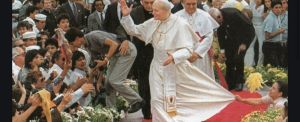
1. The difficulties that sometimes accompany the development of evangelisation highlight a delicate problem whose solution should not be sought in purely historical or sociological terms: the problem of the salvation of those who do not visibly belong to the Church. We are not given the opportunity to scrutinise the mystery of divine action in minds and hearts, to assess the power of Christ's grace in taking possession, in life and in death, of those whom 'the Father has given Him', and whom He Himself has proclaimed that He does not want to 'lose'. We hear this repeated in one of the Gospel readings proposed for the Mass of the Dead (cf. Jn 6:39-40).
But, as I wrote in the Encyclical Redemptoris Missio, one cannot limit the gift of salvation "to those who explicitly believe in God and have entered the Church. If salvation is destined for all, it must be made concretely available to all'. And, admitting that it is concretely impossible for so many people to access the Christian message, I added: "Many people do not have the possibility of knowing or accepting the revelation of the Gospel to enter the Church. They live in socio-cultural conditions that do not allow it, and they have often been educated in other religious traditions" (Redemptoris Missio, 10).
We must recognise that to the extent that it is within the human capacity for foresight and knowledge, this practical impossibility would seem destined to last much longer, perhaps even until the final completion of the work of evangelisation. Jesus himself admonished that only the Father knows "the times and moments" fixed by him for the establishment of his Kingdom in the world (cf. Acts 1:7).
2. What I have said above, however, does not justify the relativistic position of those who believe that a way to salvation can be found in any religion, even independently of faith in Christ the Redeemer, and that inter-religious dialogue should be based on this ambiguous conception. This is not the Gospel-compliant solution to the problem of salvation for those who do not profess the Christian creed. Instead, we must maintain that the road to salvation always passes through Christ, and that therefore it is up to the Church and its missionaries to make him known and loved in every time, in every place and in every culture. Outside of Christ 'there is no salvation'. As Peter proclaimed before the Sanhedrin from the very beginning of the apostolic preaching: "There is no other name under heaven given to men in which it is appointed that we should be saved" (Acts 4:12).
Even for those who through no fault of their own do not know Christ and do not recognise themselves as Christians, the divine plan has provided a way of salvation. As we read in the conciliar Decree on missionary activity Ad Gentes, we believe that "God, through the ways he alone knows, can bring men who through no fault of their own ignore the Gospel" to the faith necessary for salvation (Ad Gentes, 7). Of course, the condition 'without their guilt' cannot be verified or appreciated by human evaluation, but must be left solely to divine judgement. This is why in the Constitution Gaudium et Spes the Council declares that in the heart of every man of good will "grace works invisibly", and that "the Holy Spirit gives everyone the possibility of coming into contact, in the way God knows, with the Paschal Mystery" (Gaudium et Spes, 22).
3. It is important to emphasise that the way of salvation taken by those who ignore the Gospel is not a way outside Christ and the Church. The universal salvific will is linked to the unique mediation of Christ. This is stated in the First Letter to Timothy: "God our Saviour, who wills that all men should be saved and come to the knowledge of the truth. For one is God, and one is the mediator between God and man, the man Christ Jesus, who gave himself a ransom for all" (1 Timothy 2: 3-6). Peter proclaims this when he says that "in no one else is there salvation", and calls Jesus the "head of the corner" (Acts 4:11-12), emphasising the necessary role of Christ as the foundation of the Church.
This affirmation of the "uniqueness" of the Saviour draws its origin from the very words of the Lord, who states that he came "to give his life as a ransom for many" (Mk 10:45), i.e. for mankind, as St Paul explains when he writes: "One died for all" (2 Cor 5:14 cf. Rom 5:18). Christ obtained universal salvation by the gift of his own life: no other mediator was established by God as Saviour. The unique value of the sacrifice of the Cross must always be recognised in the destiny of every man.
4. And since Christ works salvation through his mystical Body, which is the Church, the way to salvation is essentially linked to the Church. The axiom extra Ecclesiam nulla salus - "outside the Church there is no salvation" -, enunciated by St Cyprian (Epist 73,21: PL 1123 AB), belongs to the Christian tradition and was included in the Lateran Council IV (Denz.-S. 802), in the bull Unam Sanctam of Boniface VIII (Denz.-S. 870) and in the Council of Florence (Decretum pro Jacobitis, Denz.-S. 1351).
The axiom means that for those who are unaware that the Church was founded by God through Jesus Christ as necessary there is an obligation to enter and persevere in it in order to obtain salvation (cf. Lumen Gentium, 14). On the other hand, for those who have not received the proclamation of the Gospel, as I wrote in the Encyclical Redemptoris Missio, salvation is accessible through mysterious ways insofar as divine grace is bestowed upon them by virtue of Christ's redeeming sacrifice, without external adherence to the Church but always, nevertheless, in relationship with it (cf. Redemptoris Missio, 10). It is a "mysterious relationship": mysterious for those who receive it, because they do not know the Church and indeed sometimes externally reject it; mysterious also in itself because it is linked to the salvific mystery of grace, which entails an essential reference to the Church founded by the Saviour.
Salvific grace, in order to operate, requires an adhesion, a cooperation, a yes to the divine donation: and this adhesion is, at least implicitly, oriented towards Christ and the Church. Therefore one can also say sine Ecclesia nulla salus - "without the Church there is no salvation" -: adhesion to the Church - Mystical Body of Christ, however implicit it may be, is indeed mysterious, and constitutes an essential condition for salvation.
5. Religions can exert a positive influence on the destiny of those who belong to them and follow their instructions with sincerity of spirit. But if the decisive action for salvation is the work of the Holy Spirit, we must bear in mind that man only receives his salvation from Christ, through the Holy Spirit. It begins already in the earthly life, which grace, accepted and reciprocated, makes fruitful, in the evangelical sense, for earth and heaven.
Hence the importance of the indispensable role of the Church, which "is not an end in itself but fervently strives to be all of Christ, in Christ and for Christ, and all of men, among men and for men". A role that is therefore not "ecclesiocentric" as has sometimes been said: the Church does not exist or work for itself, but is at the service of a humanity called to divine filiation in Christ (cf. Redemptoris Missio, 19). It therefore also exercises an implicit mediation towards those who are ignorant of the Gospel.
However, this should not lead to the conclusion that its missionary activity is less necessary in such circumstances. Quite the contrary. In fact, those who ignore Christ, through no fault of their own, find themselves in a condition of darkness and spiritual famine with negative repercussions often also on a cultural and moral level. The Church's missionary action can provide them with the conditions for the full development of Christ's saving grace, by proposing full and conscious adherence to the message of faith and active participation in Church life in the sacraments.
This is the theological line taken from Christian tradition. The Magisterium of the Church has followed it in doctrine and practice as the path marked out by Christ himself for the Apostles and missionaries of all times.
[Pope John Paul II, General Audience 31 May 1995]
There is no such thing as evangelisation at a distance
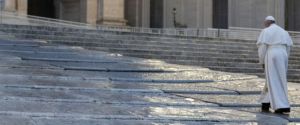
[…] we return to Jerusalem, in the Upper Room, as though guided by the two disciples of Emmaus, who had listened with great emotion to Jesus’ words along the way and then had recognized him “in the breaking of the bread” (Lk 24:35). Now, in the Upper Room, the Risen Christ presents himself in the midst of the group of disciples and greets them: “Peace to you!” (v. 36). But they are frightened and believe “that they saw a spirit” (v. 37), the Gospel says. Jesus then shows them the wounds on his body and says: “See my hands and my feet” — the wounds — “that it is I myself; handle me” (v. 39). And to convince them, he asks for food and eats it before their astonished eyes (cf. vv. 41-42).
There is a detail here, in this description. The Gospel says that the Apostles “still disbelieved for joy”. The joy they felt was such that they could not believe that this was true. And a second detail: they were bewildered, astonished; astonished because the encounter with God always leads you to astonishment: it goes beyond enthusiasm, beyond joy; it is another experience. And they were joyful, but a joy that made them think: no, this cannot be true!... It is the astonishment of God’s presence. Do not forget this frame of mind, which is so beautiful.
Three very concrete verbs characterize this Gospel passage. In a certain sense, they reflect our individual and community life: to look, to touch and to eat. Three actions that can give joy from a true encounter with the living Jesus.
To look. “See my hands and my feet”, Jesus says. To look is not only to see, it is more; it also involves intention, will. For this reason, it is one of the verbs of love. A mother and father look at their child; lovers gaze at each other; a good doctor looks at the patient carefully... Looking is a first step against indifference, against the temptation to look the other way before the difficulties and sufferings of others. To look. Do I see or look at Jesus?
The second verb is to touch. By inviting the disciples to touch him, to verify that he is not a ghost — touch me! — Jesus indicates to them and to us that the relationship with him and with our brothers and sisters cannot remain “at a distance”. Christianity does not exist at a distance; Christianity does not exist only at the level of looking. Love requires looking and it also requires closeness; it requires contact, the sharing of life. The Good Samaritan did not limit himself to looking at that man whom he found half dead along the road: he stopped, he bent down, he treated his wounds, he touched him, he loaded him onto his mount and took him to the inn. And it is the same with Jesus himself: loving him means entering into a communion of life, a communion with him.
And thus, we come to the third verb, to eat, which clearly expresses our humanity in its most natural poverty, that is, our need to nourish ourselves in order to live. But eating, when we do so together, among family or friends, also becomes an expression of love, an expression of communion, of celebration... How often the Gospels present us with Jesus experiencing this convivial dimension! Even as the Risen One, with his disciples. To the point that the Eucharistic Banquet has become the emblematic sign of the Christian community. Eating together the Body of Christ: this is the core of Christian life.
Brothers and sisters, this Gospel passage tells us that Jesus is not a “ghost”, but a living Person; that when Jesus draws near to us he fills us with joy, to the point of disbelief, and he leaves us bewildered, with that astonishment that only God’s presence gives, because Jesus is a living Person.
Being Christian is not first of all a doctrine or a moral ideal; it is a living relationship with him, with the Risen Lord: we look at him, we touch him, we are nourished by him and, transformed by his Love, we look at, touch and nourish others as brothers and sisters. May the Virgin Mary help us to live this experience of grace.
[Pope Francis, Angelus 18 April 2021]
The "stars" set aside
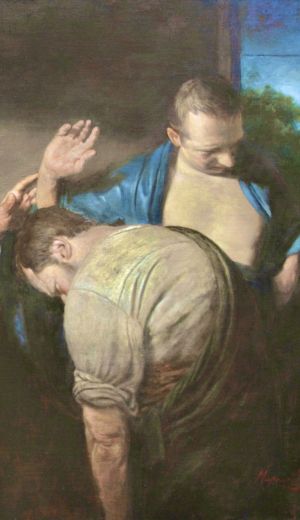
Two sons: «No» and «Me!»
(Mt 21:28-32)
In the rabbis' tales the «Son» was only one: Israel! In the teaching of Christ, however, even a reckless remains a son.
The Master of the Vineyard image of the chosen people, turns to his «prototype» of man with tenderness and maternal bowels: «My little child».
He tries to make him understand: «The unfamiliar land is full of dissensions and grudges, instead the Vineyard is yours; committed therefore to building the world of joy».
But it is basically normal to desist: «I don’t want to» - because we are often attracted not by the Beatitudes, but to worldly criteria.
Working for the life of others, recognizing their dignity and promoting it does not arise immediately and spontaneously to everyone; on the contrary, it seems onerous.
Yet it is the difference that gives us the cue, not the rule or the reproach.
The perception of what appears “foreign” becomes a rare insight into one's own essence, a dilation of the Ego - a growing movement and process that leads to an understanding of the You in the Ego itself.
Trivial instinctive reactions must be understood, because pre-emptive condemnations block growth.
Eccentricity of the brother is the paradoxical starting point for finding himself and one’s own way.
Of course, repulsion can emerge at first; there is no need to be scandalized, nor to accuse. Recovering the deep human dimension is not a piece of cake.
Moreover, we know from experience: the most convinced ‘Yes’ passes through an initial ‘No’.
The inner struggle is to be reckoned with - finally it itself will affect far beyond formal adherence.
In short, the truest ‘Yes’ comes from a request for explanation.
Although the habitual are ready to show the best intentions right away, they become all showcase and no substance; and only empty words.
The Father therefore turned to the promises’ son: «I, Lord!». How to say: «There is Me here; why think of others?».
The exaggeratedly kindred and positive reaction indicates that the customary son... did not understand.
This “son” certainly disagreed with the Father’s design - so deep and demanding - and he thought in his own way how one behaves in the Vineyard.
Therefore, he beluded himself to be benefitted, instead of Saved.
In short, the choice is between Faith or protocols: «By now, various manifest sinners are surpassing you» (v.31).
[The discrimination of life in the Spirit? The exception that becomes promotion].
Women and men respond «Here I am» to the Appeal because they are intimately persuaded, not by external influence - of labels.
True friends of vital energy are not the conventions.
In such a way, compared to the different ancient beliefs, an intrinsic side of Jesus' Invitation is the adult mind.
It excludes adherent solutions [common or elitist]: they enclose souls in a condition of dependence, with illusory progress.
In the communities of Galilee and Syria the pagans quickly became a majority - elevated to the rank of sons.
They did not submit to nerve-wracking processes, but spontaneously were recognizing the Lord.
“Contrary” Moral: never trust those who rush to say: «Yes sir!».
[26th Sunday in O.T. (year A), September 27, 2026]
The "stars" set aside
Two sons: «No» and «Me!»
(Mt 21:28-32)
Matthew writes half a century after the death of the Master and notes that the majority of Abraham's children - his people - did not recognise Jesus as the Messiah.
In his communities in Galilee and Syria, pagans quickly became the majority - elevated to the rank of children.
They did not undergo gruelling trials, but spontaneously recognised the Lord.
It is an invitation to the veterans of the church who are still Judaizing to review their religiosity (much of it superficial), which believes it has understood everything but fails to grasp the essence of God's plan for humanity - and does not set out to do the "work".
[Reassuring cults, traditional legalism or hysterical dreams only save appearances].
Matthew wants churchgoers not to have any presumption of feeling that they are in the right, almost by birthright.
Like Peter (Matthew 16:16-28), senior leaders were sometimes willing to commit themselves to a Messiah they only had in their heads - not to bear witness to the Lamb committed to transmitting life to the new; to rejoice in it, promote it, and give it.
[Of course, today we are not qualified to identify with the 'third son', the one who... 'says "yes, sir" and works'].
It is the supposed dregs of society, those excluded from the kingdom of God (vv. 31b-32) who 'take the place' of the leaders - those who have sophisticated ideas or the same 'correct' tradition.
Compared to the top of the class, the newcomers were no more deserving than the experts and the habitual, but being without a respectable screen, they gradually became willing to love.
Those whom the ancient leaders considered responsible for the delay of the Kingdom were not yet deaf to the Word.
After all, even Judas repented.
Leaders who feel they are fulfilling their duties or are great reformers and phenomena will never convert.
That is why the Master was more at ease with those who were different than with sterile religious people or disembodied idealists.
In short: we must allow ourselves to be evaluated.
We need to question ourselves, stop and ask ourselves, 'What do you think?' (v. 21).
After the expulsion of the merchants, the authorities are furious because Jesus has declared that the Temple of Jerusalem is a den of thieves.
How naive! One does not touch the one god of the ancient holy places, the real one: the bag of the guides and the treasure of the priests involved.
Those most responsible for the black market in the sacred enclosure do not want to lose face.
They appear to be believers and loyal, but only when viewed from the outside.
Their inner eye and their well-hidden activity behind the scenes focus on anything but spiritual goods.
Their one god is called convenience. So it is to them that the Master addresses the parable.
And the beginning is already provocative... In the rabbis' stories, there was only one 'son': Israel!
For Christ, however, even a wayward son remains a son [what do we think of this, for example... starting with catechism and ending with spiritual exercises?].
The Master of the Vineyard, an image of the chosen people, addresses [in the new CEI translation, initially] his 'prototype' of man with tenderness and maternal affection: 'My little son'.
He tries to make him understand: 'The unfamiliar land is full of dissent and resentment, but the Vineyard is yours; so commit yourself to building a world of joy'.
But it is normal to be stubborn: 'I don't feel like it' - because we are often attracted not by the Beatitudes, but by the worldly criteria of having, power and appearance; of keeping for ourselves, climbing over others and dominating them.
Working for the benefit of others, recognising their dignity and promoting it, does not come naturally and spontaneously to everyone.
On the contrary, it seems burdensome - at least until we are able to understand the value of our brothers and sisters for ourselves (and see 'ourselves' in 'their' faces).
It is only a journey of life in the Spirit that makes us ready to recognise that the You urges, expands, enriches and completes the I.
To truly encounter others means to have encountered ourselves, in the multifaceted nature of our own sides.
It is not easy. In fact, it is easier to identify with or be supportive from a distance than to be fraternal.
It is difficult to eliminate selfishness, which is a creaturely fact that must be integrated to enrich everyone, rather than falsely exorcised.
In short: 'otherness' is not just an appeal, but a boundless source of wealth for myself; it speaks of my very being, in that very way.
But to understand love - including love for oneself - we all need time, experience, insight, growth in empathy and further exploration.
Then working on it is also demanding, starting from the innermost self.
It is obvious that we may instinctively pull back - at least until we begin to learn the deep connection with the distant that demands life [just as we always do, in the first person].
The perception of what appears 'foreign' becomes a rare intuition of one's own essence, an expansion of the Ego - a movement and a growing process that leads to understanding the You in the I.
The eccentricity of one's brother is the paradoxical starting point for finding oneself and one's path.
Building a new world can be repellent to nature (in some respects) marked by sin and withdrawal.
We need to understand banal instinctive reactions, because preventive condemnation blocks growth.
Only step by step do we become aware that authentic and full life brings out the divine Gold.
It accentuates the exquisitely human calibre that even the heavenly Father suggests - overcoming indifference to the yearning that at first glance seems not to concern us.
Of course, at first repulsion may surface; there is no need to be scandalised or to point fingers.
Recovering the profound human dimension is no easy task.
Then it is the difference that gives us the cue, not the 'rule' - nor the 'reprimand'. The latter do not activate anything authentic.
After all, we know from experience that the most convincing 'Yes' comes through an initial 'No'.
The inner struggle is to be expected - ultimately, it will have an impact far beyond a formal adherence.
There is no need to be indignant if someone responds with a flat refusal.
Then they will change their mind [v. 29 of the new CEI translation]: 'metamellomai'. And they will recover their radical character as a son and brother.
In order to grasp one's position and respond wisely to the Lord's proposals, one must sift through things.
This calls for discernment of one's roots, relationships, and oneself (in all one's diversities).
In short, the truest 'yes' comes from a request for explanation - which brings us into direct contact with the Source of our varied character - a condition that completes us.
Life is not about copying and tracing. We must beware of 'yes-men': they are acting out a fiction as a smokescreen.
Although those identified are 'ready and willing' to immediately show their best intentions, they become all show and no substance; ultimately, just empty words.
He therefore turned to the second [v.30 in the new CEI translation], who was in fact the firstborn of the promises: 'I, Lord!'.
As if to say: 'I am here; why think of others?'.
The exaggeratedly similar and positive reaction - in reality indifferent because it is habitual and perhaps calculated - indicates that the 'veteran of belief and adherence' has, at the very least, not understood...
He certainly did not agree with the Father's programme - so profound and demanding. He had his own ideas about how to behave in the Vineyard.
Therefore, he deludes himself into thinking that he is at an advantage, rather than saved.
Faith and protocols
"Manifest sinners and various contaminants are passing you by"
(Mt 21:28-32; in particular v.31)
What is specific to Faith, which makes a difference, is not trusting the religious ideology of the best.
A belief is authentic if it can withstand being examined first-hand; the rest is artifice, mistrust with a trick.
Personal conviction passes through a spontaneous request for explanations [typical in this regard is the story of the two sons, who both say yes and no].
The discriminating factor of life in the Spirit? The exception that becomes promotion.
Compared to various ancient beliefs, an intrinsic aspect of Jesus' invitation is the adult mind.
It excludes adherent solutions (common or elitist): they enclose souls in a condition of dependence, with illusory progress.
Women and men respond 'Here I am' to the call because they are intimately persuaded, not because of external influences such as labels, rituals, protocols, officialdom, respect for canonical guidelines, other people's habits, and hearsay.
When the disciples ask him to increase their faith, Jesus does not even respond (Lk 17:6).
He does not say to improve this or that. It is impossible to chisel out love in measured stages.
Faith is not a gift to be sheltered away, which the Father gives only to some, but a relationship of creative trust that is kindled in response to the gratuitous, renewed, reinvigorated, repeatedly rejuvenated initiative of the Source of being - when, step by step, it is welcomed instead of rejected.
Not only is it a personal and varied proposal in itself, but it also wants to be reinterpreted and made lush with our own originality.
The only vigour to be introduced into events is a different face, not at all defensive, nor aimed at increasing the situation.
Because we are called to become what we are.
The soul guides us to encounter ourselves, frankly and not by following a complex set of external procedures - but, wave by wave.
So there are those who already have a lot of faith, others who have so-so faith, some who have just the right amount, or who lack faith altogether - perhaps waiting to find the Gift somewhere to put it in the safe and multiply their nest egg - always keeping it in the same hole in the wall.
The conformist, rigid and ambiguous idea of spiritual progress must therefore be eradicated.
It is not contained within the limits of the 'breach work' of a bricklayer who slavishly follows a plan. And he sweats and sweats to insert into some makeshift niche the identical treasure chest of everyone - received as a complete package.
Then, there are no favourites, nor outposts to defend it.
There are no rejects placed on the sidelines, nor 'average' troops according to guarding ability and performance.
In the authentic itinerary, there is no unilateral trajectory or way out [as if it were a single passage, already preformed in every detail].
Nor is there any slavish enrichment, as a model - considered possible for heroes apart, on a conventional ascetic basis.
These are not the true friends of vital energy.
Morality - on the contrary: never trust those who rush to say, 'Yes, sir!'.
God longs for our ‘Yes’

There are theologians who, in the face of all the terrible things that happen in the world today, say that God cannot possibly be all-powerful. In response to this we profess God, the all-powerful Creator of heaven and earth. And we are glad and thankful that God is all-powerful. At the same time, we have to be aware that he exercises his power differently from the way we normally do. He has placed a limit on his power, by recognizing the freedom of his creatures. We are glad and thankful for the gift of freedom. However, when we see the terrible things that happen as a result of it, we are frightened. Let us put our trust in God, whose power manifests itself above all in mercy and forgiveness. Let us be certain, dear faithful, that God desires the salvation of his people. He desires our salvation, my salvation, the salvation of every single person. He is always close to us, especially in times of danger and radical change, and his heart aches for us, he reaches out to us. We need to open ourselves to him so that the power of his mercy can touch our hearts. We have to be ready freely to abandon evil, to raise ourselves from indifference and make room for his word. God respects our freedom. He does not constrain us. He is waiting for us to say “yes”, he as it were begs us to say “yes”.
In the Gospel Jesus takes up this fundamental theme of prophetic preaching. He recounts the parable of the two sons invited by their father to work in the vineyard. The first son responded: “‘I will not go’, but afterward he repented and went.” The other son said to the father: “‘I go, sir,’ but did not go.” When asked by Jesus which of the two sons did the father’s will, those listening rightly respond: “the first” (Mt 21:29-31). The message of the parable is clear: it is not words that matter, but deeds, deeds of conversion and faith. As we heard, Jesus directs this message to the chief priests and elders of the people of Israel, that is, to the religious experts of his people. At first they say “yes” to God’s will, but their piety becomes routine and God no longer matters to them. For this reason they find the message of John the Baptist and the message of Jesus disturbing. The Lord concludes his parable with harsh words: “Truly, the tax collectors and the harlots go into the Kingdom of God before you. For John came to you in the way of righteousness, and you did not believe him, but the tax collectors and the harlots believed him, and even when you saw it, you did not afterward repent and believe him” (Mt 21:32). Translated into the language of the present day, this statement might sound something like this: agnostics, who are constantly exercised by the question of God, those who long for a pure heart but suffer on account of their sin, are closer to the Kingdom of God than believers whose life of faith is “routine” and who regard the Church merely as an institution, without letting it touch their hearts, or letting the faith touch their hearts.
These words should make all of us stop and reflect, in fact they should disturb us. However, this is by no means to suggest that everyone who lives in the Church and works for her should be considered far from Jesus and the Kingdom of God. Absolutely not! On the contrary, this is a time to offer a word of profound gratitude to the many co-workers, employees and volunteers, without whom life in the parishes and in the entire Church would be hard to imagine. The Church in Germany has many social and charitable institutions through which the love of neighbour is practised in ways that bring social benefits and reach to the ends of the earth. At this moment I would like to express my gratitude and appreciation to all those working in Caritas Germany and in other church organizations who give their time and effort generously in voluntary service to the Church. In the first place, such service requires objective and professional expertise. But in the spirit of Jesus’ teaching something more is needed – an open heart that allows itself to be touched by the love of Christ, and thus gives to our neighbour, who needs us, something more than a technical service: it gives love, in which the other person is able to see Christ, the loving God. So let us ask ourselves, in the light of today’s Gospel, how is my personal relationship with God: in prayer, in participation at Sunday Mass, in exploring my faith through meditation on sacred Scripture and study of the Catechism of the Catholic Church? Dear friends, in the last analysis, the renewal of the Church will only come about through openness to conversion and through renewed faith.
The Gospel for this Sunday, as we saw, speaks of two sons, but behind them, in a mysterious way, is a third son. The first son says “no,” but does the father’s will. The second son says “yes,” but does not do what he was asked. The third son both says “yes” and does what he was asked. This third son is the Only-begotten Son of God, Jesus Christ, who has gathered us all here.
[Pope Benedict, homily at Freiburg, 25 September 2011]
At first they say “yes” to God’s will, but their piety becomes routine and God no longer matters to them [Pope Benedict]
Essi, prima, dicono “sì” alla volontà di Dio. Ma la loro religiosità diventa routine, e Dio non li inquieta più [Papa Benedetto]
And «each of us can say: "for love to me"» (Pope Francis)
E «ognuno di noi può dire: “per amore a me”» (Papa Francesco)
We too, to reach a more conscious confession of Jesus Christ must follow, like Peter, a path made of attentive, caring listening (Pope John Paul II)
Anche noi per giungere a una più consapevole confessione di Gesù Cristo dobbiamo percorrere, come Pietro, un cammino fatto di ascolto attento, premuroso (Papa Giovanni Paolo II)
It is a word that must be witnessed to and proclaimed explicitly, because without a consistent witness it proves to be less comprehensible and credible [Pope Benedict]
E’ una Parola che deve essere testimoniata e proclamata esplicitamente, perché senza una testimonianza coerente essa risulta meno comprensibile e credibile [Papa Benedetto]
The “reading and meditation of the word of God root us more deeply in Christ and guide our ministry as servants of reconciliation, justice and peace” (second Synod for Africa, Propositio 46)
La lettura e la meditazione della Parola di Dio ci radicano più profondamente in Cristo e orientano il nostro ministero di servitori della riconciliazione, della giustizia e della pace (Secondo Sinodo per l’Africa, Propositio 46)
The Gospel of Matthew written in Hebrew or Aramaic is no longer extant, but in the Greek Gospel that we possess we still continue to hear, in a certain way, the persuasive voice of the publican Matthew, who, having become an Apostle, continues to proclaim God's saving mercy to us. And let us listen to St Matthew's message, meditating upon it ever anew also to learn to stand up and follow Jesus with determination (Pope Benedict)
Non abbiamo più il Vangelo scritto da Matteo in ebraico o in aramaico, ma nel Vangelo greco che abbiamo continuiamo a udire ancora, in qualche modo, la voce persuasiva del pubblicano Matteo che, diventato Apostolo, séguita ad annunciarci la salvatrice misericordia di Dio e ascoltiamo questo messaggio di san Matteo, meditiamolo sempre di nuovo per imparare anche noi ad alzarci e a seguire Gesù con decisione (Papa Benedetto)
That denarius clearly represents eternal life, a gift that God reserves for all. Indeed those who are considered the "last", if they accept, become the "first", whereas the "first" can risk becoming the "last" [Pope Benedict]
Quel denaro rappresenta la vita eterna, dono che Dio riserva a tutti. Anzi, proprio quelli che sono considerati "ultimi", se lo accettano, diventano "primi", mentre i "primi" possono rischiare di finire "ultimi" [Papa Benedetto]
The Church with its permanent contradiction: between the ideal and reality, the more annoying contradiction, the more the ideal is affirmed sublime, evangelical, sacred, divine, and the reality is often petty, narrow, defective, sometimes even selfish (Pope Paul VI)
La Chiesa con la sua permanente contraddizione: tra l’ideale e la realtà, tanto più fastidiosa contraddizione, quanto più l’ideale è affermato sublime, evangelico, sacro, divino, e la realtà si presenta spesso meschina, angusta, difettosa, alcune volte perfino egoista (Papa Paolo VI)








duevie.art
don Giuseppe Nespeca
Tel. 333-1329741
Disclaimer
Questo blog non rappresenta una testata giornalistica in quanto viene aggiornato senza alcuna periodicità. Non può pertanto considerarsi un prodotto editoriale ai sensi della legge N°62 del 07/03/2001.
Le immagini sono tratte da internet, ma se il loro uso violasse diritti d'autore, lo si comunichi all'autore del blog che provvederà alla loro pronta rimozione.
L'autore dichiara di non essere responsabile dei commenti lasciati nei post. Eventuali commenti dei lettori, lesivi dell'immagine o dell'onorabilità di persone terze, il cui contenuto fosse ritenuto non idoneo alla pubblicazione verranno insindacabilmente rimossi.