


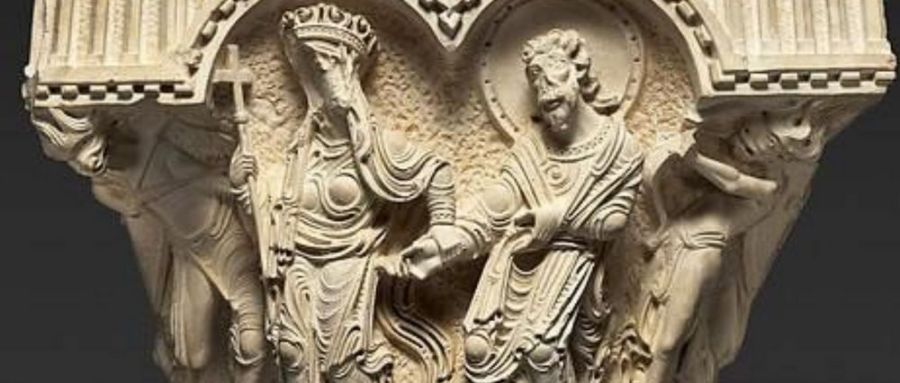
(Commemoration of All the Faithful Deceased)
"I see these fearful spaces of the universe surrounding me, and I find myself attached to a corner of this immensity, without knowing why I am placed in this place rather than in another, nor why the little time that is given to me to live is assigned to me at this point rather than in another from all the eternity that has preceded me and from all the eternity that succeeds me. I see nothing but infinite extensions on all sides, enclosing me like an atom and like a shadow that lasts but an instant without return. All I know is that I must soon die; but what I most ignore is this death itself, from which I cannot escape" [Pascal, Pensées, 194].
On the occasion of my parents' recent passing, the heartbreak of illness and the loss of both of them (soon) was compounded by the annoyance of an environment that kept on giving me 'condolences'.
As out of good manners, of course, but those who have assimilated the language of the Faith do not offer condolences, nor do they speak of 'the dead' but of the departed. They live.
Not as survivors of the blows that life has in store, but as fully realised, authentic, adorned gods.
Women and men blossomed into everything, who have experienced a new kind of being in their essence, a different kind of existence.
As in an atmosphere of pure love, where (like Jesus) one no longer lives for oneself, but one with the other and one for the other.
Without the pressing chronometers, nor the abandonments.
The term defunct comes from the Latin verb 'defungor' [infinitive 'defungi'] which indicates the partial end of an event, not a total fulfilment.
Not a definitive boundary that would open on the nullifying and cavernous abyss of lost shadows or larvae without momentum, devoid of identity and future - after transit through time.
Condolences' [from the Latin 'cum-dolēre'] were willingly offered within a purely pagan mentality or linked to an archetypal sense of religiosity.
That kind of conviction induced in relatives and friends an affliction - a hopeless weeping - that Jesus openly reproaches [John 11,33 Greek text; the Italian translation is uncertain].
To believe that with death everything ends is to imagine that existence is a progressive decay into emptiness.
Such a belief makes any path of growth, even spiritual growth, seem absurd. And it postulates the absurdity of involving oneself, of committing oneself to the ideal of lasting Good - to a Good that continues beyond our earthly vicissitude (and in favour of our neighbour).
The condolences thus stand for themselves to indicate that all is over.
An epigraph on the portal of a cemetery in a town not too far from me reads in large letters: 'here in the centuries lay affections vanities hopes'.
The cold of the end of all beautiful things, and the 'ice' of the neoclassical revisited in early 20th century style... perfectly matched on whitewashed travertine cladding.
Instead, Hope attracts us and refreshes the spirit, overcomes outrage, gives meaning to our going.
Already the believers of the first centuries had supplanted the pagan idea of the appointment of our sister death as 'dies infaustus', replacing it with its opposite: 'dies Natalis'.
Day of the true Birth, within the same Life; now complete, restored.
Life, which indeed continues - beyond the parameters of time or location.
Without the fatigue of existing that we experience. Immersed in the vastness of being.
Life without the struggles against self, and which continues in the satisfying, blessing embrace of a Father who does not depersonalise but dilates the character existence, the qualities of his children.
In such a blossoming full of light and warmth we are as if refounded on the prototype-Project of the authentic Son.
Covenant trait that we were meant to be and perhaps could be.
Overwhelmed with blissful Happiness, because our shadow-part is now included; free of judgement and commentary.
In "Hope of the Mustard Wheat" we read a gem by Joseph Ratzinger, who had the guts to write words to be seriously carved on the friezes of entablatures (in place of other superficialities for effect - unfortunately widespread):
"Today it seems clear that the fire of Judgement of which the Bible speaks does not indicate some kind of prison of the afterlife, but rather the Lord Himself who at the moment of judgement meets with man [...]".
"In the man who presents himself to the gaze of the Lord, everything in his life that is 'straw and hay' burns away and only that which can really have substance remains. And it means that through the encounter with Christ, man is recast and reshaped according to what he was meant to be and could properly be. The fundamental option of such a man is the Yes that makes him capable of accepting God's mercy; but this fundamental decision is many times numbed and shrivelled, it only peeps out with difficulty from the shackles of selfishness from which man has never been able to free himself. The encounter with the Lord is this transformation, the fire that burns and melts him, making him become that figure, that form without dross that can become the vessel of eternal Joy.
The fire that burns: Christ himself
Some recent theologians are of the opinion that the fire that both burns and saves is Christ Himself, the Judge and Saviour. The encounter with Him is the decisive act of Judgement. Before His gaze all falsehood melts away. It is the encounter with Him that, by burning us, transforms us and frees us to become truly ourselves. The things built up during life can then turn out to be dry straw, empty boasting and collapse. But in the pain of this encounter, in which the impure and unhealthy in our being become evident to us, lies salvation. His gaze, the touch of his heart heals us through a transformation that is certainly painful 'as through fire'. It is, however, a blessed sorrow, in which the holy power of his love penetrates us like a flame, enabling us in the end to be totally ourselves and thereby totally of God. Thus the interpenetration of righteousness and grace is also made evident: our way of life is not irrelevant, but our filthiness does not stain us eternally, if at least we have remained inclined towards Christ, towards truth and towards love. After all, this filth has already been burnt away in the Passion of Christ. At the moment of Judgement we experience and embrace this prevailing of his love over all evil in the world and in us. The pain of love becomes our salvation and our joy. It is clear that the "duration" of this transforming burning cannot be calculated by the chronometric measures of this world. The transforming "moment" of this encounter eludes earthly timing - it is time of the heart, time of the "passage" to communion with God in the Body of Christ. The Judgement of God is hope both because it is justice and because it is grace. If it were merely grace that renders all that is earthly irrelevant, God would remain indebted to us for the answer to the question of justice - a question that is decisive for us before history and God himself. If it were pure justice, it could in the end only be a cause for fear for all of us. The incarnation of God in Christ has so linked the one with the other - judgement and grace - that justice is firmly established: we all await our salvation "with fear and trembling" (Phil 2:12). Nevertheless, grace enables us all to hope and to go full of confidence towards the Judge whom we know as our "advocate", parakletos (cf. 1 Jn 2:1).
[Pope Benedict, Encyclical Spe Salvi no.47]








