


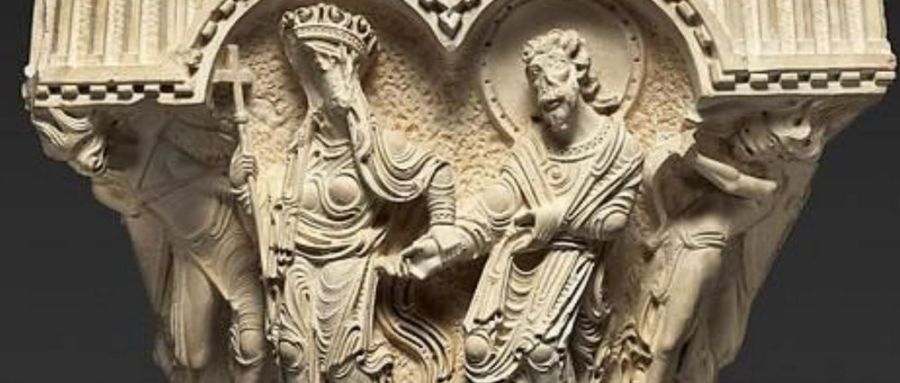
(Mt 13:36-43)
Completeness: Duplicity
From the fascinating proposal of Faith to the fatigue of retreat (2)
The parable of the Sower as historically narrated by Jesus (vv.3-8) and the parable of the tares (vv.24-30) denote the total positivity of his Message.
The Lord proclaimed a new world; first of all a different, tolerant and benevolent Heaven.
The principle of our life as saved is not what we do for God, but what He (Generous and Patient) creates for us.
Just like a condescending and longsuffering Parent, who ceaselessly provides opportunities for life.
The Master intended to shift the criterion of the pious life: from personal effort to allowing oneself to be saved, surrendering one's point of view.
Redemption is rooted in His providential initiative, in His gratuitous liberality, in His serene calm.
All conditions that allow each one a process of interaction, assimilation and reworking: a broad time of growth.
But the reflection that immediately follows - just a few decades after the Lord's death - begins to suffer from the dominant cultural cliché on the side, and unfortunately undermines both its character and its transparency.
The Son proclaimed only the longsuffering of the Father: Subject, Motive and Engine of our ability to face every path of flourishing.
In later reflection, the original parables become allegories, overflowing with symbols of defined moralistic meaning - all in all, banal.
In this way, we see them veined with impersonal considerations about the quality of the soil, or even of the Seed!
The latter - no longer identified with His Word, but in a certain zealous type of disciples [of little specific weight and proposal: those who would always feel surrounded by adversaries].
Such an inauspicious passage testifies to the difficulty of understanding the Son of God's astounding call from the earliest communities.
The Lord intended to suggest a path of Faith to all, precisely to supplant the anxiogenic yoke of the religious model - which, on the other hand, remained as an attractive archetype of discernment criteria.
A heavy yoke, albeit a usual one, that did not start from Love; for the very fact that it presupposed stinginess, inadequacies, and shame everywhere - even in the spiritual life [shrunken, perpetually in the balance, stingy, always insufficient].
We know the situations.
Instead, even vv.18-23 contain a glad tidings, rather than a judgement: in our field both good wheat and weeds arise spontaneously, but this is not a curse regardless; on the contrary (v.23c).
However, it must be admitted that the metaphor of vv.37-43 transforms the original parable (vv.24-30) into a moral allegory.
The metaphor that follows the initial parable is intended to emphasise that the presence of "evil" in the world is not to be attributed to the lack of vitality of the Seed, nor to the divine Work.
The protagonist of the passage [from v.18 and v.36] is no longer God and His munificent gesture, who spares no expense in sowing His Seed, but rather the type of soil - or here the new "good seed": the apostle himself - who would become the true "subject" of the spiritual path.
One thus enters the minefield of devotions: it seems that it is the woman and the man, the one who actually receives the Word, who must focus on himself, and identify his own shortcomings.
In addition - having finally become aware of them, a clear conscience, a natural ability and even familiarity - to strive to 'improve' according to models, on pain of exclusion from the ranks of the 'best'.
[All this leads normal people to a depersonalisation of the very quality of the Calling, and to an insane expenditure of energy].
The ethical idea - in fact - erases trust. It does not enhance the propulsive dynamism of ordinary existence. It always finds before it imperfections and tangles to unravel.
It is these, and thoughts, that get in the way. Conversely, in order to realise and complete oneself, such ballasts should be placed in the background, thrown behind one's back; flown forward.
The danger of such an approach is that it will end up piling distinction upon distinction, obsessing people with invincible sin. And affect the character lines of those who take the legalist binary seriously.
Such disembodied ethics cages the most sensitive - who unfortunately gradually exchange self-consciousness for the guilt-ridden myths [artefacts] of perfection.
Except for the careless and opportunistic, 'religion' taken head-on has always rhymed with prison.
Indeed, it still paradoxically makes the judgement of still being 'bad seed' the protagonist of our path! Other people's opinion and exterior.
In addition, there is the torment of still feeling under the cloak of perpetual 'sin': transgression and guilt that the fundamental option for God was intended to exorcise.In fact, epidermic sentencing does not know the different and very normal energies of man - all mouldable and potentially preparatory, to be fully perceived, assumed, invested.
Every prejudice, even a sacred one, actually overlooks the multifacetedness of the person, and finally turns into that deadening principle of self and others, which by proclamation would never want to be.
Because of extrinsic or recondite efforts, every external paradigm ends up losing the Way of God's Newness, its relevance, and the real Vocation - perhaps mistaking them for ballast.
The metaphor (vv.37-43) is precisely the result of the interpretation of early assemblies still under the influence of the ancient target of external, formal, apparent 'sterilisation' and 'coherence' - ethical rather than relational.
Similarly to what has already been mentioned above, even vv.18-23 contain a Glad Tidings, rather than a judgement: in our field both good wheat and weeds arise spontaneously, but this is not a curse regardless; on the contrary (v.23c).
However, it must be admitted that the metaphor of vv.37-43 transforms the original parable (vv.24-30) into a moral allegory.
With symbolic elements, the different figurative expressions take up the original narrative of Jesus, trying to interpret it according to the common codes of traditional rabbinic preaching.
As with the teachers of Israel, the next intent here is to shake up the listeners, in order to emphasise the personal, communal and spiritual importance of the diriment choices - in today's world.
However, in this passage we get the impression that the editors got caught up in the banal idea of immediate and decisive justice.
And yet haste is always inimical to the things of God.... [apart from the fact that time is often the medicine that makes useless branches, or so many parasitic elements, spontaneously wither].
In the House (v.36), i.e. in the Church, there is first of all a debate as to why Jesus does not impose a preventive sterilisation of the cornfield.
In doing so, he unfortunately opens the door to that 'purism' which the Son of God abhorred as nefarious.
This, although the evangelist's attempt to stem defections was understandable - screening well any attempt to adapt to cultural frames, to situations.
But by yielding to evaluations of efficacy and outline, the central point of the original narration of the Son of Man - and He Himself - is as if broken up into pattern elements.
A casuistry perhaps easier to digest, but even independent of the sense of the main narrative (vv.18-23).
Finally, there is the risk of identifying the Will of God with that of a Church of the elect and impecunious. A community almost placed upstream of any growth process.
In the uncertainty, particular clarifications are attempted here - according to which, however, the passage, the result of subsequent drafting, debate and reflection, risks overturning the meaning of the Jesus parable itself.
Indeed, in his people of brothers and society, the Master did not intend to erase a priori the fruitful sense of the ineffable and mysterious dynamics of 'mixing': a reality of this world in its own right.
Such was the essential, universalist proclamation of the young Rabbi; in spite of ancient purist clichés, or spineless fashions.
Legalistic religiosity was selective, elitist, conformist; concerned with maintaining social hierarchies.
As such, it constituted a tightly knit cultural cloak, and assessed in an abstract, pre-emptive way what should be considered good or bad for everyone.
Yet the idea of icy perfection [sterile of life] did not allow the preparatory energies of concrete existence to prepare the future and generate the very Newness of the Spirit.
Yet (the passage in Matthew bears witness to this) soon after Christ's death the conviction of undefiledness and the mentality of distinctions began to creep in again and take over.
This was due to the fact that externally, small communities had to confront (head-on) the rankings, the context of religions, moralistic conformisms, and the usual paradigms of widespread culture.
In some cases, this configuration led to a lack of humanity.
Historically speaking - in the second and third generation of believers, the acceptance of Jesus as Lord of one's life was perhaps in danger of becoming more binding and identifying than propelling the character of personal uniqueness - activating Freedom.
Christ's encounter with the believer changes everything in his life, certainly - but not from a presupposed hierarchy of values, procedures and pre-written sentences.
One actually becomes alert to perceive the eccentricity of one's brothers and sisters because one has experienced the Father's blessing embrace of one's 'faults'.Not out of a sense of emotional paternalism, but because not infrequently the resources that solve the real problems and activate God's Redemption come from the whirlwind of precious contradictions and destitution within us.
It is precisely these that make us less one-sided, more ductile and complete. Exceptional, alive; able to rely on the inner world instead of the outer world.
Therefore capable of a breakthrough.
Instead, exclusivism - where established morality takes the lion's share, hand in hand with appearance - has never let the living Faith, nor the world, grow.
We can see it: in order to make the world grow and make it reborn from the global crisis, each subject [even institutional] is called upon to reinvent itself outside of any already arranged and recognised score.
And today, perhaps precisely from what in the custom of thought was considered nothing more than a flaw, or annoying dissonance; incompleteness, limitation... and so on.
Suddenly and blatantly, imbalances and oscillations also make a difference in terms of quality.
They become opportunities not to be missed: an extra gear; spring power, a drive to activate the unheard of, and open up.
Here is a substantial difference between common religiosity and the life of Faith.
Duplicity makes us healthier and more perfect - and God is not prejudiced.
On the contrary, in the Father's eyes, it is precisely the unrepeatable uncertainties (not protocol) that make each of his children special, unique.
In short, one grows, is enriched and corresponds to one's personal Vocation only by bringing into play, integrating and transmuting boundaries - not by denying them.








