Jan 30, 2026 Written by 

On the sidelines, and the real holiday (preserving life force)

(Mk 6:30-34)


«Come yourselves aside, to a deserted place»: the explicit reference to the «desert» is that of Exodus - which recalls the time of first Love.

Experience of great Ideals that the path of Freedom could still infuse in a new People.

An offspring generated in silence, far from the hustle and bustle of idols: in guise of reflection and attention, sobriety of life, hospitality, real sharing.

Jesus is increasingly moving away from his environment, and does not want around him a horizon of elected, attracted by the suddenly exploded visibility - ending up considering themselves indispensable.

In fact, here they chase the many things to be done, but remain careless. They raise a great fuss, but stay in habit.

Then the Lord does not call «aside» for a "spiritual retreat". The apostles - who give themselves the air of ‘teachers’ (v.30) - receive the only task of «announcing», not of supervising, presiding over, coordinating others.

Even after failure in Nazareth (vv.1-6) - his heralds willingly confused the Servant who was educating them, for the victorious, hoped, respected, glorious Messiah.

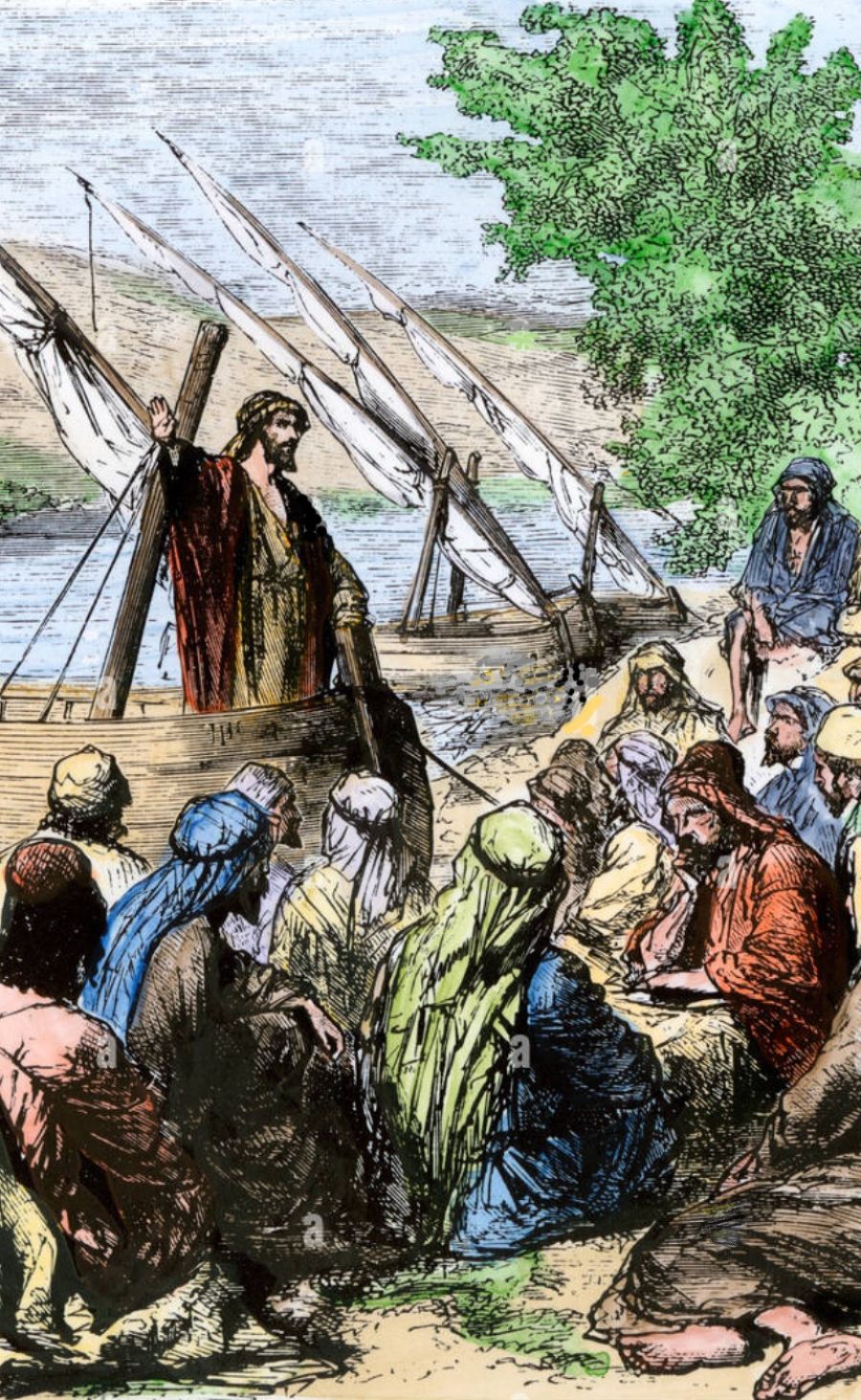
That is why, faced with masses in need of everything, the Lord first «began to teach» (v.34).

In short, the young Rabbi must start all over again, in order to correct the illusory frivolities conveyed by the followers… maybe just to leave a trace, get recognized and succeed - with lost people!

Jesus’ closest collaborators had not yet understood that there is another World, evolutionary and upside down - but ignored.

For this reason they have a fortune of their own, but they produce a lousy evangelization; without creative energy.

The crowds thronging around the Lord still remained exactly such and as before: «like sheep that have no shepherd» (v.34). People steeped in dismay.

Despite the circle’s affirmation of the disciples who had focused on the model of subservience and prestige, humanity still cried out. 

Their ‘stability’ made others even more insecure.

It lacked all the friendship that nourishes more than food, a perception of adequacy that satisfies more than health; the adherence that conveys life.

And the sense of one’s own being born and seeking. The Encounter that makes one’s gaze shift; the intimately recognized union with the Truth.

Apostles or not apostles, without the very Person of Christ, those women and men who sought their roots would not have flourished - least of all starting from their own grey, fragile, lacklustre shades.

The deep demands of the troubled were absolutely intact, despite the leaders’ busy schedule - an intense occupation around... unfortunately artificial and inattentive, still ambiguous and immature, dirigiste and superficial.

This, on the other hand, is the real holiday, the authentic decisive Appointment: to remain with the right Person; the one that does not enervate with its external rhythms, nor does add confusion to confusion.


In short, in the [established or fashionable] reference, no person is cradled in his or her novelty, or balanced and regenerated.

Enough, then, of the many 'models' without soul or prophecy that reproach us - and the commonplaces that anaesthetise.

In fact, in each of us, every expedient or artifice triggers the opposite: a loss of capacity.

«Like sheep that have no shepherd» (v.34).

In preparing us for the metamorphosis that belongs to us, the Friend of the Journey does not always intend to analyse and control.

Thus he does not extinguish the small energies, the character, the unique projections, the silent actions, and the Enchantment.

Letting us breathe, only the authentic Shepherd collects our 'core' from dispersion, our Seed from fragmentation; our Flower, from life without intimate purpose.


[Saturday 4th wk. in O.T.  February 7, 2026]

237 Last modified on Saturday, 07 February 2026 12:04
don Giuseppe Nespeca

Giuseppe Nespeca è architetto e sacerdote. Cultore della Sacra scrittura è autore della raccolta "Due Fuochi due Vie - Religione e Fede, Vangeli e Tao"; coautore del libro "Dialogo e Solstizio".

Anyone who welcomes the Lord into his life and loves him with all his heart is capable of a new beginning. He succeeds in doing God’s will: to bring about a new form of existence enlivened by love and destined for eternity (Pope Benedict)
Chi accoglie il Signore nella propria vita e lo ama con tutto il cuore è capace di un nuovo inizio. Riesce a compiere la volontà di Dio: realizzare una nuova forma di esistenza animata dall’amore e destinata all’eternità (Papa Benedetto)
You ought not, however, to be satisfied merely with knocking and seeking: to understand the things of God, what is absolutely necessary is oratio. For this reason, the Saviour told us not only: ‘Seek and you will find’, and ‘Knock and it shall be opened to you’, but also added, ‘Ask and you shall receive’ [Verbum Domini n.86; cit. Origen, Letter to Gregory]
Non ti devi però accontentare di bussare e di cercare: per comprendere le cose di Dio ti è assolutamente necessaria l’oratio. Proprio per esortarci ad essa il Salvatore ci ha detto non soltanto: “Cercate e troverete”, e “Bussate e vi sarà aperto”, ma ha aggiunto: “Chiedete e riceverete” [Verbum Domini n.86; cit. Origene, Lettera a Gregorio]
In the crucified Jesus, a kind of transformation and concentration of the signs occurs: he himself is the “sign of God” (John Paul II)
In Gesù crocifisso avviene come una trasformazione e concentrazione dei segni: è Lui stesso il "segno di Dio" (Giovanni Paolo II)
Only through Christ can we converse with God the Father as children, otherwise it is not possible, but in communion with the Son we can also say, as he did, “Abba”. In communion with Christ we can know God as our true Father. For this reason Christian prayer consists in looking constantly at Christ and in an ever new way, speaking to him, being with him in silence, listening to him, acting and suffering with him (Pope Benedict)
Solo in Cristo possiamo dialogare con Dio Padre come figli, altrimenti non è possibile, ma in comunione col Figlio possiamo anche dire noi come ha detto Lui: «Abbà». In comunione con Cristo possiamo conoscere Dio come Padre vero. Per questo la preghiera cristiana consiste nel guardare costantemente e in maniera sempre nuova a Cristo, parlare con Lui, stare in silenzio con Lui, ascoltarlo, agire e soffrire con Lui (Papa Benedetto)
In today’s Gospel passage, Jesus identifies himself not only with the king-shepherd, but also with the lost sheep, we can speak of a “double identity”: the king-shepherd, Jesus identifies also with the sheep: that is, with the least and most needy of his brothers and sisters […] And let us return home only with this phrase: “I was present there. Thank you!”. Or: “You forgot about me” (Pope Francis)
Nella pagina evangelica di oggi, Gesù si identifica non solo col re-pastore, ma anche con le pecore perdute. Potremmo parlare come di una “doppia identità”: il re-pastore, Gesù, si identifica anche con le pecore, cioè con i fratelli più piccoli e bisognosi […] E torniamo a casa soltanto con questa frase: “Io ero presente lì. Grazie!” oppure: “Ti sei scordato di me” (Papa Francesco)
Thus, in the figure of Matthew, the Gospels present to us a true and proper paradox: those who seem to be the farthest from holiness can even become a model of the acceptance of God's mercy and offer a glimpse of its marvellous effects in their own lives (Pope Benedict))
Nella figura di Matteo, dunque, i Vangeli ci propongono un vero e proprio paradosso: chi è apparentemente più lontano dalla santità può diventare persino un modello (Papa Benedetto)

Due Fuochi due Vie - Vol. 1 Due Fuochi due Vie - Vol. 2 Due Fuochi due Vie - Vol. 3 Due Fuochi due Vie - Vol. 4 Due Fuochi due Vie - Vol. 5 Dialogo e Solstizio I fiammiferi di Maria

duevie.art

don Giuseppe Nespeca

Tel. 333-1329741


Disclaimer

Questo blog non rappresenta una testata giornalistica in quanto viene aggiornato senza alcuna periodicità. Non può pertanto considerarsi un prodotto editoriale ai sensi della legge N°62 del 07/03/2001.
Le immagini sono tratte da internet, ma se il loro uso violasse diritti d'autore, lo si comunichi all'autore del blog che provvederà alla loro pronta rimozione.
L'autore dichiara di non essere responsabile dei commenti lasciati nei post. Eventuali commenti dei lettori, lesivi dell'immagine o dell'onorabilità di persone terze, il cui contenuto fosse ritenuto non idoneo alla pubblicazione verranno insindacabilmente rimossi.







