Apr 13, 2026 Written by 

Mysticism of the Bread of Life

(Jn 6:30-35)


What the term «Bread» used by Jesus in this pericope alludes to is derived from the Hebrew term «Lechem», whose root [consonants «l-h-m»] evokes his «being ground» and «sifted» in the Passion of love; thus, it relates in filigree to the complete gift on the Cross.

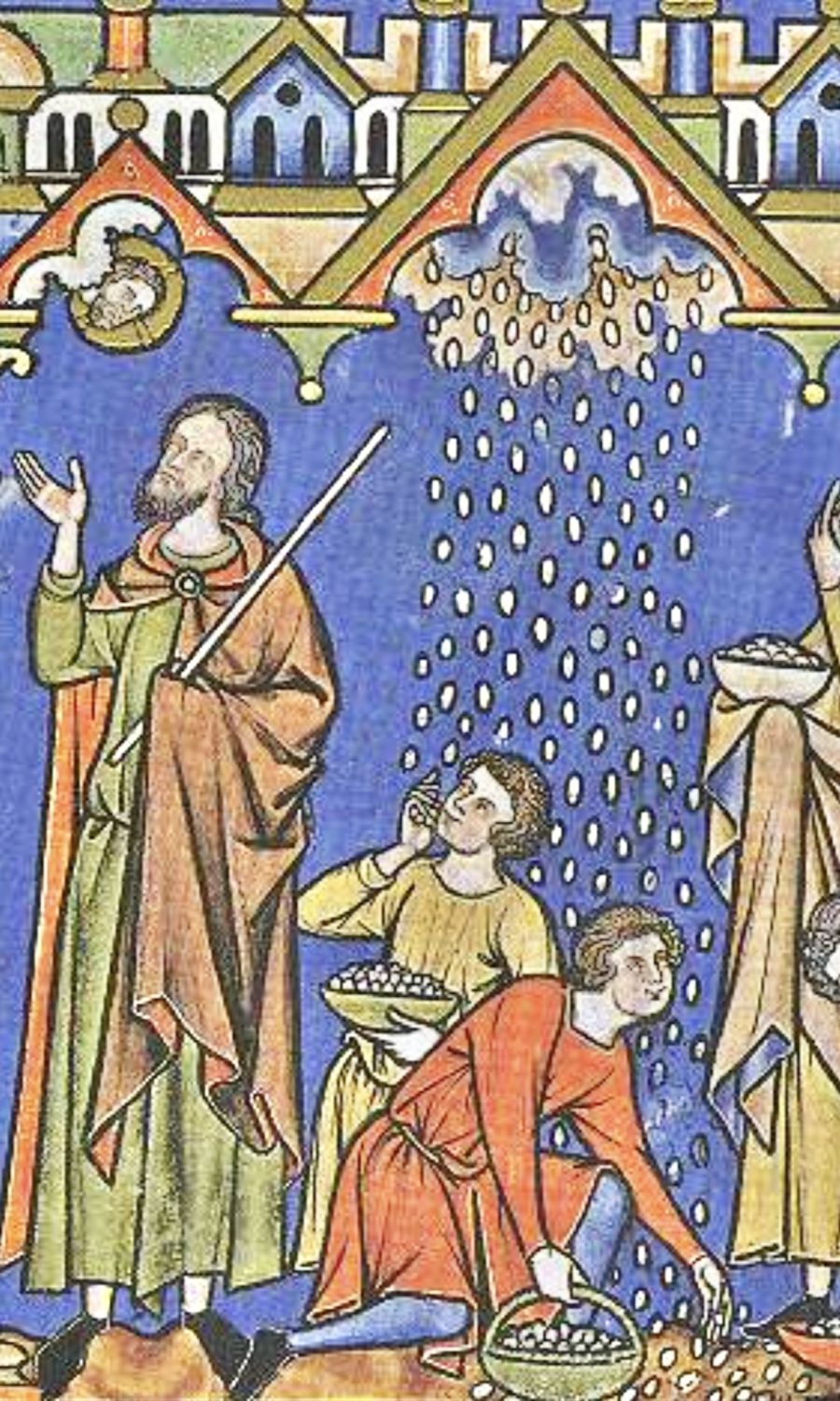
According to a Jewish belief, the coming of the Messiah would be accompanied by a shower of Manna from heaven - called Manna of the Second Redeemer - to satisfy material appetites.

Bread that does not last.

There were also rabbinic speculations that reflected other claims, not of physical necessity; and they told of the «bread» descended from above in a sapiential figure (Deut 8:3: «man does not live by bread alone, but by what comes from the mouth of the Lord»; cf. Wis 16:26).

In order to satisfy existential needs and great questions of meaning, Jesus reveals and presents Himself as the indestructible Bread of Life.


There are questions we cannot answer: why the pain and humiliation, why there are fortunate people and others who through no fault of their own live unhappily; for what great task we were born and why despite the comforts we still do not feel fulfilled.

Our experience is as if shrouded in the confusion of underlying questions... and often lacking even the eye and warmth of a Witness.

So we look for a Person who translates everything into Relation, and we long for his sapiential Food - a foundation, the humanising warmth, and a synthesis of all truth, of all history.

Only Jesus and his story give meaning to the many happenings; also to limits, wounds, boundaries, precariousness.

He is Dream, Meaning, Action and Voice of the Father. Key, Centre and Destination of each one and of humanity. The only Food for the 'hunger' and the only Source for the 'thirst' of the woman and man subjected to trials and questions.

In Jesus' time, by widespread devotion Moses continued to be the great leader to believe and adhere to. But according to the Lord, that of the Exodus of the "fathers" is configured as a proposal that has no future: it does not guarantee orientation, subsistence and a joyful, solid and full life.

It does not even remain as a stump of the now. It is only an archaic seed, a particular excrescence undone in favour of the mystical and renewed Wheat that makes one proceed on the authentic Path.

The pious and inactual custom - with all its labours - had not secured the great change: access to the 'land of the free'.

The Gift from Heaven prepared and arranged another Birth, upsetting from the root the light, tedious and insipid nourishment; whatever, for all seasons.

No reassuring recipe comes our way, because the 'second Genesis' and growth in the Spirit has character, but it does not happen once and for all.

Even the wounds and uncertainties of life become a 'call' to feed on the Person of Christ. But reinterpreting Him with new answers to new questions; to generate again and grow in Him and of Him.

So we are in the episodes, yet out of time; in the Love that is born, yet new.

We can experience the taste of living, instead of the condemnation of always feeling undermined.

For this spousal and ever-new union, the immense scope of his Person minced, ruminated, made one's own as one does with food, becomes Life itself of the Eternal (v.33).

Anointing that does not lapse, that calls us together to Concelebrate.


[Tuesday 3rd wk. in Easter, April 21, 2026]

105 Last modified on Monday, 13 April 2026 05:12
don Giuseppe Nespeca

Giuseppe Nespeca è architetto e sacerdote. Cultore della Sacra scrittura è autore della raccolta "Due Fuochi due Vie - Religione e Fede, Vangeli e Tao"; coautore del libro "Dialogo e Solstizio".

The Eucharist draws us into Jesus' act of self-oblation. More than just statically receiving the incarnate Logos, we enter into the very dynamic of his self-giving [Pope Benedict]
L'Eucaristia ci attira nell'atto oblativo di Gesù. Noi non riceviamo soltanto in modo statico il Logos incarnato, ma veniamo coinvolti nella dinamica della sua donazione [Papa Benedetto]
Jesus, the true bread of life that satisfies our hunger for meaning and for truth, cannot be “earned” with human work; he comes to us only as a gift of God’s love, as a work of God (Pope Benedict)
Gesù, vero pane di vita che sazia la nostra fame di senso, di verità, non si può «guadagnare» con il lavoro umano; viene a noi soltanto come dono dell’amore di Dio, come opera di Dio (Papa Benedetto)
The locality of Emmaus has not been identified with certainty. There are various hypotheses and this one is not without an evocativeness of its own for it allows us to think that Emmaus actually represents every place: the road that leads there is the road every Christian, every person, takes. The Risen Jesus makes himself our travelling companion as we go on our way, to rekindle the warmth of faith and hope in our hearts and to break the bread of eternal life (Pope Benedict)
La località di Emmaus non è stata identificata con certezza. Vi sono diverse ipotesi, e questo non è privo di una sua suggestione, perché ci lascia pensare che Emmaus rappresenti in realtà ogni luogo:  la strada che vi conduce è il cammino di ogni cristiano, anzi, di ogni uomo. Sulle nostre strade Gesù risorto si fa compagno di viaggio, per riaccendere nei nostri cuori il calore della fede e della speranza e spezzare il pane della vita eterna (Papa Benedetto)
Romano Guardini wrote that the Lord “is always close, being at the root of our being. Yet we must experience our relationship with God between the poles of distance and closeness. By closeness we are strengthened, by distance we are put to the test” (Pope Benedict)
Romano Guardini scrive che il Signore “è sempre vicino, essendo alla radice del nostro essere. Tuttavia, dobbiamo sperimentare il nostro rapporto con Dio tra i poli della lontananza e della vicinanza. Dalla vicinanza siamo fortificati, dalla lontananza messi alla prova” (Papa Benedetto)
In recounting the "sign" of bread, the Evangelist emphasizes that Christ, before distributing the food, blessed it with a prayer of thanksgiving (cf. v. 11). The Greek term used is eucharistein and it refers directly to the Last Supper, though, in fact, John refers here not to the institution of the Eucharist but to the washing of the feet. The Eucharist is mentioned here in anticipation of the great symbol of the Bread of Life [Pope Benedict]
Narrando il “segno” dei pani, l’Evangelista sottolinea che Cristo, prima di distribuirli, li benedisse con una preghiera di ringraziamento (cfr v. 11). Il verbo è eucharistein, e rimanda direttamente al racconto dell’Ultima Cena, nel quale, in effetti, Giovanni non riferisce l’istituzione dell’Eucaristia, bensì la lavanda dei piedi. L’Eucaristia è qui come anticipata nel grande segno del pane della vita [Papa Benedetto]
First, the world of the Bible presents us with a new image of God. In surrounding cultures, the image of God and of the gods ultimately remained unclear and contradictory (Deus Caritas est n.9)
Vi è anzitutto la nuova immagine di Dio. Nelle culture che circondano il mondo della Bibbia, l'immagine di dio e degli dei rimane, alla fin fine, poco chiara e in sé contraddittoria (Deus Caritas est n.9)

Due Fuochi due Vie - Vol. 1 Due Fuochi due Vie - Vol. 2 Due Fuochi due Vie - Vol. 3 Due Fuochi due Vie - Vol. 4 Due Fuochi due Vie - Vol. 5 Dialogo e Solstizio I fiammiferi di Maria

duevie.art

don Giuseppe Nespeca

Tel. 333-1329741


Disclaimer

Questo blog non rappresenta una testata giornalistica in quanto viene aggiornato senza alcuna periodicità. Non può pertanto considerarsi un prodotto editoriale ai sensi della legge N°62 del 07/03/2001.
Le immagini sono tratte da internet, ma se il loro uso violasse diritti d'autore, lo si comunichi all'autore del blog che provvederà alla loro pronta rimozione.
L'autore dichiara di non essere responsabile dei commenti lasciati nei post. Eventuali commenti dei lettori, lesivi dell'immagine o dell'onorabilità di persone terze, il cui contenuto fosse ritenuto non idoneo alla pubblicazione verranno insindacabilmente rimossi.







