Apr 16, 2026 Written by 

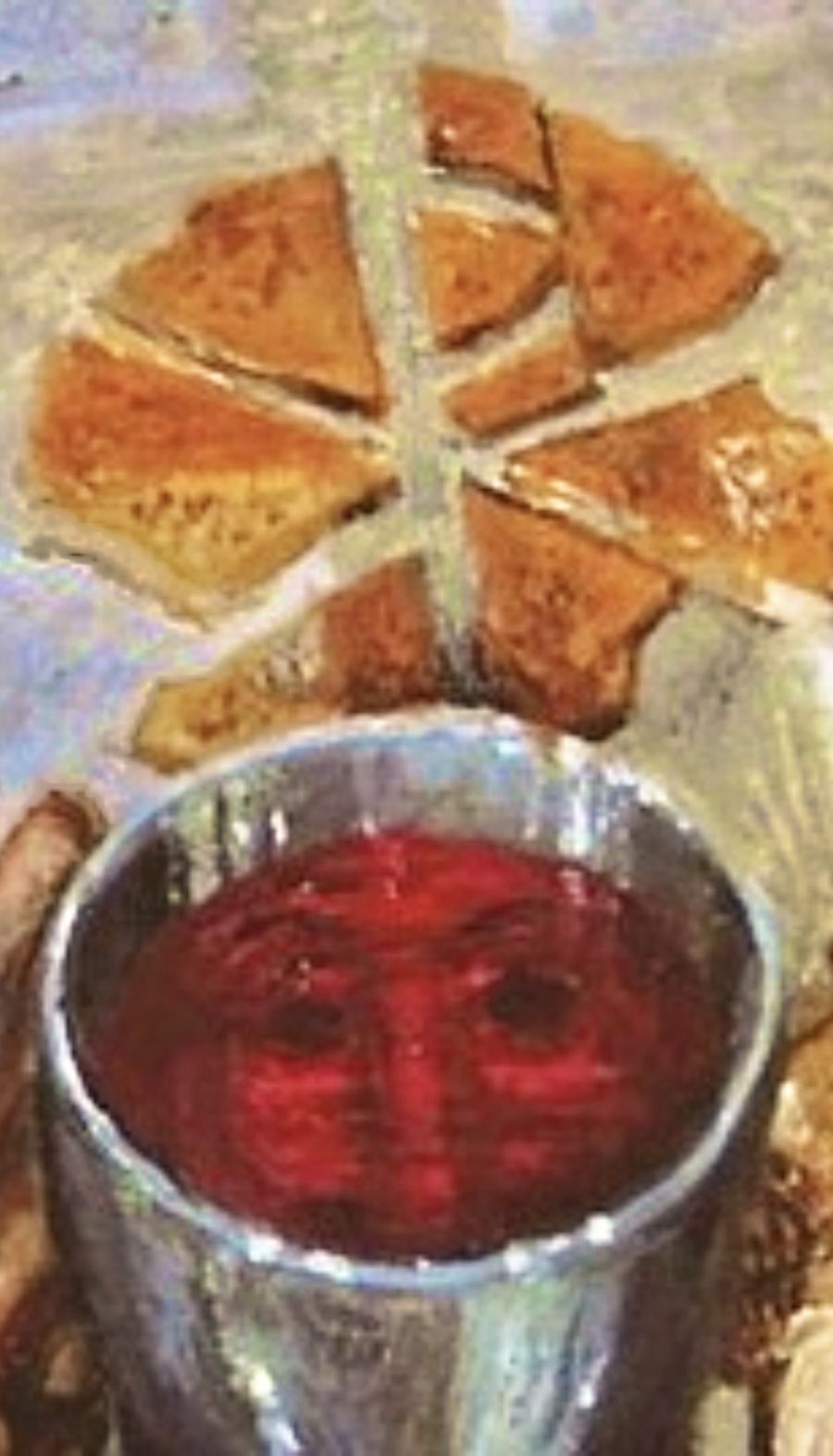
Mysticism of Flesh and Blood

No triumphal march: fragments, to reconcile

(Jn 6:52-59)


The Eucharistic theme conveys a fundamental message, about the quality of Life of the Eternal that we can already experience here and now.

The Life of the Eternal is not the effect of external “belief” in Jesus. Conviction that would stop us, and lose 'contact'.

Instead, it becomes reciprocal, evolves, recovers us, as in a natural energy.

Here is the raw Food, and Drink: by 'chewing’ Him and 'crushing’; 'drinking’ Him and 'gulping’, ‘quaffing’ Him and ‘swilling down' even [verbs used in the Greek text].

Total assimilation, which is converted into an experience - Gift from Person to person.

The Food to be fed on is not a seal, but an everlasting, convoking motion. Not a logical, compassed and consenting doctrine, but Word-event that fully engages.

For this reason, here is the Person of Christ - in his true and full human reality, offered and broken; in his authentic teaching and vicissitude as the paschal lamb, amidst wolves that shredded him.

It is the raw means by which the Life of the Eternal is given and preserved.

In this sense the Eucharist received in bare Faith is the real (not symbolic) Presence of the Risen One.

The harshness of the vocabulary used - not very intimate - scratches the lives of believers with concrete effects in the first person.

«To have Life» is to be united with Jesus - but not in a sweet, sentimental, or dazzling way.

The Pact of a new kingdom is existence in God: a charge that is not exhausted, and ushers us into the paradoxical, wounded glory of the community of sons.

The Eucharist is the reference point of Church recognizing itself, defines what it is called to be. And must not find its perennial bonds elsewhere.


With polemical crudeness, Jesus insists on proposing Himself as the Easter Lamb who rudely chopped up and totally absorbed, frees from slavery - introducing his own intimates in angular but true trajectories.

His proposal passes through an impertinent transgression of legalism: it was absolutely forbidden to assume blood, considered the seat of life.

To make the story of the total Christ one's own - so far removed from controlled thinking - is to mark a contestation of norms and habits or fashions.

In short, others "manna" or external affective dependencies, diluted, conditioning-centred, are not even pale figures of the Living Food.

The life Communion with the concrete Person of Lord is only that of the Son with the Father: cultivating it, we dream of it and keep it there, along with our events - so that they are nourished by same Spirit.

By letting the motivations and the world of images linked to the Lord's Supper evolve, we allow ourselves to be led by the efficacious Sign. It will guide and even lead, precisely where we need to go.

By surrendering to such a memorial that gives intimate impetus, something will happen - for the soul to take the field. We will see other stages give birth.

Here is the Judgement of the wounded Crucified, who sprinkles authentic life (even if inclement); without admirable attunements all around.

This by taking our flesh and blood [involves the body and moods] which assimilates to Him the discarded, those outcasts of earthly thrones and opportunistic entanglements.

This is shocking for the vulgar outside mentality that raises defences and seeks approval, recognition, achievement; mirages of success, things that everyone wants.

Decrease that does not attract enthusiastic consensus, but rather flies in the face of normal expectations of the usual choruses of glory - of the acclamation’ symphonies for whirlwind success and available, but mitigating.


Flesh and Blood: thrown into the furrows of history. We also being involved without dampening the Spirit; in a personal and intimate way: One Body, assimilated into Him and His affair.

First fruits of no triumphal march: we too became food, crumbs and fragments, to reconcile.

Otherwise, the time of the Promises cannot be fulfilled.


[Friday 3rd wk. in Easter, April 24, 2026]

113 Last modified on Thursday, 16 April 2026 06:01
don Giuseppe Nespeca

Giuseppe Nespeca è architetto e sacerdote. Cultore della Sacra scrittura è autore della raccolta "Due Fuochi due Vie - Religione e Fede, Vangeli e Tao"; coautore del libro "Dialogo e Solstizio".

What is meant by “eat the flesh and drink the blood” of Jesus? Is it just an image, a figure of speech, a symbol, or does it indicate something real? (Pope Francis)
Che significa “mangiare la carne e bere il sangue” di Gesù?, è solo un’immagine, un modo di dire, un simbolo, o indica qualcosa di reale? (Papa Francesco)
What does bread of life mean? We need bread to live. Those who are hungry do not ask for refined and expensive food, they ask for bread. Those who are unemployed do not ask for enormous wages, but the “bread” of employment. Jesus reveals himself as bread, that is, the essential, what is necessary for everyday life; without Him it does not work (Pope Francis)
Che cosa significa pane della vita? Per vivere c’è bisogno di pane. Chi ha fame non chiede cibi raffinati e costosi, chiede pane. Chi è senza lavoro non chiede stipendi enormi, ma il “pane” di un impiego. Gesù si rivela come il pane, cioè l’essenziale, il necessario per la vita di ogni giorno, senza di Lui la cosa non funziona (Papa Francesco)
In addition to physical hunger man carries within him another hunger — all of us have this hunger — a more important hunger, which cannot be satisfied with ordinary food. It is a hunger for life, a hunger for eternity which He alone can satisfy, as he is «the bread of life» (Pope Francis)
Oltre alla fame fisica l’uomo porta in sé un’altra fame – tutti noi abbiamo questa fame – una fame più importante, che non può essere saziata con un cibo ordinario. Si tratta di fame di vita, di fame di eternità che Lui solo può appagare, in quanto è «il pane della vita» (Papa Francesco)
The Eucharist draws us into Jesus' act of self-oblation. More than just statically receiving the incarnate Logos, we enter into the very dynamic of his self-giving [Pope Benedict]
L'Eucaristia ci attira nell'atto oblativo di Gesù. Noi non riceviamo soltanto in modo statico il Logos incarnato, ma veniamo coinvolti nella dinamica della sua donazione [Papa Benedetto]
Jesus, the true bread of life that satisfies our hunger for meaning and for truth, cannot be “earned” with human work; he comes to us only as a gift of God’s love, as a work of God (Pope Benedict)
Gesù, vero pane di vita che sazia la nostra fame di senso, di verità, non si può «guadagnare» con il lavoro umano; viene a noi soltanto come dono dell’amore di Dio, come opera di Dio (Papa Benedetto)
The locality of Emmaus has not been identified with certainty. There are various hypotheses and this one is not without an evocativeness of its own for it allows us to think that Emmaus actually represents every place: the road that leads there is the road every Christian, every person, takes. The Risen Jesus makes himself our travelling companion as we go on our way, to rekindle the warmth of faith and hope in our hearts and to break the bread of eternal life (Pope Benedict)
La località di Emmaus non è stata identificata con certezza. Vi sono diverse ipotesi, e questo non è privo di una sua suggestione, perché ci lascia pensare che Emmaus rappresenti in realtà ogni luogo:  la strada che vi conduce è il cammino di ogni cristiano, anzi, di ogni uomo. Sulle nostre strade Gesù risorto si fa compagno di viaggio, per riaccendere nei nostri cuori il calore della fede e della speranza e spezzare il pane della vita eterna (Papa Benedetto)
Romano Guardini wrote that the Lord “is always close, being at the root of our being. Yet we must experience our relationship with God between the poles of distance and closeness. By closeness we are strengthened, by distance we are put to the test” (Pope Benedict)

Due Fuochi due Vie - Vol. 1 Due Fuochi due Vie - Vol. 2 Due Fuochi due Vie - Vol. 3 Due Fuochi due Vie - Vol. 4 Due Fuochi due Vie - Vol. 5 Dialogo e Solstizio I fiammiferi di Maria

duevie.art

don Giuseppe Nespeca

Tel. 333-1329741


Disclaimer

Questo blog non rappresenta una testata giornalistica in quanto viene aggiornato senza alcuna periodicità. Non può pertanto considerarsi un prodotto editoriale ai sensi della legge N°62 del 07/03/2001.
Le immagini sono tratte da internet, ma se il loro uso violasse diritti d'autore, lo si comunichi all'autore del blog che provvederà alla loro pronta rimozione.
L'autore dichiara di non essere responsabile dei commenti lasciati nei post. Eventuali commenti dei lettori, lesivi dell'immagine o dell'onorabilità di persone terze, il cui contenuto fosse ritenuto non idoneo alla pubblicazione verranno insindacabilmente rimossi.







