Feb 21, 2026 Written by 

Against the tide Transfiguration

Faith and Metamorphosis

(Mk 9:2-13)


In biblical language, the experience of «the Mount» is an icon of the Encounter between God and man. Yes, for us it’s like “losing our minds”, but in a very practical way - not at all visionary.

The Master imposes it on the three eminent figures of the first communities, not because he considers them the chosen ones, but the exact opposite: he realizes that it’s his captains who need verification.

The synoptic Gospels do not speak of Transfiguration any, but of «Metamorphosis» [Greek text of Mk 9:2 and Mt 17:2]: a passing under a different ‘form’.

In particular, Lk 9:29 emphasizes that «the appearance of his face became ‘other’». Not because of a paroxysmal state.

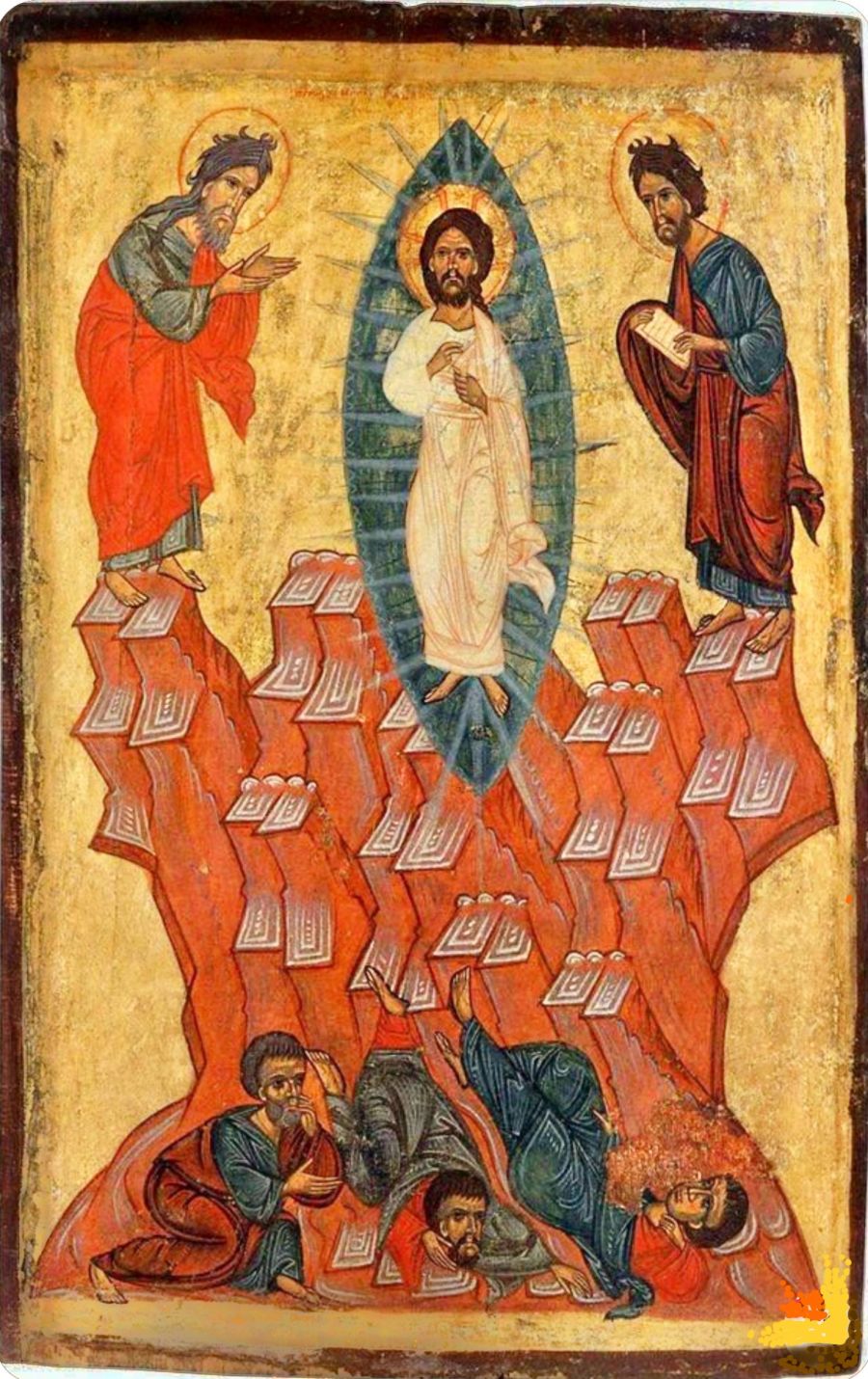
It sounds crazy, but the hieratic magnificence of the Eternal One is revealed against the tide: in the image of the humble servant.

The experience of divine Glory is unsustainable for the eminent disciples - not in reference to physical flashes of light.

As in Oriental icons, they find themselves face to earth [Mt 17:6 - in ancient Eastern culture it meant precisely: "defeated" in their aspirations] and frightened. Fearful of being they too called to the gift of self (Mk 9:6; Mt 17:6; Lk 9:34-36).

The vertigo of the experience of God was not what they cultivated and wanted.

The dazzling light to which the passage refers (Mk 9:3; Mt 17:2.5; Lk 9:29) is that of a Revelation that opens our eyes to the "impossible" identity of the Son.

He was popularly expected as resembling David, powerful sovereign, able to assure the people a quick and easy well-being.

He’s ‘revealed’ in a reversal: the Glory of God is Communion in simplicity, which qualifies us everyone.

The ‘shape’ of the "boss" is that of the attendant, who has the freedom to step down in altitude to put the least at ease: the humanly defeated one!

Peter elbows more than others to have his say. As usual, he wants to emerge and reiterate ancient ideas, but he reveals himself as the most ridiculous of all (Mk 9:6; Lk 9:33): he’s ranting.

For him [again!] at the centre of the triptych remains Moses (Mk 9:5; Mt 17:4; Lk 9:33).

With the help of prophecies animated by fiery zeal [Elijah], according to Simon, Jesus would be one of the many who makes others practise the legalistic tradition.

At foundatiion remain the Commandments, not the Beatitudes.

The first of the apostles just does not want to understand that the Lord doesn’t impose a Covenant based on obeying, but on Resembling!

Of course, the other "great ones" were also half asleep. Who knows what they were dreaming of... then bewildered, they all look for a Jesus according to Moses and Elijah (Mk 9:8-10; Mt 17:8; Lk 9:36).


In the culture of the time, the new, observant and disruptive Prince was expected during the Feast of Huts.

He would inaugurate the rule of the chosen people over all the nations of the earth (Zk 14:16-19); in practice, the golden age.

In Judaism, the Feast of Booths commemorated the ‘Mirabilia Dei’ of the Exodus [Lk 9:31: here, the new and personalised liberation from the land of slavery] and looked to the future by celebrating the prospects of victory for the protagonist ethnicity.

But the Kingdom of the Lord is not an empire affected by prodigious and immediate verticalism.

To build the Church of God there are no shortcuts, no numb safety points, and there sitting quiet - at a safe distance - by raving about accolades.


[2nd Sunday in Lent, Transfiguration of the Lord]

449 Last modified on Sunday, 01 March 2026 12:46
don Giuseppe Nespeca

Giuseppe Nespeca è architetto e sacerdote. Cultore della Sacra scrittura è autore della raccolta "Due Fuochi due Vie - Religione e Fede, Vangeli e Tao"; coautore del libro "Dialogo e Solstizio".

First, the world of the Bible presents us with a new image of God. In surrounding cultures, the image of God and of the gods ultimately remained unclear and contradictory (Deus Caritas est n.9)
Vi è anzitutto la nuova immagine di Dio. Nelle culture che circondano il mondo della Bibbia, l'immagine di dio e degli dei rimane, alla fin fine, poco chiara e in sé contraddittoria (Deus Caritas est n.9)
God loves the world and will love it to the end. The Heart of the Son of God pierced on the Cross and opened is a profound and definitive witness to God’s love. Saint Bonaventure writes: “It was a divine decree that permitted one of the soldiers to open his sacred wide with a lance… The blood and water which poured out at that moment was the price of our salvation” (John Paul II)
Il mondo è amato da Dio e sarà amato fino alla fine. Il Cuore del Figlio di Dio trafitto sulla croce e aperto, testimonia in modo profondo e definitivo l’amore di Dio. Scriverà San Bonaventura: “Per divina disposizione è stato permesso che un soldato trafiggesse e aprisse quel sacro costato. Ne uscì sangue ed acqua, prezzo della nostra salvezza” (Giovanni Paolo II)
Thus, paradoxically, from a sign of condemnation, death and failure, the Cross becomes a sign of redemption, life and victory, through faith, the fruits of salvation can be gathered (Pope Benedict)
Così la Croce, paradossalmente, da segno di condanna, di morte, di fallimento, diventa segno di redenzione, di vita, di vittoria, in cui, con sguardo di fede, si possono scorgere i frutti della salvezza (Papa Benedetto)
[Nicodemus] felt the fascination of this Rabbi, so different from the others, but could not manage to rid himself of the conditioning of his environment that was hostile to Jesus, and stood irresolute on the threshold of faith (Pope Benedict)
[Nicodemo] avverte il fascino di questo Rabbì così diverso dagli altri, ma non riesce a sottrarsi ai condizionamenti dell’ambiente contrario a Gesù e resta titubante sulla soglia della fede (Papa Benedetto)
Those wounds that, in the beginning were an obstacle for Thomas’s faith, being a sign of Jesus’ apparent failure, those same wounds have become in his encounter with the Risen One, signs of a victorious love. These wounds that Christ has received for love of us help us to understand who God is and to repeat: “My Lord and my God!” Only a God who loves us to the extent of taking upon himself our wounds and our pain, especially innocent suffering, is worthy of faith (Pope Benedict)
Quelle piaghe, che per Tommaso erano dapprima un ostacolo alla fede, perché segni dell’apparente fallimento di Gesù; quelle stesse piaghe sono diventate, nell’incontro con il Risorto, prove di un amore vittorioso. Queste piaghe che Cristo ha contratto per amore nostro ci aiutano a capire chi è Dio e a ripetere anche noi: “Mio Signore e mio Dio”. Solo un Dio che ci ama fino a prendere su di sé le nostre ferite e il nostro dolore, soprattutto quello innocente, è degno di fede (Papa Benedetto)
We see that the disciples are still closed in their thinking […] How does Jesus answer? He answers by broadening their horizons […] and he confers upon them the task of bearing witness to him all over the world, transcending the cultural and religious confines within which they were accustomed to think and live (Pope Benedict)
Vediamo che i discepoli sono ancora chiusi nella loro visione […] E come risponde Gesù? Risponde aprendo i loro orizzonti […] e conferisce loro l’incarico di testimoniarlo in tutto il mondo oltrepassando i confini culturali e religiosi entro cui erano abituati a pensare e a vivere (Papa Benedetto)

Due Fuochi due Vie - Vol. 1 Due Fuochi due Vie - Vol. 2 Due Fuochi due Vie - Vol. 3 Due Fuochi due Vie - Vol. 4 Due Fuochi due Vie - Vol. 5 Dialogo e Solstizio I fiammiferi di Maria

duevie.art

don Giuseppe Nespeca

Tel. 333-1329741


Disclaimer

Questo blog non rappresenta una testata giornalistica in quanto viene aggiornato senza alcuna periodicità. Non può pertanto considerarsi un prodotto editoriale ai sensi della legge N°62 del 07/03/2001.
Le immagini sono tratte da internet, ma se il loro uso violasse diritti d'autore, lo si comunichi all'autore del blog che provvederà alla loro pronta rimozione.
L'autore dichiara di non essere responsabile dei commenti lasciati nei post. Eventuali commenti dei lettori, lesivi dell'immagine o dell'onorabilità di persone terze, il cui contenuto fosse ritenuto non idoneo alla pubblicazione verranno insindacabilmente rimossi.







