Mar 1, 2026 Written by 

Person, extemporaneity, synagogues

Two Names of God

(Lk 4:24-30)


Jesus is annoying and generates suspicion in those who love external schemes, because he proclaims only Jubilee, rather than harsh confrontation and revenge.

In the synagogue, his ‘village’ is perplexed by this overly understanding love - just what we need.

The place of worship is where less aware believers have been educated in reverse!

Their grumpy character is the sour fruit of a pounding religiosity, which denies the right to express ideas and feelings.

The "synagogal" code has produced fake faithfuls, conditioned by a disharmonious and split personality.

Even today and from an early age, that intimate laceration manifests itself in the excess of control over openness to others.

Consequence: an accentuation of youth uncertainty - under which who knows what hatches - and a rigid adult character.

In short, the hammering that does not make the leap of Faith blocks us, prevents from understanding, and pollutes all of life.


Even in the time of Jesus, archaic teaching sharpened nationalisms, the very perception of trauma or violations, and paradoxically precisely the caged situations from which one wanted to escape.

Exclusive spirituality: it’s empty - whether crude or sophisticated.

Selective thinking is the worst disease of worldviews, which are then always telling us ‘how we should be’.


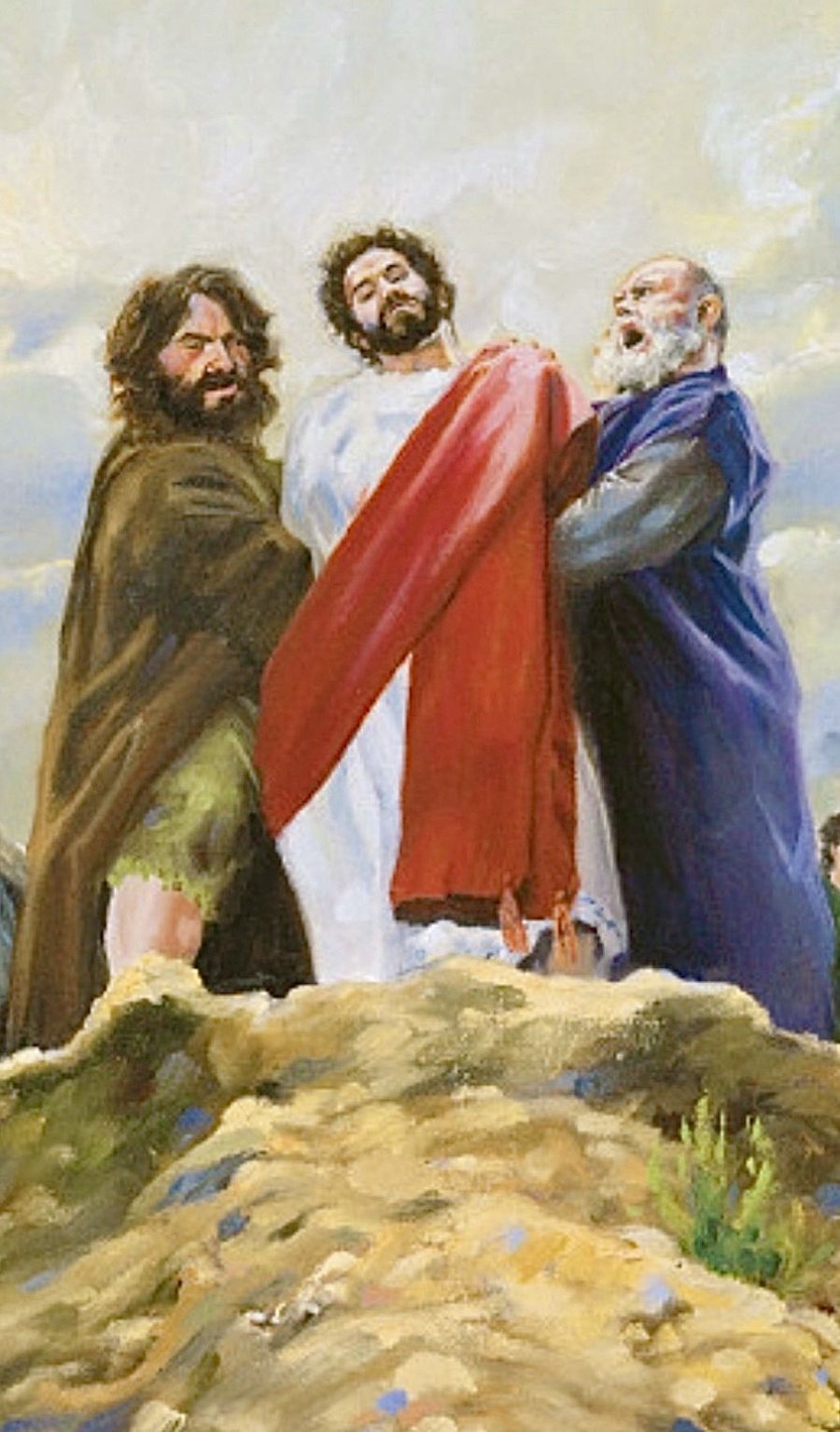
Faced with edgy convictions and conventicular illusions, the Prophet marks distance; he works to spread awareness, not reassuring images - nor disembodied ideas.

But the critical heralds violently irritate the crowd of regulars, who suddenly pass from a sort of curiosity to vengeful indignation.

As in the village, so - we read in watermark - in the Holy City [Mount Sion], from which they immediately want to throw you down (Lk 4:29). Wherever you talk about a real person and eternal dreams.


In the hostility that surrounds them, the intimates of the Lord openly challenge the normalized beliefs - acquired from the environment and not reworked.

For them it’s not only the analogy calculated to a petty side dish that counts. They see other goals and don't just want to “get there”.

If they are overwhelmed, they leave behind that trail of intuitions that sooner or later will make everyone reflect.

Therefore in his Friends it is the Risen who escapes from death and resumes the journey, crossing those who want to kill him (v.30).


At all times, the witnesses make us think: they do not seek compliments and pleasant results, but recover ‘opposite sides’ and accept the happiness of others.

They know that Uniqueness must run its course: it will be wealth for everyone, and on this point they do not allow themselves to be inhibited.

Based on the Father's personal experience, the inspired faithfuls value different approaches.

They create an unknown esteem, advocating new attitudes - different ways of relating to God.

Not, to add proselytes and consider themselves indispensable.


Even if «at home» (v.24: own townspeople, own country) they are uncomfortable characters for the ratified mentality, the nobody-Prophets make Jesus' Personalism survive, snatching it from those who want it to be dormant and kidnapped.

Like him, at the risk of unpopularity and without begging for approval.


With the scars of what has gone away, for a new Journey.


[Monday 3rd wk. in Lent, March 9, 2026]

132 Last modified on Monday, 09 March 2026 11:59
don Giuseppe Nespeca

Giuseppe Nespeca è architetto e sacerdote. Cultore della Sacra scrittura è autore della raccolta "Due Fuochi due Vie - Religione e Fede, Vangeli e Tao"; coautore del libro "Dialogo e Solstizio".

In the divine attitude justice is pervaded with mercy, whereas the human attitude is limited to justice. Jesus exhorts us to open ourselves with courage to the strength of forgiveness, because in life not everything can be resolved with justice. We know this (Pope Francis)
Nell’atteggiamento divino la giustizia è pervasa dalla misericordia, mentre l’atteggiamento umano si limita alla giustizia. Gesù ci esorta ad aprirci con coraggio alla forza del perdono, perché nella vita non tutto si risolve con la giustizia; lo sappiamo (Papa Francesco)
The true prophet does not obey others as he does God, and puts himself at the service of the truth, ready to pay in person. It is true that Jesus was a prophet of love, but love has a truth of its own. Indeed, love and truth are two names of the same reality, two names of God (Pope Benedict)
Il vero profeta non obbedisce ad altri che a Dio e si mette al servizio della verità, pronto a pagare di persona. E’ vero che Gesù è il profeta dell’amore, ma l’amore ha la sua verità. Anzi, amore e verità sono due nomi della stessa realtà, due nomi di Dio (Papa Benedetto)
“Give me a drink” (v. 7). Breaking every barrier, he begins a dialogue in which he reveals to the woman the mystery of living water, that is, of the Holy Spirit, God’s gift [Pope Francis]
«Dammi da bere» (v. 7). Così, rompendo ogni barriera, comincia un dialogo in cui svela a quella donna il mistero dell’acqua viva, cioè dello Spirito Santo, dono di Dio [Papa Francesco]
The mystery of ‘home-coming’ wonderfully expresses the encounter between the Father and humanity, between mercy and misery, in a circle of love that touches not only the son who was lost, but is extended to all (Pope John Paul II)
Il mistero del ‘ritorno-a-casa’ esprime mirabilmente l’incontro tra il Padre e l’umanità, tra la misericordia e la miseria, in un circolo d’amore che non riguarda solo il figlio perduto, ma si estende a tutti (Papa Giovanni Paolo II)
The image of the vineyard is clear: it represents the people whom the Lord has chosen and formed with such care; the servants sent by the landowner are the prophets, sent by God, while the son represents Jesus. And just as the prophets were rejected, so too Christ was rejected and killed (Pope Francis)
L’immagine della vigna è chiara: rappresenta il popolo che il Signore si è scelto e ha formato con tanta cura; i servi mandati dal padrone sono i profeti, inviati da Dio, mentre il figlio è figura di Gesù. E come furono rifiutati i profeti, così anche il Cristo è stato respinto e ucciso (Papa Francesco)
‘Lazarus’ means ‘God helps’. Lazarus, who is lying at the gate, is a living reminder to the rich man to remember God, but the rich man does not receive that reminder. Hence, he will be condemned not because of his wealth, but for being incapable of feeling compassion for Lazarus and for not coming to his aid. In the second part of the parable, we again meet Lazarus and the rich man after their death (vv. 22-31). In the hereafter the situation is reversed [Pope Francis]
“Lazzaro” significa “Dio aiuta”. Lazzaro, che giace davanti alla porta, è un richiamo vivente al ricco per ricordarsi di Dio, ma il ricco non accoglie tale richiamo. Sarà condannato pertanto non per le sue ricchezze, ma per essere stato incapace di sentire compassione per Lazzaro e di soccorrerlo. Nella seconda parte della parabola, ritroviamo Lazzaro e il ricco dopo la loro morte (vv. 22-31). Nell’al di là la situazione si è rovesciata [Papa Francesco]

Due Fuochi due Vie - Vol. 1 Due Fuochi due Vie - Vol. 2 Due Fuochi due Vie - Vol. 3 Due Fuochi due Vie - Vol. 4 Due Fuochi due Vie - Vol. 5 Dialogo e Solstizio I fiammiferi di Maria

duevie.art

don Giuseppe Nespeca

Tel. 333-1329741


Disclaimer

Questo blog non rappresenta una testata giornalistica in quanto viene aggiornato senza alcuna periodicità. Non può pertanto considerarsi un prodotto editoriale ai sensi della legge N°62 del 07/03/2001.
Le immagini sono tratte da internet, ma se il loro uso violasse diritti d'autore, lo si comunichi all'autore del blog che provvederà alla loro pronta rimozione.
L'autore dichiara di non essere responsabile dei commenti lasciati nei post. Eventuali commenti dei lettori, lesivi dell'immagine o dell'onorabilità di persone terze, il cui contenuto fosse ritenuto non idoneo alla pubblicazione verranno insindacabilmente rimossi.







