Mar 9, 2026 Written by 

Vain water, and the true Source

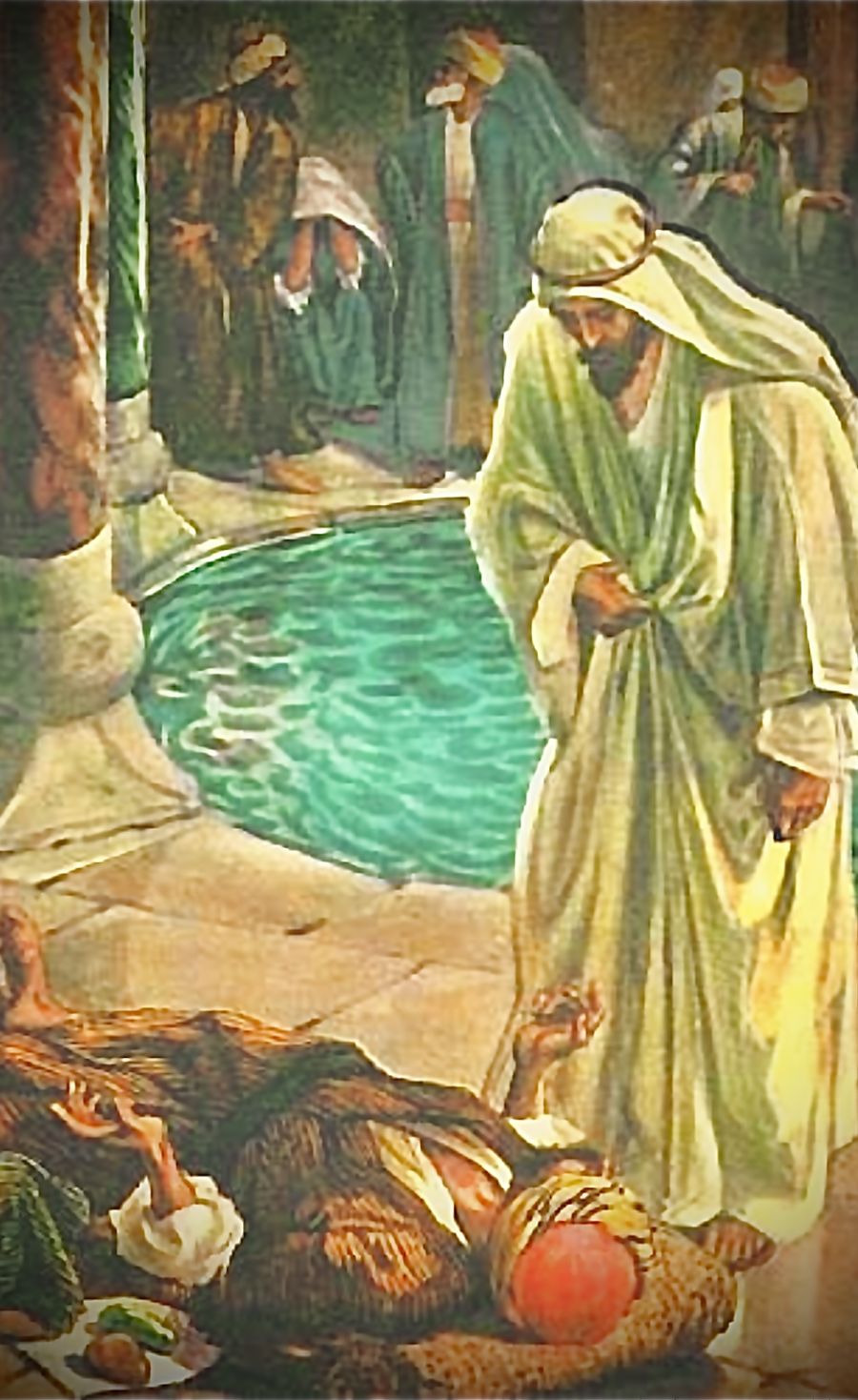
(Jn 5:1-3.5-16)


In the ‘devotion’ of competitive trophies, only the quickest heals, not the neediest.

Jesus prefers to transgress the law than to align himself with the merciless world that marginalizes the wretched.


In the holy places the cult of sacrifices required a lot of water [for the animals to be washed, then slaughtered], especially in the great feasts.

Large cisterns collected rainwater, and public baths agglomerated the sick waiting for help or recovery.

The pools outside were used to clean the lambs before the sacrifice to the Temple, and this old practise gave the water itself an aura of healing sanctity.

Many sick people flocked to bathe in the «motion of the water» [v.3: perhaps due to an intermittent source].

It was said that an angel stirred the waters of the popular baths and that the first person to enter them in the one moment the same waters became restless would be healed.

Symbol of a religion that offers false hopes to the excluded masses. 

Vain expectations attracted the imagination of the sick who did not know the man-God of their destiny.

«But he who had been healed did not know who He was, because Jesus had gone away, there being crowd in that place» (v.13).

The Face of the Son is unrecognisable in the masses pressing around, which is only distracting and content with habitual, exaggeratedly solemn forms.


Abundant conducts purified the Temple and neglected the people. The water flowed, but did not cure anyone - on the contrary, it made the situation worse.

An icon of a rich and miserable religiosity: vain, useless, harmful; that abandons those it is called upon to support.

Scribes taught the law to students in the sacred precincts, and the rabbis received clients under Solomon's porch: at the top the Torah and its trade, at the bottom and outside - close by - the treachery of the poor.

Official institution kept the unsteady at a safe distance, revealing only a ridiculous and brutal caricature of the Father's friendly, hospitable and sympathetic Face.

Crowd of the needy who were given ‘magic’ water [only randomly and by surprise] is a parable of destitute humanity, dramatically lacking everything - even genuine spiritual comfort.

On the other hand, Jesus approaches them on his own initiative (vv. 6.14).

And gets involved - at the risk of his life - with those who are most alone, awkward and clumsy; unables even to receive miracles.


We are ‘sent’ not to deserving and self-sufficient, but to those who are not able to use their ownn means to come forward.

Christ himself does not work in order to be recognized and acclaimed: «He had gone away» (v,13). Nor does He care for us, only to trigger a religious conversion.

He heals by perceiving the need, not so that the sick person ‘believes in God’.

We leave people free to go through their seasons, not stereotypes.

We enter the heart of Lent.


[Tuesday 4th wk. in Lent, March 17, 2026]

607 Last modified on Tuesday, 17 March 2026 12:00
don Giuseppe Nespeca

Giuseppe Nespeca è architetto e sacerdote. Cultore della Sacra scrittura è autore della raccolta "Due Fuochi due Vie - Religione e Fede, Vangeli e Tao"; coautore del libro "Dialogo e Solstizio".

Wherever people want to set themselves up as God they cannot but set themselves against each other. Instead, wherever they place themselves in the Lord’s truth they are open to the action of his Spirit who sustains and unites them (Pope Benedict
Dove gli uomini vogliono farsi Dio, possono solo mettersi l’uno contro l’altro. Dove invece si pongono nella verità del Signore, si aprono all’azione del suo Spirito che li sostiene e li unisce (Papa Benedetto)
But our understanding is limited: thus, the Spirit's mission is to introduce the Church, in an ever new way from generation to generation, into the greatness of Christ's mystery. The Spirit places nothing different or new beside Christ; no pneumatic revelation comes with the revelation of Christ - as some say -, no second level of Revelation (Pope Benedict)
Ma la nostra capacità di comprendere è limitata; perciò la missione dello Spirito è di introdurre la Chiesa in modo sempre nuovo, di generazione in generazione, nella grandezza del mistero di Cristo. Lo Spirito non pone nulla di diverso e di nuovo accanto a Cristo; non c’è nessuna rivelazione pneumatica accanto a quella di Cristo - come alcuni credono - nessun secondo livello di Rivelazione (Papa Benedetto)
Who touched Lydia's heart? The answer is: «the Holy Spirit». It’s He who made this woman feel that Jesus was Lord; He made this woman feel that salvation was in Paul's words; He made this woman feel a testimony (Pope Francis)
Chi ha toccato il cuore di Lidia? La risposta è: «lo Spirito Santo». È lui che ha fatto sentire a questa donna che Gesù era il Signore; ha fatto sentire a questa donna che la salvezza era nelle parole di Paolo; ha fatto sentire a questa donna una testimonianza (Papa Francesco)
But what does it mean to love Christ?  It means trusting him even in times of trial, following him faithfully even on the Via Crucis, in the hope that soon the morning of the Resurrection will come.  Entrusting ourselves to Christ, we lose nothing, we gain everything.  In his hands our life acquires its true meaning.  Love for Christ expresses itself in the will to harmonize our own life with the thoughts and sentiments of his Heart.  This is achieved through interior union [Pope Benedict]
Ma che vuol dire amare Cristo? Vuol dire fidarsi di Lui anche nell'ora della prova, seguirLo fedelmente anche sulla Via Crucis, nella speranza che presto verrà il mattino della risurrezione. Affidandoci a Cristo non perdiamo niente, ma acquistiamo tutto. Nelle sue mani la nostra vita acquista il suo vero senso. L'amore per Cristo si esprime nella volontà di sintonizzare la propria vita con i pensieri e i sentimenti del suo Cuore. Questo si realizza mediante l'unione interiore [Papa Benedetto]
St Thomas Aquinas says this very succinctly when he writes: "The New Law is the grace of the Holy Spirit" (Summa Theologiae, I-IIae, q.106 a. 1). The New Law is not another commandment more difficult than the others: the New Law is a gift, the New Law is the presence of the Holy Spirit [Pope Benedict]
San Tommaso d’Aquino lo dice in modo molto preciso quando scrive: “La nuova legge è la grazia dello Spirito Santo” (Summa theologiae, I-IIae, q. 106, a. 1). La nuova legge non è un altro comando più difficile degli altri: la nuova legge è un dono, la nuova legge è la presenza dello Spirito Santo [Papa Benedetto]
Even after seeing his people's repeated unfaithfulness to the covenant, this God is still willing to offer his love, creating in man a new heart (John Paul II)
Anche dopo aver registrato nel suo popolo una ripetuta infedeltà all’alleanza, questo Dio è disposto ancora ad offrire il proprio amore, creando nell’uomo un cuore nuovo (Giovanni Paolo II)

Due Fuochi due Vie - Vol. 1 Due Fuochi due Vie - Vol. 2 Due Fuochi due Vie - Vol. 3 Due Fuochi due Vie - Vol. 4 Due Fuochi due Vie - Vol. 5 Dialogo e Solstizio I fiammiferi di Maria

duevie.art

don Giuseppe Nespeca

Tel. 333-1329741


Disclaimer

Questo blog non rappresenta una testata giornalistica in quanto viene aggiornato senza alcuna periodicità. Non può pertanto considerarsi un prodotto editoriale ai sensi della legge N°62 del 07/03/2001.
Le immagini sono tratte da internet, ma se il loro uso violasse diritti d'autore, lo si comunichi all'autore del blog che provvederà alla loro pronta rimozione.
L'autore dichiara di non essere responsabile dei commenti lasciati nei post. Eventuali commenti dei lettori, lesivi dell'immagine o dell'onorabilità di persone terze, il cui contenuto fosse ritenuto non idoneo alla pubblicazione verranno insindacabilmente rimossi.







