May 11, 2026 Written by 

Testament in prayer: Mysticism of the Glory (for each son)

(Jn 17:1-11a)


Even in the fourth Gospel the Last Supper is followed by Jesus’ prayer, but unlike the Synoptics, Jn places it in the same Upper Room.

In the narrative of the first three Gospels, several notes tell of the Lord's intimate repugnance to the Cross - from which, however, He does not shy away, from which He does not allow himself to be overcome.

Here He only asks the Father for the indestructible quality of the Life of the Eternal in favour of his own, who have already come to know the intimacy of God: it opens up every reverberation.

To acknowledge the Son of Man as Lord is to accept a new form of existence in the Spirit.

Like a Wind that [regenerating us from within] makes itself the medium and continuer of the work of creation.

We are witnesses to a founding, glorious Relationship, that is of such value that it reactivates all destiny - beyond concatenations.

Such a platform overcomes the sense of unworthiness.

On it, here we are enabled to become passionate ‘inventors of roads’ everywhere.

Introduced into a Communion which is already here and now «Life of the Eternal» (vv.2-3). It comes from the ‘knowing’ the Father and the Son.

And it is concentrated in an Hour (v.1): an allusion that had run through the entire fourth Gospel.

Jesus' existence converges in the fruitful rawness of that point, which gives depth to everything.


The text differs from previous catecheses in that it is more amicable than teaching.

The Master retraces his story as a commitment to manifest the Father, to make us become signs of his Face.

Christ understands that the children are subject to seductions, and they risk losing the meaning of the believing in Him. Indeed, they still find it difficult to understand that Glory is not the fruit of worldly victory.

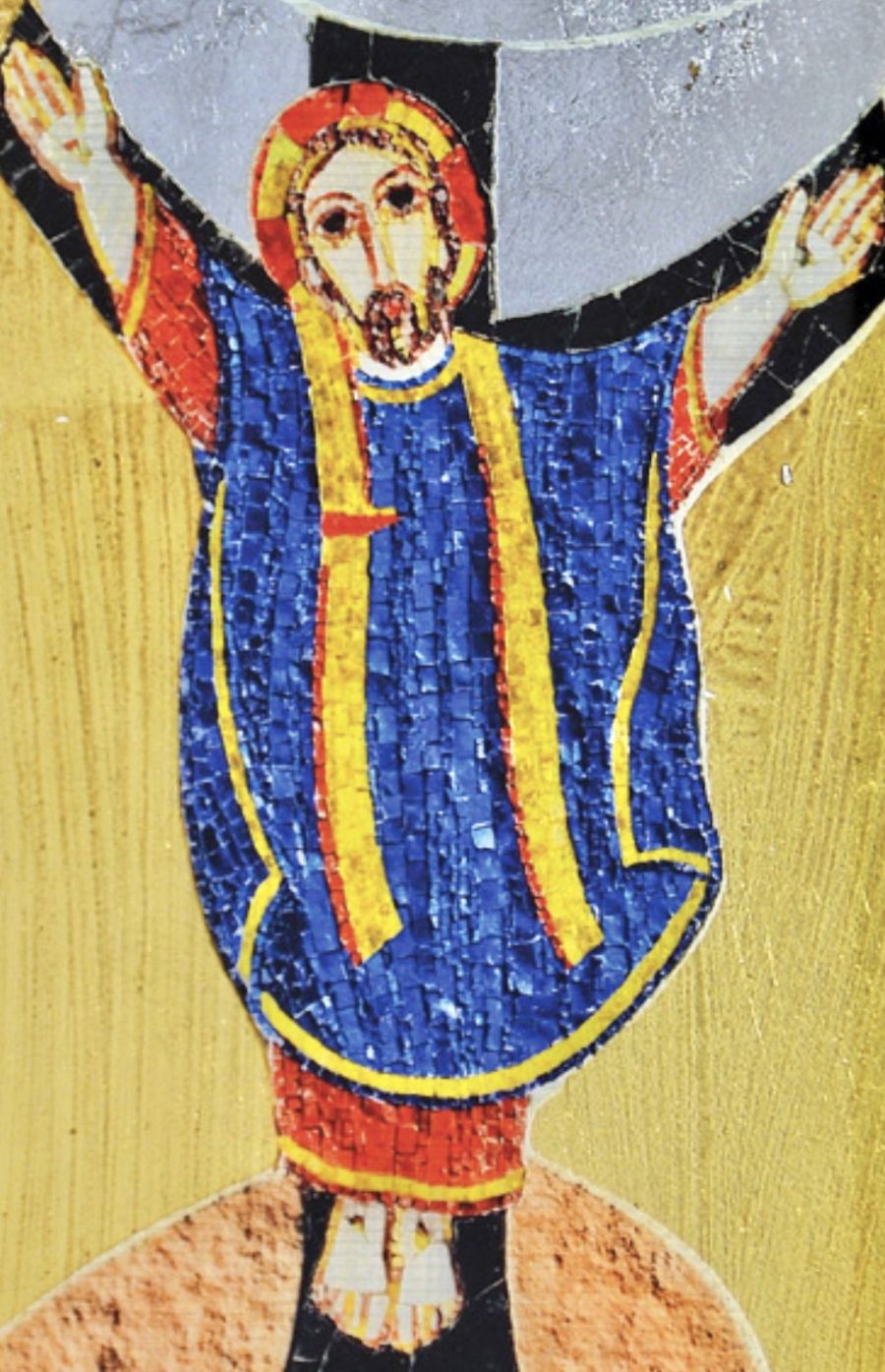
«Glory» in Jn stands for the manifestation of the Face of Eternal Love in the raising of the Cross.

Presence of the God-With - unveiling of His confidence, understanding, tenderness, recovery of opposing sides.

In this way, Glory of the Risen One is not a Relationship that remains closed in Heaven, between Father and Son.

The latter has given his intimates the «Name» (vv.6.11) i.e. revealed the Father and given access to his real Person - including the struggles undertaken.

Person who feeds us with the Word, and the sense of His events.

Such an unmistakable Voice reminds that every travail can lead us deeper with Jesus into the Glory and eternity of the Father.

God's intimate life is intensity of understanding; reciprocity that flows into expanded, open, fervent union, tending to transmute every tribulation into an appeal to new kabôd-glory.

It is about the specific [qualitative] weight that the believer assumes in a Heaven also perceivable by the senses.


Any difficulty, anguish, insecurity, now even becomes a point to converge on.

Like the Lord, the disciples do not go to death, but to the Way of complete Life that annihilates distance.

All this through a unity that deflects habits and puts one in touch with the energies of the intimate primordial bond, source-and-culmination, Father-Son.


[Tuesday 7th wk. in Easter, May 19, 2026]

312 Last modified on Tuesday, 19 May 2026 12:00
don Giuseppe Nespeca

Giuseppe Nespeca è architetto e sacerdote. Cultore della Sacra scrittura è autore della raccolta "Due Fuochi due Vie - Religione e Fede, Vangeli e Tao"; coautore del libro "Dialogo e Solstizio".

Christ reveals his identity of Messiah, Israel's bridegroom, who came for the betrothal with his people. Those who recognize and welcome him are celebrating. However, he will have to be rejected and killed precisely by his own; at that moment, during his Passion and death, the hour of mourning and fasting will come (Pope Benedict)
Cristo rivela la sua identità di Messia, Sposo d'Israele, venuto per le nozze con il suo popolo. Quelli che lo riconoscono e lo accolgono con fede sono in festa. Egli però dovrà essere rifiutato e ucciso proprio dai suoi: in quel momento, durante la sua passione e la sua morte, verrà l'ora del lutto e del digiuno (Papa Benedetto)
For the prodigious and instantaneous healing of the paralytic, the apostle St. Matthew is more sober than the other synoptics, St. Mark and St. Luke. These add broader details, including that of the opening of the roof in the environment where Jesus was, to lower the sick man with his lettuce, given the huge crowd that crowded at the entrance. Evident is the hope of the pitiful companions: they almost want to force Jesus to take care of the unexpected guest and to begin a dialogue with him (Pope Paul VI)
Per la prodigiosa ed istantanea guarigione del paralitico, l’apostolo San Matteo è più sobrio degli altri sinottici, San Marco e San Luca. Questi aggiungono più ampi particolari, tra cui quello dell’avvenuta apertura del tetto nell’ambiente ove si trovava Gesù, per calarvi l’infermo col suo lettuccio, data l’enorme folla che faceva ressa all’entrata. Evidente è la speranza dei pietosi accompagnatori: essi vogliono quasi obbligare Gesù ad occuparsi dell’inatteso ospite e ad iniziare un dialogo con lui (Papa Paolo VI)
A life without love and without truth would not be life. The Kingdom of God is precisely the presence of truth and love and thus is healing in the depths of our being. One therefore understands why his preaching and the cures he works always go together: in fact, they form one message of hope and salvation (Pope Benedict)
Una vita senza amore e senza verità non sarebbe vita. Il Regno di Dio è proprio la presenza della verità e dell’amore e così è guarigione nella profondità del nostro essere. Si comprende, pertanto, perché la sua predicazione e le guarigioni che opera siano sempre unite: formano infatti un unico messaggio di speranza e di salvezza (Papa Benedetto)
His slumber causes us to wake up. Because to be disciples of Jesus, it is not enough to believe God is there, that he exists, but we must put ourselves out there with him; we must also raise our voice with him. Hear this: we must cry out to him. Prayer is often a cry: “Lord, save me!” (Pope Francis)
Il suo sonno provoca noi a svegliarci. Perché, per essere discepoli di Gesù, non basta credere che Dio c’è, che esiste, ma bisogna mettersi in gioco con Lui, bisogna anche alzare la voce con Lui. Sentite questo: bisogna gridare a Lui. La preghiera, tante volte, è un grido: “Signore, salvami!” (Papa Francesco)
"The girl is not dead, but asleep". These words, deeply revealing, lead me to think of the mysterious presence of the Lord of life in a world that seems to succumb to the destructive impulse of hatred, violence and injustice; but no. This world, which is yours, is not dead, but sleeps (Pope John Paul II)
Let our prayer spread out and continue in the churches, communities, families, the hearts of the faithful, as though in an invisible monastery from which an unbroken invocation rises to the Lord (John Paul II)
La nostra preghiera si diffonda e continui nelle chiese, nelle comunità, nelle famiglie, nei cuori credenti, come in un monastero invisibile, da cui salga al Signore una invocazione perenne (Giovanni Paolo II)

Due Fuochi due Vie - Vol. 1 Due Fuochi due Vie - Vol. 2 Due Fuochi due Vie - Vol. 3 Due Fuochi due Vie - Vol. 4 Due Fuochi due Vie - Vol. 5 Dialogo e Solstizio I fiammiferi di Maria

duevie.art

don Giuseppe Nespeca

Tel. 333-1329741


Disclaimer

Questo blog non rappresenta una testata giornalistica in quanto viene aggiornato senza alcuna periodicità. Non può pertanto considerarsi un prodotto editoriale ai sensi della legge N°62 del 07/03/2001.
Le immagini sono tratte da internet, ma se il loro uso violasse diritti d'autore, lo si comunichi all'autore del blog che provvederà alla loro pronta rimozione.
L'autore dichiara di non essere responsabile dei commenti lasciati nei post. Eventuali commenti dei lettori, lesivi dell'immagine o dell'onorabilità di persone terze, il cui contenuto fosse ritenuto non idoneo alla pubblicazione verranno insindacabilmente rimossi.







