


XXXIII Sunday in Ordinary Time C [16 November 2025]
First Reading from the Book of the Prophet Malachi (3:19-20a)
When Malachi wrote these words around 450 BC, the people were discouraged: faith seemed to be dying out, even among the priests of Jerusalem, who now celebrated worship in a superficial manner. Everyone asked themselves: 'What is God doing? Has he forgotten us? Life is unfair! The wicked succeed in everything, so what is the point of being the chosen people and observing the commandments? Where is God's justice?" The prophet then fulfils his task: to reawaken faith and inner energy. He rebukes priests and lay people, but above all he proclaims that God is just and that his plan of justice is advancing irresistibly. "Behold, the day of the Lord is coming": history is not a repeating cycle, but is moving towards fulfilment. For those who believe, this is a truth of faith: the day of the Lord is coming. Depending on the image that each person has of God, this coming can be frightening or arouse ardent expectation. But for those who recognise that God is Father, the day of the Lord is good news, a day of love and light. Malachi uses the image of the sun: "Behold, the day of the Lord is coming, burning like an oven." This is not a threat! At the beginning of the book, God says, "I love you" (Malachi 1:2) and "I am Father" (Malachi 1:6). The "furnace" is not punishment, but a symbol of God's burning love. Just as the disciples of Emmaus felt their hearts burning within them, so those who encounter God are enveloped in the warmth of his love. The 'sun of righteousness' is therefore a fire of love: on the day we encounter God, we will be immersed in this burning ocean of mercy. God cannot help but love, especially all that is poor, naked and defenceless. This is the very meaning of mercy: a heart that bends over misery. Malachi also speaks of judgement. The sun, in fact, can burn or heal: it is ambivalent. In the same way, the 'Sun of God' reveals everything, illuminating without leaving any shadows: no lie or hypocrisy can hide from its light. God's judgement is not destruction, but revelation and purification. The sun will 'burn' the arrogant and the wicked, but it will 'heal' those who fear his name. Arrogance and closed hearts will be consumed like straw; humility and faith will be transfigured. Pride and humility, selfishness and love coexist in each of us. God's judgement will take place within us: what is 'straw' will burn, what is 'good seed' will sprout in God's sun. It will be a process of inner purification, until the image and likeness of God shines within us. Malachi also uses two other images: that of the smelter, who purifies gold not to destroy it, but to make it shine in all its beauty; and that of the bleacher, who does not ruin the garment, but makes it shine. Thus, God's judgement is a work of light: everything that is love, service and mercy will be exalted; everything that is not love will disappear. In the end, only what reflects the face of God will remain. The historical context helps us to understand this text: Israel is experiencing a crisis of faith and hope after the exile; the priests are lukewarm and the people are disillusioned. The prophet's message: God is neither absent nor unjust. His 'day' will come: it is the moment when his justice and love will be fully manifested. The central image is the Sun of Justice, symbol of God's purifying love. Like the sun, divine love burns and heals, consumes evil and makes good flourish. In each of us, God does not condemn, but transforms everything into salvation by discerning what glorifies love and dissolves pride. Fire, the sun, the smelter and the bleacher indicate the purification that leads to the original beauty of man created in the image of God. Finally, there is nothing to fear: for those who believe, the day of the Lord reveals love. "The sun of righteousness shall rise with healing in its wings" (Malachi 3:20).
Responsorial Psalm (97/98:5-6, 7-8, 9)
This psalm transports us ideally to the end of time, when all creation, renewed, joyfully acclaims the coming of the Kingdom of God. The text speaks of the sea and its riches, the world and its inhabitants, the rivers and the mountains: all creation is involved. St Paul, in his Letter to the Ephesians (1:9-10), reminds us that this is God's eternal plan: 'to bring all things in heaven and on earth together under one head, Christ'. God wants to reunite everything, to create full communion between the cosmos and creatures, to establish universal harmony. In the psalm, this harmony is already sung as accomplished: the sea roars, the rivers clap their hands, the mountains rejoice. It is God's dream, already announced by the prophet Isaiah (11:6-9): 'The wolf shall dwell with the lamb, the leopard shall lie down with the kid... no one shall do evil or destruction on all my holy mountain'. But the reality is very different: man knows the dangers of the sea, conflicts with nature and with his fellow men. Creation is marked by struggle and disharmony. However, biblical faith knows that the day will come when the dream will become reality, because it is God's own plan. The role of prophets, such as Isaiah, is to revive the hope of this messianic Kingdom of justice and faithfulness. The Psalms also tirelessly repeat the reasons for this hope: Psalm 97(98) sings of the Kingdom of God as the restoration of order and universal peace. After so many unjust kings, a Kingdom of justice and righteousness is awaited. The people sing as if everything were already accomplished: "Sing hymns to the Lord who comes to judge the earth... and the peoples with righteousness." At the beginning of the psalm, the wonders of the past are recalled—the exodus from Egypt, God's faithfulness in the history of Israel—but now it is proclaimed that God is coming: his Kingdom is certain, even if not yet fully visible. The experience of the past becomes a guarantee of the future: God has already shown his faithfulness, and this allows the believer to joyfully anticipate the coming of the Kingdom. As Psalm 89(90) says: "A thousand years in your sight are like yesterday." And Saint Peter (2 Pt 3:8-9) reminds us that God does not delay his promise, but waits for the conversion of all. This psalm therefore echoes the promises of the prophet Malachi: "The sun of righteousness shall rise with healing in its wings" (Mal 3:20). The singers of this psalm are the poor of the Lord, those who await the coming of Christ as light and warmth. Once it was only Israel that sang: "Acclaim the Lord, all the earth, acclaim your king!" But in the last days, all creation will join in this song of victory, no longer just the chosen people. In Hebrew, the verb "to acclaim" evokes the cry of triumph of the victor on the battlefield ("teru'ah"). But in the new world, this cry will no longer be one of war, but of joy and salvation, because — as Isaiah says (51:8): "My righteousness shall endure forever, my salvation from generation to generation." Jesus teaches us to pray, "Thy Kingdom come," which is the fulfilment of God's eternal dream: universal reconciliation and communion, in which all creation will sing in unison the justice and peace of its Lord.
Second Reading from the Second Letter of Saint Paul the Apostle to the Thessalonians (3:7-12)
Saint Paul writes: "If anyone does not want to work, let him not eat" (2 Thessalonians 3:10). Today, this phrase cannot be repeated literally, because it does not refer to the unemployed of good will of our time, but to a completely different situation. Paul is not talking about those who cannot work, but those who do not want to work, taking advantage of the expectation of the imminent coming of the Lord to live in idleness. In Paul's world, there was no shortage of work. When he arrived in Corinth, he easily found employment with Priscilla and Aquila, who were in the same trade as him: tentmakers (Acts 18:1-3). His manual labour, weaving goat hair cloth, a skill he had learned in Tarsus in Cilicia, was tiring and not very profitable, but it allowed him not to be a burden to anyone: 'In toil and hardship, night and day we worked so as not to be a burden to anyone' (2 Thessalonians 3:8). This continuous work, supported also by the financial help of the Philippians, became for Paul a living testimony against the idleness of those who, convinced of the imminent return of Christ, had abandoned all commitment. His phrase 'if anyone does not want to work, let him not eat' is not a personal invention, but a common rabbinical saying, an expression of ancient wisdom that combined faith and concrete responsibility. The first reason Paul gives is respect for others: not taking advantage of the community, not living at the expense of others. Faith in the coming of the Kingdom must not become a pretext for passivity. On the contrary, waiting for the Kingdom translates into active and supportive commitment: Christians collaborate in the construction of the new world with their own hands, their own intelligence, their own dedication. Paul implicitly recalls the mandate of Genesis: 'Subdue the earth and subjugate it' (Gen 1:28), which does not mean exploiting it, but taking part in God's plan, transforming the earth into a place of justice and love, a foretaste of his Kingdom. The Kingdom is not born outside the world, but grows within history, through the collaboration of human beings. As Father Aimé Duval sings: "Your heaven will be made on earth with your arms." And as Khalil Gibran writes in The Prophet: "When you work, you realise a part of the dream of the earth... Work is love made visible." In this perspective, every gesture of love, care and service, even if unpaid, is a participation in the building of the Kingdom of God. To work, to create, to serve, is to collaborate with the Creator. Saint Peter reminds us: “With the Lord, one day is like a thousand years and a thousand years like one day... He is not slow in keeping his promise, but he is patient, wanting everyone to come to repentance” (2 Peter 3:8-9). This means that the time of waiting is not empty, but a time entrusted to our responsibility. Every act of justice, every good work, every gesture of love hastens the coming of the Kingdom. Therefore, the text concludes, if we truly desire the Kingdom of God to come sooner, we have not a minute to lose. Here is a small spiritual summary: Idleness is not simply a lack of work, but a renunciation of collaboration with God. Work, in whatever form, is part of the divine dream: to make the earth a place of communion and justice. Waiting for the Kingdom does not mean escaping from the world, but committing ourselves to transforming it. Every gesture of love is a stone laid for the Kingdom to come. Those who work with a pure heart hasten the dawn of the 'Sun of Justice' promised by the prophets.
From the Gospel according to Luke (21:5-19)
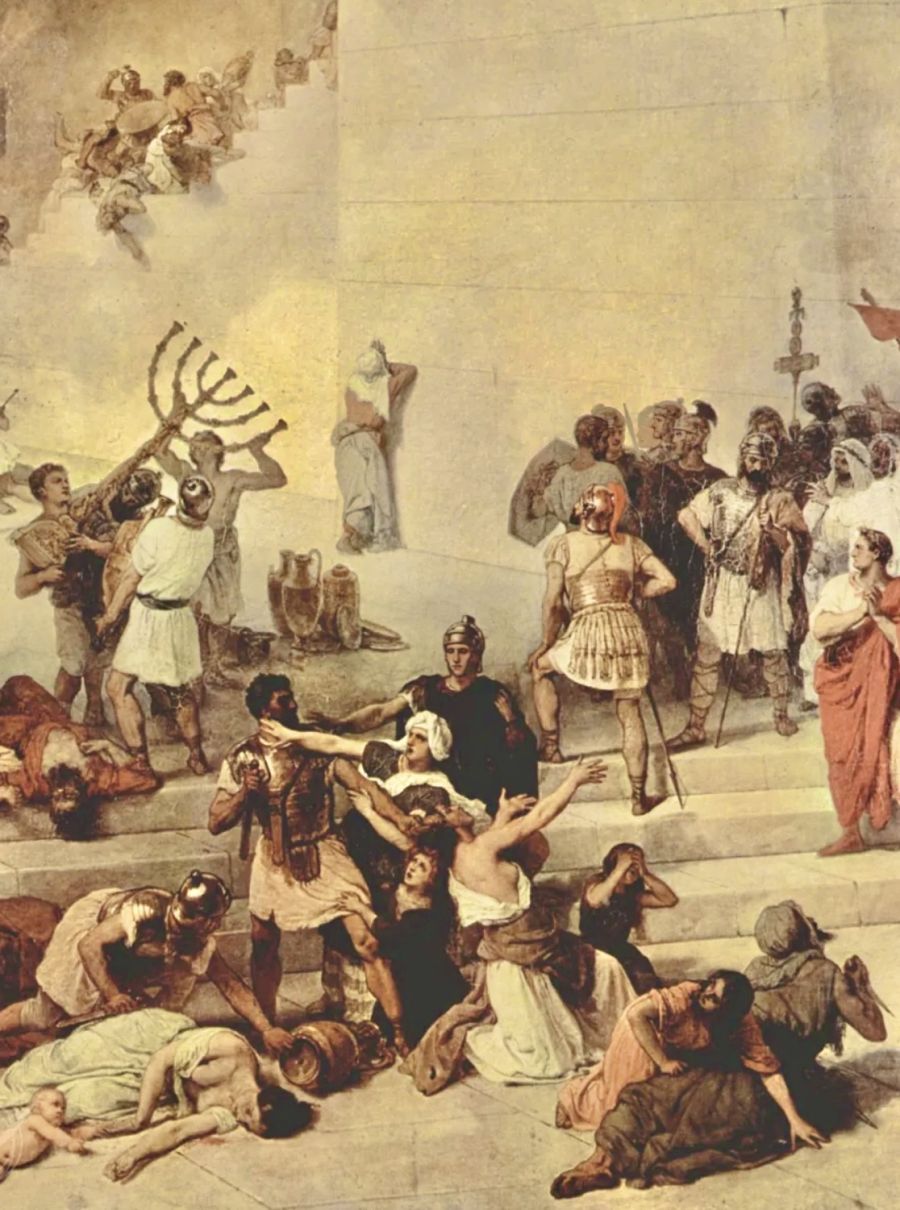
'Not a hair of your head will be lost.' This is prophetic language, not literal. We see every day that hair is indeed lost! This shows that Jesus' words are not to be taken literally, but as symbolic language. Jesus, like the prophets before him, does not make predictions about the future: he preaches. He does not announce chronicles of events, but keys of faith to interpret history. His discourse on the end of the Temple should also be understood in this way: it is not a horoscope of the apocalypse, but a teaching on how to live the present with faith, especially when everything seems to be falling apart. The message is clear: 'Whatever happens... do not be afraid!' Jesus invites us not to base our lives on what is passing. The Temple of Jerusalem, restored by Herod and covered with gold, was splendid, but destined to collapse. Every earthly reality, even the most sacred or solid, is temporary. True stability does not lie in stones, but in God. Jesus does not offer details about the 'when' or 'how' of the Kingdom; he shifts the question: 'Be careful not to be deceived...'. We do not need to know the calendar of the future, but to live the present in faithfulness. Jesus warns his disciples: "Before all this, they will persecute you, they will drag you before kings and governors because of my Name." Luke, who writes after years of persecution, knows well how true this is: from Stephen to James, from Peter to Paul, to many others. But even in persecution, Jesus promises: "I will give you a word and wisdom that no one will be able to resist." This does not mean that Christians will be spared death — "they will kill some of you" — but that no violence can destroy what you are in God: "Not a hair of your head will be lost." It is a way of saying: your life is kept safe in the hands of the Father. Even through death, you remain alive in God's life. Jesus twice uses the expression "for my Name's sake." In Hebrew, "The Name" refers to God himself: to say "for the Name's sake" is to say "for God's sake." Thus Jesus reveals his own divinity: to suffer for his Name is to participate in the mystery of his love. In the Acts of the Apostles, Saint Luke shows Peter and John who, after being flogged, "went away rejoicing because they had been counted worthy of suffering for the Name of Jesus" (Acts 5:41). It is the same certainty that Saint Paul expresses in his Letter to the Romans: "Neither death nor life, nor any creature can separate us from the love of God in Christ Jesus" (Rom 8:38-39). Catastrophes, wars, epidemics — all these "shocks" of the world — must not take away our peace. The true sign of believers is the serenity that comes from trust. In the turmoil of the world, the calmness of God's children is already a testimony. Jesus sums it up in one word: "Take courage: I have overcome the world!" (Jn 16:33). And here is a spiritual synthesis: Jesus does not promise a life without trials, but a salvation stronger than death. Not even a hair...' means that no part of you is forgotten by God. Persecution does not destroy, but purifies faith. Nothing can separate us from the love of God: our security is the risen Christ. To believe is to remain steadfast, even when everything trembles.
+ Giovanni D'Ercole








