


Dedication of the Basilica of St. John Lateran [9 November 2025]
May God bless us and may the Virgin protect us! Let us be moved by Jesus' zeal for his Church, which he loves and wants to remain whole and faithful.
First Reading from the Book of Ezekiel (47:1-12)
Before rereading Ezekiel's vision, it is useful to recall the plan of the Temple that he knew, that of Solomon. Unlike our churches, the Temple was a large esplanade divided into courtyards: those of the pagans, of women and of men. The Temple itself had three parts: the open air with the altar of burnt offerings, the Vestibule, the Holy Place and the Holy of Holies. For Israel, the Temple was the centre of religious life: the only place of pilgrimage and sacrifice. Its destruction in 587 BC represented a total collapse, not only physical but also spiritual. The question was: would faith collapse with it? How could they survive after the destruction? Ezekiel, deported to Babylon in 597 BC, found himself on the banks of the Kebar River in Tel Aviv. During the twenty years of exile (ten before and ten after the destruction), he devoted all his energies to keeping the people's hope alive. He had to act on two fronts: to survive and to keep alive the hope of return. As a priest, he spoke mainly in terms of worship and visions, many of which concerned the Temple. Surviving meant understanding that the Temple was not the place of God's presence, but its sign. God was not among the ruins, but with his people on the Kebar. As Solomon said: 'The heavens themselves and the heavens of heavens cannot contain you! How much less this House that I have built!' (1 Kings 8:27). God is always in the midst of his people and does not abandon Israel: before, during and after the Temple, he is always in the midst of his people. Even in misfortune, faith deepens. The hope of return is firm because God is faithful and his promises remain valid. Ezekiel imagines the Temple of the future and describes abundant water flowing from the Temple towards the east, bringing life everywhere: the Dead Sea will no longer be dead, like the Paradise of Genesis (Genesis 1). This message tells his contemporaries: paradise is not behind us, but ahead of us; dreams of abundance and harmony will be realised. The reconstruction of the Temple, a few decades later, was perhaps the result of Ezekiel's stubborn hope. Perhaps in memory of Ezekiel and the hope he embodied, the capital of Israel is now called Tel Aviv, 'hill of spring'.
Responsorial Psalm 45/46
The liturgy of the Feast of Dedication offers only a division of Psalm 45/46, but it is useful to read it in its entirety. It is presented as a canticle of three stanzas separated by two refrains (vv. 8 and 12): 'The Lord of hosts is with us; our bulwark is the God of Jacob'. God, king of the world. First stanza: God's dominion over the cosmic elements (earth, sea, mountains). Second stanza: Jerusalem, "the city of God, the most holy dwelling place of the Most High" (v. 5). Third stanza: God's dominion over the nations and over the whole earth: "I rule the nations, I rule the earth". The refrain has a tone of victory and war: the Lord of the universe is with us.... The name 'Sabaoth' means 'Lord of hosts', a warrior title that at the beginning of biblical history referred to God as the head of the Israelite armies. Today it is interpreted as God of the universe, referring to the heavenly armies. The second verse is about the River. The evocation of a river in Jerusalem, which in reality does not exist, is surprising. The water supply was guaranteed by springs such as Gihon and Ain Roghel. The river is not real, but symbolic: it anticipates Ezekiel's prophecy of a miraculous river that will irrigate the entire region as far as the Dead Sea. Similarities can be found in Joel and Zechariah, where living waters flow from Jerusalem and bring life everywhere, showing God as king of all the earth. All the hyperbole in the Psalm anticipates the Day of God, the final victory over all the forces of evil. The warlike tone in the refrains and in the last verse ("Exalted among the nations, exalted on earth") means that God fights against war itself. The Kingdom of God will be established over the whole earth, over all peoples, and all wars will end. Jerusalem, the "City of Peace," symbolises this dream of harmony and prosperity. For some commentators, the River also represents the crowds that pass through Jerusalem during the great processions.
Second Reading from the First Letter of Saint Paul the Apostle to the Corinthians (3:9...17)
The deepest desire of the Old Testament was that God would be forever present among his people, establishing a kingdom of peace and justice. Ezekiel expresses this with the prophetic name of Jerusalem: 'The Lord is there'. However, the fulfilment of this promise exceeds all expectations: God himself becomes man in Jesus of Nazareth, 'the Word who became flesh and dwelt among us'. St Paul, rereading the Old Testament, recognises that the whole history of salvation converges towards Christ, the eternal centre of God's plan. When the time is fulfilled, God manifests his presence no longer in a place (the Temple of Jerusalem), but in a person: Jesus Christ, and in those who, through Baptism, are united to him. The Gospels show this mystery of God's new presence in various ways: the Presentation in the Temple, the tearing of the veil at the moment of Jesus' death, the water flowing from his side (the new Temple from which life flows), and the purification of the Temple. All these signs indicate that in Christ, God dwells definitively among men. After the Resurrection, God's presence continues in his people: the Holy Spirit dwells in believers. Paul affirms this forcefully: "You are the temple of God, and the Spirit of God dwells in you." This reality has a twofold dimension: Ecclesial: the community of believers is the new temple of God, built on Christ, the cornerstone. Everything must be done for the common good and to be a living sign of God's presence in the world. Personal: every baptised person is a "temple of the Holy Spirit." The human body is a holy place where God dwells, and for this reason it must be respected and cared for. The new Temple is not a material building, but a living reality, constantly growing, 'a temple that expands without end', as Cardinal Daniélou said: humanity transformed by the Spirit. Finally, Paul warns: 'If anyone destroys God's temple, God will destroy him'. The dignity of the believer as the dwelling place of God is sacred and inviolable. Christ's promise to Peter is the guarantee: 'The powers of evil will not prevail against my Church'. In summary: God, who in the Old Testament dwelt in a temple of stone, in the New Testament dwells in Christ and, through the Spirit, in the hearts and community of believers. The Church and every Christian are today the living sign of God's presence in the world.
From the Gospel according to John (2:13-22)
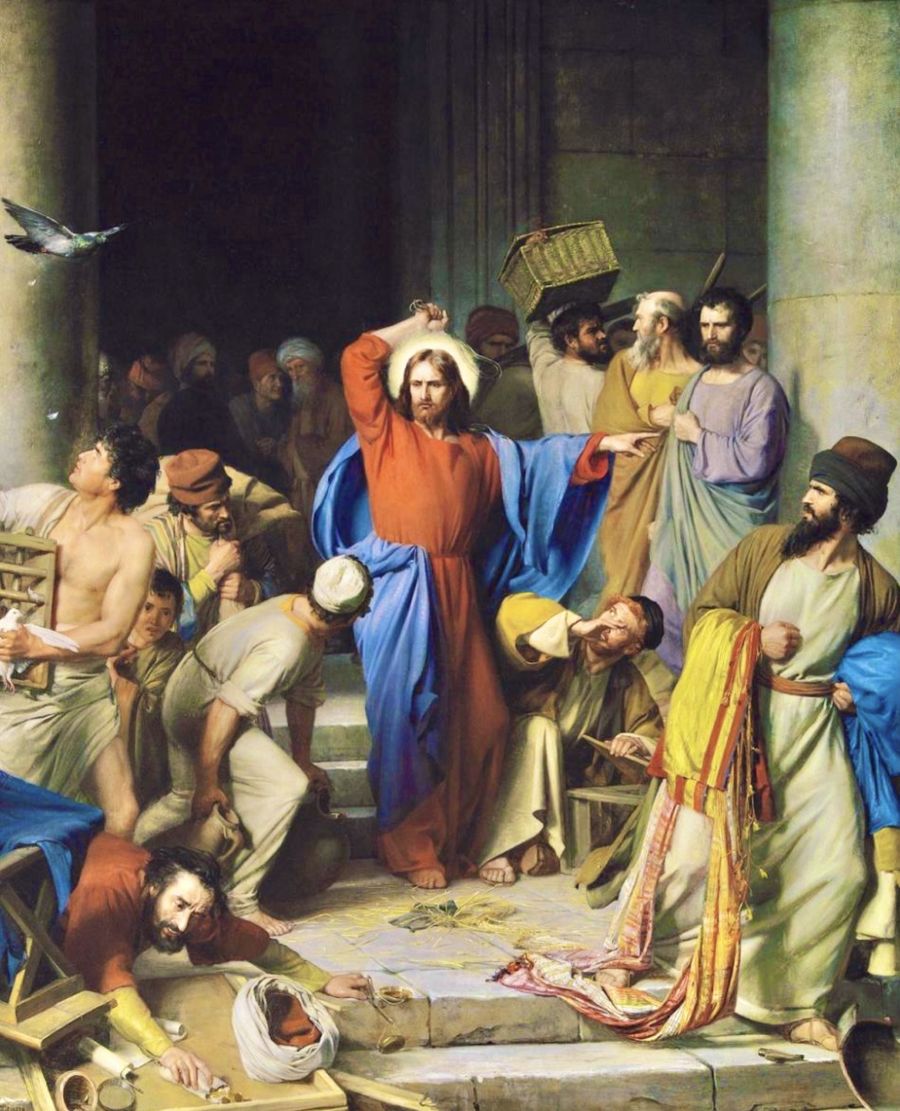
Trade on the Temple esplanade. In the Gospel of John (chapter 2), Jesus performs one of his most powerful and symbolic acts: he drives the merchants out of the Temple in Jerusalem. The episode takes place at the beginning of his public mission and reveals the profound meaning of his presence in the world: Jesus is the new Temple of God. In Jesus' time, the presence of animal sellers and money changers around the Temple was a normal and necessary practice: pilgrims had to buy animals for sacrifices and exchange Roman money, which bore the emperor's image, for Jewish coins. The problem was not the activity itself, but the fact that the merchants had invaded the Temple esplanade, transforming the first courtyard – intended for prayer and reading the Word – into a place of commerce. Jesus reacted with prophetic force: 'Do not make the house of the Father a market'. He thus denounced the transformation of worship into economic interest and reaffirmed that one cannot serve two masters, God and money. His words echo those of the prophets: Jeremiah had denounced the Temple as a 'den of thieves' (Jer 7:11), and Zechariah had announced that, on the day of the Lord, 'there shall be no more merchants in the house of the Lord' (Zech 14:21). Jesus follows in this prophetic line and brings their words to fulfilment. Two attitudes emerge in response to Jesus' gesture: the disciples, who know him and have already seen his signs (as at Cana), understand the prophetic meaning of the gesture and recall Psalm 68(69): "Zeal for your house consumes me." John changes the tense of the verb ("will consume me") to announce Jesus' future passion, a sign of his total love for God and for humanity. His opponents ("the Jews" in John) react with mistrust and irony: they ask Jesus to justify his authority and refuse to be admonished by him. To their request for a sign, Jesus responds with mysterious words: "Destroy this temple, and in three days I will raise it up." They think of the stone Temple, restored by Herod in forty-six years, a symbol of God's presence among the people. But Jesus is speaking of another temple: his body. Only after the resurrection do the disciples understand the meaning of his words: the true Temple, the sign of God's presence, is no longer a building, but the person of the risen Jesus himself, 'the stone rejected by the builders, which has become the cornerstone'. This episode, placed by John at the beginning of his Gospel, already announces the whole Christian mystery: Jesus is the new place of encounter with God, the living Temple where man finds salvation. The ancient cult is outdated: it is no longer a matter of offering material sacrifices, but of welcoming and following Christ, who offers himself for humanity. Faith divides: some (the disciples) welcome this newness and become children of God; others (the opponents) reject it and close themselves off to revelation. Jesus, by driving the merchants out of the Temple, reveals that the true house of God is not made of stones but of people united with Him. His risen body is the new Temple, the definitive sign of God's presence among men. The episode thus becomes a prophecy of Easter and an invitation to purify the heart, so that God's dwelling place may never become a place of interest, but remain a space of faith, communion and love.
+ Giovanni D'Ercole








