


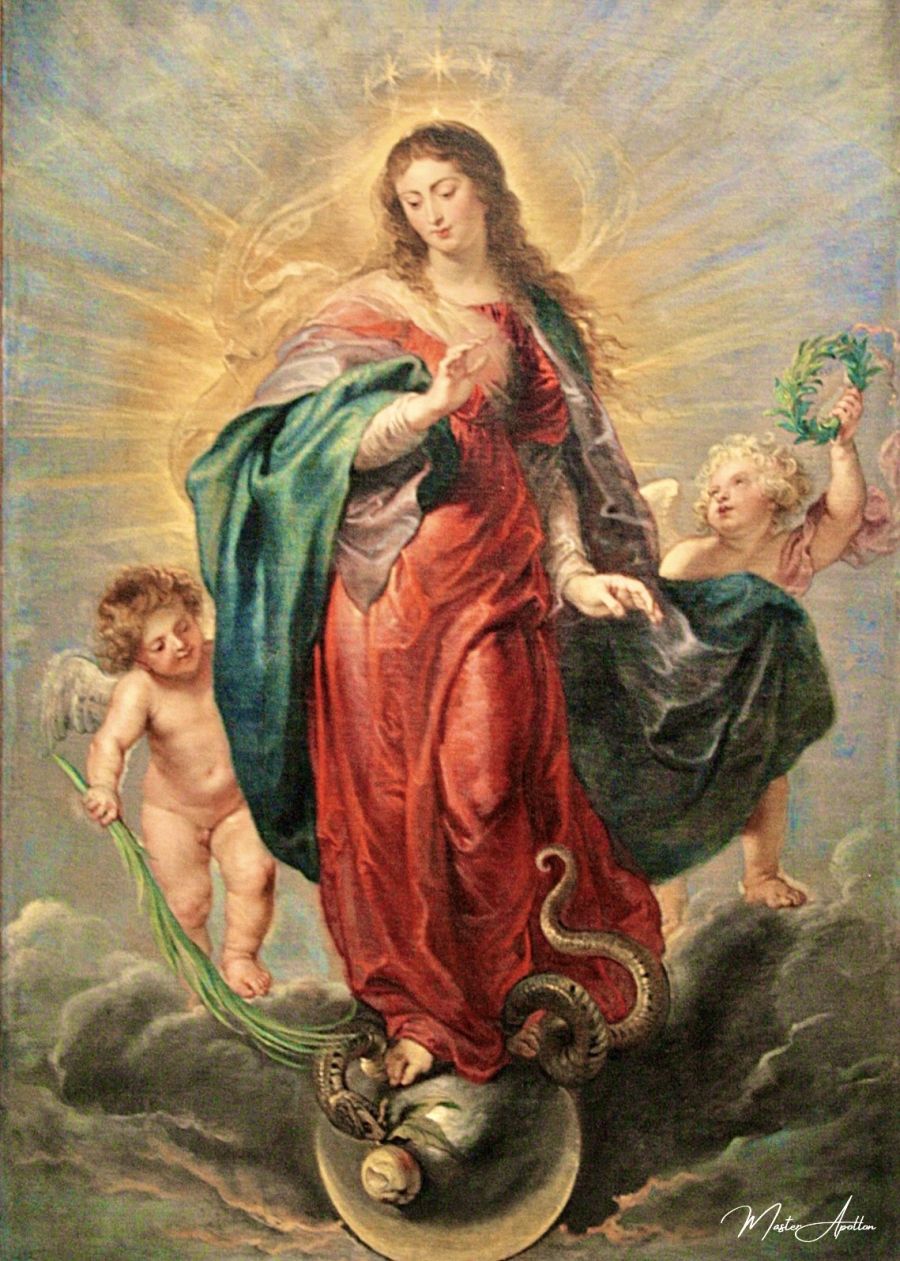
Solemnity of the Immaculate Conception of the Blessed Virgin Mary [8 December]
Biblical texts: Gn 3:9–20; Ep 1:3–12; Lk 1:26–38 May God bless us and may the Virgin protect us! Instead of commenting on the readings, I propose a theological and spiritual meditation on the Immaculate Conception, starting with St Paul and referring to the tradition of the Church and the liturgy.
1. Saint Paul and Mary: a hidden but real bond Although Paul speaks almost nothing directly about the Virgin Mary, his teaching on the election, holiness and predestination of Christians (Eph 1:4-11) deeply illuminates the mystery of Mary. Saint Paul affirms that all the baptised are chosen, holy and immaculate. Applying this to Mary, we understand that what is true for the whole Church is realised in her in a perfect and anticipated way.
2. The mystery of the Church sheds light on the mystery of Mary In the development of theology, especially in the early centuries, Mary was understood in relation to the Church: Mary is what the Church is called to become. What is partial in us is perfect in her. She is 'the first on the journey': first in time, first in perfection. Mary is 'first' in two senses: chronologically first to welcome Christ, first to share in his Passion, first to enter into glory with body and soul. Qualitatively: no one welcomed Christ with greater purity, love and freedom. Her unique grace does not separate her from us, but manifests what God wants to accomplish in the whole Church. The Immaculate Conception is not an isolated privilege, but the full realisation of the vocation of every Christian: Mary is preserved from sin in view of Christ's merits. We are saved from sin through Christ's merits (baptism, sacraments, conversion). The trajectories are the same; in Mary they are only anticipated and brought to perfection thanks to her total obedience and total abandonment to God's will: Mary did not do the divine will but lived entirely in God's will. Herein lies the key to her life: tempted like everyone else, including Jesus, she defeated Satan by choosing to live always and completely in the Father's will, and for this reason she is now a sign of sure hope for us all.
3. Why is Mary Immaculate? The reason is profoundly simple: to be truly the Mother of God. To love Jesus for what he really is — true God and true man — Mary had to be totally free from sin, totally open to love, capable of welcoming God without hindrance. The Immaculate Conception is a gift of love: God formed her this way out of love for his Son and for us, so that Mary might become the Mother of the Saviour and the Mother of the Church. St John Damascene writes: "As Eve cooperated in the fall, Mary cooperated in the redemption: immaculate, she brought life to the one who was to give life to the world." And St Bartholomew Longo, recently canonised, observes: "The Immaculate Conception is not just a title, but a living mystery: God created her entirely pure to make her the Mother of the Redeemer."
4. Mary precedes us to show us our destiny. Mary does not crush, humiliate or distance us: she shows us what we will be in glory; she is a foretaste of what the Church will become; her holiness is a promise of ours. In her we see the goal of Christian life. Mary freely receives the angel's announcement and her "fiat" opens the door to salvation. Today, too, the Church, like Mary, is called to proclaim Christ, to bring his love into the world, to say her "yes" in history. God needs our hands, our eyes, our arms, our hearts: like Mary, we are called to be bearers of light, and we can be so to the extent that God's will lives in us as the protagonist of our entire existence.
5. What does it mean to be “immaculate” today? For us, it does not mean being without sin, but welcoming God’s action in our lives. It means living open to grace, saying our daily “yes”, allowing ourselves to be purified and transformed by the Spirit, becoming transparent in order to show Christ in the world. The Immaculate Conception thus becomes a vocation and a journey. "The truth about the Immaculate Conception seemed the most difficult for me to accept... when I finally accepted it, everything became clear: my faith found meaning." (Testimony reported on the website CatholicConvert.com in the story of Delores, a woman who recounts her conversion to Catholicism).
Important points to remember: +Mary is understood starting from the Church: what is true for all the baptised is perfect in her. +Immaculate because she is the Mother of God: in order to love her Son fully, she had to be totally free from sin. +"First on the journey": first in time and in the quality of love and holiness. +Her grace is promised to us: what she already lives, the Church and Christians will live fully in glory. +Shared predestination: Mary is preserved from sin; we are saved from sin. +Mary's "fiat" as a model: God calls, but waits for our freedom; the yes opens the way to mission. +Being immaculate today: it means welcoming God, allowing ourselves to be purified, becoming transparent to his light. +Mary takes nothing away from God: she is the "echo of God"; to venerate her is to honour God's work in her. +Mary points to our destiny: in her we see what God wants to accomplish in each of us. +The Immaculate Conception is a gift of love: from God to Mary and from Mary to the world.
*Here is a very brief historical summary of the main medieval defenders of the Immaculate Conception: St. Albert the Great (1200-1280) – Dominican theologian; open to the idea of Mary's preservation from original sin, but without defining it definitively. St. Thomas Aquinas (1225-1274) – Dominican theologian; he argued that Mary was redeemed 'after original sin', therefore not immaculate from conception. Duns Scotus (1266-1308) – Franciscan theologian; main defender of the Immaculate Conception. Mary was preserved from original sin from the first moment, thanks to the merits of Christ anticipated by God. William of Ockham (1287-1347) – Franciscan; supporter of Scotus' position, albeit with some philosophical nuances. Scotus' central idea: Mary immaculate from the moment of conception, preserved by God's grace thanks to the future merits of Christ, anticipating the official dogma defined in 1854.
+ Giovanni D'Ercole








