


Third Sunday in Ordinary Time (Year A) [25 January 2026]
May God bless us and may the Virgin Mary protect us! Today marks the end of the week of prayer for Christian unity. The word of God offers food for thought, especially the second reading (which recounts the situation of the community in Corinth with divisions due to the presence of various preachers).
The Gospel shows the beginning of Jesus' preaching with his disciples, who will accompany him all the way to Jerusalem.
*First Reading from the Book of the Prophet Isaiah (8:23b - 9:3)
At the time of Isaiah, the kingdom of Israel was divided into two: the North (Israel, capital Samaria) and the South (Judah, capital Jerusalem), the latter being legitimate as heir to the dynasty of David. Isaiah preaches in Jerusalem but speaks mainly of places in the North, such as Zebulun, Naphtali, Galilee and Transjordan, territories that were conquered by the Assyrian Empire between 732 and 721 BC. The prophet announces that God will transform the situation: the regions that were initially humiliated will be honoured, as a sign of liberation and rebirth. These promises also concern the south, because geographical proximity means that threats to one area weigh on the other, and because the south hopes for future reunification under its own leadership. Isaiah describes the birth of a king, associating his coming with royal coronation formulas: 'A child has been born to us, a son has been given to us' (Isaiah 9:5-6). This is the young Hezekiah, associated with the reign of his father, King Ahaz, and considered the 'prince of peace'. The prophet's certainty is based on God's faithfulness: even in trials and oppression, God will never abandon the dynasty of David. The promised victory recalls that of Gideon over the Midianites: even with few resources, faith in God leads to liberation. The final message is one of hope: do not be afraid, God does not abandon his plan of love for humanity, even in the darkest moments.
*Responsorial Psalm (26/(27)
"The Lord is my light and my salvation" is not just an individual expression: it reflects the invincible trust of the people of Israel in God, in every circumstance of life, from joys to difficulties. The psalm uses concrete images to tell the collective story of Israel, a frequent procedure in the Psalms called clothing: the people are compared to a sick person healed by God, to an innocent person unjustly condemned, to an abandoned child or to a besieged king. Behind these individual images, we recognise specific historical situations: external threats, sieges of cities and internal crises of the kingdom, such as the attack of the Amalekites in the desert, the kings of Samaria and Damascus against Ahaz, or the famous siege of Jerusalem by Sennacherib. The people can react like David, a normal and sinful man, but steadfast in his faith, or like Ahaz, who gives in to panic and loses his trust in God. In any case, the psalm shows that collective faith is nourished by trust in God and the memory of his works. Another key image is that of the Levite, servant of the Temple: just as the Levites serve God daily, so the whole people of Israel is consecrated to the service of the Lord and belongs to him. Finally, the psalm ends with a promise of hope: 'I am sure that I shall see the goodness of the Lord in the land of the living'; trust is rooted in the memory of God's actions and translates into courage and active hope: 'Hope in the Lord, be strong, strengthen your heart and hope in the Lord'. This hope is like the "memory of the future," that is, the certainty that God will intervene even in the darkest circumstances. The psalm is therefore very suitable for funeral celebrations, because it reinvigorates the faith and hope of the faithful even in times of sorrow, reminding them that God never abandons His people and always supports those who trust in Him.
*Second Reading from the Letter of Saint Paul the Apostle to the Corinthians (1:10-13, 17)
The port of Corinth, due to its strategic position between two seas and its lively trade, was a true crossroads of cultures, ideas and peoples. This explains why newly converted Christians reacted in different ways to the teachings of preachers: each traveller brought testimonies of the Christian faith according to his own experience, and the Corinthians were very sensitive, perhaps too sensitive, to beautiful words and persuasive arguments. In this context, divisions arose in the community: some referred to Paul, others to Apollos, others to Peter, and finally a group called themselves 'of Christ'. Paul not only condemns wrong behaviour, but sees in this phenomenon the risk of compromising the very meaning of baptism. Apollos, a Jew from Alexandria, is an emblematic example: an intellectual, well-versed in the Scriptures, eloquent and fervent, he was baptised only by John and perfected by Priscilla and Aquila in Ephesus. When he arrived in Corinth, he was very successful, but he never sought to become a personal leader and, in order not to fuel divisions, he then moved to Ephesus. This episode shows how passion and skills should not become a source of division, but should be put at the service of the community. Paul reminds the Corinthians of the truth of baptism: to be baptised means to belong to Christ, not to a human preacher. Baptism is a real and definitive union with Christ, who acts through the sacrament: as the Second Vatican Council says, 'when the priest baptises, it is Christ who baptises'. Paul also emphasises that preaching should not be based on eloquence or persuasive arguments, because the cross of Christ and love are not imposed by the force of words, but are lived and witnessed. The image of grafting clarifies this point well: what is important is the result – union with Christ – not who administered the baptism. What matters is fidelity to the message and love of Christ, not rhetorical skill or personal prestige. Ultimately, Paul's message to the Corinthians is universal and relevant: the unity of the Christian community is based on a common faith in Christ, not on leaders or human eloquence, and the true greatness of the Church lies in its spiritual cohesion, founded on baptism and belonging to Christ.
*From the Gospel according to Matthew (4:12-23)
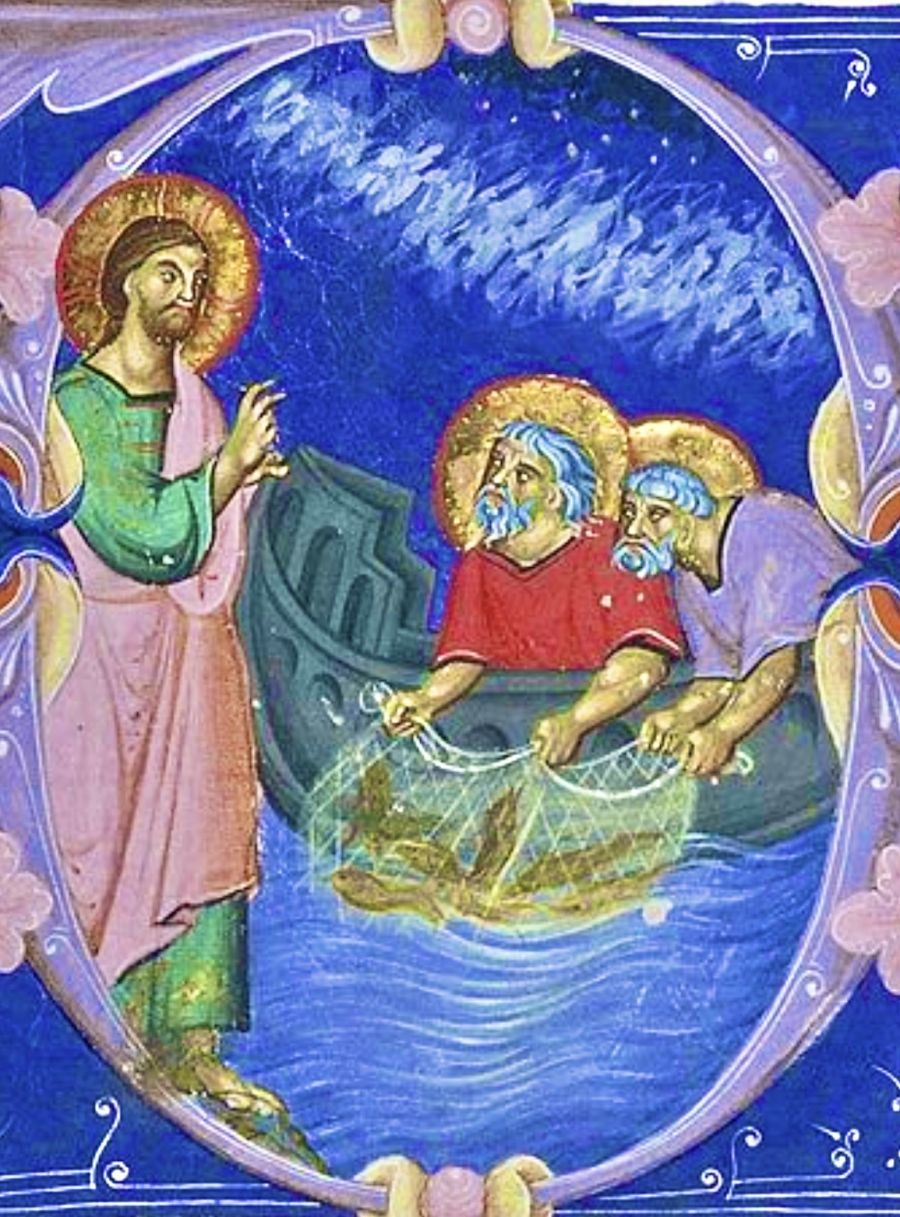
We are in chapter 4 of Matthew's Gospel. In the previous three chapters, Matthew has presented us with: first, a long genealogy that places Jesus in the history of his people, particularly in the lineage of David; then, the angel's announcement to Joseph: "Behold, the Virgin shall conceive and bear a son, and his name shall be called Emmanuel, which means God with us," a quotation from Isaiah, with the clarification that all this happened so that what the Lord had said through the prophet might be fulfilled, emphasising that the promises are finally fulfilled and the Messiah has arrived. The subsequent episodes reiterate this message of fulfilment: the visit of the Magi, the flight into Egypt, the massacre of the children of Bethlehem, the return from Egypt and the settlement in Nazareth, the preaching of John the Baptist, the baptism of Jesus and the Temptations. All these stories are full of biblical quotations and allusions. Now we are ready to listen to today's text, which is also rich in references: from the outset, Matthew quotes Isaiah to show the importance of Jesus' settlement in Capernaum. Capernaum is located in Galilee, on the shores of Lake Tiberias. Matthew specifies that it belongs to the territories of Zebulun and Naphtali: ancient names, no longer in common use, linked to Isaiah's promise that these once-humiliated lands would be illuminated by the glory of Galilee, 'the crossroads of the Gentiles' (Isaiah 8:23). The prophet continues: "The people who walked in darkness have seen a great light," a formula reminiscent of the sacred ritual of the coronation of a king, symbolising a new era. Matthew applies these words to the arrival of Jesus: the true King of the world has come; light has dawned on Israel and on humanity. Galilee, the crossroads of nations, becomes an open door to the world, from which the Messiah will spread salvation. Furthermore, Matthew already foreshadows future events: Jesus heads for Galilee after the arrest of John the Baptist, showing that Christ's life will be marked by persecution, but also by the final victory over evil: from every obstacle, God will bring forth good. Upon arriving in Capernaum, Matthew uses the expression "From then on," which is unique in the Gospel along with another in chapter 16, signalling a major turning point. Here it indicates the beginning of public preaching: "Repent, for the Kingdom of Heaven is near." The other reference in chapter 16 will concern the passion and resurrection. This episode marks the transition from the time of promise to the time of fulfilment. The Kingdom is present, not only in words but in action: "Jesus went throughout Galilee, teaching in their synagogues, proclaiming the gospel of the Kingdom and healing every kind of disease and infirmity among the people." Isaiah's prophecy is fully realised: the Kingdom of God is among us. To spread this Good News, Jesus chooses witnesses, ordinary men, to join him in his mission of salvation. He calls them "fishers of men", that is, those who save from drowning, a symbol of their task of salvation. Thus the apostles become participants in the Saviour's mission.
+ Giovanni D'Ercole








