


2nd Easter Sunday or Divine Mercy Sunday [12 April 2026]
*First Reading from the Acts of the Apostles (2:42–47)
Here is a glimpse of the very first Christian community, as Saint Luke loves to portray it in the Acts of the Apostles. On several occasions—four, in fact—he sketches, in just a few lines, a portrait of this kind; one might almost call them candid family snapshots. Taken together, these scenes paint a picture that seems almost idyllic of the lives of the early Christians: devoted to the apostles’ teaching and to prayer, they live in praise of the Lord and share everything in common, performing numerous healings along their path and continually welcoming new members… This does not prevent Luke from recounting, elsewhere, some very real difficulties faced by these same communities… Ananias and Sapphira, for example, who struggled to live out the sharing of goods to the full; and, even more seriously, the difficulties of coexistence between Christians of Jewish origin and Christians of pagan origin… One might then ask what message Luke wishes to convey to us by painting such beautiful, almost unreal portraits. This brings to mind the family photos from festive occasions that adorn the walls of our homes, the photo albums or the collages we love to look at. Clearly, the best images have been chosen; looking at them, we become aware of the beauty of our families and the joy of certain special days. For Saint Luke, this is certainly the case, but it is also much more: it is proof that the messianic times have arrived. The apostles became capable of living as brothers thanks to the gift of the Spirit. And this is all that the Spirit enables us to do: he who continues his work in the world and brings every sanctification to fulfilment (according to the splendid expression of the Eucharistic Prayer). This is the sign of the Spirit poured out upon the world by the Messiah: it is precisely what the prophets had promised. Brotherhood, peace, justice, and the abolition of evil are the values of the Kingdom of God that the Messiah was to establish, and of which the early Christians repeatedly set an example. This is the proof that Jesus is truly the long-awaited Messiah, the proof that he has poured out the Spirit of God upon the world. Then we understand the expression: “A sense of awe came over everyone”: it is wonder at the work of God. Luke tells us: see, my brothers and sisters, the first signs of the Kingdom are already here; this is what the Holy Spirit enables us to experience in our families, in our parishes and in our communities when we allow ourselves to be guided by him in the light of Easter. From Christ’s Resurrection a new humanity was born, one that grows slowly around and in the image of the Son of God. St Paul would say: look, we have truly risen! That is to say: we are truly living a new life; the old man (our former way of behaving) is dead. Luke, a converted pagan, marvels at the irresistible spread of the Gospel: ‘Every day the Lord added to the community those who were being saved.’ I note, in passing, that it is the Lord who brings new members into the community! What is asked of us? Perhaps, quite simply, to be true Christian communities, worthy of the name. For it is through its very concrete life that the community bears witness to the Resurrection of Christ: a life made up of sharing the Word and the bread, of prayer, of sharing all goods, all in joy! It is truly a world turned upside down! In particular, personal self-emptying and the sharing of all goods: this is something unachievable for ordinary people… unless they are indwelt by the Spirit of God, the one whom Christ himself has given them. Jesus had said: ‘By this everyone will know that you are my disciples: if you have love for one another. This is what will show the whole world that Jesus is alive; and this is what judges once and for all our quarrels and slander, our intolerance and divisions, our refusal to share. Naturally, we are not forbidden to draw from these beautiful portraits the criteria for assessing the quality of our communities (families, groups, Christian communities). It is a bit as if Luke were saying to us: let those who have ears to hear, hear! Because, after all, what we have heard is indeed a programme for Christian life; if I count correctly, there are four points: listening to the apostles’ teaching, living in fraternal communion (even to the point of sharing possessions), breaking bread and taking part in prayers. To conclude, it seems to me that the great Good News of this text is this: this new way of behaving, inspired by the Holy Spirit, is possible! Just as photos from festive occasions remind us of the possibilities for love within our families. But this may also prompt us to ask some questions: Luke notes that they were ‘persevering together’ in the temple and faithful in breaking bread in their homes with joy and simplicity of heart. Today we would say: they lived the Eucharist. This means at least three things: first of all, Sunday Mass is much more than an obligation; it is a vital necessity: the practice of the Eucharist is indispensable for each of us in the life of faith. Furthermore, and even more seriously, every time one of us does not take part in the Eucharist, it is the community itself that is deprived of one of its members. Finally, the third aspect: a community is severely disadvantaged when deprived of this regular nourishment; this clearly highlights the problem faced by so many Christian communities without a priest, sometimes for a very long time, whilst some parishes in our regions offer a wide choice of Mass times to meet all needs. We cannot help but admire the dynamism of the faith of those who know how to keep their communities alive despite the absence of a priest.
*Responsorial Psalm (117/118)
We have already sung this Psalm 117/118 during the Easter Vigil and on Easter Day itself. Indeed, every ordinary Sunday, it forms part of the Office of Lauds in the Liturgy of the Hours. This is hardly surprising: for the Jews, this psalm concerns the Messiah; for us Christians, when we celebrate the Resurrection of Christ, we recognise in him the Messiah awaited throughout the Old Testament, the true King, the conqueror of death. It is therefore on this twofold level — that of Jewish expectation and Christian faith — that it must be considered. For the Jewish faith, it is a psalm of praise: indeed, it begins with the word Alleluia, which means ‘praise God’ and sets the tone for the whole; furthermore, it comprises twenty-nine verses and, throughout, the word ‘Lord’ (the tetragrammaton YHWH) or at least ‘Yah’, which is its first syllable, appears more than thirty times… and these are all expressions of praise for God’s greatness, God’s love, God’s work for his people… A veritable litany! This psalm of praise is intended to accompany a thanksgiving sacrifice during the Feast of Tabernacles, an important and joyful festival lasting eight days in autumn: we find traces of the joy of this festival in the text of the psalm itself. For example: “This is the day the Lord has made; let us rejoice and be glad in it.”
During this festival, people dwell in tents for eight days, in remembrance of the tents of the Exodus after the departure from Egypt, to rediscover the meaning of the Covenant. Then there are numerous celebrations in the Temple of Jerusalem, and processions are held around the altar, waving branches and singing “Hosanna”, which means “Grant, Lord, grant salvation”; and as the expectation of the Messiah is very much alive in the spirit of this festival, the words “Blessed is he who comes in the name of the Lord” are repeated, as a sort of prayer to hasten his coming. Another significant rite was a grand and spectacular illumination of the Temple on the final evening. All these rites resonate in this psalm, provided one reads it in its entirety. For example, in other verses which we do not hear in the liturgy of the Second Sunday of Easter, it is proclaimed: ‘With branches in hand, form a procession to the altar… Blessed is he who comes in the name of the Lord”, “Say, the Lord enlightens us”, alluding to the illumination of the final evening. All this concerns words of praise, and these are the reasons: to speak of the history of Israel, the psalm recounts the story of a king who has just faced a merciless war and achieved victory. This king now comes to give thanks to his God for having sustained him. He says, for example: “They pushed me hard to make me fall, but the Lord helped me… and again, all the nations surrounded me: in the name of the Lord I defeated them… and again: I shall not die, I shall live and proclaim the works of the Lord”. The speaker is therefore a king who has miraculously escaped all the attacks of hostile peoples; but in reality we know what to read between the lines: it is the story of the people of Israel. Many times, throughout its history, it has come close to annihilation; but each time the Lord has raised it up, and it celebrates this in the great Feast of Tabernacles: it sings “I shall not die, I shall live and proclaim the works of the Lord”. This role as a witness to the works of the Lord is Israel’s very vocation; and it is in the very awareness of this vocation that it has found the strength to survive all its trials throughout history. For us Christians, this psalm evokes a connection between the Jewish Feast of Tabernacles and Jesus’ triumphal entry into Jerusalem, which we commemorate on Palm Sunday. But above all, the joy that runs through this psalm is fitting for the Risen One on Easter morning! He is that victorious king and, on closer inspection, the evangelists, each in their own way, present him to us as the true king. Matthew, for example, constructed the episode of the Magi’s visit in such a way as to make us understand that the true king is not the one indicated by historians (Herod), but the child of Bethlehem… or John, who, in the account of the Passion, clearly presents Jesus as the true King of the Jews. Meditating on the mystery of this Messiah—rejected, despised, crucified—the apostles discovered a new meaning in this psalm: ‘The stone the builders rejected has become the cornerstone; this was the Lord’s doing, and it is marvellous in our eyes’. Jesus had already quoted it in the parable of the murderous vineyard tenants, showing that he is the cornerstone, rejected by the builders and become the foundation stone; that is, rejected by his own people, he became the foundation stone of the new Israel. He is truly ‘the one who comes in the name of the Lord’, as the psalm says: this very expression was used during his solemn entry into Jerusalem. Finally, we know that this psalm was sung in Jerusalem on the occasion of a thanksgiving sacrifice. Jesus, however, has just performed the sacrifice of thanksgiving par excellence! He takes the lead of the new Israel, which gives thanks to God his Father: and it is precisely this that characterises Jesus. His entire attitude towards the Father is one of thanksgiving, thus inaugurating the New Covenant between God and humanity: the one in which humanity is nothing other than a response of love to the Father’s love.
*Second Reading from the First Letter of Saint Peter the Apostle (1:3–9)
Some wonder whether Peter might have drawn here on a hymn sung during baptisms… We have no proof of this, but it is nonetheless an interesting hypothesis that may help us to understand this text better. Three stanzas are easily discernible, of which I offer a brief summary: First stanza (vv. 3, 4, 5): “Blessed be God…”. He has brought us to new life through the Resurrection of Christ, and now we live in faith and hope; as a well-known hymn says: God makes us, in Jesus Christ, free people. Second stanza (vv. 6 and 7): hope already makes us leap for joy, but we are still in the time of the testing of our faith. Third stanza (vv. 8 and 9): blessed are those who believe without having seen; our faith already gives us an inexpressible joy that transfigures us. The word ‘faith’ appears five times in these few lines. This is not surprising, given that we are in a baptismal celebration; and there is also an extraordinary joy, which he describes as inexpressible, despite the present trials (even though you must now be grieved for a little while by various trials, v. 6): here he is clearly addressing Christian communities living in a hostile world, probably persecuted, and this seems precisely to be the case for Peter’s audience. For convenience, I shall now take up the three verses one by one: “Blessed be God, the Father of our Lord Jesus Christ”: the form is Jewish, the content is Christian; beginning with a great blessing of God is typical of Jewish prayer; and it is certainly someone who has sung the psalms a great deal who is able to write such a text! But the content is Christian: in the Psalms, God is celebrated as the God of the Fathers, Abraham, Isaac, Jacob… by now Revelation has taken a decisive step: God is known as the Father of Jesus Christ, and it is through Jesus Christ that he fulfils his plan for humanity. “God has brought us to new life through the Resurrection of Jesus Christ”: just as Jesus himself did in his conversation with Nicodemus, Peter speaks of baptism as a new birth, and this new birth has its source in the Resurrection of Christ; today, after well over two thousand years of Christianity, we are so accustomed to the phrase “Jesus Christ is risen” that perhaps we no longer feel its shock; but the early Christians experienced it as a true revolution: by now, for them, the face of the world had changed; as Paul says, the old world has passed away, a new one has been born (2 Cor 5).
Another theme typical of Paul is also very prominent in Peter: the tension between the present and the future: everything is already accomplished in the resurrection of Christ and so he speaks in the past tense: God has made us born again… everything is already decided, so to speak; yet everything remains yet to come: we are reaching out towards the salvation ready to be revealed in the last days, as Peter says. The word ‘salvation’ could be translated as life… which knows neither corruption, nor stain, nor decay; it could also be translated as liberation from all that is indeed corruption, stain, and decay. A salvation, a liberation already accomplished in Jesus Christ, but into which all humanity has not yet entered: and this is what remains to come.
It is the fact that everything is already accomplished from this moment that makes us leap for joy, as Peter says; the days when we are sad are perhaps those in which we lose sight of this great news of Easter: the good news that love and life are stronger than all hatred and death, even if in certain situations this certainty tends to fade and our faith is then put to the test! And the second verse puts it well: ‘You are being tested for a little while by various trials,’ says Peter. The rest of the letter gives a glimpse of the difficulties in question, probably the hostility encountered by these young Christians who appear marginalised in a pagan world.
The final verse takes up this theme of faith during the time of waiting; Peter had the privilege of knowing and spending a long time with Jesus Christ, but he addresses Christians who did not know him and explains to them the blessedness that Jesus had spoken of to Thomas: ‘Blessed are those who believe without having seen’, and he encourages them: You love him without having seen him; and without seeing him yet, you believe in him… and you rejoice with an ‘inexpressible and glorious’ joy. When he uses the expression ‘glorious joy’, Peter knows what he is talking about, he who had the privilege of witnessing the Transfiguration of Jesus: and on the faces of Christians he sees a reflection of the light that radiated from Jesus himself. Peter’s emphasis on the joy of Christians—a joy that is at once inexpressible and stronger than all passing trials—resonates today as a call to ensure that everyone can see the joy of our baptism on our faces, as a reflection of the transfigured Jesus. Traditionally, this Sunday was called ‘in albis’, meaning ‘in white garments’. Indeed, those newly baptised on Easter night wore their baptismal garments throughout the Easter week. And this Sunday represented for them a kind of feast of the baptised.
*From the Gospel according to John (20:19–31)
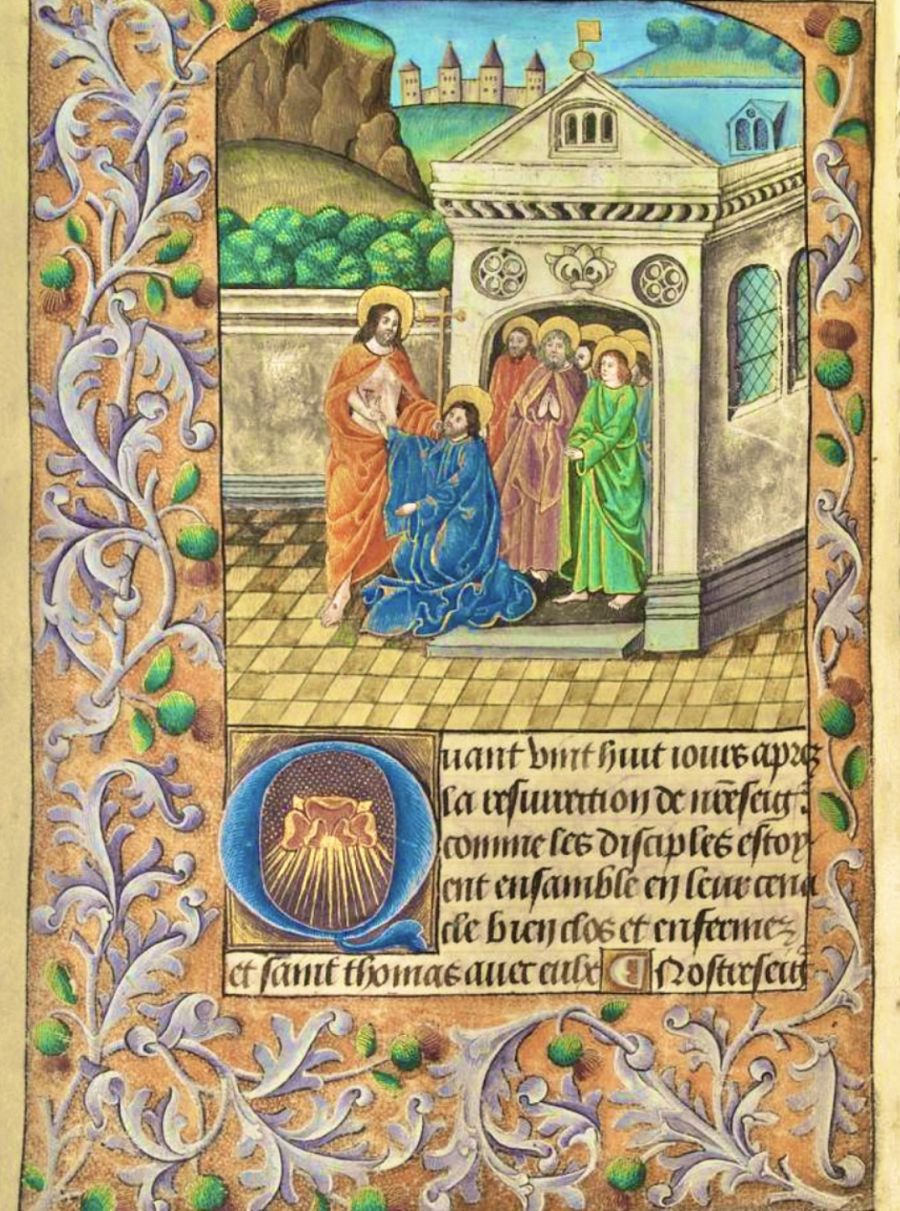
It was after Jesus’ death, on the evening of the first day of the week, that is, Sunday. This is not merely a temporal detail that Saint John offers us, but rather a small yet significant sign. When John wrote his Gospel, some fifty years had already passed since the events—that is, since the passion, death and resurrection of Jesus of Nazareth. Fifty years during which Christians gathered every Sunday to celebrate the resurrection of Jesus; and so the message he wishes to convey is: ‘Do you understand, then, why we gather every Sunday?’ The gathering of Christians every Sunday was a characteristic of Christians within the Jewish world, and it was precisely to commemorate the resurrection of Christ. For the Jews, the first day of the week – Sunday – was a working day like any other, whilst the seventh day, the Sabbath (Shabbat), was a day of celebration, rest, assembly and prayer. Now, it was the day after the Shabbat that Jesus rose from the dead, and on several occasions he appeared alive to his apostles after the resurrection, always on the first day of the week: thus, for Christians, that day took on a special significance. This first day of the week appears as the first day of the new era: just as the Jews’ seven-day week recalled the seven days of Creation, so this new week, which began with Christ’s resurrection, was understood by Christians as the beginning of the new Creation. The disciples had locked the doors of the place where they were, out of fear of the Jews, when Jesus came and stood among them. John emphasises that the disciples are shut inside and afraid because, having killed the Master, they might well kill his disciples too. Yet this too highlights Christ’s freedom. Everything is locked up, but for him it is no problem: he has no need of bolts and, above all, he knows no fear! And, precisely for this reason, his first words are: ‘Peace be with you’! It was the customary Jewish greeting… yet it is still a surprising greeting after all that has happened! The fear, the anguish of the last few months before Jesus’ arrest, the horror of his passion and death, Thursday night, Friday, and that silence of the Sabbath, after Jesus had been laid in the tomb… Is it possible to be at peace as if nothing had happened? Yet, it is incredible but true: he is truly alive… and, to prove it, he shows his wounds, the permanent marks of the crucifixion. In this regard, it is specifically noted that the marks are still present in his hands, feet and side: the Resurrection does not erase our death. So, even though it may seem incredible, Saint John notes that the disciples rejoiced. What they are experiencing is unheard of! And, at this point, John continues: “Jesus said to them again: ‘Peace be with you’”. Now they can truly be at peace… not as if nothing had happened, but in spite of what has happened: because this peace of the Risen One goes far beyond anything that might happen. “Having said this, he breathed on them and said to them: ‘Receive the Holy Spirit. ‘Whose sins you forgive are forgiven; whose sins you retain are retained.’ The link between the gift of the Spirit and the mission of reconciliation is striking: in the Bible, the Spirit is always given for a mission. But ultimately, can there be any mission more important than reconciling people with God? Everything else flows from this. It is a command that Jesus gives: “As the Father has sent me, so I send you.” Go and proclaim that sins are remitted, that is, forgiven. Be ambassadors of universal reconciliation. And if you do not go, the Good News, the gospel of Reconciliation, will not be proclaimed. Jesus says: “As the Father has sent me…”: from the very mouth of Jesus Christ, we have a summary of his entire mission, for it is as if he were saying: The Father has sent me to proclaim universal reconciliation, to proclaim that sins are forgiven, and that God does not keep a record of people’s sins; in other words, I have come to proclaim one thing alone: that God is all Love and Forgiveness. In turn, I send you on the same mission. Therefore, we must pay close attention: the only true sin, which is at the root of all others, is not to believe in or to reject God’s love: I therefore send you so that you may proclaim to all people God’s infinite love, that is, that God is infinite Mercy. But how can we make God’s love known? It is not enough to proclaim God’s mercy; one must ‘give one’s life’ for the ‘salvation’ of souls. When will we understand that this is the whole Gospel and how great our responsibility is?
NB Please note: We must fully understand the phrase: ‘Whose sins you forgive are forgiven; whose sins you do not forgive are not forgiven’. I have been drawn into a structural and theological analysis which I share with you.
|
Greco |
Traslitterazione |
Traduzione italiana |
|
ἄν |
an |
se / a chiunque |
|
τινων |
tinōn |
di alcuni / di chiunque |
|
ἀφῆτε |
aphēte |
rimettete / lasciate andare |
|
τὰς |
tas |
i (femminile plurale, oggetto) |
|
ἁμαρτίας |
hamartias |
peccati |
|
ἀφέωνται |
apheōntai |
sono rimessi |
|
αὐτοῖς |
autois |
a loro |
|
ἄν |
an |
se / a chiunque |
|
τινων |
tinōn |
di alcuni / di chiunque |
|
κρατῆτε |
kratēte |
trattenete / tenete |
|
κεκράτηνται |
kekratēntai |
sono trattenuti |
Full Greek text with transliteration ἄν τινων ἀφῆτε τὰς ἁμαρτίας, ἀφέωνται αὐτοῖς· (an tinōn aphēte tas hamartias, apheōntai autois) ἄν τινων κρατῆτε, κεκράτηνται. (an tinōn kratēte, kekratēntai) Fluid translation of the verse: “Whose sins you forgive, they are already forgiven; whose sins you retain, they remain retained.” The sentence is constructed in two parallel movements: ἀφῆτε (you forgive), ἀφέωνται (they are already forgiven by God); κρατῆτε (you retain), κεκράτηνται (they are already retained) Immediate emergence: visible action and divine reality. Verbs of the apostles: ἀφῆτε / κρατῆτε which are aorist subjunctive and signify: a precise and decisive act, a real event. b) The final verbs ἀφέωνται / κεκράτηνται are in the passive perfect tense and mean: an action already accomplished and already established by God, a lasting effect. Why does John use the aorist? He does not use the present tense because it does not indicate a continuous action, but the aorist, which means: “ At the moment you forgive or retain sins, a real and decisive act takes place” and the act of the apostles enters into God’s permanent, effective action. Theological consequences: Primacy of God: only God forgives. Role of the Church: to make visible, to apply forgiveness concretely, and sin is either removed or remains. Spiritual insight: Forgiveness is a real event, not a symbol, and the Church is a visible instrument, but the efficacy comes from God. Final summary: When the Church remits sins, a real and decisive act takes place in which the forgiveness that is already at work in God is manifested and made present; when she withholds them, it is evident that, unfortunately, that forgiveness has not been accepted. And here lies the problem: why is it not accepted? Forgiveness is neither an idea nor a process: it is an event of God, and the Church makes it visible. God always forgives us, and we are forgiven when we confess our sin with faith. God is infinite Mercy that never fails and desires that all may be saved; but it is necessary for man to welcome His gratuitous love into his heart. The Church is called to make this forgiveness visible every day, without ceasing, and every Christian is called to bear witness to and proclaim the forgiveness that is God’s absolutely gratuitous love, so that all may believe, welcome it and experience it in their own lives. In short: God forgives endlessly, and those who believe proclaim it and live it as the Gospel that enters their very being. I conclude with this message from Medjugorje, 2 March 1997: “Dear children! Pray for your brothers and sisters who have not come to know the love of God the Father, and for those for whom life on earth is more important. Open your hearts to them and see in them my Son who loves them. You must be my light: enlighten all souls in whom darkness reigns. Thank you for responding to my call.”
It depends on you, says Jesus to the apostles and today to us, that your brothers and sisters may come to know and experience God’s love and live in his mercy. God’s plan will be fully accomplished only when you, in turn, have completed your mission. In short, understand well: just as the Father sent me, so I send you. And you do not have much time to lose
+Giovanni D’Ercole








