


don Giuseppe Nespeca
Giuseppe Nespeca è architetto e sacerdote. Cultore della Sacra scrittura è autore della raccolta "Due Fuochi due Vie - Religione e Fede, Vangeli e Tao"; coautore del libro "Dialogo e Solstizio".

Let us enter into the truth and the freedom that comes from the truth
The first characteristic which the Lord requires of his servant is fidelity. He has been entrusted with a great good that does not belong to him. The Church is not our Church but his Church, the Church of God. The servant must account for how he has managed the good that has been entrusted to him. We do not bind people to us; we do not seek power, prestige or esteem for ourselves. We lead men and women toward Jesus Christ, hence toward the living God. In so doing, we introduce them into truth and into freedom, which derives from truth. Fidelity is altruism and, in this very way, liberating for the minister himself and for all who are entrusted to him. We know how in civil society and often also in the Church things suffer because many people on whom responsibility has been conferred work for themselves rather than for the community, for the common good. With a few strokes the Lord sketches an image of the wicked servant, who begins by grovelling and beating the workers, thereby betraying the essence of his responsibility. In Greek, the word for "fidelity" coincides with the word for "faith". The fidelity of the servant of Jesus Christ also consists precisely in the fact that he does not attempt to adapt faith to the fashions of the times. Christ alone has the words of eternal life and we must bring these words to the people. They are the most precious good that has been entrusted to us. There is nothing sterile or static about such fidelity; it is creative. The master rebuked the servant who, attempting to avoid all risk, had buried the money given to him in the ground. With this apparent fidelity, the servant had in reality set aside the good of his master to dedicate himself exclusively to his own affairs. Fidelity is not fear but rather is inspired by love and by its dynamism. The master praises the servant who has invested his goods profitably. Faith demands to be passed on: it was not given to us merely for ourselves, for the personal salvation of our own souls, but for others, for this world and for our time. We must bring faith into this world so that it may become in it a living force; in order to increase God's presence in the world.
[Pope Benedict, homily for episcopal ordination 12 September 2009]
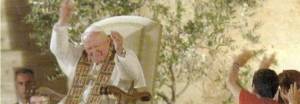
3. “… even as the Son of man came not to be served but to serve” (Mt 20:28).
In truth, Jesus is the perfect model of the “servant” of whom Scripture speaks. He is the one who radically emptied himself to take on “the form of a servant” (Phil 2:7) and to dedicate himself totally to the things of the Father (cf. Lk 2:49), as the beloved Son in whom the Father is well pleased (cf. Mt 17:5). Jesus did not come to be served, “but to serve, and to give his life as a ransom for many” (Mt 20:28). He washed the feet of his disciples and obeyed the plan of the Father even unto death, death on a cross (cf. Phil 2:8). Therefore, the Father himself has exalted him, giving him a new name and making him Lord of heaven and of earth (cf. Phil 2:9-11).
How can one not read in the story of the “servant Jesus” the story of every vocation: the story that the Creator has planned for every human being, the story that inevitably passes through the call to serve and culminates in the discovery of the new name, designed by God for each individual? In these “names”, people can grasp their own identity, directing themselves to that self-fulfilment which makes them free and happy. In particular, how can one not read in the parable of the Son, Servant and Lord, the vocational story of the person who is called by Jesus to follow him more closely: that is, to be a servant in the priestly ministry or in religious consecration? In fact, the priestly vocation or the religious vocation are always, by their very nature, vocations to the generous service of God and of neighbour.
Service thus becomes both the path and the valuable means for arriving at a better understanding of one’s own vocation. Diakonia is a true vocational pastoral journey (cf. New Vocations for a New Europe, 27c).
[Pope John Paul II, Message for the XL World Day for Vocations, 11 May 2003]
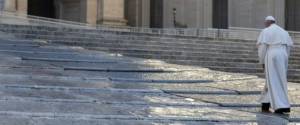
In the text of today’s Gospel (Lk 12:32-48), Jesus speaks to his disciples about the attitude to assume in view of the final encounter with him, and explains that the expectation of this encounter should impel us to live a life full of good works. Among other things he says: “Sell your possessions, and give alms; provide yourselves with purses that do not grow old, with a treasure in the heavens that does not fail, where no thief approaches and no moth destroys” (v. 33). It is a call to give importance to almsgiving as a work of mercy, not to place trust in ephemeral goods, to use things without attachment and selfishness, but according to God’s logic, the logic of attention to others, the logic of love. We can be so attached to money, and have many things, but in the end we cannot take them with us. Remember that “the shroud has no pockets”.
Jesus’ lesson continues with three short parables on the theme of vigilance. This is important: vigilance, being alert, being vigilant in life. The first is the parable of the servants waiting for their master to return at night. “Blessed are those servants whom the master finds awake when he comes” (v. 37): it is the beatitude of faithfully awaiting the Lord, of being ready, with an attitude of service. He presents himself each day, knocks at the door of our heart. Those who open it will be blessed, because they will have a great reward: indeed, the Lord will make himself a servant to his servants — it is a beautiful reward — in the great banquet of his Kingdom He himself will serve them. With this parable, set at night, Jesus proposes life as a vigil of diligent expectation, which heralds the bright day of eternity. To be able to enter one must be ready, awake and committed to serving others, from the comforting perspective that, “beyond”, it will no longer be we who serve God, but He himself who will welcome us to his table. If you think about it, this already happens today each time we meet the Lord in prayer, or in serving the poor, and above all in the Eucharist, where he prepares a banquet to nourish us of his Word and of his Body.
The second parable describes the unexpected arrival of the thief. This fact requires vigilance; indeed, Jesus exhorts: “You also must be ready; for the Son of man is coming at an hour you do not expect” (v. 40).
The disciple is one who awaits the Lord and his Kingdom. The Gospel clarifies this perspective with the third parable: the steward of a house after the master’s departure. In the first scene, the steward faithfully carries out his tasks and receives compensation. In the second scene, the steward abuses his authority, and beats the servants, for which, upon the master’s unexpected return, he will be punished. This scene describes a situation that is also frequent in our time: so much daily injustice, violence and cruelty are born from the idea of behaving as masters of the lives of others. We have only one master who likes to be called not “master” but “Father”. We are all servants, sinners and children: He is the one Father.
Jesus reminds us today that the expectation of the eternal beatitude does not relieve us of the duty to render the world more just and more liveable. On the contrary, this very hope of ours of possessing the eternal Kingdom impels us to work to improve the conditions of earthly life, especially of our weakest brothers and sisters. May the Virgin Mary help us not to be people and communities dulled by the present, or worse, nostalgic for the past, but striving toward the future of God, toward the encounter with him, our life and our hope.
[Pope Francis, Angelus 7 August 2016]
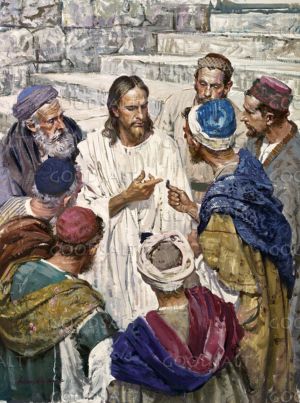
29th Sunday in Ordinary Time (year A) [18 October 2026]
First Reading from the Book of the Prophet Isaiah 45:1–6
When Isaiah wrote this text, the Jews had been in exile in Babylon for almost fifty years. In 587 BC, Nebuchadnezzar’s armies had conquered Jerusalem, destroyed and plundered the Temple, and deported the survivors. Now, however, news is arriving of the conquests of Cyrus, King of Persia, the new ruler of the world. For the Jews, this news offers a glimmer of hope, for Cyrus is rapidly conquering the entire region. Cyrus stands out from other rulers because he adopts a more humanitarian policy: he does not kill the vanquished, nor does he destroy or plunder their cities, nor does he deport the populations. On the contrary, in the conquered territories he allows the exiles to return to their homeland, restores to them the property taken by previous conquerors, and even provides the means to rebuild the country. He probably realises that it is in an emperor’s interest to rule over happy peoples. In this context, Isaiah utters a prophecy that is above all a profession of faith and hope. He says: ‘Thus says the Lord to his anointed one, to Cyrus’. The message is probably not addressed directly to Cyrus—who would not have listened to a Jewish prophet—but to the exiled Jews, to restore their hope. This hope is based on two fundamental convictions. Firstly, God is faithful to his Covenant.
God has not abandoned his people: Israel remains his servant and his chosen people. Even though they have lost their freedom, their land, the Temple, their king and their political independence, God continues to be faithful to the Covenant with Jacob and Israel. This certainty is particularly important precisely at a time when the Jews might think that God has abandoned them. Secondly,
God is the Lord of history. God declares: ‘I am the Lord; there is no other.’ Even the mighty Cyrus is in his hands. The expressions relating to bestowing a title, taking by the hand and opening the gates recall the rites of the coronation of kings: the king received the title of Son of God, was anointed with oil and placed in God’s hands; the open gates also symbolised the conquest of enemy cities. Isaiah therefore applies to Cyrus imagery typical of the coronation of the kings of Israel, presenting him as a king chosen and consecrated by God, even though he is a pagan. This proves that it is always God who retains the initiative and control over events.
Responsorial Psalm (95/96)
There is a thrill, indeed an exultation, running through these few verses. One senses the faith that stirs this people; indeed, even better, the hope that is the joy of faith. It is hope that enables us to affirm with certainty what we do not yet possess, as the Letter to the Hebrews states (1:1). If we pause to read the final verses, we realise that this psalm already transports us to the end of the world, to that blessed day when all peoples, without exception, will recognise God as the one and only God. Joy in heaven! Let the earth rejoice! Let the depths of the sea roar; let the whole countryside be in celebration. Let the trees of the forests dance for joy before the Lord, for he is coming to judge the earth. He will judge the world with justice and the peoples according to his truth! Here, the blessed day we await is already being sung of. Let us imagine the scene: we are in Jerusalem; all peoples, nations and races are thronging around the Temple. The esplanade is teeming; the steps of the courtyard are black with people; crowds are pouring in from every corner of the world; the number of pilgrims stretches as far as the eye can see, and Jerusalem is not big enough to contain them all. Everyone is singing at the top of their voices, like a true symphony: ‘God reigns!’ It is an immense and colossal clamour, like the ovation given to every new king on the day of his coronation. This time, however, it is not the people of Israel acclaiming an earthly king; it is the whole of humanity acclaiming the King of the world: ‘Great is the Lord, highly praised, awesome’. And it is not just humanity; the earth itself trembles, and even the seas join in the symphony, whilst the countryside rejoices and the trees dance, for they recognise their Creator. Amidst so many idols and false gods, there is no room for error, and even the trees are not deceived. People, on the other hand, have long allowed themselves to be deceived, and it is incredible that it has taken them so long to recognise their Creator, their Father. This time, however, it has happened, and everyone is coming to Jerusalem to acclaim God because at last the good news resounds: ‘Day by day Israel has proclaimed its salvation… the ceaseless work of liberation… day by day Israel has borne witness that God first delivered it from Egypt, then from every kind of slavery; and the most terrible form of slavery is to place one’s trust in false values, false gods that can only disappoint. Israel is immensely fortunate to know and to be charged with proclaiming that our God is the one and only God, as declared in the Shema Israel: ‘Hear, O Israel: the Lord our God is one’ (Deut 6:4). This is the mystery of Israel’s vocation, as we read in Deuteronomy: ‘You have been granted to see all this, so that you may know that the Lord is God; there is no other’ (Deut 4:32). But the chosen people have never forgotten that if they have been granted to see, it is so that they may make it known; and whilst awaiting the fulfilment of this dream, Israel sings this psalm to renew its faith and hope.
Second Reading from the Letter of Saint Paul the Apostle to the Thessalonians (1:1–5)
This is the earliest Christian writing, even though we are accustomed to seeing the Gospels at the beginning of the New Testament, thus running the risk of forgetting that they were written after Paul’s letters. The First Letter to the Thessalonians dates back to just twenty years or so after the Resurrection of Christ, and so here we have the earliest statements of Christian preaching. It is the first time that an attempt has been made to set down in writing the mystery of Jesus Christ. It is around the year 50, and the Gospel has already been proclaimed far from Jerusalem, for Thessalonica is in Europe, in northern Greece, in the region known as Macedonia. Before reaching that far, Paul had already had time to establish communities throughout the south, the centre and even the west coast of Turkey. It is from the Acts of the Apostles that we know how events unfolded: Paul was on a mission on the west coast of Turkey when, one night, he had a vision of a Macedonian man imploring him: ‘Come over to Macedonia and help us’. And Luke, who was part of the journey, recounts: “Following this vision of Paul’s, we immediately set out for Macedonia, for we realised that God was calling us to bring the Good News there” (Acts 16:9–10). Paul, Luke and Silas arrived on the Greek coast in the city of Philippi, where they were initially well received, but were soon accused of disturbing the peace; they were beaten and thrown into prison. Thanks to a providential earthquake, they were set free and, having left the city, went on to Thessalonica. According to the Acts of the Apostles, Paul’s preaching was always the same: “For three Sabbaths he reasoned with them from the Scriptures, explaining and proving that the Christ had to suffer and rise from the dead, and he added: ‘This Jesus whom I am proclaiming to you is the Christ’”. The text adds: “Some of them (that is, the Jews he met in the synagogue) were persuaded and joined Paul and Silas, along with a large crowd of Greeks who worshipped God and a good number of prominent women” (Acts 17:2–4). But, as usual, Paul did not arouse only enthusiasm because, as we read in the Acts of the Apostles: “The Jews, driven by jealousy, gathered some troublemakers in the public square; having stirred up crowds, they were causing unrest in the city” (Acts 17:5), so much so that it seemed very prudent for Paul and Silas to leave the area. Paul therefore left this new community too hastily and remained somewhat troubled about it for a while. When he wrote this letter, which we begin to read today, he had just been reassured by Silas and Timothy, who had remained in Macedonia and were bringing him excellent news. This explains the particularly joyful tone at the beginning of the letter: “Paul, Silvanus (another name for Silas) and Timothy to the Church of the Thessalonians, which is in God the Father and in the Lord Jesus Christ. Grace and peace to you. At all times we give thanks to God for all of you.” Right from this first sentence, one is struck by the solemnity of the greeting: this community is very small, and he grandly calls it “the Church of Thessalonica which is in God the Father and in the Lord Jesus Christ”. This immense respect that Paul has for Christian communities, even modest ones, is characteristic of all his letters.
From the Gospel according to Saint Matthew (22:15–21)
‘Is it lawful to pay the tribute to the emperor?’ Jesus replies by calling the questioners ‘hypocrites’! Why ‘hypocrites’? Because this is not a genuine question, and they are hypocrites for two reasons: first of all, because they have long since resolved this issue. Paying the tax to the Emperor – ‘Render unto Caesar the things that are Caesar’s’ – is something they do, and Jesus does not say they are wrong. Now they are setting a trap and trying to catch Jesus out… And the falsely respectful tone that precedes the question further emphasises this: ‘Teacher, we know that you are always truthful and teach the way of God in accordance with the truth’. All this politeness is nothing more than a preamble to a trick question designed to put Jesus in a difficult position. If Jesus urges his compatriots to refuse to pay the tax levied for the benefit of the Roman occupiers, it will be easy to denounce him to the authorities as a resistance fighter or even a revolutionary, and he will be condemned. If, on the other hand, he advises paying the tax, he could be discredited in the eyes of the people as a collaborator, losing any chance of being recognised as the Messiah; for the expected Messiah must be an independent and sovereign king on the throne of Jerusalem, which necessarily involves a revolt against the Roman occupiers. The trap is well laid, and in any case, whatever his answer, Jesus is doomed. In fact, they are seeking the first suitable opportunity to put him to death, for the Passion is already looming on the horizon, given that we are in the very final moments in Jerusalem. In his reply, Jesus clearly shows that he has understood: ‘Hypocrites! Why are you trying to test me?’ He is not naive in the face of the trap being set for him… Yet he does not seek to embarrass his interlocutors, for Jesus never did so and never sought to set a trap for anyone: this would be unworthy of the God whose light shines upon both the good and the wicked.
Jesus therefore does not respond to the trap with another trap, but takes the question seriously and answers it properly, setting out his argument in three points: ‘Give to Caesar what is Caesar’s… and give to God what is God’s. Firstly, ‘Render unto Caesar what is Caesar’s’, including by paying tax. By this he invites us to recognise that Caesar is the holder of power, and this has nothing to do with servile collaboration; on the contrary, it is accepting a de facto situation and, furthermore, from the Old Testament perspective, it was considered that all power comes from God. Jesus himself, during his Passion, will say to Pilate: ‘You would have no power over me unless it had been given to you from above’ (Jn 19:11). Moreover, Isaiah also recalled this in the first reading when speaking of King Cyrus: God can turn every human kingship to the good of his people. The Pharisees know the passage from Isaiah about Cyrus better than we do; they therefore know that all power, even pagan power, is in God’s hands. Let us note, however, in passing that the Caesar of the time was actually called ‘Tiberius’ and that the name ‘Caesar’ had become a title of the Roman emperor. Secondly, ‘Render unto Caesar only what is Caesar’s’: when Caesar – that is, the Roman emperor – demands tax, he is within his rights, but when he demands to be called ‘Lord’ and to be worshipped, he exposes you to idolatry, and here there must be no compromise. At the time when Matthew was writing his Gospel, this scenario was a reality. Many martyrs paid with their lives for this refusal to worship the Roman emperor. The invitation is therefore important: ‘Render unto God what is God’s’. That is the real issue: are you sure you are rendering unto God what is God’s? Why do you not recognise in Jesus the one who ‘is of God’? Without wishing to derive a theory of political power from this text – which Jesus certainly did not intend to do here – we can nevertheless draw from this Gospel passage, once again, a surprising lesson in freedom. Caesar is but Caesar, and the kings of the earth are but petty kings whose kingship is fleeting, whilst the kingdom of God is of an entirely different order: it is within the very heart of the kingdoms of the earth that every act of love and brotherhood causes the one true kingdom—the Kingdom of God—to grow.
+Giovanni D’Ercole
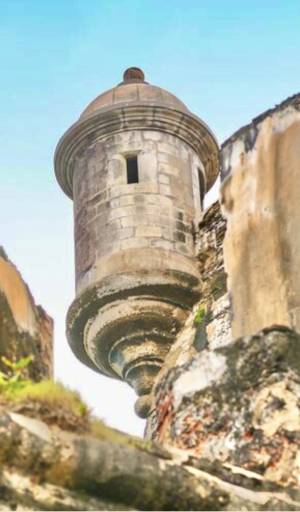
Parishes: tension to Heaven, without burdening or hindering
Lamps lit, start now
(Lk 12:35-38)
In order to make it clear what it means to be prepared to leave immediately, Jesus urges our readiness to notice, our ability to perceive.
He does not extinguish the aptitude for unprecedented judgement, and gains amazement.
Because the roles are suddenly reversed - so one has to be open to trust: the seemingly small becomes suddenly “big”.
Old religion drags the problems, and makes one sick, inculcating the spirit of submission and toil, for wages. And the slave remains a slave.
Servant and master are conversely in a reciprocal relationship and incessantly reverse roles.
As Lk says, the Lord himself “will gird himself and make them lie [the position of the lords of the time at solemn banquets] and pass by serving them” as if he were a “deacon” (v.37 Greek text).
This activates a total vigilance, ready to move the whole person, the territories (Fratelli Tutti, n.1: «beyond the place of the world»), the hierarchies.
He who felt “employee” becomes “manager” and protagonist: he acquires an attitude to fullness.
In the Kingdom of God, forms of life change.
In religions without the step of Faith - vice versa - nomenclatures consolidate.
In the Church there is no hoarding up, because our hearts do not live on worldliness and competition: goods are transformed into relationships and possibilities for encounter.
Christ has shown the Way to true enrichment. Thus he has transformed us into perhaps restless, but brisk beings.
We cannot even rest quietly: we have a step that flies by.
Indeed, it seems very strange that this Master does not arrive at the appointed time. Instead, Christ wants to be reinterpreted.
This condition is a source of growth for us: it accentuates our vigilance over events, the folds of history; over the meaning of encounters, the motions of the soul; and so on.
Thus, life in the Spirit challenges and enriches the exuberant side of the personality, accentuating the most singular opportunities for the unprecedented.
The «butler» placed at the service of the House of God and the brethren has the role of helping dynamic discernment, and the task of supporting it.
His service on behalf of others will be all-rounded, so that each one may correspond to the Call and proceed on his or her own feet.
'Blessed' then shall we be (v.38) without condition, but with the belt at our sides, that is, with the attitude of one who leaves a land of bondage.
«This was well known to the primitive Christian community, which considered itself "alien" here below and called its populated nucleuses in the cities "parishes", which means, precisely, colonies of foreigners [in Greek, pároikoi] (cf. I Pt 2: 11). In this way, the first Christians expressed the most important characteristic of the Church, which is precisely the tension of living in this life in light of Heaven» [Pope Benedict, Angelus August 12, 2007]
[Tuesday 29th wk. in O.T. October 20, 2026]
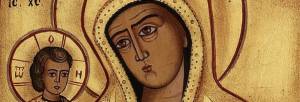
Parishes: strive for Heaven, without burden or hindrance
(Lk 12:35-38)
In order to make us understand what it means to be prepared to set out immediately, Jesus urges our awareness, our capacity for perception.
He does not extinguish the aptitude for unprecedented judgement, and gains amazement.
Because the roles are suddenly reversed - so one must be open to trust: those who seem small suddenly become 'big'.
Ancient religion drags problems down, and makes one sick, inculcating the spirit of submission and toil, for wages. The slave remains a slave, although he pursues who knows what.
In the adventure of Faith, one does not strive for goals that do not correspond. In addition, servant and master are in a reciprocal relationship and incessantly reverse roles.
As Lk says, the Lord himself "will gird himself and make them lie down [position of the lords of the time at solemn banquets] and pass by serving them" as if he were a "deacon" (v.37 Greek text).
This activates a total vigilance, ready to move the whole person, the territories (Fratelli Tutti, n.1: "beyond the place of the world"), the hierarchies.
The one who felt "employed" becomes "director" and protagonist: he acquires an attitude of fullness.
In the Kingdom of God, forms of life change. In religions - conversely - nomenclatures consolidate, and the very symptoms of errors even find a sacralisation.
Many devout forms have a different foundation, a very different idea of how to enrich existence, than the experience of Faith.
In the Church there is no treasure, because our hearts do not live on worldliness and competition: goods are transformed into relationships and possibilities for encounter.
The particular task and the entire existence of each person becomes a source of joy for the desperate, nourishment for those who seek understanding, listening, acceptance, a "true recognition" (Brothers All, 221).
The Tao Tê Ching (LXVI) says: "The saint stands above and the people are not burdened by it, he stands in front and the people are not hindered by him".
Christ has shown the Way to true enrichment. Thus he has transformed us into perhaps restless, but brisk beings.
We cannot sleep even at night, we cannot take a holiday, we cannot rest in a quiet, relaxed, normal way, but we have a step that flies by.
We sigh all the time, not because of material fortune, but because the opportunity of life may not find us ready to recognise it.
Augustine said: 'Timeo Dominum transeuntem'.
In religions, everything seems clear and pre-established - and in reality everything is left in doubt and to a quirky hypothesis of a hoped-for future.
And indeed, it is very strange that this Master does not arrive at the appointed time.
Instead, Christ wants to be reinterpreted.
He is living in us, joint and coheirs - Incarnate, all real. If so, He will also permeate the rebels, changing their outlook.
This condition is a source of growth for us: it heightens our vigilance over events, the folds of history; over the meaning of encounters, the motions of the soul, and so on.
Thus, life in the Spirit challenges and enriches the exuberant side of the personality, accentuating the most singular opportunities for the unprecedented.
The Lord even admits wandering: sometimes we need to lose ourselves, in order to find ourselves - and coincide with what we are in essence, and are becoming.
The 'butler' placed at the service of the House of God and the brethren has the task of helping dynamic discernment, and the duty to support it.
His service on behalf of others will be all-round, so that each one may correspond to the Call and proceed on his own feet.
And we shall do so willingly, without any effort whatsoever, because of the excess of Grace that comes our way: in spite of and because of indeterminacy, because we are made abundantly rich by God.
Blessed (v.38) without condition, but with the belt at our sides, that is, with the attitude of one who leaves a land of bondage.
«The primitive Christian community was well aware of this, which considered itself down here as "foreigners" and called its nuclei living in the cities "parishes", which means precisely colonies of foreigners [in Greek pàroikoi] (cf. 1Pt 2:11). In this way the early Christians expressed the most important characteristic of the Church, which is precisely the tension towards heaven».
[Pope Benedict, Angelus 12 August 2007].
To internalise and live the message:
Does the Christian community accentuate your personal perception or dampen it? Does it make you live in a swampy, predictable state, where all solutions are ready, complete and already tried and tested, or does it make you start again promptly, immediately and autonomously?
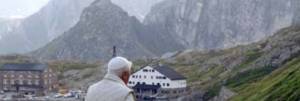
Gospel passage, continuing last Sunday's message, asks Christians to detach themselves from material goods, which are for the most part illusory, and to do their duty faithfully, constantly aspiring to Heaven. May the believer remain alert and watchful to be ready to welcome Jesus when he comes in his glory.
By means of examples taken from everyday life, the Lord exhorts his disciples, that is, us, to live with this inner disposition, like those servants in the parable who were waiting for their master's return. "Blessed are those servants", he said, "whom the master finds awake when he comes" (Lk 12: 37). We must therefore watch, praying and doing good.
It is true, we are all travellers on earth, as the Second Reading of today's liturgy from the Letter to the Hebrews appropriately reminds us. It presents Abraham to us in the clothes of a pilgrim, as a nomad who lives in a tent and sojourns in a foreign land. He has faith to guide him.
"By faith", the sacred author wrote, "Abraham obeyed when he was called to go out to a place which he was to receive as an inheritance; and he went out, not knowing where he was to go" (Heb 11: 8).
Indeed, Abraham's true destination was "the city which has foundations, whose builder and maker is God" (11: 10). The city to which he was alluding is not in this world but is the heavenly Jerusalem, Paradise.
This was well known to the primitive Christian community, which considered itself "alien" here below and called its populated nucleuses in the cities "parishes", which means, precisely, colonies of foreigners [in Greek, pároikoi] (cf. I Pt 2: 11). In this way, the first Christians expressed the most important characteristic of the Church, which is precisely the tension of living in this life in light of Heaven.
Today's Liturgy of the Word, therefore, desires to invite us to think of "the life of the world to come", as we repeat every time we make our profession of faith with the Creed. It is an invitation to spend our life wisely and with foresight, to consider attentively our destiny, in other words, those realities which we call final: death, the last judgement, eternity, hell and Heaven. And it is exactly in this way that we assume responsibility for the world and build a better world.
May the Virgin Mary, who watches over us from Heaven, help us not to forget that here on earth we are only passing through, and may she teach us to prepare ourselves to encounter Jesus, who is "seated at the right hand of the Father. He will come again in glory to judge the living and the dead".
[Pope Benedict, Angelus 12 August 2007]
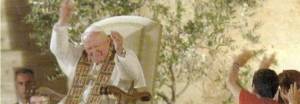
Stay with us Risen Lord!
This is also our daily aspiration.
If you remain with us
our heart is at peace.
Accompany us, as you did
with the disciples of Emmaus, on our personal and ecclesial journey. Open our eyes, that we may recognise
the signs of your ineffable presence.
Make us docile to listen to your Spirit.
Nourish us daily
on your Body and Blood,
we will know how to recognise you
and serve you in our brothers.
[John Paul II]
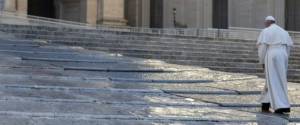
In today’s Gospel passage (cf. Lk 12:32-48), Jesus calls his disciples to be continually vigilant. Why? In order to understand God’s transition in one’s life because God continually passes through life. And he indicates the manners in which to live this vigilance properly: “Let your loins be girded and your lamps burning” (v. 35) This is the way. First and foremost, “the loins girded”, an image that evokes the attitude of the pilgrim, ready to set out on a journey. It is a case of not putting down roots in comfortable and reassuring dwellings but rather to surrender oneself, to be open with simplicity and trust to God’s passage in our lives, to the will of God who guides us towards the next destination. The Lord always walks with us and often he takes us by the hand, to guide us so that we do not err on this journey that is so difficult. Indeed, those who trust in God know well that the life of faith is not something static, but rather dynamic! The life of faith is a continuous journey towards ever new phases that the Lord himself points out to us day by day. Because he is the Lord of surprises, the Lord of novelty, indeed of true newness.
And then — the first manner was “the loins girded” — next there is the request to keep the “lamps burning” in order to be able to light up the darkness of the night. Thus, we are invited to live an authentic and mature faith capable of illuminating the many “nights” of our lives. We know, we have all had some days which were real spiritual nights. The lamp of faith requires being continuously nourished by the heart-to-heart encounter with Jesus in prayer and in listening to his Word. I return to something I have said to you many times: always carry a small Gospel in your pocket, in your bag, to read. It is an encounter with Jesus, with Jesus’ Word. This lamp of encounter with Jesus in prayer and in his Word is entrusted to us for the good of all: thus nobody can pull back in an intimist way in the certainty of one’s salvation, not interested in others. It is a fantasy to believe that one can illuminate oneself within, on one’s own. No, it is a fantasy. Real faith opens the heart to our neighbour and urges us towards concrete communion with our brothers, especially with those in need.
And in order to help us understand this attitude, Jesus recounts the parable of the servants who await the return of their master from the marriage feast (v. 36-40), thus presenting another aspect of vigilance: being ready for the last and definitive encounter with the Lord. Each of us will encounter, will find him/herself in that day of encounter. Each of us has their own date for the definitive encounter. The Lord says: “Blessed are those servants whom the master finds awake when he comes; ... If he comes in the second watch, or in the third, and finds them so, blessed are those servants!” (v. 37-38). With these words the Lord reminds us that life is a journey towards eternity; therefore, we are called to employ all the talents that we have, without ever forgetting that “here we have no lasting city, but we seek the city which is to come” (Heb 13:14). In this perspective, every instant becomes precious, and thus we must live and act on this earth, while longing for Heaven: our feet on the ground, walking on the ground, working on the ground, doing good on the ground and the heart longing for Heaven.
We cannot truly understand in what this supreme joy consists. However, Jesus lets us sense it with the analogy of the master who, finding his servants still awake on his return: “will gird himself and have them sit at table, and he will come and serve them” (v. 37). The eternal joy in heaven is manifested this way: the situation will be reversed and it will no longer be the servants, that is, we who will serve God, but God himself will place himself at our service. And Jesus does this as of now: Jesus prays for us, Jesus looks at us and prays to the Father for us. Jesus serves us now. He is our servant. And this will be the definitive joy. The thought of the final encounter with the Father, abundant in mercy, fills us with hope and stirs us to constant commitment, for our sanctification and for the building of a more just and fraternal world.
May the Virgin Mary support this commitment of ours through her maternal intercession.
[Pope Francis, Angelus 11 August 2019]
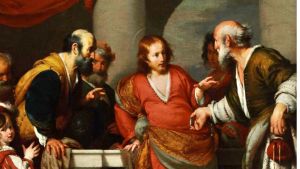
Returning to God the image of true humanity. What Acronym characterises it?
The more we do for others, the more we understand and can appropriate the words of Christ: “We are useless servants” (Lk 17:10). We recognize that we are not acting on the basis of any superiority or greater personal efficiency, but because the Lord has graciously enabled us to do so [Pope Benedict, Deus Caritas est n.35]
Quanto più uno s'adopera per gli altri, tanto più capirà e farà sua la parola di Cristo: « Siamo servi inutili » (Lc 17, 10). Egli riconosce infatti di agire non in base ad una superiorità o maggior efficienza personale, ma perché il Signore gliene fa dono [Papa Benedetto, Deus Caritas est n.35]
Each time we celebrate the dedication of a church, an essential truth is recalled: the physical temple made of brick and mortar is a sign of the living Church serving in history (Pope Francis)
Ogni volta che celebriamo la dedicazione di una chiesa, ci viene richiamata una verità essenziale: il tempio materiale fatto di mattoni è segno della Chiesa viva e operante nella storia (Papa Francesco)
It is a happy image with which, however, Jesus teaches a truth that calls us into question […] If we remove God, we remove Christ and the world falls back into emptiness and darkness (Pope Benedict)
E’ un’immagine felice, con cui però Gesù insegna una verità che ci mette in discussione […] Se togliamo Dio, se togliamo Cristo, il mondo ripiomba nel vuoto e nel buio (Papa Benedetto)
We would also like to set an example ourself, even if the smallness of our means might prevent anyone from appreciating the practical and quantitative significance of it. We want to see our own charitable institutions undergo a new development in the struggle against hunger and toward meeting the main needs of the world. This is the way and the only way to build peace (Pope Paul VI)
Vorremmo anche Noi dare l'esempio, sebbene l'esiguità dei Nostri mezzi ci impedisca di farne apprezzare la rilevanza pratica e quantitativa: Noi vogliamo dare alle Nostre istituzioni caritative un nuovo sviluppo in favore della fame e dei bisogni del mondo: è in questo modo, e non altrimenti, che si costruisce la pace (Papa Paolo VI)
As St. Ambrose put it: You are not making a gift of what is yours to the poor man, but you are giving him back what is his (Pope Paul VI, Populorum Progressio n.23)
Non è del tuo avere, afferma sant’Ambrogio, che tu fai dono al povero; tu non fai che rendergli ciò che gli appartiene (Papa Paolo VI, Populorum Progressio n.23)
Here is the entire Gospel! Here! The whole Gospel, all of Christianity, is here! But make sure that it is not sentiment, it is not being a “do-gooder”! (Pope Francis)
Qui c’è tutto il Vangelo! Qui! Qui c’è tutto il Vangelo, c’è tutto il Cristianesimo! Ma guardate che non è sentimento, non è “buonismo”! (Papa Francesco)
Christianity cannot be, cannot be exempt from the cross; the Christian life cannot even suppose itself without the strong and great weight of duty [Pope Paul VI]
Il Cristianesimo non può essere, non può essere esonerato dalla croce; la vita cristiana non può nemmeno supporsi senza il peso forte e grande del dovere [Papa Paolo VI]
The horizon of friendship to which Jesus introduces us is the whole of humanity [Pope Benedict]
L’orizzonte dell’amicizia in cui Gesù ci introduce è l’umanità intera [Papa Benedetto]
The Church invites believers to regard the mystery of death not as the "last word" of human destiny but rather as a passage to eternal life (Pope John Paul II)




duevie.art
don Giuseppe Nespeca
Tel. 333-1329741
Disclaimer
Questo blog non rappresenta una testata giornalistica in quanto viene aggiornato senza alcuna periodicità. Non può pertanto considerarsi un prodotto editoriale ai sensi della legge N°62 del 07/03/2001.
Le immagini sono tratte da internet, ma se il loro uso violasse diritti d'autore, lo si comunichi all'autore del blog che provvederà alla loro pronta rimozione.
L'autore dichiara di non essere responsabile dei commenti lasciati nei post. Eventuali commenti dei lettori, lesivi dell'immagine o dell'onorabilità di persone terze, il cui contenuto fosse ritenuto non idoneo alla pubblicazione verranno insindacabilmente rimossi.