Jul 9, 2026 Written by 

Leaving everything to internalise

The Liturgy of the feast of St Benedict, co-patron of Europe, emphasises the theme of leaving everything for Christ, for the Gospel, reciprocated by the hundredfold and the Life of the Eternal.

Benedict, like Francis, left all possessions to follow Jesus, summing up his path in the famous axiom: «Ora et labora», «pray and work».

Sometimes the severity of Benedictine monastic asceticism is contrasted with Franciscan cheerfulness, as if St Benedict and St Francis were two separate universes; but this is not the case.

There are elements in which they differ and others in common, perhaps elaborated differently.

Both consider prayer and work important. As well as prayer as the path leading to detachment from everything and interiorisation, the place of encounter with Christ - to be put before everything.

Francis, too, considers work an important aspect of his life and of the Minorite Rule, recalling in this the Benedictine one.

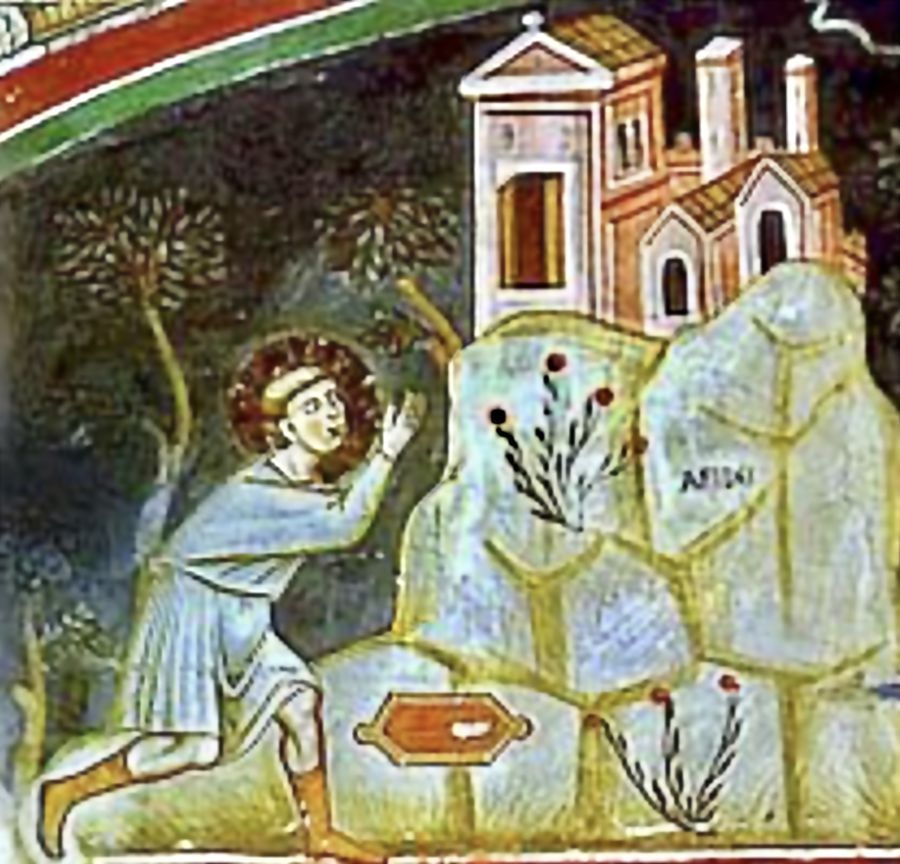
The Poor Man, although not Benedictine (as depicted in the Sacro Speco of Subiaco, in an ancient image) also lived within a history that preceded him, drawing from it some things, others rejecting them.

Those familiar with the Franciscan Sources, wishing to affirm the novelty of Brother Francis compared to St Benedict of Norcia, refer to a passage in the Compilatio Assisiensis.

In it it is narrated how during a Chapter at the Portiuncula, where the Minorite Rule was being discussed, some brothers proposed the adoption of earlier forms of life.

But Francis replied:

«Brothers, my brethren, God has called me to the way of humility and shown me the way of simplicity. Therefore, I do not want you to name me any other Rule, neither that of St Augustine, nor that of St Bernard or St Benedict.

The Lord told me that this is what he wanted:

that I should be in the world a 'new fool'; and the Lord does not want to lead us by any other path than that of this science!» (FF 1564).

The greatness of the Benedictine Rule does not lie so much in its contribution of novelty, but in its ability to synthesise the various previous monastic experiences in a sort of sapiential reading.

But these saints both place great importance on work that overcomes idleness and makes one live in the constant Presence of Christ in history, to which they put everything before him.

Continuous prayer and constant work are therefore two common elements differently elaborated, but fundamental for the following of Jesus and detachment from everything.

Francis taught the brothers:

«In prayer we purify our feelings and unite ourselves with the one, true and supreme Good and reinvigorate virtue [...].

In prayer we speak to God, we listen to him and we linger in the midst of the angels; in preaching, on the other hand, we must often descend to men and, living as men among men, think, see, say and listen in the human way» (FF 1204).

In his Testament, the Minim writes:

«And I worked with my hands, and I want to work; and I firmly want all the other brothers to work in a manner befitting honesty.

Those who do not know, let them learn, not out of greed to receive the reward of work, but to set an example and keep idleness at bay» (FF 119).

And it is precisely this approach of thought and life that made the Benedictines capable of building Europe "by making the everyday heroic and the everyday heroic" and that drove the Franciscan friars, among other things, to constant and faithful work especially in the evangelising mission of peace.

Sons of God in a different way, equally projected to follow Jesus, knowing that having left everything for his Kingdom is a guarantee of eternal life.


«And whoever has left houses or brothers or sisters or father or mother or children or fields for my name's sake will receive a hundredfold and inherit eternal life» (Mt 19:29)


S. Benedict patron of Europe  (Mt 19:27-29)

246 Last modified on Thursday, 09 July 2026 16:56
Teresa Girolami

Teresa Girolami è laureata in Materie letterarie e Teologia. Ha pubblicato vari testi, fra cui: "Pellegrinaggio del cuore" (Ed. Piemme); "I Fiammiferi di Maria - La Madre di Dio in prosa e poesia"; "Tenerezza Scalza - Natura di donna"; co-autrice di "Dialogo e Solstizio".

Email This email address is being protected from spambots. You need JavaScript enabled to view it.
And it is not enough that you belong to the Son of God, but you must be in him, as the members are in their head. All that is in you must be incorporated into him and from him receive life and guidance (Jean Eudes)
E non basta che tu appartenga al Figlio di Dio, ma devi essere in lui, come le membra sono nel loro capo. Tutto ciò che è in te deve essere incorporato in lui e da lui ricevere vita e guida (Giovanni Eudes)
Consequently, just as for Christ carrying the cross was not an option but a mission to be embraced for love, so it is for Christians too. In our world today, where the forces that divide and destroy seem to dominate, Christ does not cease to offer to all his clear invitation [Pope Benedict]
Come per Cristo, così pure per i cristiani portare la croce non è dunque facoltativo, ma è una missione da abbracciare per amore. Nel nostro mondo attuale, dove sembrano dominare le forze che dividono e distruggono, il Cristo non cessa di proporre a tutti il suo chiaro invito [Papa Benedetto]
We see this great figure, this force in the Passion, in resistance to the powerful. We wonder: what gave birth to this life, to this interiority so strong, so upright, so consistent, spent so totally for God in preparing the way for Jesus? The answer is simple: it was born from the relationship with God (Pope Benedict)
Noi vediamo questa grande figura, questa forza nella passione, nella resistenza contro i potenti. Domandiamo: da dove nasce questa vita, questa interiorità così forte, così retta, così coerente, spesa in modo così totale per Dio e preparare la strada a Gesù? La risposta è semplice: dal rapporto con Dio (Papa Benedetto)
The lamp is a symbol of the faith that illuminates our life, while the oil is a symbol of the charity that nourishes the light of faith, making it fruitful and credible (Pope Francis)
La lampada è il simbolo della fede che illumina la nostra vita, mentre l’olio è il simbolo della carità che alimenta, rende feconda e credibile la luce della fede (Papa Francesco)
Jesus wants our existence to be laborious, that we never lower our guard, so as to welcome with gratitude and wonder each new day given to us by God. Every morning is a blank page on which a Christian begins to write with good works (Pope Francis)
Gesù vuole che la nostra esistenza sia laboriosa, che non abbassiamo mai la guardia, per accogliere con gratitudine e stupore ogni nuovo giorno donatoci da Dio. Ogni mattina è una pagina bianca che il cristiano comincia a scrivere con le opere di bene (Papa Francesco)
And this is the problem: when the People put down roots in the land and are the depository of the Law, they are tempted to place their security and joy in something that is no longer the Word of God (Pope Benedict)
Ed ecco il problema: quando il popolo si stabilisce nella terra, ed è depositario della Legge, è tentato di riporre la sua sicurezza e la sua gioia in qualcosa che non è più la Parola del Signore (Papa Benedetto)
Despite the scarcity of information about him, St Bartholomew stands before us to tell us that attachment to Jesus can also be lived and witnessed to without performing sensational deeds. Jesus himself, to whom each one of us is called to dedicate his or her own life and death, is and remains extraordinary (Pope Benedict)
La figura di san Bartolomeo, pur nella scarsità delle informazioni che lo riguardano, resta comunque davanti a noi per dirci che l'adesione a Gesù può essere vissuta e testimoniata anche senza il compimento di opere sensazionali. Straordinario è e resta Gesù stesso, a cui ciascuno di noi è chiamato a consacrare la propria vita e la propria morte (Papa Benedetto)

Due Fuochi due Vie - Vol. 1 Due Fuochi due Vie - Vol. 2 Due Fuochi due Vie - Vol. 3 Due Fuochi due Vie - Vol. 4 Due Fuochi due Vie - Vol. 5 Dialogo e Solstizio I fiammiferi di Maria

duevie.art

don Giuseppe Nespeca

Tel. 333-1329741


Disclaimer

Questo blog non rappresenta una testata giornalistica in quanto viene aggiornato senza alcuna periodicità. Non può pertanto considerarsi un prodotto editoriale ai sensi della legge N°62 del 07/03/2001.
Le immagini sono tratte da internet, ma se il loro uso violasse diritti d'autore, lo si comunichi all'autore del blog che provvederà alla loro pronta rimozione.
L'autore dichiara di non essere responsabile dei commenti lasciati nei post. Eventuali commenti dei lettori, lesivi dell'immagine o dell'onorabilità di persone terze, il cui contenuto fosse ritenuto non idoneo alla pubblicazione verranno insindacabilmente rimossi.







