


Teresa Girolami
Teresa Girolami è laureata in Materie letterarie e Teologia. Ha pubblicato vari testi, fra cui: "Pellegrinaggio del cuore" (Ed. Piemme); "I Fiammiferi di Maria - La Madre di Dio in prosa e poesia"; "Tenerezza Scalza - Natura di donna"; co-autrice di "Dialogo e Solstizio".
Sowing without ceasing
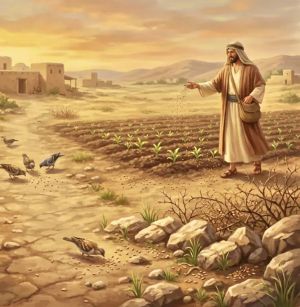
In this liturgy, the passage from Luke presents the parable of the Sower and the reception of the various soils; a parallel with the Word of God assimilated in different ways.
The new Evangelist of recent times, Francis, was enamoured with the Word and listened to it constantly, so much so that it was imprinted in his memory.
He was good soil that produced a hundredfold.
The Sources inform us:
"Radiant with the splendour of eternal light, he scrutinised the depths of the Scriptures with a clear and sharp intellect. His mind, pure of all stain, penetrated the secret of mysteries [...]
He read the sacred books from time to time and kept what he had once assimilated firmly imprinted in his memory, since he continually ruminated with affectionate devotion on what he had heard with an attentive mind" (FF 1188).
"With equal care and devotion, he committed himself to carrying out the other teachings he had heard.
In fact, he had never been a deaf listener to the Gospel, but, entrusting everything he heard to his commendable memory, he sought with every diligence to carry it out to the letter" (FF 357).
As Celano calls him in the First Life - «river of Paradise» - Francis, "the new evangelist of this last time, spread the waters of the Gospel with loving care throughout the whole world, and by his works he showed the way and the true doctrine of the Son of God" (FF 475).
In the Earlier Rule (1221):
«Let us therefore remain faithful to the words, life, doctrine and Holy Gospel of Him who deigned to pray for us to the Father» (FF 62).
And "let us beware of being the soil along the road, or the stony ground, or the ground overgrown with thorns, as the Lord says in the Gospel:
«The seed is the Word of God [...] the seed entrusted to good soil are those who, listening to the word with good, indeed excellent dispositions, understand it and keep it and bear fruit with perseverance»" (FF 58).
«The Sower went out to sow his seed [...] The seed is the Word of God» (Lk 8:5a, 11b)
Saturday of the 24th wk. in Ordinary Time (Lk 8:4-15)
The proclamation, the indispensable, and the female following
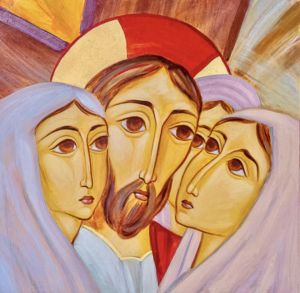
Chapter eight of Luke, at the beginning, speaks of the proclamation of the Good News of the Kingdom by Jesus and the Twelve, and of the following of women who, healed, follow the Lord, putting all they possess at their service.
Opening the Franciscan window we see that, after having known the Lord's will by divine inspiration, Francis, the Minim, devotes himself body and soul to fulfil the mission entrusted to him by God.
His task: to announce the Kingdom, to make the Good News known to people in poverty, renouncing everything that was not indispensable.
The Sources are extraordinarily rich in this regard.
"One day, while listening to Mass, he heard the instructions given by Christ when he sent his disciples to preach [...] He understood these instructions better afterwards, having the passage explained to him by the priest.
Then, beaming with joy, he exclaimed:
«This is precisely what I long to accomplish with all my strength!».
And fixing those directives in his memory, he undertook to carry them out happily [...].
He got rid of everything he owned that was double [...] He made himself a poor, coarse tunic and, instead of a leather belt, he tightened his hips with a rope.
Inspired by God, he began to proclaim the perfection of the Gospel, preaching penance to all, with simplicity.
His words were not frivolous [...] but full of the virtue of the Holy Spirit they penetrated into the depths of consciences, so as to touch his listeners vividly" (FF 1427).
"The man of God, Francis, animated by the Spirit of the prophets and following their language, as if echoing his forerunner, announced peace and preached salvation" (FF 1428).
"An increasing number of people were attracted by the frankness and truthfulness of Francis' teaching and life.
Two years after his conversion, some men felt encouraged by his example to do penance and join him, renouncing everything, wearing the same habit and leading the same life" (FF 1429).
The first woman to follow Francis was Clare, who left her father's house and followed him to live the Gospel.
"Noble by birth, nobler by grace [...] Clare by name, clearer by life, clearer by virtue" (FF 351).
Following her example, the other sisters also put their spiritual goods at the service of the Gospel.
«There were with him the Twelve and some women who had been healed [...] Susanna and many others, who served them with their possessions» (Lk 8:1b-2a.3b)
Friday 24th wk. in O.T. (Lk 8:1-3)
To those who love much
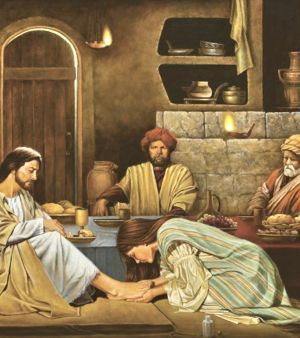
After his conversion, Francis told his brothers:
«A sinner can fast, pray, weep and macerate his flesh [...] So we must glory only in this case: if we render to God the glory that is his» (FF 1105).
Which the sinful woman did well in the Pharisee's house and which the latter did not understand.
Francis and Clare, aware of the mercy God had shown them, spent their lives loving without measure, knowing that they had been graced by the Most High. Hence their living by continual acts of love towards others, kissing, bending over their neighbour's needs, forgiving.
The Sources inform about this, and, specifically, St Bonaventure tells us in the Major Legend:
"A man from the county of Spoleto, had a horrible disease that ravaged his mouth [...].
He had gone to Rome to visit the tomb of the Apostles and implore their grace. Returning from his pilgrimage, he met the servant of God, whose feet he would have liked, out of devotion, to kiss. But the humble Francis did not allow it, instead he kissed the one who would have liked to kiss his feet on the face.
As soon as Francis, the servant of the lepers, moved by his admirable piety, had touched that hideous wound with his sacred mouth, it disappeared completely and the sick man regained his longed-for health.
I do not know what to admire more, with good reason, in this event, whether the profound humility that prompted that benevolent kiss, or the splendid power that worked such a stupendous miracle" (FF 1046).
But Clare too, in the Papal Bull (Clara Claris praeclara) is contemplated thus:
"Breaking hard in the narrow solitude of her cell the alabaster of her body, she filled with the aromas of her holiness the entire edifice of the Church" (FF 3285).
"That truly pure vessel turned out to be a vessel of grace" (FF 3157).
And "very often he washed the feet of the servants* who returned from outside and, washing them, kissed them" (FF 3182).
To those who love much, much will be forgiven!
- Sisters in charge of the external service of the Monastery.
Thursday, 24th wk. in Ordinary Time (Lk 7:36–50)
Wisdom recognised by the sons, without murmuring

In this passage from the Gospel of Luke, Jesus compares the generation of his time to those children who cry out to one another about their inability to accept the prophets and the Son of Man, criticising everything done or proposed.
John the Baptist was treated as a demon because he fasted, the Son of God, who eats and drinks, as a friend of publicans and sinners.
But he who has Wisdom from above knows how to recognise the nature of things.
Thus Francis of Assisi!
Following in Christ's footsteps, he made himself 'one' with sinners, considering himself the first - and entertained himself with them in love.
We read in the Sources:
"Let the brothers beware, wherever they may be, in hermitages or in other places, not to appropriate any place for themselves nor to contend with anyone.
And whoever comes to them, friend or foe, thief or robber, let him be received with kindness.
And wherever the brothers are and wherever they meet, they should meet again willingly and with joy of spirit and honour one another without murmuring" (FF 26).
Francis possessed true Wisdom that enabled him to be with all, sinners and not, to discern and recognise the work of the Lord at work in any context, because he penetrated the root of things, looking at them with the eye of God.
Thus Clare, sister among sisters, with great discernment recognised the passage of the Spirit and his holy operation, welcoming all and conforming herself to the divine plans.
«For John the Baptist has come, who neither eats bread nor drinks wine, and you say, “He has a devil”.
The Son of Man has come who eats and drinks, and you say, “Behold, a man who eats and drinks wine, a friend of publicans and sinners!”» (Lk 7:33-34)
Wednesday 24th wk. in O.T. (Lk 7,31-35)
Stay and meditate
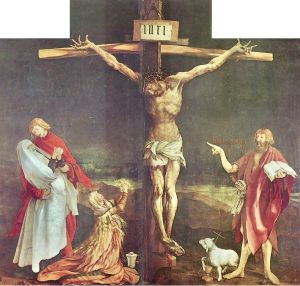
In both the Gospel of John and that of Luke, the liturgy focuses on the figure of the Virgin Mary, immersed in the mystery of salvific suffering that she endures.
Mary had been forewarned of the piercing sword that would strike her and lead her to stand at the foot of the Cross, united with her Son in the Paschal Mystery, for the good of many.
Francis loved the Blessed Virgin with an indescribable love and contemplated her mysteries continually.
So too did Clare, urging her daughters to live out, like Mary, both the hopes and the sufferings.
We read in the Sources what she wrote to her spiritual daughter Ermentrude of Bruges:
«Lift up your eyes to heaven, O most beloved, for it is a call to us, and take up the cross and follow Christ who goes before us. For after many and varied tribulations, it is He who will lead us into his glory.
Love God with all your heart, and Jesus, his Son, crucified for us sinners, and may the memory of Him never fade from your mind.
MEDITATE WITHOUT WEARING YOURSELF OUT ON THE MYSTERY OF THE CROSS AND THE SORROWS OF THE MOTHER STANDING AT THE FOOT OF THE CROSS […]» (FF 2915).
And again, in Clare’s Rule, regarding poverty lived out at every level:
«Never, most beloved sisters, should you desire anything else under heaven, for the love of our Lord Jesus Christ and of his most holy Mother» (FF 2795).
And Francis himself ‘surrounded the Mother of the Lord Jesus with unspeakable love, because she had made the Lord of Majesty our brother and obtained mercy for us.
In her […] after Christ, he placed his trust’ (FF 1165).
The Blessed Virgin was ever in his thoughts, and he ceaselessly contemplated the sorrows and hardships she endured during her earthly pilgrimage.
«Now standing by the cross of Jesus were his mother and his mother’s sister, Mary the wife of Clopas, and Mary of Magdala» (Jn 19:25)
Blessed Virgin Mary of Sorrows (Jn 19:25–27)
Exaltation of the Cross: a gift of Franciscan elevation
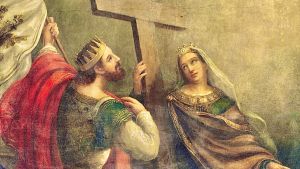
Gift of transformation-raising of the Cross
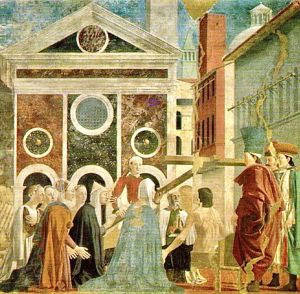
John, highlights how God sent His Son Jesus into the world not to condemn it, but to save it through Him.
Francis so loved the Crucified One and for Him and in Him the Cross on which He was confined for the salvation of the world, that he received the gift of the stigmata.
Made like Christ, therefore Alter Christus. He had always fixed in his mind the Gift of the Father to humanity, in the Son.
The Sources illuminate in this regard:
"And we give thee thanks, because as thou hast created us through thy Son, so by thy holy love, with which thou hast loved us, thou hast brought forth the same true God and true man from the glorious ever-virgin most blessed Saint Mary, and, by the cross, blood and death of Him hast willed to redeem us from slavery" (FF 64).
And again: 'For he said that nothing is more important than the salvation of souls, and he proved this very often by the fact that the only-begotten of God deigned to be hung on the cross for souls [...] He did not consider himself a friend of Christ, if he did not love the souls He loved' (FF 758).
"One morning, as the feast of the Exaltation of the Holy Cross approached, while he was praying on the side of the mountain, he saw a figure like a seraphim, with six wings as bright as they were fiery, descending from the sublimity of the heavens [...] He came close to the man of God, and then there appeared between his wings the effigy of a crucified man, who had his hands and feet spread out and confined on the cross [...He understood by divine revelation the purpose for which divine Providence had shown him that vision, that is, to make known to him in advance that he [...] was about to be transformed wholly into the visible portrait of Christ Jesus crucified [...] by the fire of the Spirit" (FF 1225).
Passing through pain and death would be the triumph of Life. A Cross blossomed in the Paschal Mystery.
«For so God loved the world that he gave his Son, the Only Begotten, that whoever believes in him should not perish but have the life of the Eternal One» (Jn 3:16)
Exaltation of the Holy Cross (Jn 3:13-17)
Compassion for our fellow human beings
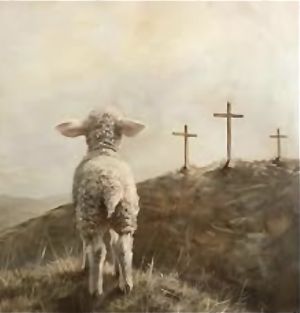
This Sunday, the Liturgy presents the parable of the unforgiving servant, taken from the Gospel of Matthew.
Jesus highlights how everyone seeks understanding and forgiveness for themselves whilst applying a different standard to their neighbour. All this runs counter to the logic of the Gospel.
We are called to show compassion for our neighbour when they suffer the same afflictions we have experienced, abandoning the worldly logic of double standards.
For Francis of Assisi, compassion for a brother in difficulty, whether sick or facing any other problem, was a fundamental attitude that shaped his likeness to Christ.
We read of various episodes on this subject in the Sources.
We shall highlight one.
‘On another day during his preaching, a poor man, who was also infirm, came to the place where Francis was.
Feeling compassion for this man’s double misfortune—that is, poverty and illness—he began to speak with his companion about poverty.
He had already moved, in his regard for the sufferer, from pity to heartfelt affection, when his companion interrupted him:
«Yes, brother, he is poor, but perhaps there is no one in the whole province richer in desires».
The Saint rebuked him on the spot and ordered the companion, who was confessing his fault:
«Come now, quickly: take off your habit, kneel at the feet of the poor man and openly acknowledge your fault. And not only shall you ask him for forgiveness, but you shall also insist that he pray for you!»
The friar obeyed, and when he returned, having completed his penance, the Saint said to him:
«When you see a poor person, brother, the mirror of the Lord and of his poor Mother is set before you.
In the same way, in the sick, you must consider what infirmities he took upon himself for our sake!»
Truly, Francis always carried that small bundle of myrrh in his heart; he always gazed upon the face of his Christ; he always remained in contact with the Man of Sorrows, who knows all suffering (FF 672).
«You wicked servant! I forgave you that entire debt because you pleaded with me. Shouldn’t you also have had mercy on your fellow servant, just as I had mercy on you?» (Mt 18:32–33)
24th Sunday in Ordinary Time, year A (Mt 18:21–35)
A fruitful heart because it is on the Rock

Jesus emphasises the main criterion for recognising the fruitfulness of the tree: noting what fruit it produces.
He also refers to the heart of every creature that says, says... but does not do.
Listen or don't listen!
The first rests on the Rock that He is, the second on not wanting to put His Word into practice, with the consequent ruin of each one.
Francis, the Little One of Assisi, drew goodness from his new heart. He was a fruitful tree, recognisable by his fruits.
In fact, the Sources inform us of an episode that bears witness to this:
"After several months had passed, Francis was staying at the church of the Porziuncola, and he was near the cell that stands behind the house, along the road, when that friar returned to speak to him about the psalter.
Francis said to him, «Go and do as your Minister tells you».
At these words, the friar began to return the way he had come.
But the Saint, remaining on the road, began to reflect on what he had said, and suddenly cried out after him:
«Wait for me, brother, wait for me!».
He went up to him and said:
«Come back with me, brother, and show me the place where I told you to do what the minister will tell you about the psalter».
When they reached that place, Francis bowed before the friar and, kneeling down, said:
«My fault, brother, my fault! Anyone who wants to be a 'minor' must have nothing but a tunic, a cord and breeches, as the Rule says, and in addition footwear, for those who are constrained by obvious necessity or illness».
He gave the same answer to all the friars who came to consult him on the subject.
He said: «A MAN KNOWS AS MUCH AS HE DOES; AND A RELIGIOUS IS AS GOOD A PREACHER AS HE ACTS».
As if to say: «A GOOD TREE IS KNOWN BY THE FRUIT IT PRODUCES» (FF 1628).
«Every tree is known by its fruit [...]
But why do you call me, 'Lord, Lord,' and do not do what I say?» (Lk 6:44a, 46)
Saturday of the 23rd wk. in Ordinary Time (Lk 6:43-49)
Judgement belongs to God
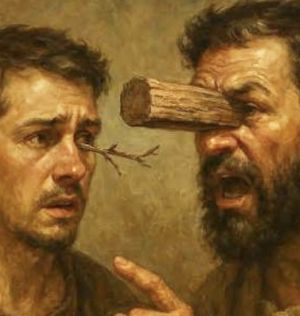
The Gospel casts its gaze on the blind guides of the blind [with nefarious results] and on those who pretend to remove the mote from their brother's eye while forgetting the beam that dwells in him.
Francis abhorred any judgement of the brothers, for he believed that every haughty expression addressed to them was, practically, addressed to God himself.
Clare advised the sisters to beware of judgement, detraction and murmuring:
«Let the sisters [...] beware of detraction and murmuring» (FF 2809).
In that treasure chest of riches that are the Sources we find many interesting narratives on the subject.
In the Regola bollata (1223) written by Francis we read:
«[The brethren] I admonish them, however, and exhort them not to despise and judge men whom they see dressed in soft and coloured clothing and using delicate food and drink, but rather let each one judge and despise himself» (FF 81).
And in the Letter to the Faithful he continues:
«Those then who have received authority to judge others, let them exercise judgement with mercy, just as they themselves wish to obtain mercy from the Lord: for judgement will be without mercy for those who have not used mercy» (FF 191).
To the brothers themselves:
"If it sometimes happened that a brother missed a word that could hurt, the remorse of conscience would not let him have peace, until he confessed his mistake, humbly throwing himself to the ground and begging the offended one to put a foot on his mouth [...].
The brothers undertook to banish all rancour and incompatibility, and to keep exchangeable love intact" (FF 1449).
Therefore the yardstick for every thought and expression was to look at oneself in honesty before God, leaving the gaze on others to Him.
«Can a blind man guide [another] blind man? [...]
Why do you look at the mote in your brother's eye but the beam in your own eye you do not see?» (Lk 6:39a.41)
Friday of the 23rd wk. in O.T. (Lk 6:39-42)
And «each of us can say: "for love to me"» (Pope Francis)
E «ognuno di noi può dire: “per amore a me”» (Papa Francesco)
We too, to reach a more conscious confession of Jesus Christ must follow, like Peter, a path made of attentive, caring listening (Pope John Paul II)
Anche noi per giungere a una più consapevole confessione di Gesù Cristo dobbiamo percorrere, come Pietro, un cammino fatto di ascolto attento, premuroso (Papa Giovanni Paolo II)
It is a word that must be witnessed to and proclaimed explicitly, because without a consistent witness it proves to be less comprehensible and credible [Pope Benedict]
E’ una Parola che deve essere testimoniata e proclamata esplicitamente, perché senza una testimonianza coerente essa risulta meno comprensibile e credibile [Papa Benedetto]
The “reading and meditation of the word of God root us more deeply in Christ and guide our ministry as servants of reconciliation, justice and peace” (second Synod for Africa, Propositio 46)
La lettura e la meditazione della Parola di Dio ci radicano più profondamente in Cristo e orientano il nostro ministero di servitori della riconciliazione, della giustizia e della pace (Secondo Sinodo per l’Africa, Propositio 46)
The Gospel of Matthew written in Hebrew or Aramaic is no longer extant, but in the Greek Gospel that we possess we still continue to hear, in a certain way, the persuasive voice of the publican Matthew, who, having become an Apostle, continues to proclaim God's saving mercy to us. And let us listen to St Matthew's message, meditating upon it ever anew also to learn to stand up and follow Jesus with determination (Pope Benedict)
Non abbiamo più il Vangelo scritto da Matteo in ebraico o in aramaico, ma nel Vangelo greco che abbiamo continuiamo a udire ancora, in qualche modo, la voce persuasiva del pubblicano Matteo che, diventato Apostolo, séguita ad annunciarci la salvatrice misericordia di Dio e ascoltiamo questo messaggio di san Matteo, meditiamolo sempre di nuovo per imparare anche noi ad alzarci e a seguire Gesù con decisione (Papa Benedetto)
That denarius clearly represents eternal life, a gift that God reserves for all. Indeed those who are considered the "last", if they accept, become the "first", whereas the "first" can risk becoming the "last" [Pope Benedict]
Quel denaro rappresenta la vita eterna, dono che Dio riserva a tutti. Anzi, proprio quelli che sono considerati "ultimi", se lo accettano, diventano "primi", mentre i "primi" possono rischiare di finire "ultimi" [Papa Benedetto]
The sower is Jesus. With this image, we can see that he presents himself as one who does not impose himself, but rather offers himself. He does not attract us by conquering us, but by donating himself: he casts seeds. With patience and generosity, he spreads his Word, which is not a cage or a trap, but a seed which can bear fruit (Pope Francis)
Il seminatore è Gesù. Notiamo che, con questa immagine, Egli si presenta come uno che non si impone, ma si propone; non ci attira conquistandoci, ma donandosi: butta il seme. Egli sparge con pazienza e generosità la sua Parola, che non è una gabbia o una trappola, ma un seme che può portare frutto (Papa Francesco)
At first they say “yes” to God’s will, but their piety becomes routine and God no longer matters to them [Pope Benedict]
Essi, prima, dicono “sì” alla volontà di Dio. Ma la loro religiosità diventa routine, e Dio non li inquieta più [Papa Benedetto]








duevie.art
don Giuseppe Nespeca
Tel. 333-1329741
Disclaimer
Questo blog non rappresenta una testata giornalistica in quanto viene aggiornato senza alcuna periodicità. Non può pertanto considerarsi un prodotto editoriale ai sensi della legge N°62 del 07/03/2001.
Le immagini sono tratte da internet, ma se il loro uso violasse diritti d'autore, lo si comunichi all'autore del blog che provvederà alla loro pronta rimozione.
L'autore dichiara di non essere responsabile dei commenti lasciati nei post. Eventuali commenti dei lettori, lesivi dell'immagine o dell'onorabilità di persone terze, il cui contenuto fosse ritenuto non idoneo alla pubblicazione verranno insindacabilmente rimossi.