Mar 6, 2026 Written by 

Sacred space and inner space

6. "Two men went up to the temple to pray: one was a Pharisee and the other a publican" (Lk 18:10). However, only one returned home justified. And it was precisely the publican (cf. Lk 18:14). This means that only he reached the inner mystery of the temple, the mystery united to his consecration. Only he, although both had gone there to pray.

Thus it turns out that the same sacred space, the temple, the cathedral, must be further filled with another totally interior and spiritual space: "Do you not know that you are God's temple and that God's spirit dwells in you?" - writes St Paul (1 Cor 3:16).

In fact, your cathedral, like so many others in the world, is filled with an almost infinite number of those inner temples, which are the human 'hearts'. To whom do these human 'hearts' most resemble? The Pharisee or the publican? The temple is a sign of man's reconciliation with God in Jesus Christ. However, the reality of this reconciliation - which is indicated by the external sign of the temple - ultimately passes through the human heart, through this sanctuary of justification and holiness.

7. The Pharisee returned "unjustified" because he was "full of himself". In the "space" of his heart there was no room for God. The Pharisee was present in the material temple; but God was not present in the temple of his heart. Why, on the other hand, is the publican "justified" again? Because - unlike the Pharisee - he humbly acknowledges that he needs to be justified. He does not judge others. He judges himself.

The publican 'stands at a distance', yet - and perhaps he does not exactly realise it - he is closer than ever to the Lord, because 'the Lord, as the Psalm says (33:19), is close to the one whose heart is wounded'. God is by no means distant from the sinner, if this sinner has a 'wounded heart', i.e. is repentant, and trusts, like the publican, in divine mercy: 'O God, have mercy on me a sinner'. The publican, therefore, does not glory in himself, but in the Lord. He does not exalt himself. He does not put himself first, but recognises in God his majesty, his transcendence. He knows that God is great and merciful, and that he bends to the cry of the poor and humble.

The publican "stands at a distance", but at the same time he trusts. Here is the right attitude towards God. To feel unworthy of him, because of one's sins; but to trust in his mercy, precisely because he loves the repentant sinner.

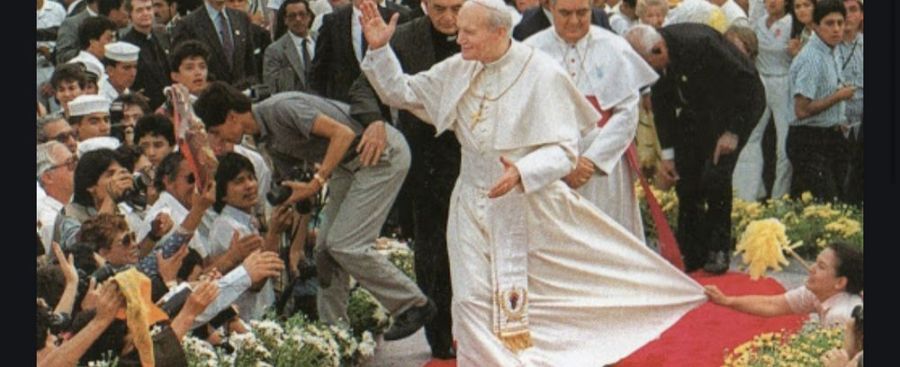
[Pope John Paul II, homily Perugia 26 October 1986]

224 Last modified on Friday, 06 March 2026 03:03
don Giuseppe Nespeca

Giuseppe Nespeca è architetto e sacerdote. Cultore della Sacra scrittura è autore della raccolta "Due Fuochi due Vie - Religione e Fede, Vangeli e Tao"; coautore del libro "Dialogo e Solstizio".

Email This email address is being protected from spambots. You need JavaScript enabled to view it.
«Doctrina eius (scilicet Catharinae) non acquisita fuit; prius magistra visa est quam discipula» [Pope Pius II, Canonization Edict]
«Doctrina eius (scilicet Catharinae) non acquisita fuit; prius magistra visa est quam discipula» [Papa Pio II, Bolla di Canonizzazione]
In this passage, the Lord tells us three things about the true shepherd:  he gives his own life for his sheep; he knows them and they know him; he is at the service of unity [Pope Benedict]
In questo brano il Signore ci dice tre cose sul vero pastore: egli dà la propria vita per le pecore; le conosce ed esse lo conoscono; sta a servizio dell'unità [Papa Benedetto]
Let us permit St Augustine to speak once more: "If only good shepherds be not lacking! Far be it from us that they should be lacking, and far be it from divine mercy not to call them forth and establish them. It is certain that if there are good sheep, there are also good shepherds: in fact it is from good sheep that good shepherds are derived." (Sermones ad populum, Sermo XLIV, XIII, 30) [John Paul II]
Lasciamo ancora una volta parlare Sant’Agostino: “Purché non vengano a mancare buoni pastori! Lungi da noi che manchino, e lungi dalla misericordia divina il non farli sorgere e stabilirli. Certo è che se ci sono buone pecore, ci sono anche buoni pastori: infatti è dalle buone pecore che derivano i buoni pastori” (S. Agostino, Sermones ad populum, I, Sermo XLIV, XIII, 30) [Giovanni Paolo II]
Jesus, Good Shepherd and door of the sheep, is a leader whose authority is expressed in service, a leader who, in order to command, gives his life and does not ask others to sacrifice theirs. One can trust in a leader like this (Pope Francis)
Gesù, pastore buono e porta delle pecore, è un capo la cui autorità si esprime nel servizio, un capo che per comandare dona la vita e non chiede ad altri di sacrificarla. Di un capo così ci si può fidare (Papa Francesco)
To be Christians means to be missionaries, to be apostles (cfr. Decree Apostolicam Actuositatem, n.2). It is not enough to discover Christ - you must bring Him to others! [John Paul II]
Essere cristiani significa essere missionari-apostoli (cfr. «Apostolicam Actuositatem», 2). Non basta scoprire Cristo - bisogna portarlo agli altri! [Giovanni Paolo II]
What is meant by “eat the flesh and drink the blood” of Jesus? Is it just an image, a figure of speech, a symbol, or does it indicate something real? (Pope Francis)
Che significa “mangiare la carne e bere il sangue” di Gesù?, è solo un’immagine, un modo di dire, un simbolo, o indica qualcosa di reale? (Papa Francesco)
What does bread of life mean? We need bread to live. Those who are hungry do not ask for refined and expensive food, they ask for bread. Those who are unemployed do not ask for enormous wages, but the “bread” of employment. Jesus reveals himself as bread, that is, the essential, what is necessary for everyday life; without Him it does not work (Pope Francis)
Che cosa significa pane della vita? Per vivere c’è bisogno di pane. Chi ha fame non chiede cibi raffinati e costosi, chiede pane. Chi è senza lavoro non chiede stipendi enormi, ma il “pane” di un impiego. Gesù si rivela come il pane, cioè l’essenziale, il necessario per la vita di ogni giorno, senza di Lui la cosa non funziona (Papa Francesco)
In addition to physical hunger man carries within him another hunger — all of us have this hunger — a more important hunger, which cannot be satisfied with ordinary food. It is a hunger for life, a hunger for eternity which He alone can satisfy, as he is «the bread of life» (Pope Francis)

Due Fuochi due Vie - Vol. 1 Due Fuochi due Vie - Vol. 2 Due Fuochi due Vie - Vol. 3 Due Fuochi due Vie - Vol. 4 Due Fuochi due Vie - Vol. 5 Dialogo e Solstizio I fiammiferi di Maria

duevie.art

don Giuseppe Nespeca

Tel. 333-1329741


Disclaimer

Questo blog non rappresenta una testata giornalistica in quanto viene aggiornato senza alcuna periodicità. Non può pertanto considerarsi un prodotto editoriale ai sensi della legge N°62 del 07/03/2001.
Le immagini sono tratte da internet, ma se il loro uso violasse diritti d'autore, lo si comunichi all'autore del blog che provvederà alla loro pronta rimozione.
L'autore dichiara di non essere responsabile dei commenti lasciati nei post. Eventuali commenti dei lettori, lesivi dell'immagine o dell'onorabilità di persone terze, il cui contenuto fosse ritenuto non idoneo alla pubblicazione verranno insindacabilmente rimossi.







