


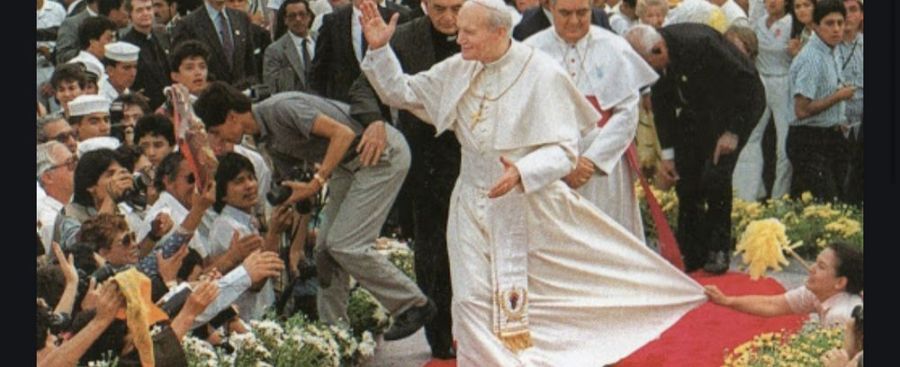
Our meeting today puts us into direct contact with the depths of the mystery of God’s love. We are in fact taking part in Vespers in honour of the Most Sacred Heart of Jesus, which enable us to live and experience the reality of God’s love for man. “For God so loved the world that he gave his only Son, that whoever believes in him should not perish but have eternal life” (Jn 3:16). God loves the world and will love it to the end. The Heart of the Son of God pierced on the Cross and opened is a profound and definitive witness to God’s love. Saint Bonaventure writes: “It was a divine decree that permitted one of the soldiers to open his sacred wide with a lance . . . The blood and water which poured out at that moment was the price of our salvation” (The Liturgy of the Hours, Solemnity of the Sacred Heart, Office of Readings, Second Reading).
With trembling hearts and in humility we stand before the great mystery of God, who is love. Here today, in Gliwice, we wish to express to him our praise and immense gratitude.
It is with great joy that I come to you today, because you are dear to me. All the people of Silesia are dear to my heart. When I was Archbishop of Kraków I would go each year on pilgrimage to Our Lady of Piekary and we would gather there for prayer in common. I greatly appreciated every invitation. For me it was always a profound experience. However, this is the first time that I have come to the Diocese of Gliwice, because it is a young diocese which was established just a few years ago. Therefore, receive my cordial greeting, which I send first of all to your Bishop Jan and to his Auxiliary Bishop Gerard. I also greet the clergy, the families of Religious men and women, all consecrated persons and the faithful people of this Diocese. I am pleased that my travels on this pilgrimage in our homeland include Gliwice, a city which I have visited many times and of which I have special memories. With great joy I visit this land of men and women who are accustomed to hard work: it is the land of the Polish miner, the land of steel mills, mines and industrial furnaces; but it is also a land with a rich religious tradition. My thoughts and my heart open today to all of you here present, to all the people of Upper Silesia and of the entire land of Silesia. I greet all of you in the name of the one Triune God.
2. “God is love” (1 Jn 4:16). These words of Saint John the Evangelist constitute the theme of the Pope’s pilgrimage in Poland. On the eve of the Great Jubilee of the Year 2000 this joyous and impressive news of a God who loves needs to be spread anew throughout the world. God is a reality which is beyond our human capacity to understand fully. Since he is God, our reasoning is unable to grasp his infiniteness, nor can his limitlessness be confined within narrow human dimensions. It is he who measures us, who rules over us, guides us and understands us, even though we may be unaware of it. This God, however unattainable in his essence, has made himself close to men and women by his paternal love. The truth of God who is love constitutes a kind of summing up and at the same time the high point of everything that God has revealed about himself, of what he has told us through the Prophets and through Jesus Christ about what he is.
God has revealed this love in various ways. First, in the mystery of creation. Creation is the work of God’s omnipotence guided by wisdom and love. “I have loved you with an everlasting love; therefore I have continued my faithfulness to you”, God says to Israel through the lips of the Prophet Jeremiah (31:3). God has loved the world which he has created, and above all things in the world he has loved man. Even when man turned away from this original love, God did not stop loving him and raised him up from his fall, because he is Father, because he is Love. In the most perfect and definitive way, God has revealed his love in Christ — in his Cross and in his Resurrection. Saint Paul will say: “God, who is rich in mercy, out of the great love with which he loved us, even when we were dead through our trespasses, made us alive with Christ” (Eph 2:4-5). In this year’s message for youth I wrote: “The Father loves you”. This magnificent news has been placed in the heart of believing men and women who, like the disciple whom Jesus loved, rest their heads on the Master’s breast and listen to what he confides to them: “He who loves me will be loved by my Father, and I will love him and manifest myself to him” (Jn 14:21).
“The Father loves you” — these words of the Lord Jesus are at the very heart of the Gospel. At the same time, no one shows more clearly than Jesus how demanding this love is: “he became obedient unto death” (Phil 2:8) and thus taught in the most perfect way that love waits for a response from men and women. It demands fidelity to the commandments and to the vocation which each person has received from God.
3. “We know and believe the love God has for us” (1 Jn 4:16).
By grace, men and women are called to the Covenant with their Creator, to give a response of faith and love which no one else can give for them. This response has not been lacking here in Silesia. For whole centuries you have responded to God with your Christian lives. Your history shows you always united with the Church and her Pastors, strongly attached to the religious traditions of your forebears. In a particular way, the long post-War period — up to the changes which took place in our country in 1989 — was also for you a time of great trial of faith. You faithfully stood by God, withstanding atheism and the secularization of the nation and the battle against religion. I remember how thousands of workers in Silesia, at the Shrine of Piekary, repeated with firm resolve the motto: “Sunday belongs to God and to us”. You have always been aware of the need for prayer and for places where prayer could be better raised to God. Therefore you were never without the willingness of spirit or the generosity to work for the construction of new churches and places of worship, which sprang up in large numbers during that period in the cities and towns of Upper Silesia. You also had at heart the well- being of the family. For this reason you spoke up for the rights of families, especially the right for your children and for young people to be freely educated in the faith. You would often gather at shrines and in many other places dear to your hearts to give expression to your attachment to God and to bear witness to him. You would also invite me to those community celebrations in Silesia. I was always eager to proclaim the word of God, for you needed comfort during the difficult period of struggle when you fought to preserve your Christian identity, and you needed strength to obey “God rather than men” (Acts 5:29).
Looking at the past, we give thanks to Providence today for that test of faithfulness to God and to the Gospel, to the Church and to her Pastors. It was also a test of the responsibility of the nation, of our Christian homeland and of its thousand-year heritage, which despite the many great trials did not suffer destruction or sink into oblivion. It happened this way because you “know and believe the love God has for us”, and you responded always with love to God.
4. “Blessed are they who walk not in the counsel of the wicked . . . but whose delight is in the law of the Lord, who meditate on his law day and night” (Ps 1:1- 2).
We have listened to these words of the Psalmist in the short reading at today’s Vespers service. Remain faithful to the experience of the past generations who lived in this land with God in their hearts and prayer on their lips. In Silesia may there ever prevail faith and sound morality, a true Christian spirit and respect for divine law. Preserve as your greatest treasure that which for your ancestors’ was a source of spiritual strength. Your forebears included God in their lives; in him they overcame every manifestation of evil. An eloquent expression of this is the miners’ greeting “God be good to you!”. Keep your hearts always open to the values proclaimed by the Gospel, cherish them; for they define your identity.
Dear Brothers and Sisters, I also wanted to let you know that I am aware of the difficulties, fears and hardships which you are now experiencing, the fears and hardships afflicting the work sector in this Diocese and in all of Silesia. I am aware of the dangers which this state of affairs poses especially for many families and for the life of society as a whole. A careful consideration is needed both of the causes and of possible solutions. I have already spoken of this during my pilgrimage to Sosnowiec. Today I address once more all my fellow countrymen in our homeland: build the nation’s future on love of God and love of man, on respect for God’s commandments and on the life of grace! Indeed, happy are they, and happy is the nation, who take delight in the law of the Lord.
The knowledge that God loves us should make us love all men and women, without exception and without separating them into friends and enemies. Love of man consists in desiring what is truly good for each person. It consists also in concern to guarantee this good and to reject every form of evil and injustice. We must strive always and with perseverance to seek the paths of just development for all people, “to make life more human”, as the Council says (Gaudium et Spes, 38). May love and justice flourish in our country, producing daily results in the life of society. Thanks only to love and justice can this land become a happy home. Without great and authentic love there is no home for man. Even should great successes be achieved in the area of material development, without love and justice he would be condemned to a life without any real meaning.
“Man is the only creature on earth which God willed for itself” (cf. Gaudium et Spes, 24). He has been called to share in God’s life, he has been called to the fulness of grace and truth. His own greatness, the value and dignity of his humanity, he finds precisely in this vocation.
May God who is love be the light of our lives today and in the times to come. May he be the light of our homeland. Build a future worthy of man and his vocation!
I place you, your families and your problems at the feet of our Most Blessed Mother, who is venerated in many shrines in this Diocese and in all of Silesia. May she teach love of God and love of man, as she practised it in her own life.
To all, “God be good to you”!
[Pope John Paul II, homily in Gliwice 15 June 1999]








