


"How are we to buy bread, so that these people may eat?"
Before the multitude which has followed him from the shores of the Sea of Galilee to the mountains in order to listen to his word, Jesus begins, with this question, the miracle of the multiplication of the loaves. This is the significant prelude to the long speech in which he reveals himself to the world as the real Bread of life which came down from heaven (cf. Jn 6:41).
1. We have listened to the evangelical narration: with five barley loaves and two fish, offered by a boy, Jesus feeds about five thousand people. But the latter, not understanding the depth of the "sign" in which they have been involved, are convinced that they have at last found the King-Messiah, who will solve the political and economic problems of their nation. Before this obtuse misunderstanding of his mission, Jesus withdraws, all alone, to the mountains.
We, too, beloved Brothers and Sisters, have followed Jesus and continue to follow him. But we can and must ask ourselves "With what interior attitude?" With the true one of faith, which Jesus expected of the Apostles and of the multitude that he had fed, or with an attitude of incomprehension? Jesus presented himself on that occasion like, in fact more than, Moses who had fed the people of Israel in the desert during the Exodus. He presented himself like, in fact more than, Elisha, who had fed a hundred persons with twenty loaves of barley and grain. Jesus manifested himself, and manifests himself to us today, as the One who is capable of satisfying for ever the hunger of our hearts: "I am the bread of life; he who comes to me shall not hunger, and he who believes in me shall never thirst." (Jn 6:33)
And man, especially modern man, is so hungry: hungry for truth, justice, love, peace, beauty; but, above all, hungry for God. "We must hunger for God!", St Augustine exclaims ("famelici Dei esse debemus": Enarrat. in psal. 146, n. 17,: PL 37, 1895 f.). It is he, the heavenly Father, who gives us the true bread!
2. This bread, which we need, is first and foremost Christ, who gives himself to us in the sacramental signs of the Eucharist, and makes us hear, at every Mass, the words of the last Supper: "Take and eat, all of you: this is my body offered in sacrifice for you." In the sacrament of the eucharistic bread—the Second Vatican Council affirms —"the unity of all believers who form one body in Christ (cf. I Cor 10:17) is both expressed and brought about. All men are called to this union with Christ, who is the light of the world, from whom we go forth, through whom we live, and toward whom our journey leads us." (Lumen Gentium, 3.)
The bread that we need is, moreover, the Word of God, because "Man shall not live by bread alone, but by every word that proceeds from the mouth of God" (Mt 4:4; cf. Dt 8:3). Certainly, men, too, can express and utter words of high value. But history shows us how the words of men are sometimes insufficient, ambiguous, disappointing, biased; while the Word of God is full of truth (cf. 2 Sam 7:28; 1 Cor 17:26); it is upright (Psalms 33:4); it is stable and remains for ever (cf. Psalms 119:89; 1 Pet 1:25).
We must listen religiously to this Word continually; assume it as the criterion of our way of thinking and acting; get to know it, by means of assiduous reading and personal meditation; but especially, we must day after day, in all our behaviour, make it ours, put it into practice,
The bread we need, finally, is grace; and we must invoke it, ask for it with sincere humility and tireless constancy, well aware that it is the most precious thing we can possess.
3. The path of our life, laid out for us by God's providential love, is a mysterious one, sometimes incomprehensible on the human plane, and nearly always hard and difficult. But the Father gives us the bread from heaven" (cf. In 6:32), to encourage us in our pilgrimage on earth.
I am happy to conclude with a passage from St Augustine, which sums up admirably that upon which we have meditated: "We can understand very well... how your Eucharist is daily food. The faithful know, in fact, what they receive and it is good that they should receive the daily bread necessary for this time. They pray for themselves, to become good, to be persevering in goodness, faith, and a good life... the Word of God, which is explained to us and, in a certain sense, broken, every day, is also daily bread" (Sermo 58, IV: PL 38, 395).
May Christ Jesus always multiply his bread, also for us!
Amen!
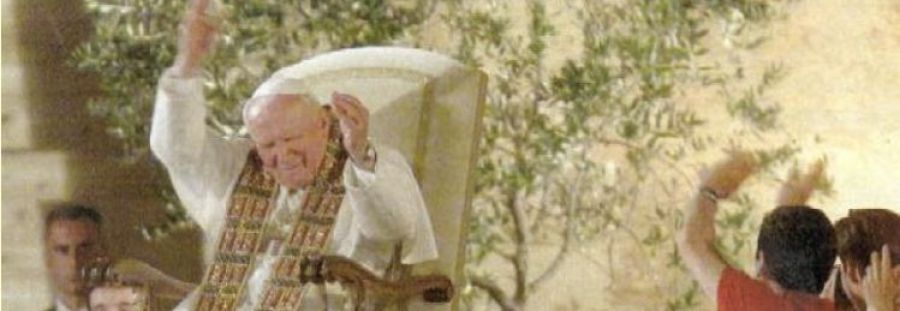
[Pope John Paul II, homily 29 July 1979]








