Dear Brothers and Sisters,
As the present century and millennium draw to a close, we see an unprecedented expansion of the means of social communications, with ever new products and services. We see the lives of more and more people being touched by the spread of new technologies of information and communication. Yet, there are still great numbers of people who have no access to the media, old or new.
Those who do benefit from this development experience an ever growing choice of sources. The greater the choice, the harder it may be to choose responsibly. The fact is that it is increasingly difficult to protect one's eyes and ears from images and sounds which arrive through the media unexpectedly and uninvited. It is particularly hard for parents to guard their children from unwholesome messages, and to ensure that their education in human relations and their learning about the world comes about in a way that is appropriate to their age and sensibility, and to their developing sense of right and wrong. Public opinion has been shocked at how easily the advanced communication technologies can be exploited by those whose intentions are evil. At the same time, can we not observe a relative slowness on the part of those who wish to do good to use the same opportunities?
We must hope that the gap between the beneficiaries of the new means of information and expression and those who as yet do not have access to them will not become another intractable source of inequity and discrimination. In some parts of the world voices are being raised against what is seen as domination of the media by so-called Western culture. Media products are seen as in some way representing values that the West holds dear and, by implication, they supposedly present Christian values. The truth of the matter may well be that the foremost value they genuinely represent is commercial profit.
In addition, the proportion of media programmes which deal with religious and spiritual aspirations, programmes which are morally uplifting and help people to live better lives, is apparently decreasing. It is not easy to remain optimistic about the positive influence of the mass media when they appear either to ignore the vital role of religion in people's lives, or when the treatment that religious belief receives seems consistently negative and unsympathetic. Some elements of the media - especially in the entertainment sectors - often seem to wish to portray religious believers in the worst possible light. Is there still a place for Christ in the traditional mass media? May we claim a place for Him in the new media?
In the Church, the year 1997, as the first part of a three-year period of preparation for the Great Jubilee of the Year 2000, is being devoted to reflection on Christ, the Word of God, made man by the power of the Holy Spirit (cf. Tertio Millennio Adveniente, 30). Appropriately therefore the theme of World Communications Day is "Communicating Jesus Christ: the Way, the Truth and the Life" (cf. Jn 14:6).
This theme provides an opportunity for the Church to meditate and act on the specific contributions which the communications media can offer in making known the Good News of salvation in Jesus Christ. It also provides an opportunity for professional communicators to reflect on how religious and specifically Christian themes and values can enrich media productions and the lives of those whom the media serve.
The modern media are addressed not only to society in general, but most of all to families, to young people and also to very young children. What "way" do the media point out? What "truth" do they propose? What "life" do they offer?
This is of concern not only to Christians, but to all people of good will.
The "way" of Christ is the way of a virtuous, fruitful and peaceful life as children of God and as brothers and sisters in the same human family; the "truth" of Christ is the eternal truth of God, who has revealed himself to us not only in the created world but also through Sacred Scripture, and especially in and through his Son, Jesus Christ, the Word made flesh; and the "life" of Christ is the life of grace, that free gift of God which is a created share in his own life and which enables us to live for ever in his love. When Christians are truly convinced of this, their lives are transformed. This transformation results not only in a credible and compelling personal witness but also in an urgent and effective communication - likewise through the media - of a living faith which paradoxically increases as it is shared.
It is consoling to know that all who bear the name Christian share this same conviction. With due respect for the communications activities of the individual Churches and Ecclesial Communities, it would be a significant ecumenical achievement if Christians could cooperate more closely with one another in the media as they prepare to celebrate the forthcoming Great Jubilee (cf. Tertio Millennio Adveniente, 41). Everything ought to focus on the primary objective of the Jubilee: the strengthening of faith and of Christian witness (ibid., 42).
Preparing for the 2000th Anniversary of the birth of the Saviour has become, as it were, the key to interpreting what the Holy Spirit is saying to the Church and to the Churches at this time (cf. ibid., 23). The mass media have a significant role to play in proclaiming and explaining this grace to the Christian community itself and to the world at large.
The same Jesus who is "the way, the truth and the life" is also "the light of the world" - the light that illumines our path, the light that enables us to perceive the truth, the light of the Son who gives us supernatural life here and hereafter. The two thousand years which have passed since the birth of Christ represent an extraordinary commemoration for humanity as a whole, given the prominent role played by Christianity during these two millennia (cf. ibid., 15). It is surely appropriate that the mass media should pay tribute to that contribution.
Perhaps one of the finest gifts which we could offer to Jesus Christ on the two thousandth anniversary of his birth would be that the Good News will at last be made known to every person in the world - first of all through the living witness of Christian example, but also through the media: "Communicating Jesus Christ: the Way, the Truth and the Life". May this be the aim and commitment of all who profess the uniqueness of Jesus Christ, the source of life and truth (cf. Jn 5:26; 10:10, 28), and who have the privilege and the responsibility of working in the vast and influential world of social communications.
From the Vatican, 24 January 1997
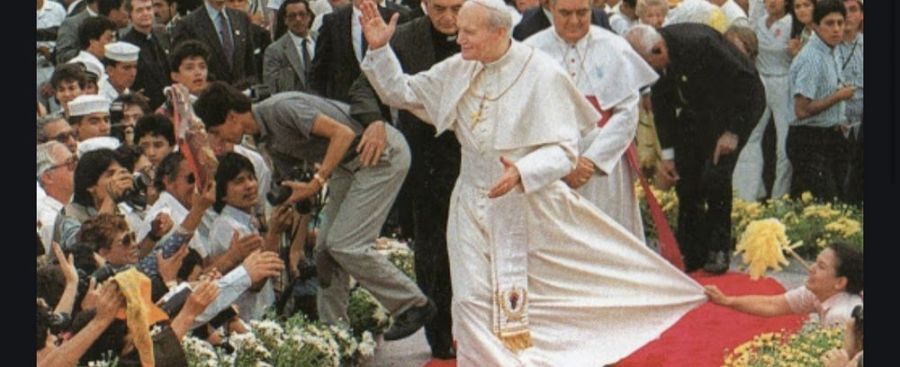
[Pope John Paul II, Message for the 31st World Day of Social Communications]