Jun 4, 2026 Written by 

Trinitarian Spirituality of the Heart

3. The coincidence of this centenary with the last year of preparation for the Great Jubilee of the Year 2000, which is "aimed at broadening the horizons of believers, so that they will see things in the perspective of Christ: in the perspective of the 'Father who is in heaven' (cf. Mt. 5:45)" (Apostolic Letter Tertio millennio adveniente, n. 49) offers a fitting opportunity to present the Heart of Jesus, "the burning furnace of love, ... the symbol and the expressive image of the eternal love with which 'God so loved the world, that he gave his only begotten Son' (Jn 3:16)" (Paul VI, Apostolic Epistle Investigabiles divitias). The Father is love (1 Jn 4:8, 16), and the only-begotten Son, Christ, manifests this mystery while fully revealing man to man.

Devotion to the Heart of Jesus has given form to the prophetic words recalled by St John: "They shall look on him whom they have pierced" (Jn 19:37; cf. Zec 12:10). It is a contemplative gaze,"which strives to enter deeply into the sentiments of Christ, true God and true man. In this devotion the believer confirms and deepens the acceptance of the mystery of the Incarnation, which has made the Word one with human beings and thus given witness to the Father's search for them. This seeking is born in the intimate depths of God, who loves man eternally in the Word, and wishes to raise him in Christ to the dignity of an adoptive son" (Tertio millennio adveniente, n. 7). At the same time devotion to the Heart of Jesus searches the mystery of the Redemption in order to discover the measure of love which prompted his sacrifice for our salvation.

The Heart of Christ is alive with the action of the Holy Spirit, to whom Jesus attributed the inspiration of his mission (Lk 4:18; cf. Is 61:1) and whose sending he had promised at the Last Supper. It is the Spirit who enables us to grasp the richness of the sign of Christ's pierced side, from which the Church has sprung (cf. Constitution Sacrosanctum Concilium, n. 5). "The Church, in fact", as Paul VI wrote, "was born from the pierced Heart of the Redeemer and from that Heart receives her nourishment, for Christ "gave himself up for her, that he might sanctify her, having cleansed her by the washing of water with the word" (Eph 5:25-26)" (Letter Diserti interpretes). Through the Holy Spirit, then, the love which permeates the Heart of Jesus is poured out in the hearts of men (cf. Rom 5:5), and moves them to adoration of his "unsearchable riches" (Eph 3:8) and to filial and trusting petition to the Father (cf. Rom 8:15-16) through the Risen One who "always lives to make intercession for us" (Heb 7:25).

4. Devotion to the Heart of Christ, "the universal seat of communion with God the Father; ... seat of the Holy Spirit" (8 June 1994; L'Osservatore Romano English edition 15 June 1994, p. 3), aims at strengthening our bond with the Holy Trinity. Thus, the celebration of the centenary of the consecration of the human race to the Sacred Heart prepares the faithful for the Great Jubilee, because it concerns its objective of "giving glory to the Trinity, from whom everything in the world and in history comes and to whom everything returns" (Tertio millennio adveniente, n. 55), and because of its orientation to the Eucharist (cf. ibid.), in which the life that Christ came to bring in abundance (cf. Jn 10:10) is communicated to those who feed on him in order to have life because of him (cf. Jn 6:57). The entire devotion to the Heart of Jesus in its every manifestation is profoundly Eucharistic: it is expressed in religious practices which stir the faithful to live in harmony with Christ, "meek and humble of heart" (Mt 11:29), and it is intensified in adoration. It is rooted and finds its summit in participation in Holy Mass, especially Sunday Mass, where the hearts of the faithful, fraternally assembled in joy, listen to the word of God and learn to offer with Christ themselves and the whole of their lives (Sacrosanctum Concilium, n. 48). There they are nourished at the paschal banquet of the Redeemer's Body and Blood and, sharing fully the love which beats in his Heart, they strive to be ever more effective evangelizers and witnesses of solidarity and hope.

We give thanks to God, our Father, who has revealed his love in the Heart of Christ and has consecrated us by the anointing of the Holy Spirit (cf. Dogmatic Constitution Lumen gentium, n. 10) so that, in union with Christ, we may adore him in every place and by our holy actions consecrate to him the world itself (ibid., n. 34) and the new millennium.

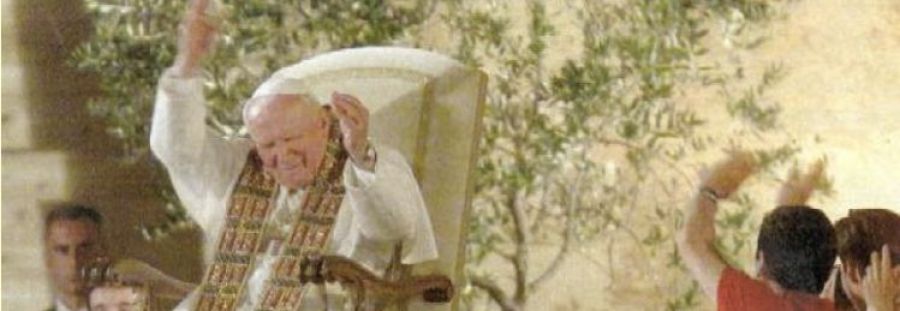
[Pope John Paul II, Warsaw 11 June 1999; centenary of the consecration of the human race to the Divine Heart of Jesus]


151 Last modified on Thursday, 04 June 2026 04:06
don Giuseppe Nespeca

Giuseppe Nespeca è architetto e sacerdote. Cultore della Sacra scrittura è autore della raccolta "Due Fuochi due Vie - Religione e Fede, Vangeli e Tao"; coautore del libro "Dialogo e Solstizio".

Email This email address is being protected from spambots. You need JavaScript enabled to view it.
For Jesus we are not a "mass", a "multitude"! We are individual "persons" with an eternal value, both as creatures and as re-deemed persons! He knows us! He knows me, and loves me and gave himself for me! (Gal 2:20) [John Paul II]
Non siamo “massa”, “moltitudine”, per Gesù! Siamo “persone” singole con un valore eterno, sia come creature sia come persone redente! lui ci conosce! lui mi conosce, e mi ama e ha dato se stesso per me! (Gal 2,20) [Giovanni Paolo II]
The grain of wheat that "falls to the ground and dies" becomes the promise of bread (Pope John Paul II)
Il chicco di grano che “cade in terra e muore” diventa la promessa del pane (Papa Giovanni Paolo II)
The power of faith can move mountains (cf. Mt 17:20): the Lord can illuminate even the deepest darkness [Pope Benedict]
La forza della fede può spostare le montagne (cfr Mt 17,20): il Signore può illuminare anche la tenebra più profonda [Papa Benedetto]
By willingly accepting death, Jesus carries the cross of all human beings and becomes a source of salvation for the whole of humanity. St Cyril of Jerusalem commented: “The glory of the Cross led those who were blind through ignorance into light, loosed all who were held fast by sin and brought redemption to the whole world of mankind” (Catechesis Illuminandorum XIII, 1: de Christo crucifixo et sepulto: PG 33, 772 B) [Pope Benedict]
Accettando volontariamente la morte, Gesù porta la croce di tutti gli uomini e diventa fonte di salvezza per tutta l’umanità. San Cirillo di Gerusalemme commenta: «La croce vittoriosa ha illuminato chi era accecato dall’ignoranza, ha liberato chi era prigioniero del peccato, ha portato la redenzione all’intera umanità» (Catechesis Illuminandorum XIII,1: de Christo crucifixo et sepulto: PG 33, 772 B) [Papa Benedetto]
In the New Testament, it is Christ who constitutes the full manifestation of God's light [Pope Benedict]
Nel Nuovo Testamento è Cristo a costituire la piena manifestazione della luce di Dio [Papa Benedetto]
Faith opens us to knowing and welcoming the real identity of Jesus, his newness and oneness, his word, as a source of life, in order to live a personal relationship with him. Knowledge of the faith grows, it grows with the desire to find the way and in the end it is a gift of God who does not reveal himself to us as an abstract thing without a face or a name, because faith responds to a Person who wants to enter into a relationship of deep love with us and to involve our whole life (Pope Benedict)
La fede ci apre a conoscere e ad accogliere la reale identità di Gesù, la sua novità e unicità, la sua Parola, come fonte di vita, per vivere una relazione personale con Lui. Il conoscere della fede cresce, cresce con il desiderio di trovare la strada, ed è finalmente un dono di Dio, che si rivela a noi non come una cosa astratta senza volto e senza nome, ma la fede risponde a una Persona, che vuole entrare in un rapporto di amore profondo con noi e coinvolgere tutta la nostra vita (Papa Benedetto)
Jesus Christ clearly indicates that even acts of devotion and penance (such as fasting, almsgiving, prayer), which by their religious purpose are primarily 'interior', can succumb to current 'externalism', and can therefore be falsified [John Paul II]
Gesù Cristo indica chiaramente che anche gli atti di devozione e di penitenza (come digiuno, elemosina, preghiera) che per la loro finalità religiosa sono principalmente “interiori”, possono cedere all’“esteriorismo” corrente, e quindi possono essere falsificati [Giovanni Paolo II]

Due Fuochi due Vie - Vol. 1 Due Fuochi due Vie - Vol. 2 Due Fuochi due Vie - Vol. 3 Due Fuochi due Vie - Vol. 4 Due Fuochi due Vie - Vol. 5 Dialogo e Solstizio I fiammiferi di Maria

duevie.art

don Giuseppe Nespeca

Tel. 333-1329741


Disclaimer

Questo blog non rappresenta una testata giornalistica in quanto viene aggiornato senza alcuna periodicità. Non può pertanto considerarsi un prodotto editoriale ai sensi della legge N°62 del 07/03/2001.
Le immagini sono tratte da internet, ma se il loro uso violasse diritti d'autore, lo si comunichi all'autore del blog che provvederà alla loro pronta rimozione.
L'autore dichiara di non essere responsabile dei commenti lasciati nei post. Eventuali commenti dei lettori, lesivi dell'immagine o dell'onorabilità di persone terze, il cui contenuto fosse ritenuto non idoneo alla pubblicazione verranno insindacabilmente rimossi.






