


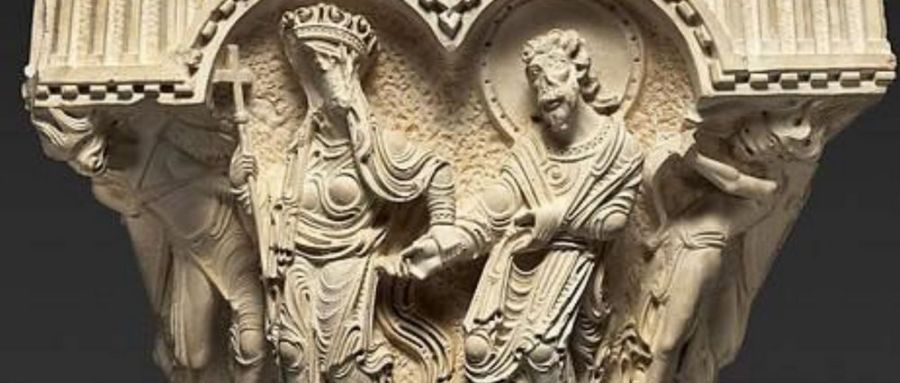
Religion turned into obsession - for "held back"
(Mt 11:28-30)
The rabbis chose disciples from among those who had greater intellectual and ascetic abilities. Jesus, on the other hand, goes looking for the outcasts, the "infants" (v.25) who did not even have self-esteem.
Even for the rebirth that lies ahead today, Christ has no need of false phenomena; on the contrary, it is He who frees from external constraints; He releases inner strength [and also heals the brain].
Into the intimacy of the Mystery of divine life enters he who knows how to receive everything and lets go - but remains himself.
God is not distant, but very close; he is not great, but small: the effective itinerary for becoming intimate with the Father is not to make oneself subordinate with effort, but to know how to be dissolved family members.
Only here can we grasp him in the centre of his unveiling: wise power, succouring, united; for us, as we are.
The pundits of official religion - overflowing with self-love and a sense of election - preached a God to be persuaded with confident attitudes and contrived, edgy, imperious actions.
They allowed neither being nor becoming. Their intransigence was a sign that they did not know the Father.
The Eternal One transformed into the Controller had become a source of discrimination and obsession for the intimate lives of minute people, harassed by the insecurity of distinguish-avoid-observe, and by doubts of conscience.
Discouraged from living personally (and as a class) the conversion they preached to others, the professors did not realise that they had to empty themselves of absurd presumptions and become - they - pupils of ordinary people.
In short, as children we are incessantly invited to build a multifaceted Family, where we are not always on the alert.
We are not the subordinates of a frowning and all-distant - but manipulative - Lord.
Rather, we are called to a paradoxical, personal and class choice: and without forcing it, to recognise ourselves - to stand alongside the humiliated and harassed.
This while provincial false piety continues to drag burdens - precisely those of the thwarted and weary, of existence made more hesitant rather than free; obsessed and heavy, rather than light.
Why? Without mincing words, the Encyclical Fratelli Tutti would answer:
"The best way to dominate and advance without limits is to sow hopelessness and arouse constant distrust, albeit masked by the defence of certain values" (no.15).
As if to say: when the authorities and the leaders have little credibility, only the sowing of fear produces significant conditioning in the people, and puts them on a leash.
In the widespread Church, only in the last few decades have we overcome the cliché of moralistic and terroristic preaching [e.g. even at Advent time] divorced from a meridian sense of humanisation.
The excluded, dejected and exhausted by meaningless fulfilments have nevertheless continued to meet the Saviour frankly, finding rest of soul, conviction, peace, balance, hope.
Instinctively, they were able to carve out what no pyramid religion had ever been able to provide and deploy.
In this way, the new, the voiceless, the inadequate and invisible, never know how to calculate in terms of doctrine and laws, norm and code - ancient 'yoke' (vv.29-30) unbearable, crushing people and concrete vocations; particular autonomies or communionalities.
In short, no 'patriarch' is empowered by God to pack our souls, force directions, and keep a maniacal, perfectionist, meticulous eye on us.
Exaggerating failures, across the board.
Everyone has an innate way of being in the world, all their own - even if it is habitual. It is an opportunity of impulse and richness for everyone.
We ourselves do not want to exacerbate events by regulating every detail, even 'spiritual' ones, from irritating patterns of vigilance that do not belong to us.
We prefer to let personal ways of dealing with reality flow; thus tracing its essential and spontaneous energies.
We reason according to codes of life and humanisation: temperament, unrepeatable history, cultural influences, broad friendships. We do not live to prevent.
Only in this way can we enrich the fundamental experience: Love - which does not come from judgements, cuts and separations, but from the Father-Son relationship. The only one that does not stigmatise.
The root of the transformation of being in the Unpredictable of God is precisely concealment, 'tapinōsis' [(tapeínōsis, 'lowering'), from ταπεινός (tapeinós, 'low') [v.29 Greek text; Lk 1:48].
Only those who love strength start from the too far from themselves.
To internalise and live the message:
Do you find yourself more or less free and serene in community?
Does your Calling gain breath or do you feel the burden of others' doubts, judgements, prohibitions and prescriptions?
Do you suffer from some guide or from yourself a kind of controller complex?








