


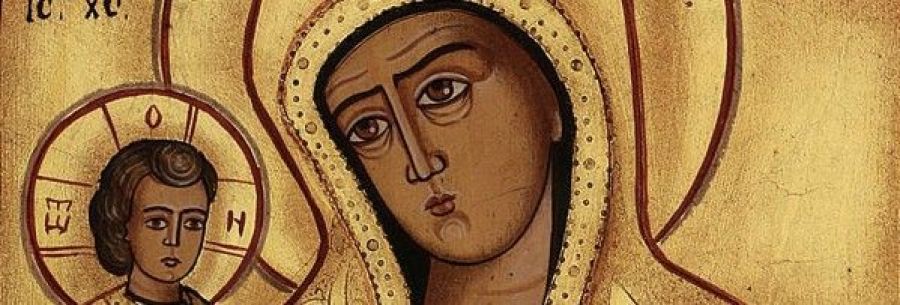
And Mary: the Question that is the Answer
(Gal 4:4-7; Lk 2:16-21)
We ask ourselves: in this time, what can make us intimate with the Lord?
[A certain Christopher changed history by sailing backwards...].
The shepherds experience the preference of a true and excessive Love, by blessing of the eccentric - and Wonder.
Preference that is not granted in exchange for merits, but because of needs.
Lk wants to emphasise that - by praising and glorifying God (v.20) just as the Angels do - the imperfect and defaulters paradoxically find themselves closer to the divine throne than the ever-arrogant position of the most sterile, or the most 'performing'.
We too are surprised to know a Father who, instead of incinerating us because of our insecurities, not only shrouds us in 'light' (v.9), but also builds his Newness on those very insecurities.
We all thought we were born to be pious and obedient children, or great 'phenomena' [narcissists].
Instead of putting us under stress, the Father wants us to rediscover the pleasure and wonder of gratuitousness and togetherness. Without models first - and minding obligations, ways, times, places, duties, reverences, prostrations and kissing of any kind!
God knows that we are surrounded by spheres, stimuli, moves, chores, which take us away. But neither does he demand a minimum of his own, for he does not act like the wayward child who wants the big slice of cake at snack time [corresponding to his rank].
The relationship with Him is not a continual effort, to be laboriously kept up with. It is a lightening, and even strengthening in the counterweights.
In Advent we have already emphasised: that of the Lord Who Comes is a Ray that does not intrude into the horizon of normal expectations, adapting itself to our external dreams - those that live of expected goals, and then become a torment.
In the arc of life, the encounter with such wise Light that pierces the darkness of night is in the difficulties that force us to shift our gaze, in the failure that compels us to regenerate creativity, in the bewilderment that makes us contact new ways of being.
The life of Faith does not endure the demon of 'perfection' imagined by archaic religions.
They willingly replace all gratuitousness with a sense of adult duty - which inevitably gives birth to nerve-wracking and even compensatory strategies [thank God, today less and less hidden].
According to Chinese thought, in order to gain polish and escape a polluted and worn-out servility, the saints 'are taught by beasts the art of avoiding the harmful effects of domestication, which life in society imposes'.
Indeed: 'Domesticated animals die prematurely. And so do men, whom social conventions forbid to obey spontaneously the rhythm of universal life'.
"These conventions impose continuous, self-interested, exhausting activity [whereas it is appropriate] to alternate between periods of slow life and jubilation".
"The saint does not submit himself to retreat or fasting except in order to achieve, through ecstasy, to escape for long journeys. This liberation is prepared by life-giving games, which nature teaches".
"One trains oneself for the paradisiacal life by imitating the amusements of animals. To sanctify oneself, one must first brutalise oneself - that is to say, learn from children, from beasts, from plants, the simple and joyful art of living only in view of life."
[M. Granet, The Chinese Thought, Adelphi 2019, kindle pp. 6904-6909].
The 'shepherds' immediately place both guilt and the obligatory time of fulfilment in the background of their real existence, retaining their charge and enthusiasm.
In this way, for us too, nothing in life seems an insurmountable wall any more - apart from the prejudice of the 'just' [those of the 'conditional': the 'ifs', the 'buts'].
Even routine does not take away energy and drive - how come? Because spontaneous souls do not need to take care of the external look, to please the opinion of others; so on.
Without even realising it, having no artificial screens to hold up, the genuine can face life head-on, and get off on the right foot.
Thus, attracting great opportunities for change.
They may not go too deep, but they listen to needs.
And they expand their space without asking permission from those who will never grant it; they sense the essentials that flow from freedom of mind and code.
Their 'having to be' has no artificial expectations: it is simple attunement with nature and with themselves.
A decisive position, because on such a ray they are able to see the weak side as a container of great strength, which activates capacities capable of building a whole other destiny.
They do not pose the problem of having to look good, or of not being what they are. Then they have plenty of time, and are seen to be orderly and good-natured, with no discomfort; in harmony with everyone.
They follow their story, and without too many expectations or intentions, they learn to trust the flow of events, even intimate ones.
They know how to welcome as worthy guests all their inner states, without feeling guilty.
In their own motives, they are 'clear'. So they do not fall into neuroses.
The encounter with serene Authenticity has retrained them.
Light that has conquered self-esteem.
They feel empowered instead of targets. And the regained confidence makes them open and welcoming towards others.
They have realised that they must rely on deeper knowledge than that inoculated by the prejudices of decision-makers.
God is the exact opposite of the veterans' catechism: it is only the encounter with Him that purifies - not the apparent vice versa.
We too wish to open ourselves to the new Mystery. Experience that is preparing the womb of our souls at this time.
We are in a transhumance full of discoveries and adventures: we can learn how to be with what is coming and reinterpret it, learning to walk on our own legs and putting our attitudes into action.
Side by side with the shepherds, who ceaselessly put energies back into circulation - our lives can turn out to be much richer than the affair of the precise and impeccable.
We want to turn routine into an adventure that glimpses the authentic Sacred in the small Seed that inhabits us.
We will do this without too much efficiency: perhaps we will also build a regenerating highland refuge, to train intuition - and from there recreate the Vision, and the world.
No one this year should feel inadequate, excluded from the action of God's Love and the ability to radiate it.
As in the Gospel of Easter morning, we can peer into the darkness and sense even amidst signs of death the great energies of Life.
The world of shadows is no longer in the same trim as before.
Among the humbled, even Mary is astonished, but seeks to understand and makes her own way. Indeed, she understands that the Answer is already in the Question.
Comparing within herself Word and events around her Son, she realises that in the 'problem' (which surprised her) there was already the energy of the 'solution'.
Who is Jesus?
The contrast between the extraordinary figure of the awaited and misunderstood Messiah, and the obtuseness of the elusive judgement of popular doctrines, ended up leaving things as they were.
Indeed, worse: it encapsulated the Mystery - the most normal one in the world [but one that remains forever]: the humanity of God.
And he lost his 'whereabouts'.
He could not understand the Person of Christ from the things he knew or by trying to frame him in the familiar criteria of the First Testament; in the common feeling, with the magical models of the time.
His Master pupil could not be satisfied with an improvement of the situation.
He had to replace it, announcing the Truth of the Father; of the authentic man and woman.
Proposing a germ of an alternative world to the ruthless and pyramidal society; the one that establishes what to think and say, how one must be and behave.
God intends to bring out and enhance the intuition of consciences more than to impose duties or cravings for analysing behaviour.
This is the incredible.
Each religious group enclosed the Messiah in its own interpretative model, consonant with an environment tinged with ancient hopes: defence of goods and customs, well-being at the expense of others, expansion, prodigies.
The children's revolution poses an issue that seeks its Way Elsewhere - after all around the corner, but not relegated 'inside' a corner.
For to question the Person of Christ is already to begin to overcome petty, habitual interpretations, and to embrace the irruption of God.
The ever-childlike Lord will overturn the fortunes, the destiny of man's kingdom, and its claims that cage the soul, immobilising life.
The knowledge of his story, the adhesion to his Person, and the Action of the Spirit, will not allow the fixed thoughts, attachments, clichés, window dressing that then impregnate the whole soul, depriving it of intoxication and fruitfulness, to persist in Mary's mind.
It is in the Son that she becomes a Mother, a totally personal Presence, a new Sense.
Maternity hers, of innate Wisdom, that opens horizons: in the authentic Church she is leading us to different Dreams of being.
Woman who wants to express herself by humanising.








