Sep 8, 2025 Written by 

Is death a way of no return?

The dark aspect, allied

(Lk 7:11-17)


Na'im means Delicious: symbol of all the pleasant and laughing places, where life flows quietly until the day when the carefree ends: smiles turn into tears and songs into lamentation.

There are always two parades, and two guides. The procession of death comes to collect everyone: it is precisely preceded by a corpse.

Destiny that knocks down, and we try to exorcise. But beyond distractions - it anguishes us to imagine that the physical end is a way without return.


Who can stop humanity’s march to the grave?

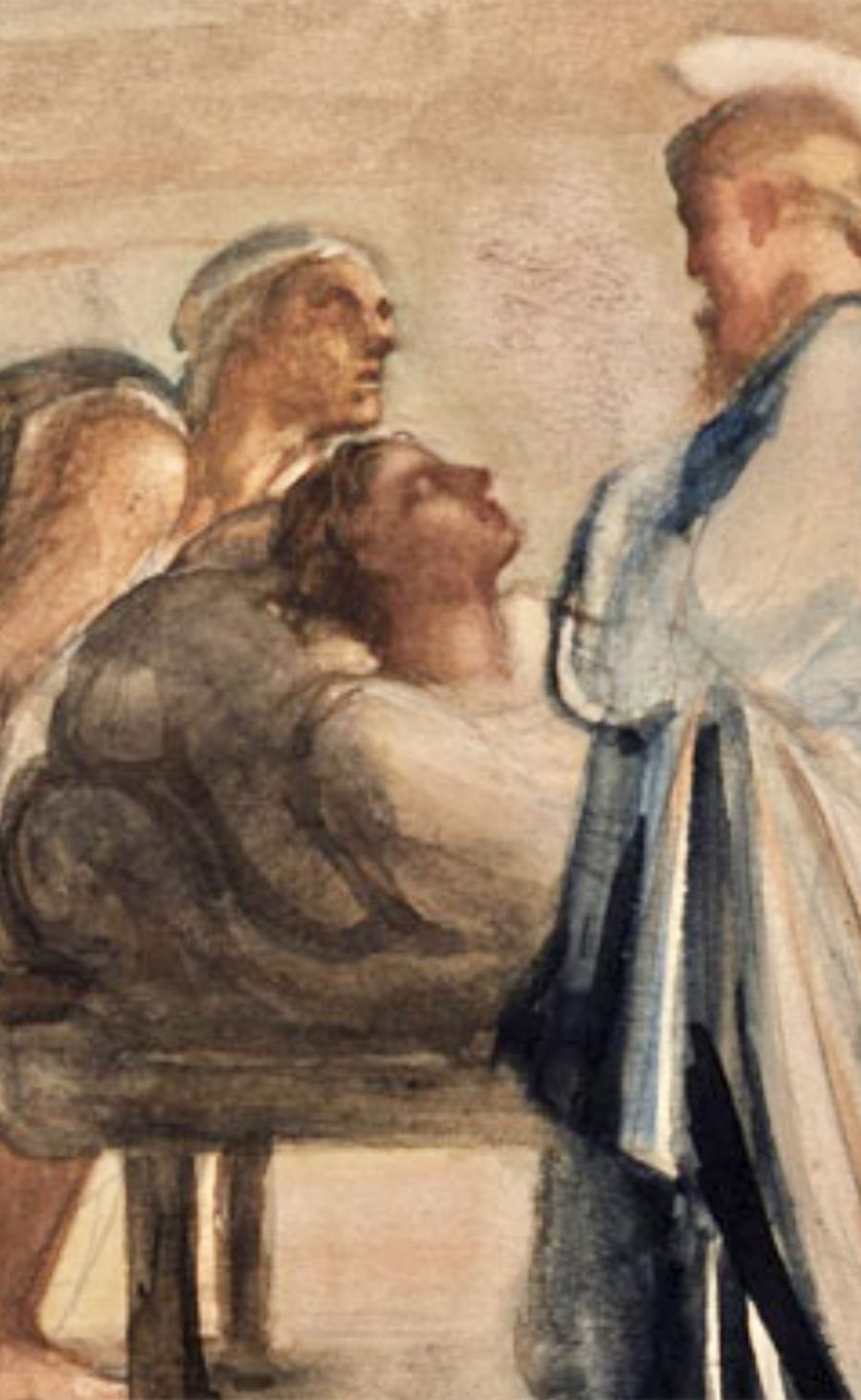
Here, in the opposite direction, comes another procession, preceded by the Lord of Life, who wins ours.

In the common opinion of religions, impurity is contagious, transmitted immediately by contact, and even prevails over holiness.

According to the rabbis themselves, if e.g. an object came into contact with the hem of a priestly cloak, it would not be sanctified, despite having touched a holy person.

But if the same object had touched a corpse, it would have become unclean. 

Rambling fixations and extravagant idols, typical of superstitions.


Christ deliberately, in a blatant way, violates both the law of purity and the customary of common thought.

In the path of Faith that He proposes, not only does life prevail over death, but death itself has nothing unclean.

The reality that baffles us all is no longer a dark frontier, but a ‘mouth’.

It introduces us into the fullness, the expression and complete flowering of our potentialities.

[It’s the Easter Announcement: it resounds as a source of expectation of the One who makes every death pure, and transforms it into the Womb of Life].


The "widow" Israel had been deprived of the affection of the Bridegroom for the deleterious work of false official guides.

That nation had thus found itself begetting spiritually dying ‘children‘ (from a young age).

Infertile, barren, destined for solitude [in Hebrew the term Israel is of female gender]. That is, without the true Son of God.

A people deprived of the Messiah, therefore without a future.


In addition to this central message, Lk - evangelist of the needy - wants to draw the attention of his communities to those who are left alone.

«And Jesus gave him to his Mother» (Lk 7:15b).

The Church has the task of returning sons or families to those who have lost them.

Fraternity must respect and care for those who mourn loneliness.

Like Jesus, it stands out from all other competitive devotional forms because revives, restores affections, communicates balance and the desire to succeed.

It always marks a triumph of life over the haze of the tombs.


Pope Francis said: «In order to give himself to us, God often chooses unthinkable paths, perhaps those of our limitations, our tears, our defeats».

In short, in our trials and error, [alongside] we have to keep all the aspects - which we have come to know over time, and which we have realised are part of us.

This will change the solidity of our relationship with ourselves, others, nature, history, and the world.

Here the dark aspect becomes invigorating, Allied.


[Tuesday 24th wk. in O.T.  September 16, 2025]

285 Last modified on Tuesday, 16 September 2025 11:59
don Giuseppe Nespeca

Giuseppe Nespeca è architetto e sacerdote. Cultore della Sacra scrittura è autore della raccolta "Due Fuochi due Vie - Religione e Fede, Vangeli e Tao"; coautore del libro "Dialogo e Solstizio".

Christianity cannot be, cannot be exempt from the cross; the Christian life cannot even suppose itself without the strong and great weight of duty [Pope Paul VI]
Il Cristianesimo non può essere, non può essere esonerato dalla croce; la vita cristiana non può nemmeno supporsi senza il peso forte e grande del dovere [Papa Paolo VI]
The horizon of friendship to which Jesus introduces us is the whole of humanity [Pope Benedict]
L’orizzonte dell’amicizia in cui Gesù ci introduce è l’umanità intera [Papa Benedetto]
However, the equality brought by justice is limited to the realm of objective and extrinsic goods, while love and mercy bring it about that people meet one another in that value which is man himself, with the dignity that is proper to him (Dives in Misericordia n.14)
L'eguaglianza introdotta mediante la giustizia si limita però all’ambito dei beni oggettivi ed estrinseci, mentre l'amore e la misericordia fanno si che gli uomini s'incontrino tra loro in quel valore che è l'uomo stesso, con la dignità che gli è propria (Dives in Misericordia n.14)
The Church invites believers to regard the mystery of death not as the "last word" of human destiny but rather as a passage to eternal life (Pope John Paul II)
La Chiesa invita i credenti a guardare al mistero della morte non come all'ultima parola sulla sorte umana, ma come al passaggio verso la vita eterna (Papa Giovanni Paolo II)
The saints: they are our precursors, they are our brothers, they are our friends, they are our examples, they are our lawyers. Let us honour them, let us invoke them and try to imitate them a little (Pope Paul VI)
I santi: sono i precursori nostri, sono i fratelli, sono gli amici, sono gli esempi, sono gli avvocati nostri. Onoriamoli, invochiamoli e cerchiamo di imitarli un po’ (Papa Paolo VI)
Man rightly fears falling victim to an oppression that will deprive him of his interior freedom, of the possibility of expressing the truth of which he is convinced, of the faith that he professes, of the ability to obey the voice of conscience that tells him the right path to follow [Dives in Misericordia, n.11]
L'uomo ha giustamente paura di restar vittima di una oppressione che lo privi della libertà interiore, della possibilità di esternare la verità di cui è convinto, della fede che professa, della facoltà di obbedire alla voce della coscienza che gli indica la retta via da seguire [Dives in Misericordia, n.11]
We find ourselves, so to speak, roped to Jesus Christ together with him on the ascent towards God's heights (Pope Benedict)
Ci troviamo, per così dire, in una cordata con Gesù Cristo – insieme con Lui nella salita verso le altezze di Dio (Papa Benedetto)
Church is a «sign». That is, those who looks at it with a clear eye, those who observes it, those who studies it realise that it represents a fact, a singular phenomenon; they see that it has a «meaning» (Pope Paul VI)
La Chiesa è un «segno». Cioè chi la guarda con occhio limpido, chi la osserva, chi la studia si accorge ch’essa rappresenta un fatto, un fenomeno singolare; vede ch’essa ha un «significato» (Papa Paolo VI)
Let us look at them together, not only because they are always placed next to each other in the lists of the Twelve (cf. Mt 10: 3, 4; Mk 3: 18; Lk 6: 15; Acts 1: 13), but also because there is very little information about them, apart from the fact that the New Testament Canon preserves one Letter attributed to Jude Thaddaeus [Pope Benedict]

Due Fuochi due Vie - Vol. 1 Due Fuochi due Vie - Vol. 2 Due Fuochi due Vie - Vol. 3 Due Fuochi due Vie - Vol. 4 Due Fuochi due Vie - Vol. 5 Dialogo e Solstizio I fiammiferi di Maria

duevie.art

don Giuseppe Nespeca

Tel. 333-1329741


Disclaimer

Questo blog non rappresenta una testata giornalistica in quanto viene aggiornato senza alcuna periodicità. Non può pertanto considerarsi un prodotto editoriale ai sensi della legge N°62 del 07/03/2001.
Le immagini sono tratte da internet, ma se il loro uso violasse diritti d'autore, lo si comunichi all'autore del blog che provvederà alla loro pronta rimozione.
L'autore dichiara di non essere responsabile dei commenti lasciati nei post. Eventuali commenti dei lettori, lesivi dell'immagine o dell'onorabilità di persone terze, il cui contenuto fosse ritenuto non idoneo alla pubblicazione verranno insindacabilmente rimossi.







