


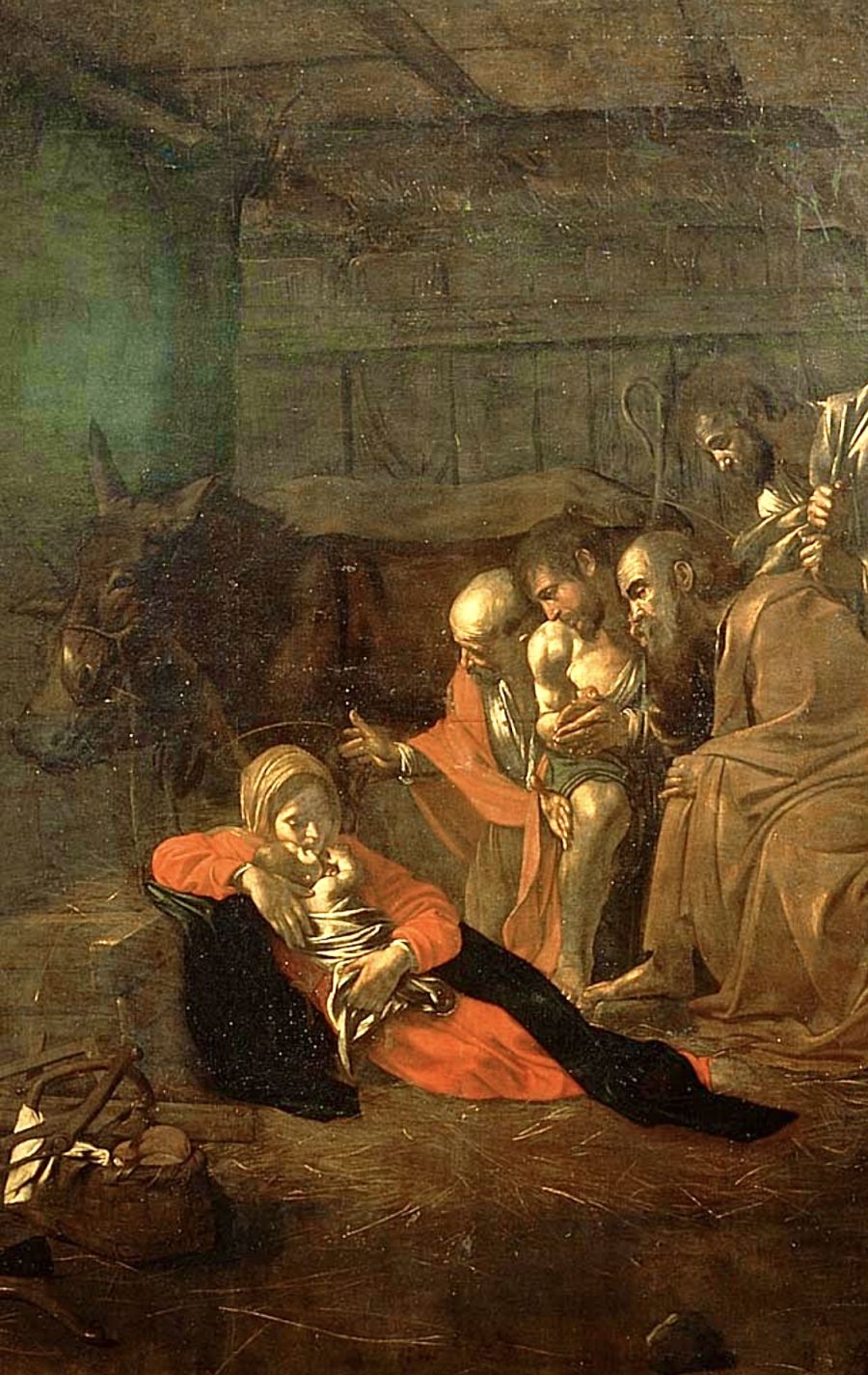
(Nm 6:22-27; Lk 2:16-21)
Blessing the people was an ancient prerogative of the sovereign who acted in the name of God and at first had priestly functions.
But in an attitude of encounter that makes God present ‘in the midst’ of the crowds - people of his Face - that of the ancient king also becomes an act of worship to be rediscovered.
We need to feel that we are blessed: not to extinguish ourselves, to regenerate the affective truth that dwells within us and brings us back to life, thus contemplating it and thus initiating any adventure.
Cursing does not strengthen, it indicates rejection; it separates us. Blessing is the way of sharing and Peace, that is to say, of attaining completeness.
In Israel, the divine blessing was (in fact) expected in material guise. But the formula of the Aaronnite priesthood attests to the original idea that human life does not have its secret in the most obvious configuration.
We too know that partial and comfort-only situations, irenicism, wellbeing and security, turn into their opposite - they do not increase the integrity of life [authentic biblical sense of Shalôm].
Those who do not follow innate intuition, a more radical call of the self, or stunning proclamations (Lk 1:26-38. 2:8-15) do not develop their destiny, do not move, do not set things right.
Common proclamations end up incinerating personalities.
It is true that the shepherds find nothing extraordinary or prodigious, other than a family reduced to an ordinary condition that they know.
But it is that simple hearth that draws them into God's new plan, and into the proclamation of his scandalous unconditional Mercy - which did not electrocute them for impurity.
Religion had branded them forever: lost, despicable, remedyless beings.
Now they are free from identification. They have 'another eye' - like that of the “first time”: a gaze that will lead them one hundred per cent.
Exodated with an image of helpless God in front of them, they do not bother to engage in ethical discipline, which would crumble them.
They enjoy the wonder of a simply human reality - in a mysterious relationship of mutual recognition.
Strange that the modest sign - a baby in a manger, an unclean place where beasts linger - convinces them, makes them regain esteem, makes them proclaimers [perhaps not even assiduous evangelizers].
Like Calvary to which it refers, the resolving Manifestation of the Eternal is a paradox.
But the affective geography of this Bethlehem devoid of conformist circuits remains intact, because it is spontaneously rooted in us.
There is a sense of immediacy, without any particular entanglement or ceremony.
The Child is not even worshipped by the now “pure” gazes of the small, vilified prairie dogs and transhumance - as, conversely, will the Magi (Mt 2:11).
They did not even know what it meant, the reflecting of Eastern court ceremonials - such as the kissing of slippers.
The wretched of the earth [the distant of the flocks] are those who hear the Announcement, readily verify it, and establish the new divine 'lineage'.
People not tormented by static judgement, but now «in the midst» of all men and no longer at high altitude.
(Lk 2:16-21)
Mary sought the meaning of surprises (v.19). Thus She regenerated, for a new way of understanding and being together - to also give birth the inner world of the people.
She ‘put together’ facts and Word, in order to discover its main thread, to remain receptive and not to be conditioned by inflexible convictions, which would not give her escape.
The Mother, while caught by surprise, was preparing herself for the eccentricity of God, without straying from time and the real condition.
His figure and that of the shepherds challenge us, ask for the courage of an answer - but after letting the same kind of ‘inner presences’ flow, worthy visitors, which are allowed to express themselves.
Like us, she too had to go from the fathers’ beliefs to the Faith in the Father. From the idea of love as a reward to that of the ‘gift’.
The Good News proclaims a reversal: what the religion of yesteryear had considered distant from the Most High, is very close to Him; indeed, it fully corresponds to Him.
The adventure of Faith is wide open. And the new Child has a Name that expresses the unprecedented essence of Saviour, not of executioner.
The plenitude of his story will be fully instructive also in terms of how to internalize uncertainties and hardships: these bad moments and precariousness teach us how to live.
In fact, we too, as Mary, «go recognizing» the presence of God in the riddles of Scripture, in the Little One ‘wrapped in bandages’ - even in the ancestral echo of our inner worlds.
And we let us go - we don’t quite know where. But just like this is the Infinity, in its folds.
The wise Dream that inhabits the human, tastes of ancient humus, but its echo is reborn every day, in the tide of being that orients to ‘look’ truly, without veils.
A conformist demeanor of coming across and ‘seeing’ things outwardly would not solve the problem.
Sometimes, in order not to be conditioned, it’s necessary to re-edifying oneself in silence, like the Virgin; building a sort of hermeneutic island wich opens up different doors, wich introduces other lights.
Within her sacred circuit also the Mother of God valued the innate transformative energies, precisely by rooting them on questions.
In this way, returning to its primordial being and the sense of the Newborn - ancient image, dear to many cultures.
She entered an Elsewhere and did not leave the reality field: inside his Centre, without haste.
By researching for the Sun drowned in his being and which came back, emerged, rose in her innermost depth, that made her exist beyond.
Thus she did not allow herself to be absorbed by traditional ideas or external situations, which also wanted to break the balance.
In her modest solitude - full of Grace - that higher self (hidden in the essence) came more and more to her, became a new Dawn and guide.
She didn’t want to live inside thoughts, knowledge and reasoning around - no one capable of amplifying life - all in the hands of conventions‘ drugs dehumanizing the Enchantment.
The happy magic of that Frugulus of flesh brought his Peace.
Dreams supported and conveyed her Center - by flowing a new life from the Core of her Person. And the youthfulness of the world.
[Mary Most Holy Mother of God, January 1st]
Incredible of the Year
At the beginning of the New Year, a rich gentleman had an idea: only the person capable of doing the most incredible thing of the year should inherit all his possessions.
His friends engaged all their imagination.
Some old people - in pursuit of their own taste - had indigestion and risked dying from eating and drinking.
Some brats practised somersaults instead.
Then a whole exhibition of unbelievable tricks was set up. One person played the part of Moses on the Mount with the Tablets of the Law, but he found it difficult to reproduce lightning and thunder; the backdrop was static and antiquated.
A guy disguised as a crow was telling stories and old memories, next to an unlit stove.
Someone dressed up as an undertaker, but people did not appreciate his overly professorial air or his loden.
Others wanted to perform the Beatitudes, but forgot about the persecuted.
An artist defaced his own paintings; a sculptor hammered like a madman, but the noise of his grinding wheel was even more unbearable.
A carpenter was working very well on a chest, but in everyone's opinion he lifted too much chaff, leaving an excessive amount of shavings on the ground.
Suddenly a bouncer as tall as a gorilla and as strong as Maciste burst in: 'I am the man of the most incredible thing'.
With his fists he knocked out the onlookers and with an axe he smashed everything around, everything to shreds.
Every object was destroyed and everyone was left stunned to the ground. "This is what I am capable of!" - said the man - "my deed beat the whole universe! I have done the most incredible thing, and not just of the year!"
The judges of the contest were puzzled, but at that point it seemed they could not award the palm of victory to anyone else...
In the atmosphere of general annihilation, the last on the list popped up from who knows where; a certain Christopher. He proposed to go to the Levant by way of the Ponente. Everyone laughed loudly, but he asked for time.
Thus, at the end of his tale of miscalculations and - at times - favourable winds, he proved that he could land in a new territory, richer than anywhere and previously unimagined. (Often, however, passing through inaccurate news and seemingly destructive forces).
Everything changed, because of his visionary courage.
From that moment on, the continent from which the caravels set sail became 'the old world' in the common understanding, which in fact - satiated and desperate, stuck in its positions - also aged demographically and gradually irreparably; ruining itself.
That absurd adventure - a metaphor for the journey of each person who does not learn to hold back - then burst forth as a type of a new life proposal, open and creative, prone to wonder.
The variety of experiences and even the range of fantasies were no longer held in contempt of costumes, but became an added value.
Such a proposal model (visions that anticipated needs) gradually emerged in common pedagogy.
It was also adopted by the pilgrims of the Spirit as a positive icon of the New Covenant between God and man - now capable of enhancing the intricate mixture of values and criteria of our hearts; with its common and earthly interests, but enraptured in the most sublime dreams.
For a Christian life not of cosmetics, but of exploration and surprise; a programme for the whole year.
This is how Christopher changed history, by sailing backwards.








