Mar 15, 2026 Written by 

Adulterous ‘church’, accused Jesus

(Jn 8:1-11)


Every day at sunrise, from the Mount of Olives, by contemplating the Temple, the people recited the Shema’ Israel, and so did Jesus.

Like many, he spent his nights in a cave, outdoors (Lk 21:37-38; Jn 8:1-2), then he went to Solomon's portico to teach.

A new Day begins. The confrontation with the sinful woman who represents us, activates a new Aurora.

The adulterer and the adulteress had to be put to death (Dt 22:22-24): why is no there the male accomplice one?

In many biblical passages, the 'woman' is a collective parable - here evoked for a catechesis against the traditionalist prosecutors who were also coming forward in the early communities.

[They don’t sleep at night, in order to spy on others and accuse them of their sins]. But there is a new ‘dawn’ (v.2) on the face of God.


In the whole scene the true accused is Jesus and his idea of ​​Justice, irregular. He does not allow the “gendarmes” to isolate persons.

Whoever makes a mistake or is unsteady, is not marked for life.

We are bent over by weights and can hardly stand up. Therefore, divine action unmasks the old fanatical wigs, not at all innocent.

The conciliatory and reflexive attitude turns the accusations right back on the veterans of the rules, who let the stones fall from their hands only when unmasked.

However, it is a theology passage, not a gossip piece.

In bygone leaders who like to organize trials even internal ones, there is sometimes no honesty: it is better that in the House of God they avoid being judges and accusers, and go back to their homes.


Incredible then that Jesus does not make sure that the woman is repentant, before forgiving her! In this the Son of God violates the Law, Tradition, the common way of thinking and teaching catechism!

His most incriminated sentence is a bomb, which has created embarrassment for centuries: «Stop hurting yourself, but I do not condemn you!»"  [sense of v.11].

The ‘living’ and true God proceeds without inquiries and penitential torments: he puts us back on our feet.

Therefore He does not want to have anything in common with the unexceptionable who cunningly shield themselves with ancient norms to annoy (and project their own defects onto others, in order to exorcise them).

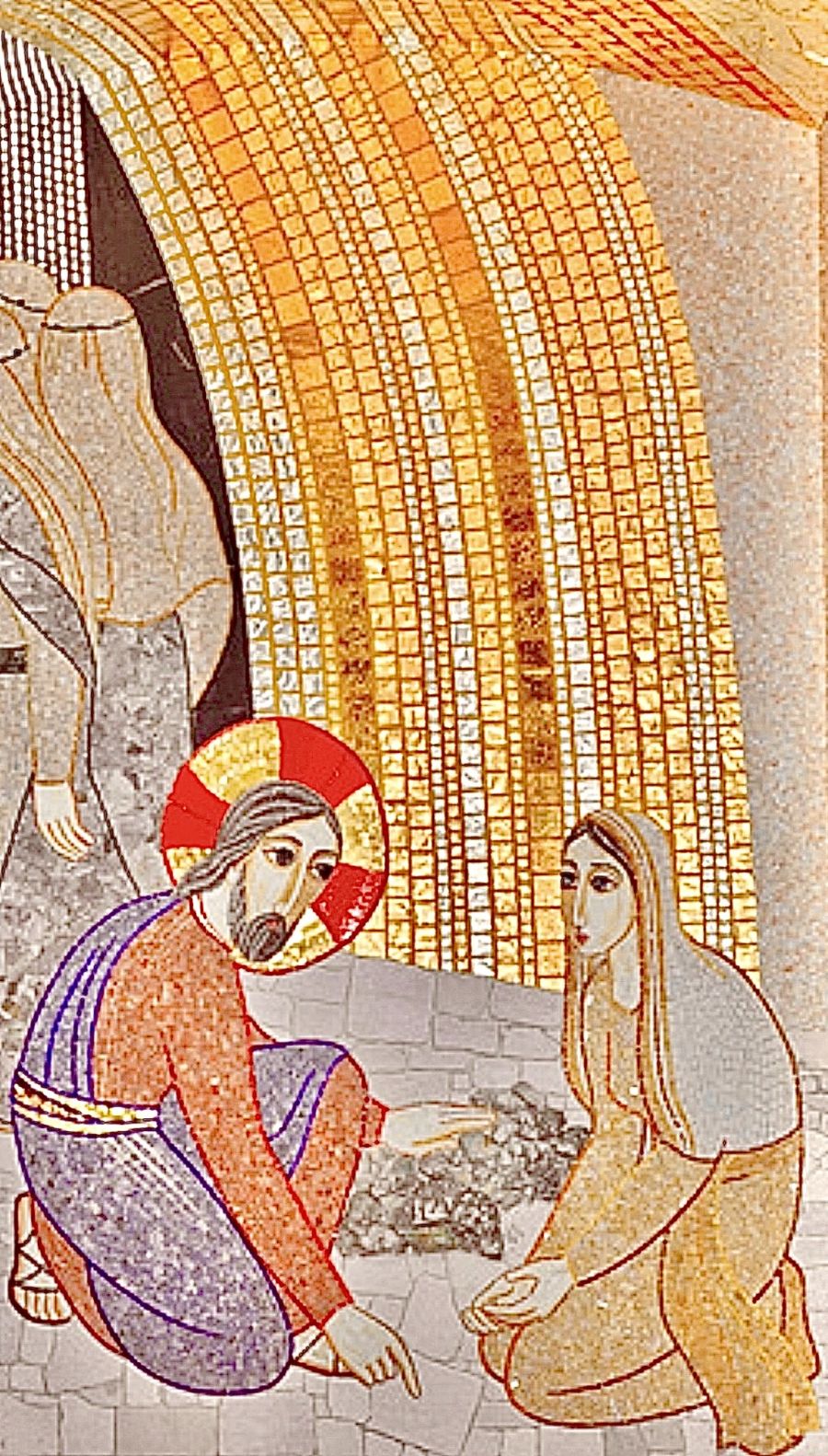
That is why the Lord’s Finger on the ‘stone slabs’ of the esplanade of the Jerusalem Temple!

A clear accusation to the censors still accustomed to the Decalogue of the No […], who remained at the age of Sinai: opinionated and deadly ones, devoid of the flesh and Spirit ‘heart’ - corpses calibrated at room temperature.


Throughout the scene, Jesus - figure of the new Justice of the Father - remains crouched on the ground [cf. Greek text], threatened by those who are on top of him to accuse or take him hostage.

He remains subjected even to the adulteress reduced to silence, because the request for mercy is authentic even when it remains only implicit.

And in any case, Christ relates to each of us without incumbent upon. Looking at us all from below!

Here is the difference between Faith approach and assessments of trivial religiosity. The qualitative leap between Finger on the stone slabs, and the Looking on the persons.


To internalize and live the message:


In what situations did you consider: "Justice is done"?

On what occasions have you experienced divine judgment as understanding and mercy?


[Monday 5th wk. in Lent (year A.B), March 23, 2026]

490 Last modified on Monday, 23 March 2026 12:00
don Giuseppe Nespeca

Giuseppe Nespeca è architetto e sacerdote. Cultore della Sacra scrittura è autore della raccolta "Due Fuochi due Vie - Religione e Fede, Vangeli e Tao"; coautore del libro "Dialogo e Solstizio".

Wherever people want to set themselves up as God they cannot but set themselves against each other. Instead, wherever they place themselves in the Lord’s truth they are open to the action of his Spirit who sustains and unites them (Pope Benedict
Dove gli uomini vogliono farsi Dio, possono solo mettersi l’uno contro l’altro. Dove invece si pongono nella verità del Signore, si aprono all’azione del suo Spirito che li sostiene e li unisce (Papa Benedetto)
But our understanding is limited: thus, the Spirit's mission is to introduce the Church, in an ever new way from generation to generation, into the greatness of Christ's mystery. The Spirit places nothing different or new beside Christ; no pneumatic revelation comes with the revelation of Christ - as some say -, no second level of Revelation (Pope Benedict)
Ma la nostra capacità di comprendere è limitata; perciò la missione dello Spirito è di introdurre la Chiesa in modo sempre nuovo, di generazione in generazione, nella grandezza del mistero di Cristo. Lo Spirito non pone nulla di diverso e di nuovo accanto a Cristo; non c’è nessuna rivelazione pneumatica accanto a quella di Cristo - come alcuni credono - nessun secondo livello di Rivelazione (Papa Benedetto)
Who touched Lydia's heart? The answer is: «the Holy Spirit». It’s He who made this woman feel that Jesus was Lord; He made this woman feel that salvation was in Paul's words; He made this woman feel a testimony (Pope Francis)
Chi ha toccato il cuore di Lidia? La risposta è: «lo Spirito Santo». È lui che ha fatto sentire a questa donna che Gesù era il Signore; ha fatto sentire a questa donna che la salvezza era nelle parole di Paolo; ha fatto sentire a questa donna una testimonianza (Papa Francesco)
But what does it mean to love Christ?  It means trusting him even in times of trial, following him faithfully even on the Via Crucis, in the hope that soon the morning of the Resurrection will come.  Entrusting ourselves to Christ, we lose nothing, we gain everything.  In his hands our life acquires its true meaning.  Love for Christ expresses itself in the will to harmonize our own life with the thoughts and sentiments of his Heart.  This is achieved through interior union [Pope Benedict]
Ma che vuol dire amare Cristo? Vuol dire fidarsi di Lui anche nell'ora della prova, seguirLo fedelmente anche sulla Via Crucis, nella speranza che presto verrà il mattino della risurrezione. Affidandoci a Cristo non perdiamo niente, ma acquistiamo tutto. Nelle sue mani la nostra vita acquista il suo vero senso. L'amore per Cristo si esprime nella volontà di sintonizzare la propria vita con i pensieri e i sentimenti del suo Cuore. Questo si realizza mediante l'unione interiore [Papa Benedetto]
St Thomas Aquinas says this very succinctly when he writes: "The New Law is the grace of the Holy Spirit" (Summa Theologiae, I-IIae, q.106 a. 1). The New Law is not another commandment more difficult than the others: the New Law is a gift, the New Law is the presence of the Holy Spirit [Pope Benedict]
San Tommaso d’Aquino lo dice in modo molto preciso quando scrive: “La nuova legge è la grazia dello Spirito Santo” (Summa theologiae, I-IIae, q. 106, a. 1). La nuova legge non è un altro comando più difficile degli altri: la nuova legge è un dono, la nuova legge è la presenza dello Spirito Santo [Papa Benedetto]
Even after seeing his people's repeated unfaithfulness to the covenant, this God is still willing to offer his love, creating in man a new heart (John Paul II)
Anche dopo aver registrato nel suo popolo una ripetuta infedeltà all’alleanza, questo Dio è disposto ancora ad offrire il proprio amore, creando nell’uomo un cuore nuovo (Giovanni Paolo II)

Due Fuochi due Vie - Vol. 1 Due Fuochi due Vie - Vol. 2 Due Fuochi due Vie - Vol. 3 Due Fuochi due Vie - Vol. 4 Due Fuochi due Vie - Vol. 5 Dialogo e Solstizio I fiammiferi di Maria

duevie.art

don Giuseppe Nespeca

Tel. 333-1329741


Disclaimer

Questo blog non rappresenta una testata giornalistica in quanto viene aggiornato senza alcuna periodicità. Non può pertanto considerarsi un prodotto editoriale ai sensi della legge N°62 del 07/03/2001.
Le immagini sono tratte da internet, ma se il loro uso violasse diritti d'autore, lo si comunichi all'autore del blog che provvederà alla loro pronta rimozione.
L'autore dichiara di non essere responsabile dei commenti lasciati nei post. Eventuali commenti dei lettori, lesivi dell'immagine o dell'onorabilità di persone terze, il cui contenuto fosse ritenuto non idoneo alla pubblicazione verranno insindacabilmente rimossi.







