Aug 9, 2026 Written by 

Empty spirituality, or Spirituality of tangible goods-Relation

From customs with limits to the Spirituality of possessions-Relation

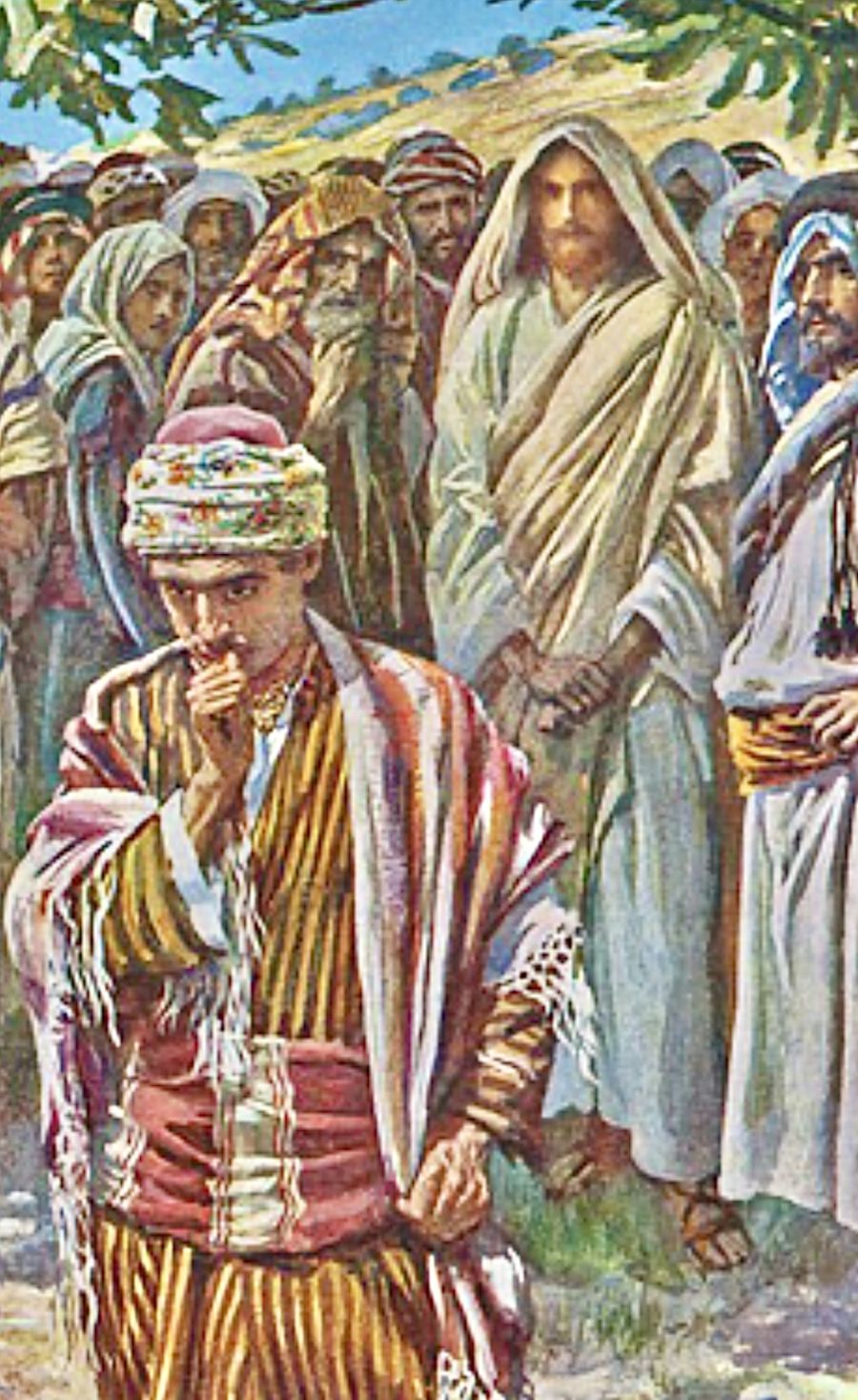
(Mt 19:16-22)


At the time of Jesus, people lived a moment of social collapse and disintegration of the communitarian dimension of life - in the past more related to family, clan and community.

Herod's policy guaranteed the Empire control of the situation: a reality of maximum exploitation and severe economic and civil repression.

Religious impositions even ensured the subjugation of consciences - and the spiritual authorities were happy to act as guarantors of this most covert form of slavery.

The condition of total (civil and religious) subjugation of the people everywhere tended to diminish the sense of interpersonal and group fraternity.

There was no lack of severe conditions of social and cultural exclusion, which accentuated the bewilderment of the people, who were marginalized, homeless and without references - even religious ones.

Some movements attempted to reweave the lacerations and propose shared forms of life, certainly - but united by an idea of nagging decontamination [Essenes, Pharisees, Zealots].

Jesus chooses the path of a decisive vital redemption, as opposed to the ideologies of the ascetic purism and custom rediscovery.

For a radical fulfilment of the spirit of the Law, it was necessary to go beyond doctrines. They excite some, yet they do not erase our inner sense of emptiness.


The community of sons does not keep itself within the 'limits', and does not live apart; thus it does not accentuate the torments of imperfection, or the perception of incompleteness, nor the marginalizations - but welcomes them.

It does not feel endangered by contact with the realities that the external legalism of devotion considered dangerous and cursed or in sin. It trembles for them.

The Church recognises the value of existential poverties: it feels it’s not enough to seek “good things” without 'fire' within.

It confesses the richness not of everything that is already recognizable and static, but of new positions and differing relationships, which dilate the present and open up creative visions of the future.

Faith, in short, is not a popularly identified belief capable of accrediting roles, tasks and characters.


In vv.18-19 Jesus does not enumerate commandments that would make the interlocutor [as they used to say] live 'more from near' to 'God alone', but the criteria that bring us close and alongside our sisters and brothers.

The honour reserved for the Father is not one of many forms of competitive love: the threshold is the neighbour.

The Son does not even mention the first commandments, those identifying the exalted Lord of his people.

Our hands embrace the time-less… in concrete love.

They trigger the dynamisms that annihilate the torments of the least, and thus in an unthinkable way help us rediscover the meaning and joy of life - letting the world be reborn [far more than with the usual forms of insurance].

Conscious living does not have to do with usage and clichés [which produce alibis] but with another serenity and joy: the wonder of the unusual and of new degrees, places, states, relationships, situations.

There is no other richness that can fill our days, while there is only sadness (v.22) in the old bonds without humanity. They lower us all into an artificial mental and emotional reality.

To detach oneself from immediate calculation seems an absurd choice, far-flung and destined to go wrong, but on the contrary, it is the winning move that opens the door to new Life of the Kingdom and to Happiness, which can be accessed precisely when tangible goods are transformed into Relationship.


Let us free ourselves from the plethora of misguided goals that crush our paths, making them swampy.

We have to reflect well on «that which is eminent» (v.17).


To internalize and live the message:


Have you learnt to embrace your life from the Goodness of God, or to be lulled and content with what is there - just within reach?


[Monday 20th wk. in O.T.  August 17, 2026]

289 Last modified on Monday, 17 August 2026 12:00
don Giuseppe Nespeca

Giuseppe Nespeca è architetto e sacerdote. Cultore della Sacra scrittura è autore della raccolta "Due Fuochi due Vie - Religione e Fede, Vangeli e Tao"; coautore del libro "Dialogo e Solstizio".

It is necessary to know how to be silent, to create spaces of solitude or, better still, of meeting reserved for intimacy with the Lord. It is necessary to know how to contemplate. Today's man feels a great need not to limit himself to pure material concerns, and instead to supplement his technical culture with superior and detoxifying inputs from the world of the spirit [John Paul II]
Occorre saper fare silenzio, creare spazi di solitudine o, meglio, di incontro riservato ad un’intimità col Signore. Occorre saper contemplare. L’uomo d’oggi sente molto il bisogno di non limitarsi alle pure preoccupazioni materiali, e di integrare invece la propria cultura tecnica con superiori e disintossicanti apporti provenienti dal mondo dello spirito [Giovanni Paolo II]
This can only take place on the basis of an intimate encounter with God, an encounter which has become a communion of will, even affecting my feelings (Pope Benedict)
Questo può realizzarsi solo a partire dall'intimo incontro con Dio, un incontro che è diventato comunione di volontà arrivando fino a toccare il sentimento (Papa Benedetto)
He is “the very stone which the builders rejected” (cf. Mt 21:42), because they judged him to be hostile to the law and a danger to public order [Pope Benedict]
Egli è “la pietra che i costruttori hanno scartato” (cfr Mt 21,42), perché l’hanno giudicato nemico della legge e pericoloso per l’ordine pubblico [Papa Benedetto]
"His" in a very literal sense: the One whom only the Son knows as Father, and by whom alone He is mutually known. We are now on the same ground, from which the prologue of the Gospel of John will later arise (Pope John Paul II)
“Suo” in senso quanto mai letterale: Colui che solo il Figlio conosce come Padre, e dal quale soltanto è reciprocamente conosciuto. Ci troviamo ormai sullo stesso terreno, dal quale più tardi sorgerà il prologo del Vangelo di Giovanni (Papa Giovanni Paolo II)
That 'always seeing the face of the Father' is the highest manifestation of the worship of God. It can be said to constitute that 'heavenly liturgy', performed on behalf of the whole universe [John Paul II]
Quel “vedere sempre la faccia del Padre” è la manifestazione più alta dell’adorazione di Dio. Si può dire che essa costituisce quella “liturgia celeste”, compiuta a nome di tutto l’universo [Giovanni Paolo II]
But what moves me even more strongly to proclaim the urgency of missionary evangelization is the fact that it is the primary service which the Church can render to every individual and to all humanity [Redemptoris Missio n.2]
Ma ciò che ancor più mi spinge a proclamare l'urgenza dell'evangelizzazione missionaria è che essa costituisce il primo servizio che la chiesa può rendere a ciascun uomo e all'intera umanità [Redemptoris Missio n.2]
Freedom and love coincide! On the contrary, obeying one’s selfishness leads to rivalry and conflict (Pope Benedict)
Libertà e amore coincidono! Al contrario, obbedire al proprio egoismo conduce a rivalità e conflitti (Papa Benedetto)
Are they not all spirits charged with a ministry, sent to serve those who are to inherit salvation? (Heb 1:14)
The Church with its permanent contradiction: between the ideal and reality, the more annoying contradiction, the more the ideal is affirmed sublime, evangelical, sacred, divine, and the reality is often petty, narrow, defective, sometimes even selfish (Pope Paul VI)

Due Fuochi due Vie - Vol. 1 Due Fuochi due Vie - Vol. 2 Due Fuochi due Vie - Vol. 3 Due Fuochi due Vie - Vol. 4 Due Fuochi due Vie - Vol. 5 Dialogo e Solstizio I fiammiferi di Maria

duevie.art

don Giuseppe Nespeca

Tel. 333-1329741


Disclaimer

Questo blog non rappresenta una testata giornalistica in quanto viene aggiornato senza alcuna periodicità. Non può pertanto considerarsi un prodotto editoriale ai sensi della legge N°62 del 07/03/2001.
Le immagini sono tratte da internet, ma se il loro uso violasse diritti d'autore, lo si comunichi all'autore del blog che provvederà alla loro pronta rimozione.
L'autore dichiara di non essere responsabile dei commenti lasciati nei post. Eventuali commenti dei lettori, lesivi dell'immagine o dell'onorabilità di persone terze, il cui contenuto fosse ritenuto non idoneo alla pubblicazione verranno insindacabilmente rimossi.







